*This article may contain affiliate links. For full information, please see the disclaimer here.
My fascination with German began, like many, down a rabbit hole of captivating storytelling, specifically with the mind-bending German TV series “Dark.” As I found myself increasingly drawn into its complex narrative, I began to want to understand the original dialogue, beyond just the subtitles.
German is a language with some delightful quirks, from its famously long compound words (try saying “Donaudampfschifffahrtsgesellschaftskapitän” five times fast!) to its always capitalized nouns. These unique characteristics are just some of the many compelling reasons to learn German, aside from the access it gives to German literature, philosophy, television, and other cultural experiences.
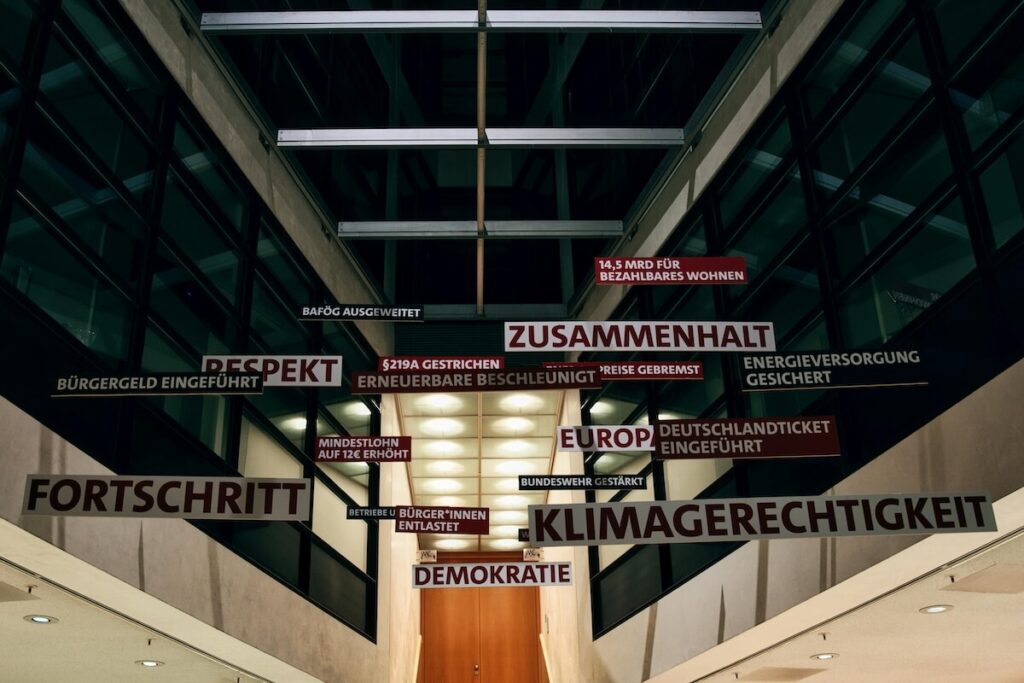
That said, even if you’ve been learning German for quite some time and maybe even able to follow or hold a German conversation, you might still find yourself searching for the right word. It’s a problem many language learners face even in advanced stages—a limited vocabulary. This is where German vocabulary apps become incredibly valuable tools.
Why use a German vocabulary app?
Building a solid vocabulary is the cornerstone of truly understanding and expressing yourself in German. While grammar provides the structure, it’s words that carry the meaning. Without a strong vocabulary, you’ll constantly find yourself struggling to convey even simple ideas or grasp the nuances of what others are saying, even if you understand the grammatical rules perfectly.
This becomes even more apparent when you consider the subtle differences in German dialects across regions; sometimes a word you’ve learned in Standard German might have a different, or even non-existent, equivalent in Austrian or Swiss German.

Fortunately, we live in an era rich with diverse German learning resources, and vocabulary apps stand out as particularly useful. Their accessibility means you can squeeze in a quick learning session anytime, anywhere. Some of these apps leverage clever learning techniques like spaced repetition or incorporate gamified elements to make the process not just effective but also enjoyable.
These apps also offer targeted practice. Instead of passively reading lists, you’re actively engaging with words through interactive exercises, audio pronunciation from native speakers, and often, visual aids that help you connect words to concepts. So, if you’re looking to improve your German vocabulary and move beyond basic comprehension to true fluency, adding these apps to your learning routine is a smart move.
Ready to dive in? Up next, I’ve rounded up 16 German vocabulary apps, ranging from gamified ones to more structured options for serious learners.
Top picks
The good news is, there’s no shortage of apps to help you build your German vocabulary. You can definitely try all the recommendations below. But if you don’t have the time to do that, you can simply choose from this short list:
- Mondly and Ling can help you pick up new words through fun games.
- Babbel teaches German through well-structured courses.
- Pimsleur grows your vocabulary through conversation practice.
- MosaLingua and Anki let you create German flashcard decks for memorizing.
You may also check out this list of apps to learn German if you’re targeting other skills beyond vocabulary.
Best German vocabulary apps for language learners
1. Mondly

Mondly offers a fun but comprehensive approach to learning German vocabulary, moving beyond simple word lists to immerse you in practical language. Instead of just isolated words, the app cleverly focuses on teaching you phrases that genuinely matter in everyday conversations, something that’s helpful for building fluency.
With over 50 topics covering common situations like travel, ordering food, or discussing hobbies, you’ll learn vocabulary that’s immediately applicable. The learning experience is made engaging through various exercises and games. It even includes audio spoken by native German speakers, so you can train your ear and perfect your pronunciation.
Plus, a standout feature is the ability to apply your newly learned vocabulary through interactive chatbot conversations, giving you a chance to practice speaking in a low-pressure environment and build confidence.
Key features:
- Focus on useful phrases for real-world situations
- Extensive topic coverage
- Native speaker audio to learn correct pronunciation for all vocabulary
Pricing: Free lesson daily. Unlock all content for as low as $9.99/month. You can also get discounts with Mondly’s latest promo.
Devices: iOS and Android
2. Babbel

Babbel stands out as a well-rounded app that doesn’t just focus on vocabulary in isolation but trains you in all core language skills: listening, speaking, writing, and reading. But while it provides a holistic learning experience, it’s particularly effective for building your German vocabulary.
Babbel’s method is smart—it introduces new words by themselves, then quickly integrates them into example sentences, sample conversations, and various new contexts. This approach helps you understand not just what a word means, but how it actually functions in real-world German.
Babbel’s German courses are quite extensive, covering levels up to C1, meaning you can progress from a beginner to an advanced speaker with the app. To perfect your pronunciation, it also includes audio spoken by native speakers and features voice recognition software that gives you immediate feedback.
Beyond the app itself, you can further immerse yourself and boost your vocabulary by listening to Babbel’s German podcasts, such as “Babbel Nachrichten” and “Speaking of Berlin.”
Key features:
- Contextual vocabulary learning
- Advanced level coverage
- Variety of exercises teaching vocabulary, grammar, and more
Pricing: Introductory lessons for free. Unlock all content for as low as $6.95/month. Find Babbel discounts here.
Devices: iOS and Android
3. Ling App

Ling app provides an engaging and efficient way to build your German vocabulary through its short, immersive lessons. Each lesson is designed to introduce a few key vocabulary items and immediately show you how to use them within complete sentences, giving you practical context right from the start.
You can easily review these words and reinforce your learning through a variety of fun mini-games and quick exams, which helps with retention without feeling like a chore. What’s more, Ling’s lessons are conveniently bite-sized, meaning you can squeeze in a meaningful learning session in as little as five minutes, perfect for busy schedules.
What’s more, to further solidify newly learned words and build conversational confidence, you can practice applying your vocabulary in interactive dialogues with the Ling chatbot.
Key features:
- Teaches practical vocabulary across a variety of topics
- Bite-sized and gamified lessons
- Practice acquired vocabulary with Ling’s chatbot
Pricing: Some content available for free. You can unlock more lessons and features for as low as $14.99/month. Check the latest Ling offers here.
Devices: iOS and Android
4. Pimsleur

Pimsleur takes a unique, audio-first approach to language learning, and as a German vocabulary app, it’s particularly effective for building spoken fluency. The world-famous Pimsleur Method is built on solid research, delivering the most useful vocabulary through a completely intuitive process that gets you speaking German right from day one.
Pimsleur teaches practical vocabulary directly within audio dialogues, ensuring you learn words in context and master their correct pronunciation from native speakers. No rote memorization here! The system also incorporates graduated interval recall, which reviews words at optimal times to embed them firmly in your long-term memory.
Beyond the core audio lessons, the app enhances your learning with valuable features like digital flashcards for quick review, engaging mini-games to test your knowledge, and quizzes to track your progress, offering a highly effective way to expand your German vocabulary.
Key features:
- Teaches practical vocabulary within realistic dialogues
- Scientifically-backed method to build long-term recall
- Includes supplementary tools (e.g., flashcards, mini-games, etc.)
Pricing: $14.95/month for Audio-Only access. Unlock all materials for as low as $19.95/month. Or try it for free first!
Devices: iOS and Android
5. Rosetta Stone

For something more challenging, try Rosetta Stone. This app offers a distinct approach to learning German vocabulary through its “Dynamic Immersion” method, which teaches you the language much like you learned your first—without direct translations.
This means you’ll be exposed to German and prompted to infer meaning through images, sounds, and context, rather than relying on your native language. To ensure you’re speaking correctly, Rosetta Stone incorporates its TruAccent speech recognition technology, which provides instant feedback on your pronunciation.
Beyond the core lessons, the app enhances your learning journey with engaging content like “Stories,” read by native speakers, allowing you to hear vocabulary in authentic narratives. It also includes a “Phrasebook,” which can be useful for travelers looking to quickly learn essential phrases for common situations.
Key features:
- Teaches German vocabulary and phrases without direct translation
- Authentic pronunciation and accent from native speakers
- Practical phrasebook for travelers
Pricing: Starts at $11.99/month. Check out the latest Rosetta Stone German promo here.
Devices: iOS and Android
6. MosaLingua

Taking a scientifically backed approach to helping you build your German vocabulary, MosaLingua prioritizes efficiency and long-term retention. The core of its method revolves around highly useful and practical content presented through digital flashcards.
What makes this app particularly effective is its intelligent use of spaced repetition systems (SRS), active recall, and metacognition. This means the app smartly schedules your review sessions, presenting words just as you’re about to forget them, prompting you to actively retrieve the information from your memory rather than just passively recognizing it, and even encourages you to self-assess your understanding.
This combination ensures that the vocabulary you learn is truly solidified and becomes part of your active German lexicon, making it an excellent tool for focused word acquisition.
Key features:
- Practical flashcard content
- Scientifically optimized review
- Lessons designed for long-term retention
Pricing: Starts at $9.49/month. Find the latest MosaLingua promo here.
Devices: iOS and Android
7. uTalk

One of the most robust German vocabulary apps available, uTalk is packed full of useful, everyday words and phrases thoughtfully divided into over 60 topics. Each topic is designed to take roughly two to three hours to complete, providing a substantial amount of content—up to 180 hours of German learning in total—but its flexible format means you can easily dip in for just five minutes at a time.
Every single word and phrase is voiced by both male and female native speakers, ensuring you’re not just learning vocabulary, but also real-world pronunciation. The app encourages active learning by letting you record yourself mimicking their speech, then practice until you get it just right.
To solidify your knowledge, uTalk incorporates five increasingly challenging games that test what you’ve learned, helping you track your memory improvement with each session.
Key features:
- Extensive, practical vocabulary
- Authentic native audio with female and male voices
- Gamified learning
Pricing: Starts at $11.99/month. Find uTalk discounts here.
Devices: iOS and Android
8. Clozemaster

Are you past the beginner stage and craving more challenge in your German vocabulary acquisition? Clozemaster is an excellent, gamified option, particularly suited for advanced beginners and intermediate German learners aiming for fluency.
The app throws you into thousands of fill-in-the-blank sentences in German, forcing you to learn words in their natural context. You won’t find single-word flashcards here; instead, Clozemaster presents a sentence with a missing word, and your task is to select or type the correct word based on the surrounding context—essentially, a cloze test.
This method is incredibly effective for rapidly expanding your vocabulary in a fast and fun way, as it trains your brain to recognize and recall words in real-world usage, rather than in isolation.
Key features:
- Teaches vocabulary through fill-in-the-blank sentences, showing real-world use
- Large sentence database
- Fun and engaging interface
Pricing: Free. For more features and stats, get Clozemaster Pro starting at $14.55/month.
Devices: iOS and Android
9. Promova

Promova is another engaging way to learn German vocabulary. The app breaks down learning into short, focused lessons that you can easily complete in just a few minutes, making it ideal for busy schedules.
Each lesson is designed to cover a specific topic, ranging from essential real-life vocabulary and practical grammar tips to pronunciation guidance, ensuring a well-rounded learning experience. With over 4000 lessons complemented by vocabulary flashcards and clear grammar explanations, the content is reinforced with hand-crafted illustrations to aid memorization.
For those looking to take their speaking practice a step further, Promova includes an AI role-play feature, allowing you to apply your learned vocabulary in simulated conversations and steadily build confidence.
Key features:
- Comprehensive content that covers vocabulary and grammar
- Bite-sized, topic-focused lessons
- Visual learning aids and flashcards
Pricing: As low as $13.33/month. Snag Promova deals here.
Devices: iOS and Android
10. Drops

One of the most straightforward German vocabulary apps out there, Drops makes learning engaging with its visually driven, gamified approach.
In just five minutes a day, you can immerse yourself in beautifully illustrated and playful lessons, turning vocabulary acquisition into a quick and enjoyable habit. The app’s effectiveness comes from its focus on creating memorable visual associations with new German words, making them stick better than traditional rote memorization.
Covering over 2,000 German words, Drops provides a solid foundation, and while a free version offers limited access, it’s a fantastic way to quickly expand your lexicon in a fun and efficient manner.
Key features:
- Ideal for visual learners
- Fun, addictive mini games
- Covers 2,000 practical German words
Pricing: Free for five minutes daily. Unlock more content with a Drops Premium subscription.
Devices: iOS and Android
11. Duolingo

If you’re a beginner looking to get started in German vocabulary, Duolingo is likely one of the first apps that comes to mind, and for good reason. It’s one of the most popular language learning platforms, widely recognized for its game-like features and fun challenges.
Designed with beginners in mind, Duolingo makes learning German accessible and enjoyable, promising that you can pick up the language in just five minutes a day, entirely for free.
Duolingo’s quick, bite-sized lessons keep you engaged, and the app’s gamified elements—like earning points, unlocking new levels, and competing on leaderboards—provide constant motivation to continue building your vocabulary and progressing through the course.
Key features:
- Gamified learning
- Quick, manageable lessons perfect for daily practice
- Fun features like Stories, Adventures, and DuoRadio
Pricing: Free! Duolingo Super, which has no ads and lets you make unlimited mistakes, is available for $12.99/month.
Devices: iOS and Android
12. Memrise

Another immersive option is Memrise, which takes a personalized approach to teaching you German vocabulary.
It does this by curating thousands of authentic video lessons, often featuring native German speakers, that specifically highlight the words and phrases you’ve just learned. This real-world context helps you understand how vocabulary is used naturally.
Furthermore, to truly solidify your learning and boost your confidence in speaking, Memrise offers unlimited human-like conversation practice powered by advanced AI (powered by GPT-3). This allows you to apply vocabulary and engage in realistic dialogues.
Key features:
- Lessons tailored to your interests
- Authentic video content
- Teaches words within phrases and sentences for better understanding and retention
Pricing: Some features are available for free. Memrise Pro starts at $14.99.
Devices: iOS and Android
13. Tobo
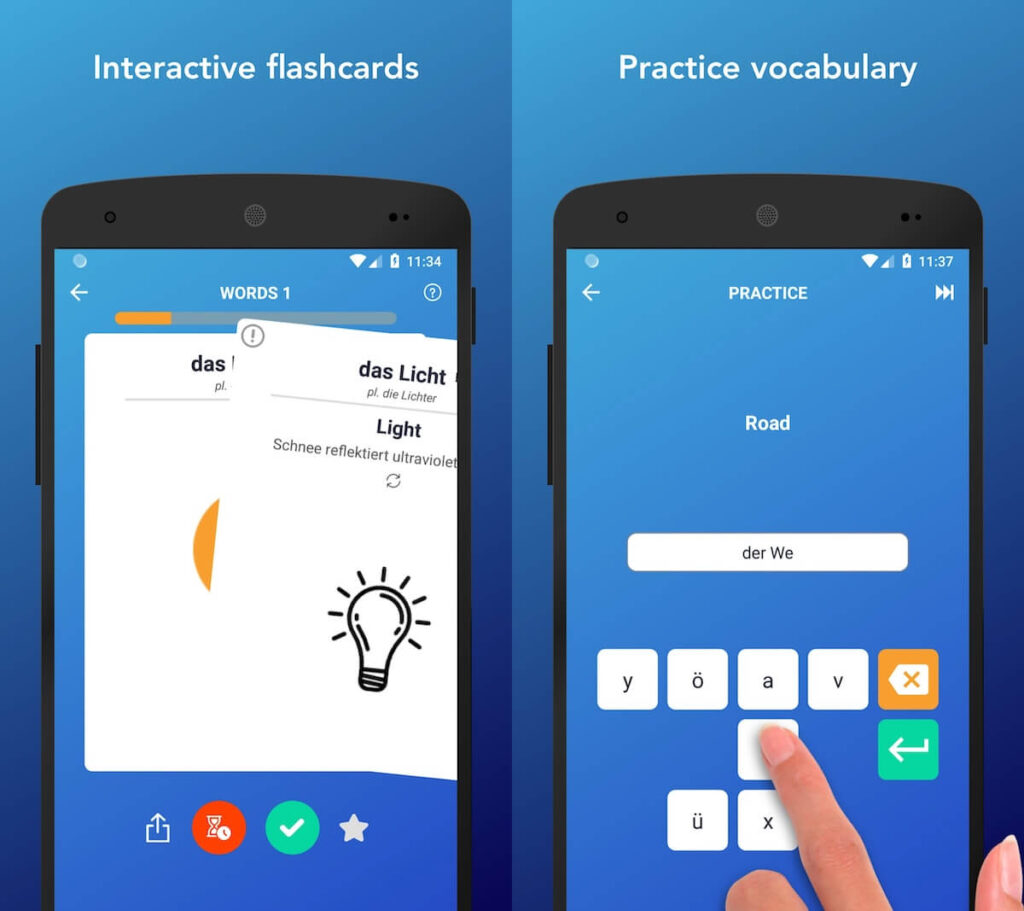
One of the best German vocabulary apps is Tobo if you’re looking for straightforward but engaging content. This app helps you learn new vocabulary quickly through a blend of fun games, interactive flashcards, and practical phrases.
Tobo’s flashcards are particularly intuitive; you simply swipe right if you’ve mastered a word and swipe left if you need more practice, making review sessions highly efficient. You can also solidify the words you learn with various exercises and games, ensuring active recall and deeper understanding.
With a strong focus on high-frequency words, Tobo covers an impressive 3,500 common German words, providing a solid foundation for everyday communication.
Key features:
- Interaction flashcards for vocabulary building
- Gamified practice
- Extensive coverage of frequently used German words
Pricing: Basic content for free. Pro access starts from $2.99/month.
Devices: iOS and Android
14. FunEasyLearn

One of the most extensive German vocabulary apps available, FunEasyLearn is packed with an impressive amount of content designed for thorough learning.
This app offers over 6,000 common German words, encompassing nouns, verbs, and adjectives, all neatly categorized into 7 levels and 200 topics, providing a highly structured learning path. Beyond individual words, you’ll also find over 5,000 frequently used German phrases, essential for daily conversations and travel, broken down into 10 levels and 120 topics.
Maybe you’re asking, how can I remember all that?! Well, this app helps you memorize with intuitive illustrations that help create visual associations with new vocabulary. Plus, it includes professional audio recordings by native speakers for accurate pronunciation. It’s also available offline, which means you can continue your German learning anytime, anywhere, even without an internet connection!
Key features:
- Vast library of German words and phrases
- Illustrations for visual associations
- Offline access for uninterrupted learning
Pricing: Free with limited features. Unlock all content with the Premium version, starting from $3.99/month.
Devices: iOS and Android
15. DuoCards

Not to be confused with the more widely known Duolingo, DuoCards is a powerful flashcard app designed to help you actively acquire German vocabulary.
Its strength lies in its flexibility: you can easily save words directly from your phone or, even better, use its Chrome Extension to grab words and phrases as you browse or watch content online. This means you can learn by watching videos and movies in German, seamlessly saving new vocabulary as flashcards, and using its integrated translator for quick lookups.
The app also allows you to tap into a community by studying with flashcard sets created by other users, offering a wide range of topics and levels. DuoCards incorporates a built-in Spaced Repetition System (SRS), ensuring that you review vocabulary at optimal intervals for maximum long-term retention.
Key features:
- Learn vocabulary in real-world contexts from content you consume
- Option to study with user-created flashcard sets or build your own
- Optimized review schedule
Pricing: Free limited content. DuoCards Premium starts from $29.99/month.
Devices: iOS and Android
16. Anki

Anki hardly needs an introduction. Popular among language learners (or just learners in general), this powerful flashcard program is renowned for its intelligent spaced repetition system, which ensures you spend more time on challenging vocabulary and less on what you’ve already mastered.
Its customizable nature is a huge plus: you can create your own German vocabulary decks tailored to your specific needs, or you can choose from a vast library of pre-made decks shared by other users, often complete with audio, images, and example sentences.
Anki’s flexibility also extends to letting you easily change flashcard layouts and fine-tune the timing of your review sessions, empowering you to optimize your learning process and truly embed new German words into your long-term memory.
Key features:
- Intelligent review system
- Highly customizable flashcards
- Easily syncs across devices
Pricing: Free on Android, $24.99 on iOS
Devices: iOS and Android
Final thoughts

Ultimately, no matter your current level, investing time in apps specifically designed for German vocabulary building is a game-changer. While grammar provides the skeleton of the language, a robust vocabulary is the flesh and blood that brings it to life, enabling you to understand more, express yourself precisely, and connect deeply with German culture.
For a well-rounded learning journey, consider listening to German podcasts, reading German books (yes, novels count too!), and maybe even finding German tutors online. Whichever learning resource you end up sticking with, remember to enjoy the process and stay motivated!