This article may contain affiliate links. As an Amazon Associate, I earn from qualifying purchases. For full information, please see the disclaimer here.
Once you’ve decided to learn (or relearn) a language, the next step is to figure out how exactly you’re going to learn. Going through each language resource and identifying which one works for you can be overwhelming and time-consuming.
The good news is, you don’t have to do that. Mobile apps, courses, podcasts, online classes, books, and language tutors – we’ve reviewed them all so you don’t waste your time, money, and energy with the bad ones.

Our list covers resources that you can use for multiple languages so if your goal is to be a polyglot, you’re in the right place. And even better, many of these tools offer amazing deals and discounts!
Best language learning apps
When learning any language, your mobile phone is your best tool. Mobile apps are one of the most convenient and interactive ways to get started on your learning journey. With the best language learning apps, you can study anytime, anywhere, and often, within a tight budget.
1. Babbel

It takes only 10 minutes a day to learn on Babbel. With lessons that are grounded in real-life conversations, you’ll learn not just the most useful vocabulary in native voices but also the culture. Babbel’s holistic language courses include interactive app lessons, games, videos, podcasts, and more, catering to all kinds of learners.
Read our comprehensive review of Babbel to know more.
2. Mondly
Mondly promotes active learning through gamified lessons that make you want to keep advancing to the next level. Through bite-sized and engaging lessons, you’ll gain new conversational vocabulary and develop a good grasp of grammar. Quality recordings of native speakers help you practice correct pronunciation.
Want to know more about this app’s features and benefits? Check out this Mondly review.
3. Ling App

One of the best tools for self-studying, Ling features interactive lessons that cater to learners of all proficiency levels. From basic grammar to commonly used words and phrases, everything is delivered via fun mini-games, quizzes, puzzles, and flashcards. Plus, you get to practice your conversational skills with the app’s smart chatbots.
4. Lingopie
Lingopie is a pretty cool way to learn a language if you’re a fan of TV and movies. Instead of dry textbooks, it uses actual shows and films in your target language, complete with subtitles that you can interact with. You can click on words to see their meaning and save them for later review, turning your binge-watching habit into a language-learning session that helps you pick up vocabulary and grammar naturally.
5. Duolingo
One of the most popular language learning apps, Duolingo provides a free, fun, and effective way to learn languages. Offering quick, gamified, and personalized lessons in over 40 languages, this app is a great tool to keep your breaks and commutes more productive. While not the best resource for grammar, it’s an engaging vocab tool for casual learners.
6. uTalk

This neat app that focuses on getting you speaking a new language quickly by drilling essential vocabulary and phrases with native speaker audio. It’s got a massive library of languages, even some of the less common ones. While it’s not going to give you a deep dive into grammar, it’s a solid option for building a practical vocabulary for travel or getting your feet wet in a new language.
Find out how uTalk works with this review.
7. MosaLingua
MosaLingua is built around the idea of spaced repetition—a fancy way of saying it helps you memorize vocabulary and phrases super efficiently by showing you things just before you’re about to forget them. The app focuses on practical, everyday language you’ll actually use, and it lets you create your own flashcards and learn at your own pace.
Best language learning programs
While apps provide convenience with quick lessons that you can pick up anytime, language learning programs and courses give depth and structure that many serious learners appreciate. Here are the best ones out there.
8. Pimsleur

Designed for learning on the go, Pimsleur consists of core 30-minute high-quality audio lessons that get you speaking from day 1. This hands-free option is best for building conversational skills and acquiring useful vocabulary through science-backed, well-timed intervals that facilitate recall.
Read this rave review of Pimsleur to know more.
9. Rosetta Stone
With nearly 30 years under its belt, Rosetta Stone delivers a holistic and immersive curriculum that supports all learning goals. Ultimately, however, its TruAccent technology and recordings of native speakers are what fine-tune your pronunciation, while contextualized and immersive lessons help you thrive in real-world conversations.
10. Rocket Languages

Known for its vast library of downloadable content, Rocket Languages teaches thousands of practical words and phrases through a mix of outstanding audio lessons and well-structured reading materials. For languages like Chinese, Korean, Japanese, Russian, and Arabic, lessons on the writing systems are also included. A comprehensive choice whether you’re a noob or a language-learning vet.
This Rocket Languages review walks you through the app.
11. FluentU
Immersion is one of the most effective ways to learn any language. But if conversations with a native speaker are not on the horizon yet, you can turn to FluentU’s whopping collection of real-world videos. Existing content includes news, movie trailers, music videos, cartoons, documentaries, and more – all with carefully translated subtitles that aid learning.
12. Live Lingua
Live Lingua currently offers live online language lessons in only seven languages. However, the site is home to the largest collection of free public domain language learning materials – thousands of free e-books, audio recordings, and US Foreign Service Institute’s public domain courses on over 150 languages. For a free resource, it does a pretty good job.
13. Cudoo
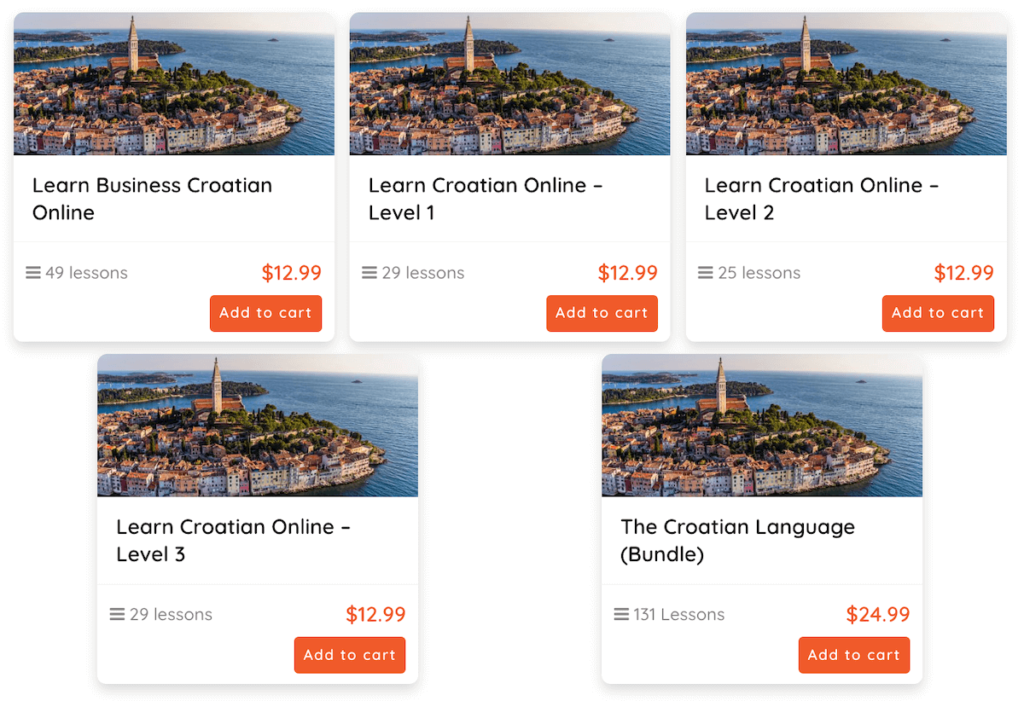
Cudoo offers a wide range of courses, often at pretty affordable prices, covering not just languages but also professional skills and more. The language courses are video-based, often taught by native speakers, and covering various levels from beginner to advanced. If you’re looking for budget-friendly options and a diverse catalog of learning materials, Cudoo could be worth checking out.
Best language learning podcasts
Before you start speaking a new language, you first have to learn how you should sound. And what better way to train your ears than to listen to native speakers and language experts? Podcasts let you do that while doing chores on the side!
14. Coffee Break Languages
Produced by Radio Lingua Network, Coffee Break Languages podcasts are short but always insightful. With 15 to 25-minute lessons that you can easily fit into a short coffee break, you’ll learn useful vocab, grammar, cultural references, and improve your listening skills. This podcast is offered in seven languages, with Coffee Break Spanish and French being the most popular ones.
15. Innovative Language (Pod101/Class101)

Innovative Language is known for its huge arsenal of free language learning content, including podcasts on 34 languages from Afrikaans to Vietnamese. The lessons are straightforward and ideal for beginners to intermediate learners. However, its library isn’t as organized as Coffee Break, and you’ll have a better chance of finding all episodes on Google Podcast than on Spotify or iTunes.
16. News in Slow
If keeping abreast of current events while learning a language sounds like a treat to you, this one’s right up your alley. Ideal for intermediate learners of European Spanish, Latin American Spanish, French, Italian, and German, News in Slow takes brief clips of real news broadcasts and slows them down for you so you can better digest the expressions and grammar in the clips.
Best online language classes
Some of us thrive best in classroom settings. If that’s your thing, live online classes are the way to go.
17. Lingoda

Lingoda holds online video classes on English, German, Spanish, and French via Zoom. You can take a solo class but Lingoda believes that live and interactive classes with up to five students are the best way to accelerate language learning. Here, you’ll be encouraged to practice speaking and you’ll be given personalized feedback to help you improve.
18. Fluent City
Like Lingoda, Fluent City gives you the option of taking private study plans with a live instructor. But if you want more speaking practice in a social setting, you can join a group class of up to 10 students via Zoom. Offering over 10 languages, Fluent City has expert language tutors who focus on building confidence and conversational skills.
Best websites to find online language tutors
Getting help from native speakers is a fast and efficient way to achieve your language learning goals. Language tutors will teach you the essentials with the added benefit of cultural insight. You can find the best ones on these sites.
19. italki
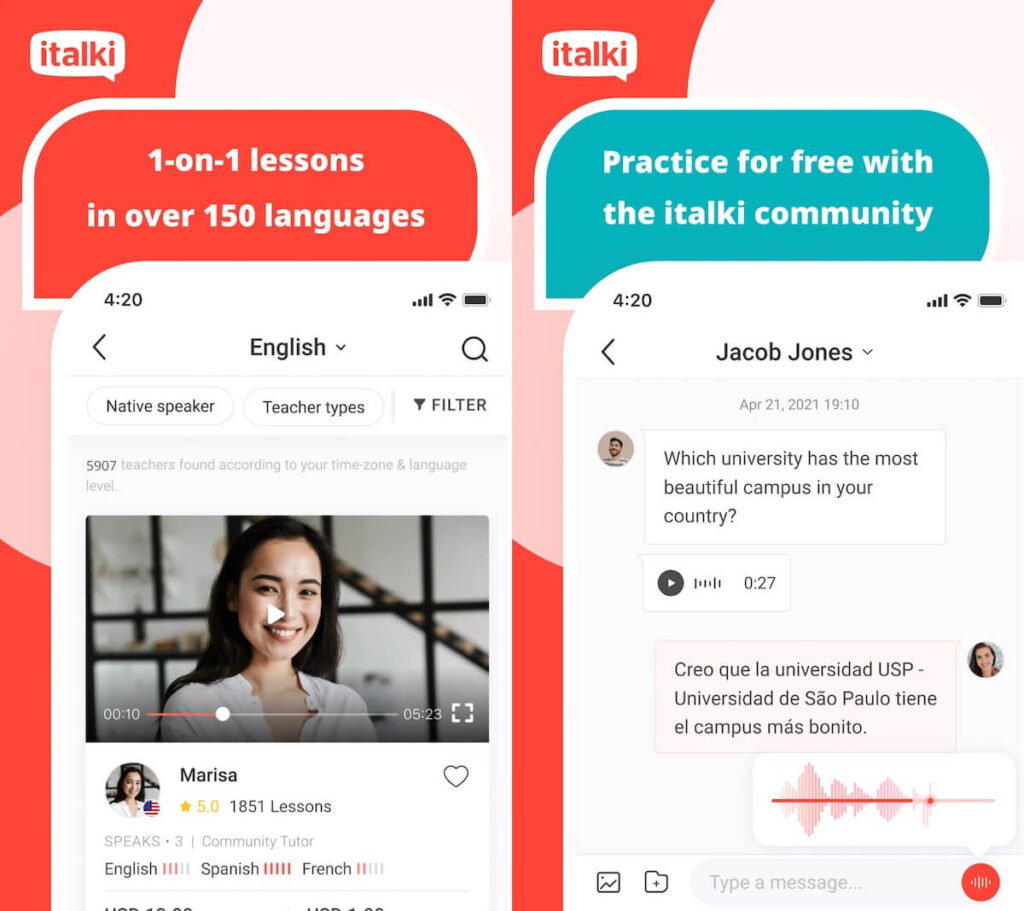
italki has a massive database of professional language teachers and native-speaking community tutors who provide one-on-one coaching on various language proficiencies. The best part is the flexibility as italki lets you choose a tutor based on your learning goals, budget, teacher ratings, and preferred schedule.
Find out how italki works with this walkthrough and review.
20. Preply
Just like italki, Preply also connects students to language tutors by demand. Choose your tutor based on their profiles (which are pretty detailed), the languages he/she speaks, reviews from other students, your budget, and your schedule. With over 140,000 tutors, you can be sure that you’ll find a good match.
21. AmazingTalker
AmazingTalker is another great option for connecting with tons of native-speaking teachers from all over the world for one-on-one online lessons. Browse teacher profiles, see their rates and specialties, and book personalized classes that fit your schedule and learning goals.
22. Wyzant

Depending on the language and proficiency of the tutor, language lessons on Wyzant cost $35-60 per hour. But the great thing is its pay-as-you-go pricing. Compare qualifications, hourly rates, and reviews to find the tutor that matches your needs. Then, pay only for the time you need – no upfront payments, no costly subscriptions.
Best books to learn new languages
You may think they’re old-school but books are here to stay. Great language learning books give you loads of written practice and a structured way to learn languages that digital means don’t.
23. Practice Makes Perfect series


This bestseller is one of the most comprehensive ways to learn any language – whether you want to master Spanish verb tenses, gain a solid grasp of French vocabulary and grammar, or create well-formed sentences in Italian. Lessons are structured in a concise, step-by-step, easy-to-follow manner.
24. Living Language series


- Chinese, Mandarin, Teacher, Training
- Audio CD – Audiobook
Composed of multiple books per language and audio CDs, Living Language expertly presents lessons on vocabulary, grammar, reading, and writing in a logical structure. Whether you want to learn to write in Korean or start speaking Greek, extensive lessons help build a strong foundation while cultural insights add depth to the courses.
25. Short Stories by Olly Richards series


If you’re a fan of captivating short stories and you’re also learning a new language, this book is for you. Curated for easy language learning, the Short Stories series of books combine eight stories of different genres – French sci-fi, Italian crime, Norwegian thriller – all using 1000 frequently used words and accessible grammar.
Mix up the resources

The journey of learning any language may be challenging but it is undoubtedly fun and exciting. The best part? You have access to a plethora of both paid and free resources to get you to fluency.
Don’t limit yourself to just one type of material. Complement your online course with a reliable book and app. In your free time, listen to podcasts. Better yet, hire a tutor for personalized coaching.
Ultimately, learning and improving depends on the quality of the resources you choose, how you mix them up, and how well you stick to them.
Best resources for language learners – Pin it!


The information on this website was so helpful. Thank You so much.
Could you please tell me what you think about the mostusedwords frequency dictinories?