
*This article may contain affiliate links. For full information, please see the disclaimer here.
It’s a bit of a cliché at this point but as a longtime language learner, I, unfortunately, have to confirm: vocab can be a real chore sometimes.
From embarrassing false friends to complicated compound constructions, some languages really test you with the words you need to learn to understand and communicate well.
Trying to improve your German vocabulary is no different in that regard, I’m afraid!

Of course, English speakers learning German can indeed rely on a lot of shared vocabulary and cognate terms. Still, acquiring a whole new lexicon can be tough!
That’s why I decided to write this handy guide for you. Drawing from my own experience learning German, I will tell you every trick I know for making the vocabulary-learning process as pain-free as can be!
1. Keep a journal

One of the things that I have learned over the years about acquiring new vocab is that it is, at its core, a matter of memory.
In theory, all you have to do for a word to ‘stick’ is to be able to recognize it maybe three or four times in a conversation before you’re eventually able to use it yourself in a natural way.
Of course, that’s much easier said than done. One technique that has helped me a ton in the past, though, is to use a journal to keep track of new words. This is especially easy to do when watching a movie in German, for instance.
Just note down any words you don’t recognize (subtitles always help to recognize the proper spelling right away) and make sure to review them the next time you add anything new to your journal. Rinse, repeat, and watch your vocabulary grow!
2. Utilize cognates to your advantage

English, like German, is part of the Germanic language family, itself a member of the primary Indo-European family. What this means is that the two not only share a lot of curious grammatical similarities but also parallels in terms of vocabulary.
You can use this to your advantage by homing in on cognates wherever you notice them. Because they’re so similar, they’ll be easier and quicker to learn compared to more foreign-sounding vocab!
Some examples to help you get a head start: singen (to sing), Socken (socks), and Buch (book).
3. Watch out for false friends

At the same time, it’s important to mind false friends in German. I’m talking about those annoying words that seem to be cognates of English analogs at first glance, and might be related to some extent, but carry completely different meanings in their respective languages.
A good example, and a common source of frustration both to German learners as well as Germans learning English, is the verb bekommen, which does not actually mean “to become”, but rather “to receive”!
Similarly, you might think a Regisseur is some kind of a political ruler, given the regis part. Nope, it’s actually referring to a movie director!
So, whenever you see or hear a new word that at least seems similar to an English equivalent at first glance, remember to note it down and research the proper meaning so you can get any confusion out of the way early.
4. Put on subtitles

Of course, depending on your level of proficiency, it might be hard for you to really enjoy German-language media such as TV shows, movies, or books at the moment. That’s okay!
To help you work yourself up to that level, consider adding German subtitles to the shows you’re already watching.
You might think that this won’t do much if you already understand the spoken dialogue just fine, but in actuality, I’ve experienced it as a great way to passively add some vocab to your list while having fun doing it!
Using apps like Lingopie can also help. Choose a German show or movie, click on the subtitles to learn a new word and its pronunciation, and save your favorite words into flashcards. You’ll grow your vocab in no time and improve your German listening and speaking skills too!
5. Engage with native speakers

This is arguably one of the most common pieces of advice most language learners tend to hear, but I nonetheless feel the need to underline how effective this can be when trying to up your vocabulary.
Having native speakers around to interact with won’t just accelerate your learning by exposing you to a lot more German than any other day-to-day method (especially if the native speakers in question don’t have fluent English to fall back on). Learning in this way can also teach you some of the fine nuances of vocab that often get lost in traditional textbook material and such.
Of course, not everyone lives in an area where finding German speakers is that easy. Thankfully, there are a lot of apps out there nowadays that offer one-on-one as well as group-based lessons with German tutors.
Italki is great if you want to go the tried and tested route. It connects you with a huge pool of German native speakers eager to teach in a one-on-one setting; many also offer language exchanges there.
A more avant-garde option I’ve had great experiences with in the past is Mondly, which lacks “real” native tutors. Instead, it incorporates AI speech recognition and other high-tech trickery to monitor speaking exercises and test your pronunciation.
6. Build a solid foundation first

Before you try to up your vocab to the level of fluency, you need to have a solid foundation to work from.
The reason for this is that a rich vocabulary without the necessary base fundamentals will prevent you from engaging in the kinds of activities – reading, writing, speaking, and passive listening – that really foster faster, more natural growth.
In reference to this, linguists might speak of the “first 500 words”. Those 500 are not necessarily the first that you learn, but the first (i.e. most common) that you use in a normal, daily context.
Words such as “to think” (denken), “to eat” (essen), “yes” and “no” (ja und nein), and so on – all in their most common conjugations and inflectional forms – are what you should focus on right away. From there, you can begin growing your German vocabulary much more smoothly.
7. For advanced vocab, study your synonyms

If you’re at a farther stage in your German learning quest already, you might be wondering how to dramatically increase your repertoire beyond those first 500 (or even the first 5,000) most commonly used words.
As simple as it may be, the answer often lies in synonyms. German is particularly rich in these, and you can express the same general meaning in a surprising variety of ways – even if the average native speaker won’t always make use of this diversity of options on a normal day.
The trick is to seek out media and interactions that will really test you on this side of German vocabulary where learning apps and textbooks as well as casual conversations might not.
For example, consider newscasts for German political, scientific, legal, and formal lingo, as well as German literature and poetry for more beautiful, lofty expressions.
8. Realize the value of spaced repetition
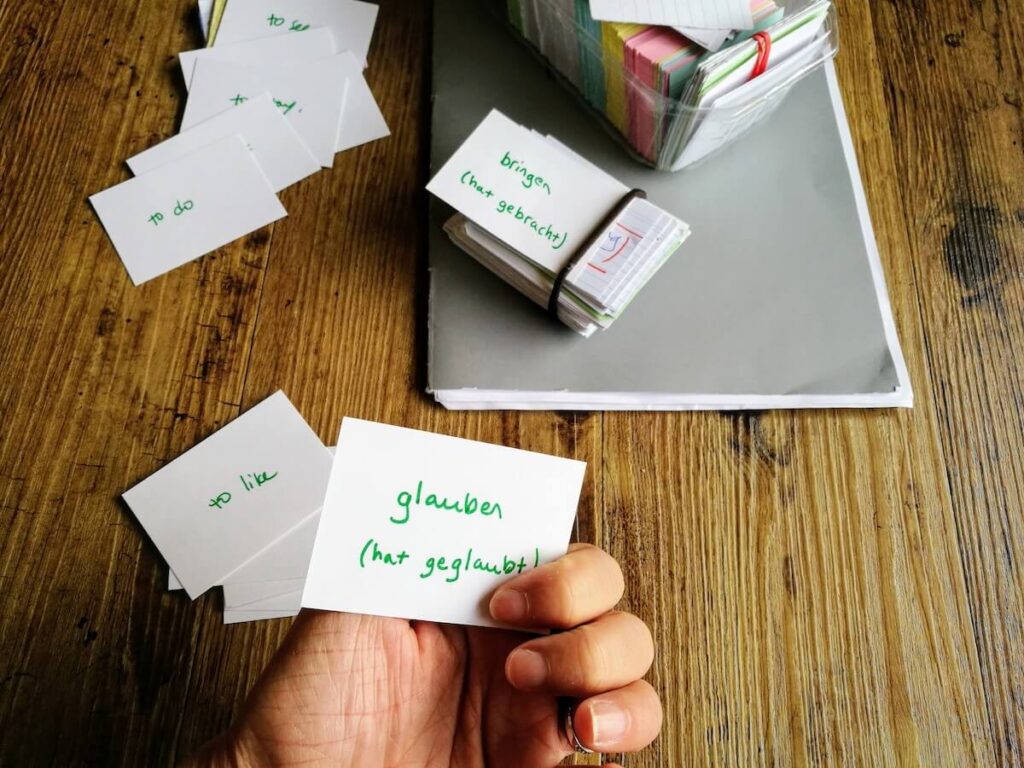
I talked earlier about how recognizing and remembering a new word a few times is usually all it takes to let the new vocab sink in.
Spaced repetition is a technique you can use to learn German vocabulary quickly and effectively while taking advantage of that fact.
Instead of sitting and studying a set of words by rote repetition for a significant amount of time (pauken, as they say in German), spaced repetition involves studying in regular, sustained bursts according to a specific pattern, where each new word is eventually (but not immediately) repeated to test your ability to recall it intuitively.
While pen, paper, and a solid imagination are technically all you need to design your own spaced repetition program, I’d recommend an algorithmic flashcard app like Anki to make the setup a lot easier and more fun!
Another shoutout goes to Drops. It’s an example of an app employing a proprietary mechanism that makes use of spaced repetition and other tricks to accelerate vocabulary learning.
In particular, Drops bets on bite-sized – I guess I should rather say drop-sized – learning that encourages repetition, experimentation, and creative fun. I rather enjoy it, and it’s definitely helped me get closer to some of my long-term learning goals!
9. Keep a dictionary around

I don’t want to make myself sound too old-fashioned here, but a good dictionary can be one of the greatest hidden secrets for learning how to improve your German vocabulary.
This doesn’t need to be a thousand-page tome weighing more than your desk – these days, the Big Two online German dictionaries, Duden and dict.cc, are more than enough.
I suggest using a combo of both. The Duden has been the academic standard for decades and offers very well-organized German-language resources on not just any imaginable word, but also on conjugations, spelling rules, grammar, and much more.
Meanwhile, dict.cc is probably the single best English-German dictionary you can find online, and is also integrated with its own, handy flashcard program that you can use to further practice new and tricky words.
10. Watch out for the umlauts

This pet peeve seems to be particularly common with native English speakers studying German, in my experience.
It’s not rare that I see people studying words like spat, grußen, and Ol instead of spät, grüßen, and Öl, without realizing it! The origin of this mistake seems to be that many beginners have trouble telling the sound of the umlaut apart from its regular, Latin analog.
That’s understandable of course, but when learning how to improve your German vocabulary, you should make sure to get the spelling right the first time. Ask a native speaker or consult your dictionary of choice if you’re not sure!
Doing so, you’ll avoid nasty pitfalls like accidentally adopting the wrong pronunciation of words, which will take more time and energy to unlearn! Note that in some words, the umlaut is either added or dropped as the word is conjugated, or when it changes from singular to plural.
Another reason to make sure you know the German alphabet in and out before embarking on your vocab journey!
11. Consider a companion app to accelerate your learning

More and more people these days primarily use apps for learning a new language – I can’t even count how many of my friends and acquaintances have mentioned to me that they’ve been trying out this or that new language on Duolingo!
While I’m not an advocate for an app-only approach, using a language app in addition to a broader curriculum tailor-made to your needs can really make it easier to improve your German vocabulary. There are even German vocabulary apps designed specifically for growing your lexicon.
One of my favorites has to be Babbel, one of the most successful and well-known language-learning programs in this niche. It’s actually Made in Germany, too, developed by a team of linguists and teachers.
The curriculum might be a bit more academic than what we’re used to from more modern apps, but it definitely helps a lot with instilling large amounts of vocab and grammar.
There’s also Ling, which offers a more Duolingo-esque, gamified approach and is available in many more languages (both for the user interface and as learning targets).
Also read: 18 Best Apps to Learn German & Bonus Tips
12. Make life easier with compounds

If there’s one thing that stands out about German to English learners, especially written German, it’s the many many long compound words. Unlike English, German never separates compounds with spaces, which can give rise to some really funny and excessive constructions if you’re creative enough!
Commonly used compound words can also allow you to vastly accelerate your German vocabulary learning pace by acquiring multiple words at the same time. Know schreiben (to write) and Tisch (table)? Well, now you already know Schreibtisch (desk), too!
Note that some compounds aren’t quite as logical or straightforward in their meaning. Waschbär is a compound of the words meaning “to wash” and the animal “bear”, but it refers to… a raccoon.
At the very least, it does prove that German is full of humor, after all!
Final thoughts

No matter where you’re coming from, whether you’re a total beginner or have been studying intensely for the past ten years, vocab is one area where even native speakers never stop adding new knowledge to their existing repertoire.
In that sense, I hope that this quick guide has given you some useful advice to take with you on this lifelong journey!
How to improve your German vocabulary – Pin it!

