*This article may contain affiliate links. For full information, please see the disclaimer here.
Pimsleur is one of our favorite language learning resources here at Learn Languages From Home. Established nearly 50 years ago, this audio-based language program is one of the oldest and most popular ways to build conversational skills from day one.
Despite its good reputation, however, many are wondering if Pimsleur is effective. If you’re one of those asking if Pimsleur works for various kinds of learners, or if Pimsleur is worth its price tag, this Pimsleur review is for you.
In this Pimsleur app review, we’ll take a look at how Pimsleur works, its contents and features, and what it does well. I’ll also answer some of your most frequently asked questions about Pimsleur so, stick around!
What is Pimsleur?

Pimsleur is an audio-based language program developed by linguist and professor Dr. Paul Pimsleur. There were originally five courses (Greek, French, Spanish, German, and Twi) available on cassette tapes.
When the program was acquired by Simon and Schuster, more languages were added and the courses became available on CDs and digital audio downloads. Then in 2018, the Pimsleur app was released for iOS, Android, and Amazon Echo.
Pimsleur claims to teach languages through 30-minute core lessons, which you can take anywhere. But besides the audio lessons, Pimsleur has also added reading lessons, digital flashcards, speed round games, and conversation reviews in its courses.
If you think you’re not an auditory learner (though you probably shouldn’t limit yourself to this box), Pimsleur’s new interactive features will make learning more engaging for you.
The Pimsleur Method
More than a program or app though, Pimsleur is a language learning method. The trademarked Pimsleur Method is a scientifically proven set of principles designed to help learners speak, read, and understand foreign languages quickly without confusion and info overload.
The Pimsleur Method highlights the following key principles:
- Graduated interval recall – well-timed intervals to build recall
- Principle of anticipation – the system of pausing and “anticipating” a correct response
- Core vocabulary – learning and “internalizing” a relatively limited but essential number of words and phrases
- Organic learning – learning languages in the context of conversations
While all key principles are valuable, many Pimsleur users would agree that the first one is what makes this program unique. And without getting too ahead of myself, let me just say that this principle is my favorite thing about Pimsleur. So, let’s dive deeper.
Graduated interval recall
If you’ve been learning languages for quite some time, you’ve most likely heard of the term SRS or Spaced Repetition System. This learning technique leverages a memory phenomenon called the ‘spacing effect’.
Basically, with SRS, our brains learn more effectively when we space out our learning over time. For vocabulary building, words are taught repeatedly, but with a larger time gap each time, helping the memory stick with each interval.
Based on Dr. Pimsleur’s research on memory, Pimsleur uses graduated interval recall — the program’s version of SRS. Here, learners are reminded of new words at gradually increasing intervals, what Pimsleur believes to be the optimal spacing for information to be retained from short-term to long-term or permanent memory.
What languages can you learn with Pimsleur?
Pimsleur covers 50 languages. The most popular ones typically have five levels or a total of 150 lessons, while others have three or fewer levels.

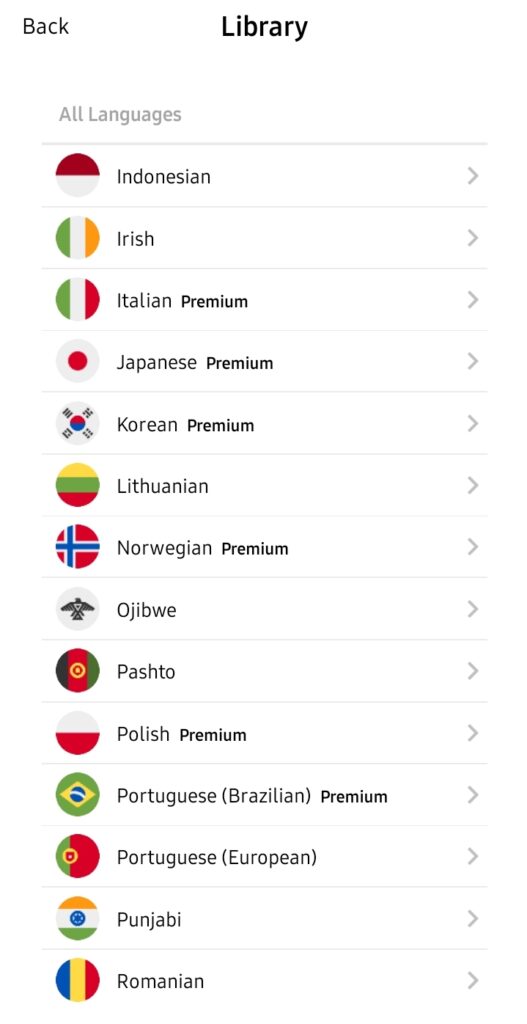
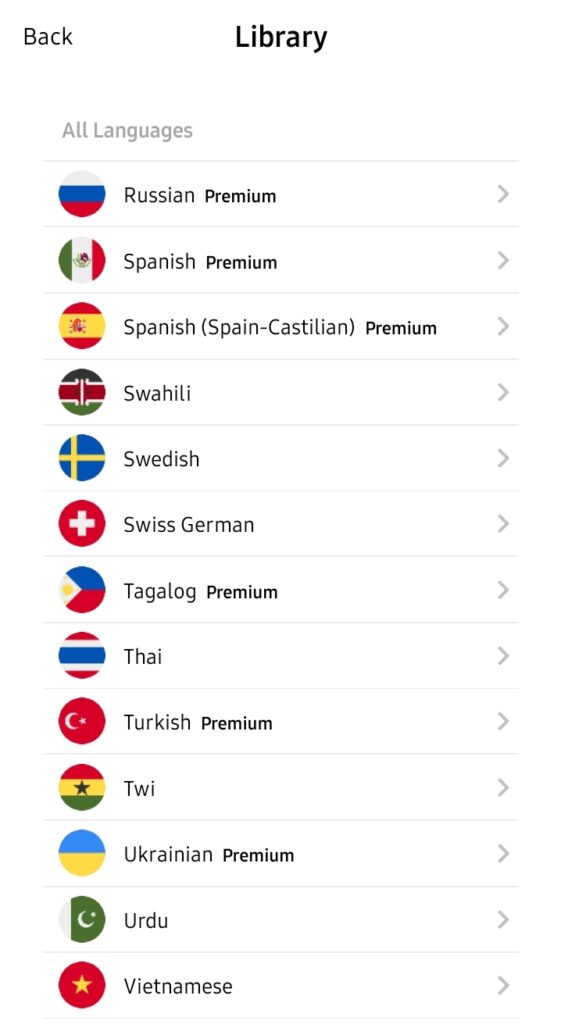
Some of the languages on Pimsleur include:
- French
- Spanish
- German
- Chinese
- Italian
- Japanese
- Portuguese Brazilian
- Russian
- Arabic
- Hebrew
- Icelandic
- Korean
- Tagalog
For those who don’t speak English as their first language, there are 14 ESL courses, which include:
- English for Spanish speakers
- English for Russian speakers
- English for Arabic speakers
- English for Hindi speakers
- English for Haitian speakers
How much does Pimsleur cost and where can you get it?
Pimsleur has two payment models: purchasing and subscribing.
The courses are available in CD or digital formats and may be purchased in either audio-only or premium versions with bonus materials. However, each package is limited to a single language.
When you purchase courses on pimsleur.com, you get lifetime access to the lessons. This is great if you want to take your time and enjoy the course at your own pace or maybe even re-take the courses every so often. But this model requires a pricey upfront investment.
With a Pimsleur subscription, on the other hand, you can choose from these three:
- Basic audio single language subscription at $14.95/month
- Premium single language subscription with all bonus materials at $19.95/month
- All Access language subscription at $20.95/month
Subscriptions are available via Apple or Google Play via in-app purchases through the Pimsleur mobile app. You may share it with three additional household members across unlimited devices.
For this review, I’m zeroing in on the mobile app. It’s the more affordable option if you can manage to go through the lessons as quickly as possible. It also offers utmost portability as well as the option to access all languages on Pimsleur’s roster.
Do note, however, that not all languages have premium versions. The Library section of the app shows which languages have premium features. You may also check Pimsleur’s FAQ page for a complete list of languages with premium versions, something worth doing before deciding to invest in the program.
The good thing about Pimsleur is that it offers a 7-day free trial so you can dip your toes before committing. The free trial lets you try all three subscription options — so I say, try the All Access!
Learning with Pimsleur
For this Pimsleur review, I tested the All Access subscription. For starters, here’s how your lessons will appear.

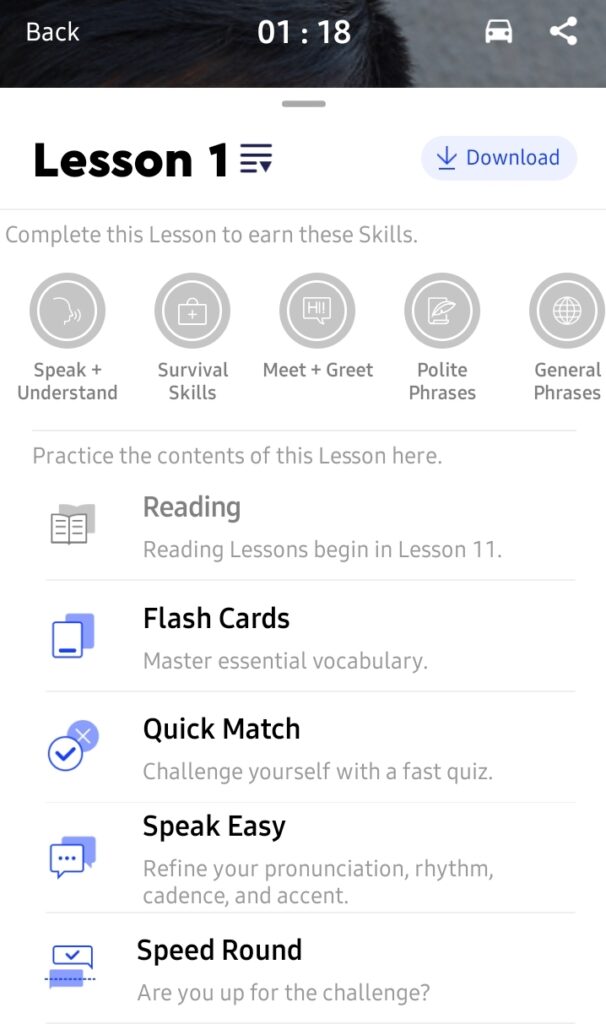
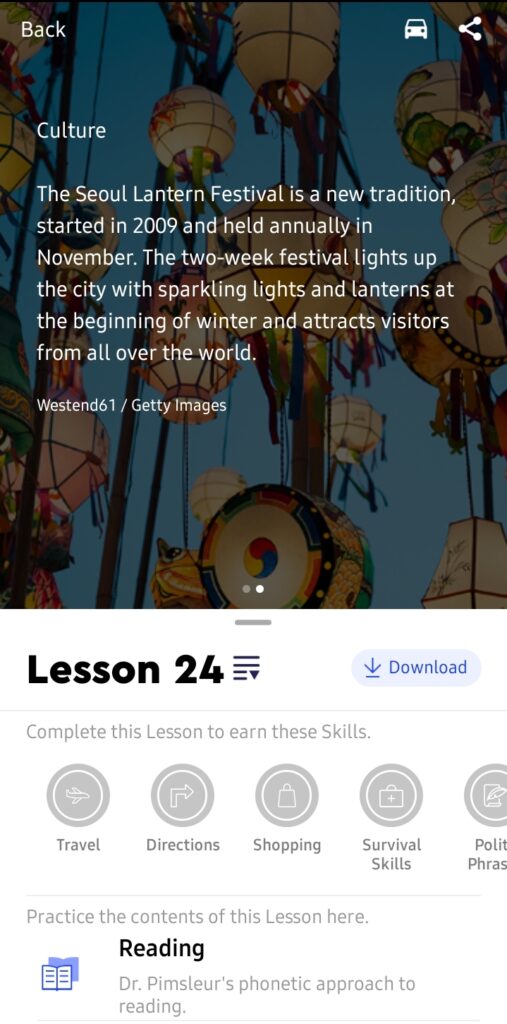
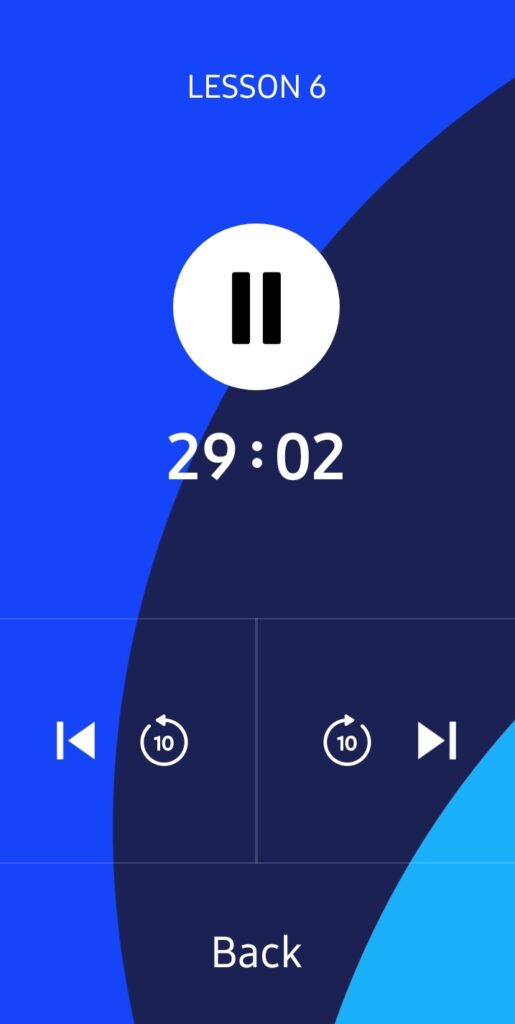
On the top portion of the lesson page, you’ll see an image with a running timer and audio controls (play, pause, rewind and forward 10 seconds, and arrows for previous and next lesson). You can swipe left to reveal the “lightbulb moments” or cultural insights that correspond to the image.
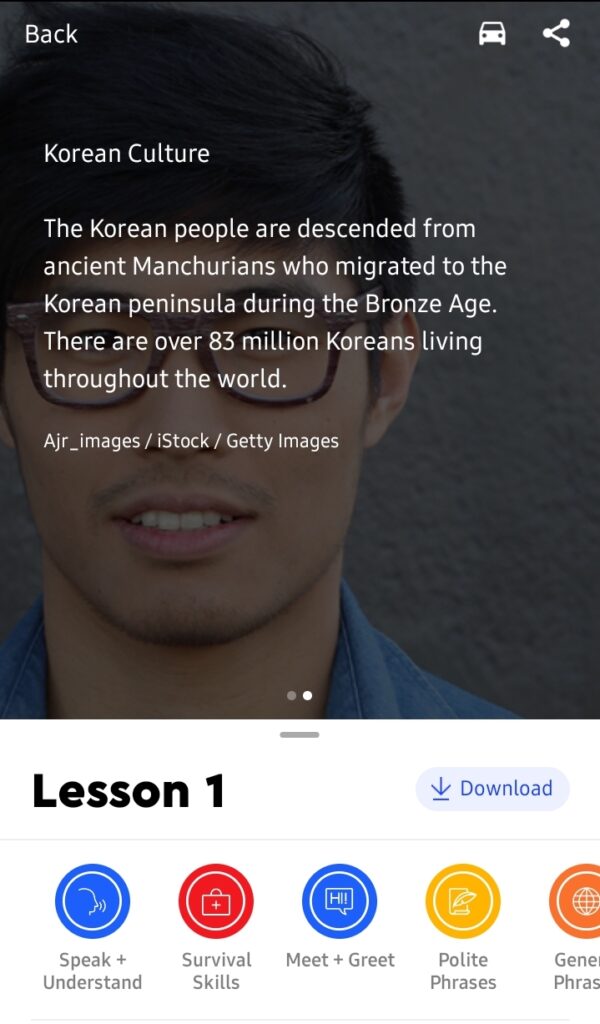
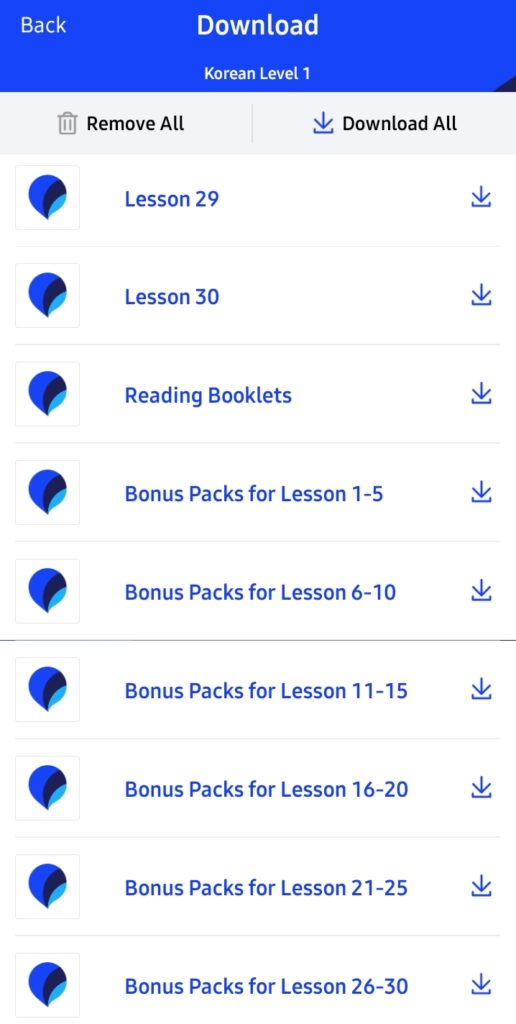
There’s a “download” button on the right side. On the left is the lesson number and beside it is a drop-down arrow, which reveals the lessons for the rest of the course. There’s not much to glean from this, however, as the lessons are not titled.


You will also see badges of Skills that you’ll gain after the lesson. These will be colored once the lesson is over.
These bonus materials, available for some languages, are also shown on the screen:
- Reading lessons
- Flashcards
- Quick Match
- Speak Easy
- Speed Round
Let’s take a closer look at the features of this subscription.
Core audio lessons
Pimsleur is an almost exclusively audio-based language learning program. In fact, Pimsleur insists on not putting transcripts on its audio lessons (except for its Speak Easy mode) because Dr. Pimsleur’s research found that the fastest way to learn a language is by listening to it and speaking it from memory.
The courses come with thirty 30-minute core audio lessons or a total of 15 hours per level or unit. I played around with Korean, French, and Japanese, all of which have Premium formats. Japanese and French have five levels (total of around 75 hours) for the whole course, while Korean has three (45 hours).


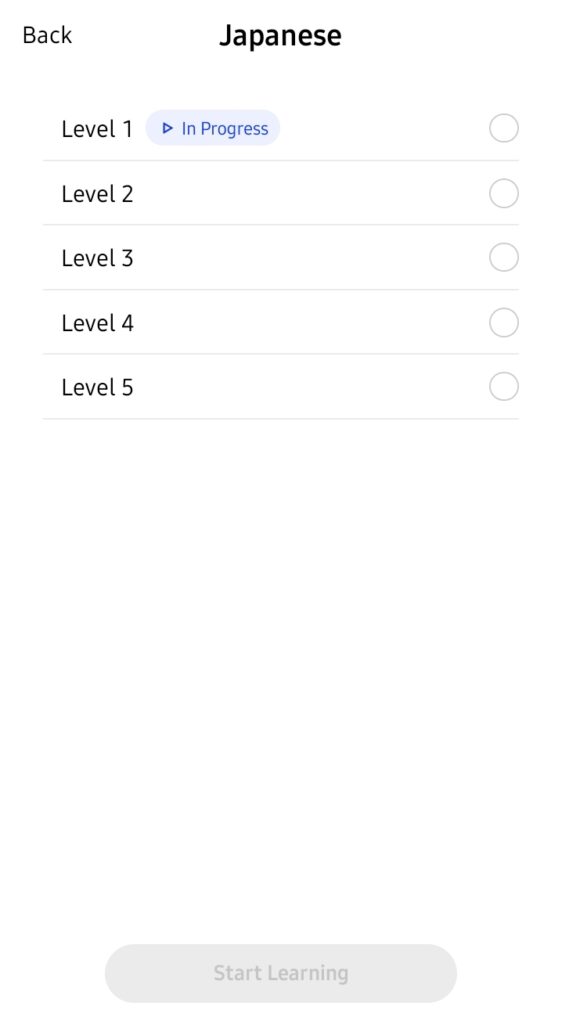
Each course starts with a conversation in the native language, giving you a glimpse of what you’re about to learn from the lesson. In all three courses I’ve tried, the conversations started with either the foreigner (who knows a bit of the native language) asking the local if he/she can understand English or the local asking the foreigner if he/she can understand Korean/French/Japanese.
You will hear this conversation again several times during the lesson, broken down into phrases, words, and even syllables as you progress. What’s interesting is that the native speaker speaks the word backward, one syllable at a time. This further helps you “visualize” the words. By the end of the lesson, you’d have understood the conversation.
An English-speaking narrator/instructor gives directions to listen or repeat what the native speaker says. The program also uses listen-and-repeat and call-and-response patterns throughout the course, which are some of the most interactive aspects of the app.
With Pimsleur, you can expect a previously taught phrase to come up again three lessons later. These well-timed intervals and repetitions are aimed to reinforce memory, making you conversational early on in your learning journey.
Given these interactive patterns, it’s clear that while you can listen to Pimsleur’s audio lessons while doing something else, you can gain more from it when you’re concentrating on it.
It’s also worth noting that even though the lessons are just 30 minutes long, you’d benefit more from spending more time reviewing what you’ve learned with the bonus materials or even listening to the whole lesson again.
This is also why Pimsleur recommends listening to one lesson per day consecutively, lest you want to be overloaded with info. If you follow this recommendation, you’ll be able to finish the one level in one month. Pimsleur also recommends only studying the review components (e.g., reading lessons, flashcards) only after you’ve completed the daily audio lessons.
Skills
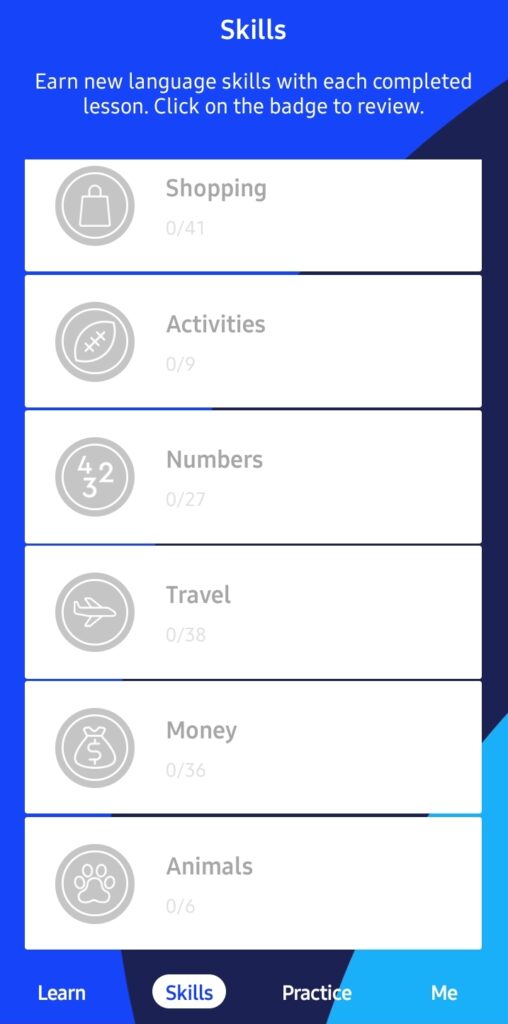
Aside from actually learning from the lessons, Pimsleur also incentivizes the lessons with Skills — badges that you can earn from completing lessons. Clicking on each badge lets you see everything you’ve learned so far, broken down into topics.
While these mainly keep you motivated, it also helps you track what you’ve learned and what skills you’ve gained.


Reading Lessons
Another feature of the Pimsleur course is the Reading Lesson which helps teach the sounds of individual letters and how they combine to form new sounds. However, as this is an audio-based program, it is still through listen-and-repeat instructions that you can learn new vocabulary.
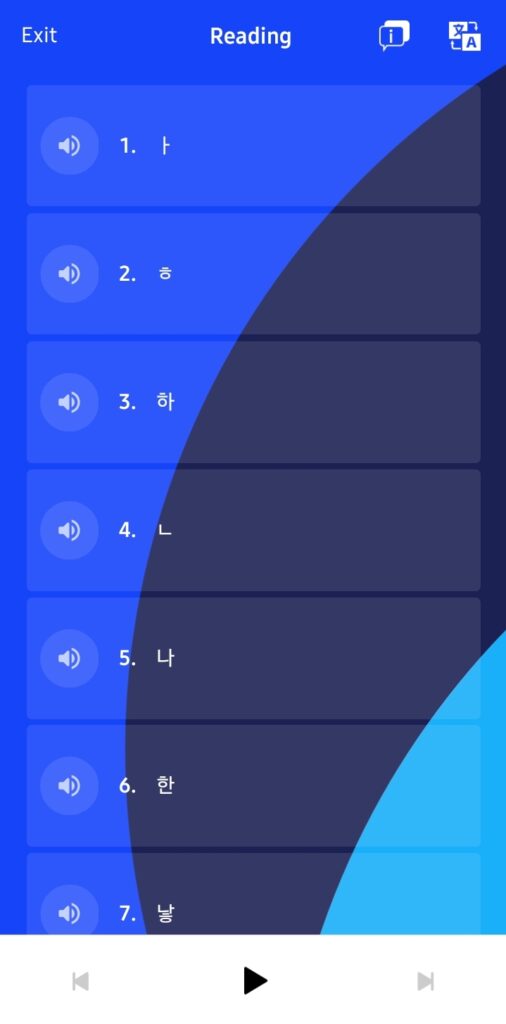

It helps that the words are spoken by native speakers, so you learn the proper intonation and accent each time.
Do note, however, that the availability of the Reading Lessons is not the same across all languages. For French, it starts as early as lesson 2, while for Korean and Japanese, you only get Reading Lessons starting from lesson 11.
Flashcards and Bonus Cards
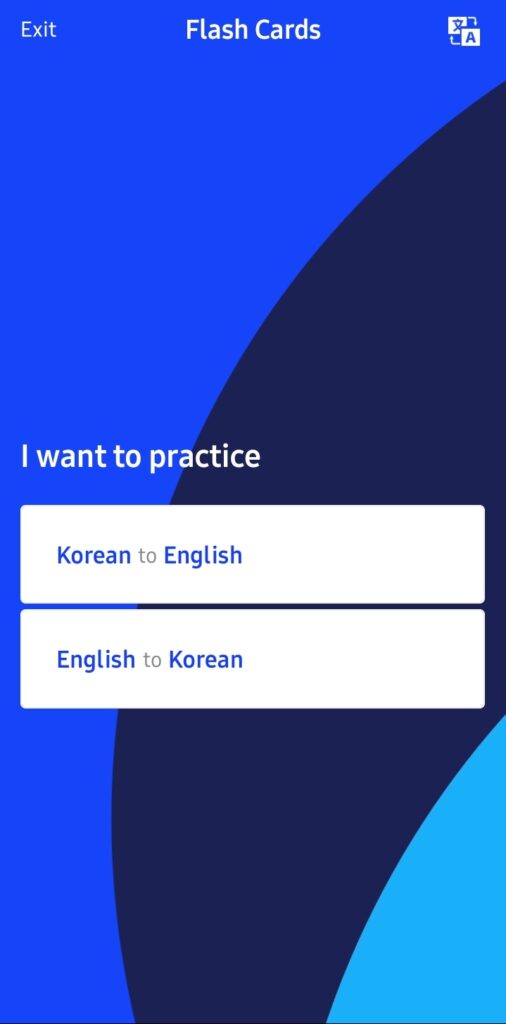
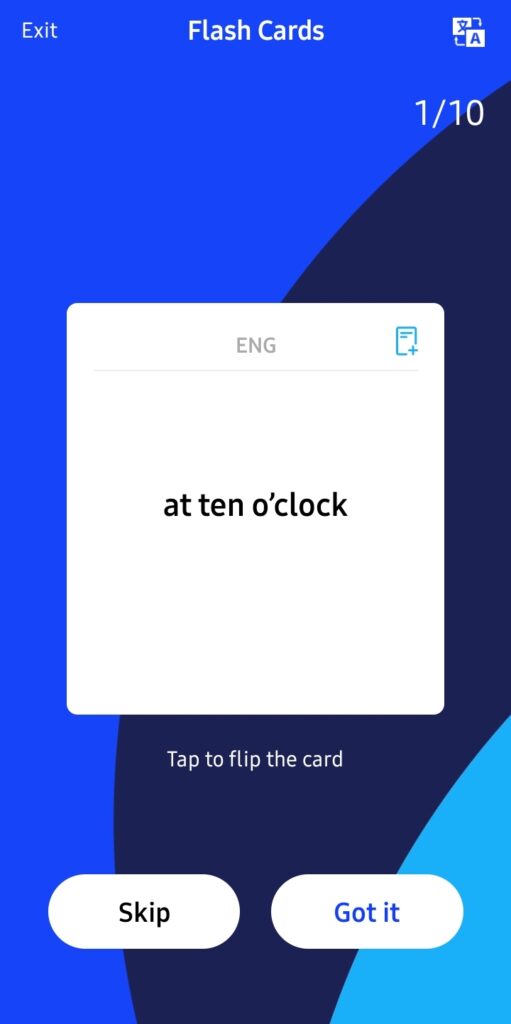
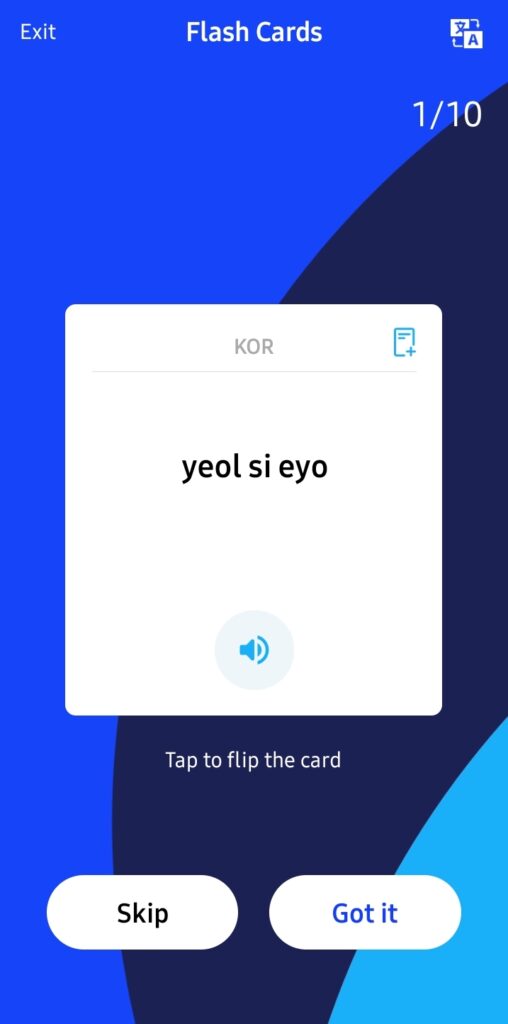
For vocabulary review, you can access the digital flashcards. You can either cue the flashcards from English to the target language or vice versa.
Each flashcard contains words or phrases taught in the particular lesson, with a native speaker pronouncing the word from the target language. It’s pretty straightforward, and like many flashcard apps, you can save difficult words to practice later.
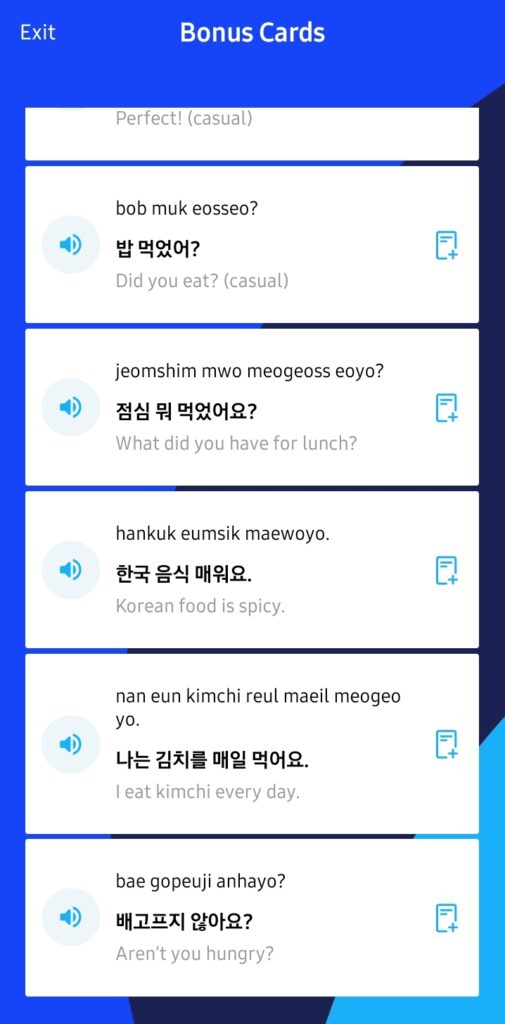
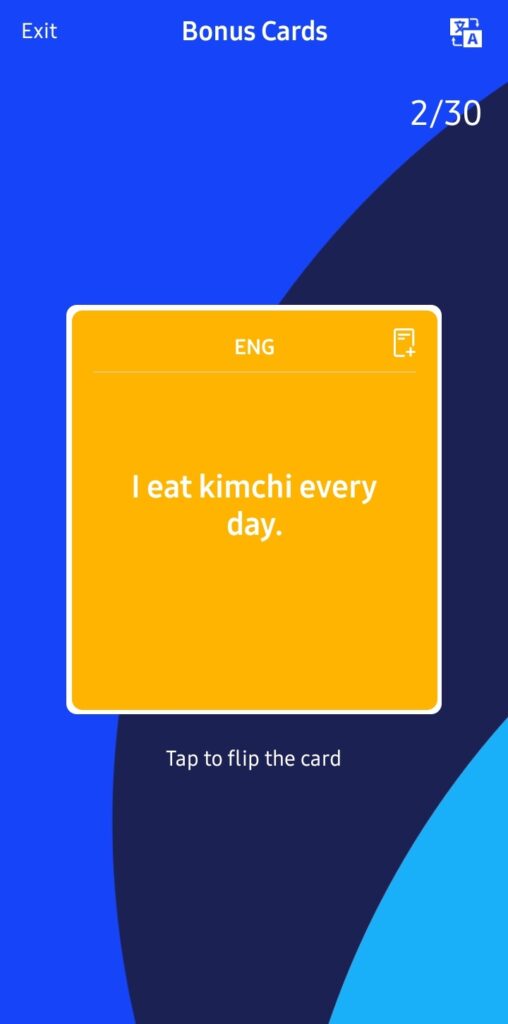
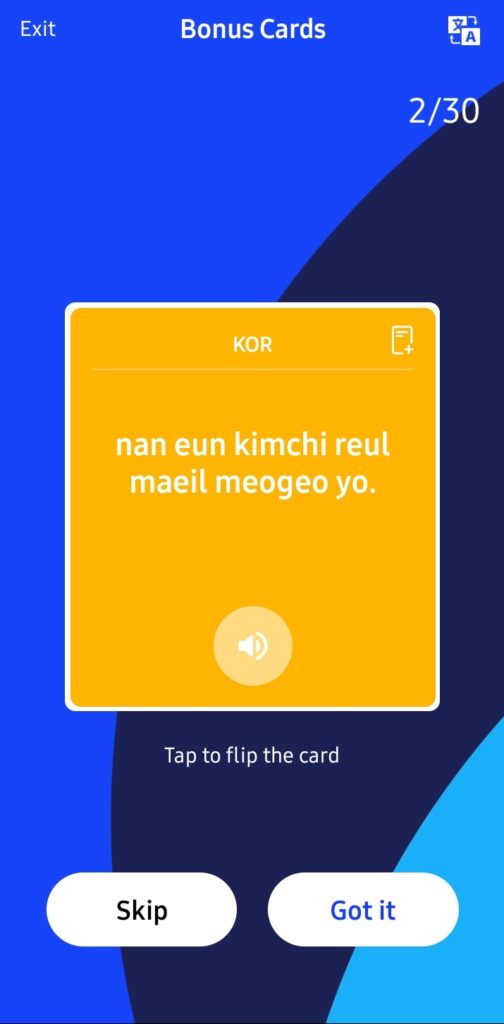
As you progress into your lessons, you can also unlock Bonus Cards, which contain vocabulary not heard in your lessons. Often, these phrases and sentences are longer and more advanced than what is usually taught in the lessons.
Quick Match
This feature is a straightforward one — Quick Match is a quiz that lets you visualize sentences and structures you’ve heard in your lessons while testing your memory at the same time.
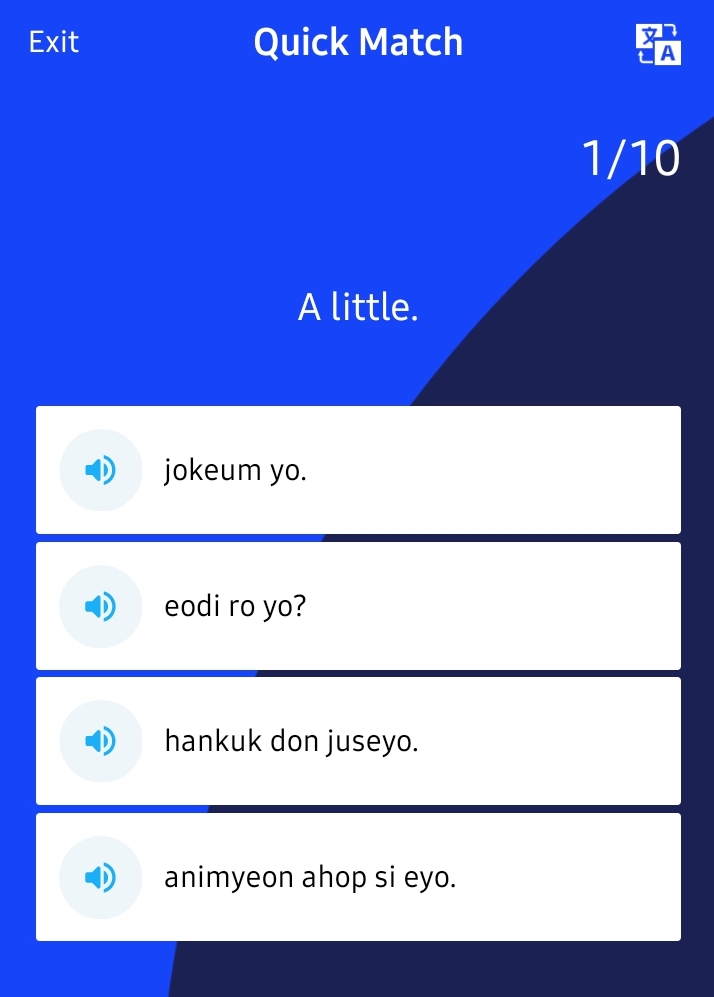
You can think of this as an extension of your listening (since you can also play the audio of each phrase) and reading lessons.
Speak Easy
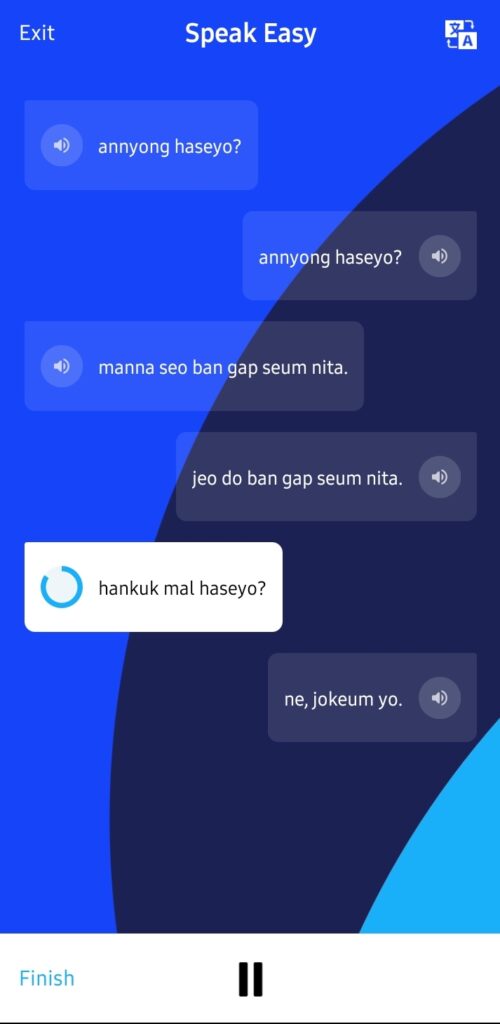
The Speak Easy feature of Pimsleur is pretty much an extension of the audio lessons, albeit with conversation transcripts. With this, you can role-play and review the conversation you just learned. It’s a good way to mimic and practice the pronunciation and intonation of native speakers.
Speed Round
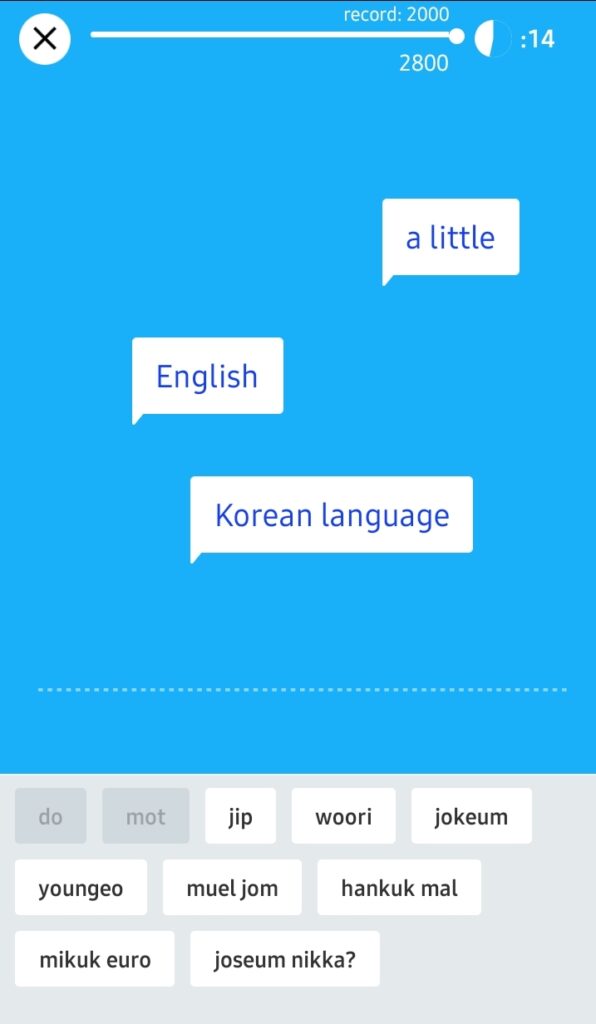
Probably the most challenging and gamified section of Pimsleur, Speed Round is a game where you need to quickly identify the vocabulary you learned from the lessons. The words descend from the top of the screen and you have to choose their correct translation before they hit the bottom.
Although the Speed Round is like the flashcards and Quick Match in that they help you recall vocabulary, it is a much more engaging way to practice.
Additional features
Aside from the above, Pimsleur also has other features that it interesting as well as convenient:
- Lightbulb Moments – As mentioned earlier, Premium and All Access subscriptions let you in on some insights that help expand your understanding of the culture surrounding the language you’re learning. While not groundbreaking by any means, it’s always nice to learn something new.
- Offline learning – A very useful feature, offline mode lets you download the lessons so you can study while you’re in a place where you don’t have access to the internet.
- Driving mode – Another convenient feature, driving mode helps you study while you’re driving. This means your screen is free of reading materials, interactive games, or any distraction.
What I love about Pimsleur
Now, on to the fun part of this Pimsleur review. These are the things that make Pimsleur an effective language learning course.
Learning by listening
Although I often think I’m an auditory learner (a huge fan of educational podcasts here), I do rely on reading text when I’m studying a language. Written words help me “visualize” how I’m supposed to read and pronounce the words.
And so, Pimsleur being almost entirely audio-based made me a bit skeptical about its effectiveness.
But Pimsleur emphasizes learning by listening and not just hearing. Those are two different things. Hearing is passive while listening requires paying attention to how native speakers pronounce the words. Listening involves understanding, hence, the need to focus on the lessons.
The lack of transcripts also means you won’t get confused by looking at letters and sounding them out as if they were English. For instance, there are lots of silent letters in French. But without seeing them, at least not right away, you won’t get tripped up.
Instead of written words and transcripts, Pimsleur uses the power of imagination for visualization. The narrator often prompts you to imagine a scenario (e.g., you as an American on a train with a French woman) where you need to put to work what you’ve learned.
Although this mental imagery is not necessarily my preferred way of studying a language, I can see why it’s an effective tool in learning. You absorb what you imagine and eventually commit it to memory.
Native speakers and intonation
I’m sure many would second this: Pimsleur’s use of native-speaking voices is one of its best features.
I love that all the vocabulary the courses teach is sounded out by native speakers, never the English-speaking narrator who only prompts you with English instructions. This way, you only learn the native way of pronouncing words.
The pronunciations and accents were also spot-on for all the courses I tried. They sounded authentic and natural, which can’t be said for all language learning apps. Here, you get a sense of sentence rhythm and native pronunciation. Repeating after the native speakers gradually helps you become more confident with your speech.
It also helps that you learn to say words and phrases in the context of conversations. You don’t learn in isolation and most of the vocabulary you gain — from general courtesies to asking for directions to leisure and business — proves useful.
Participation and motivation
Something I appreciated about Pimsleur is that despite its mostly audio-based approach, it tried its best to be interactive. And no, I don’t just mean the bonus materials and challenges but the actual audio lessons.
Using the listen-and-repeat and call-and-response patterns in the audio lessons, Pimsleur encourages you to participate by speaking and recalling what you’ve learned.
As I progressed into the courses, the pressure to recall previously learned vocab increased. Every question is followed by a pause that is just long enough to give you some pressure to answer. This makes you feel a bit disappointed if you’re unable to answer right away. But oh, what relief and motivation it gives when you recall and answer quickly.
The well-timed intervals are also really commendable. There’s a sense of pride when a phrase you learned three or four lessons ago springs up and you can recall and translate right away.
Polite language
Some languages involve various levels of politeness or honorifics. This is true for Korean and I’m glad to say that Pimsleur nailed this aspect.
The endings “-yo”, “-nida”, and “-nikka” are often used to express degrees of politeness in Korean. I found Pimsleur’s sample conversations to be just on the right level of politeness, with sentences and questions often ending with “-yo”.
Some conversations do use more formal levels of politeness (e.g., 안녕하십니까 instead of 안녕하세요) but given that the scenarios often involve strangers or acquaintances conversing, not close friends, this is still justifiable.
Pimsleur isn’t perfect
This Pimsleur review wouldn’t be complete without mentioning some of the less-than-ideal things about the program.
No writing lessons
Pimsleur’s reading materials add some meat to the lessons but as someone who’s learning languages like Korean and Japanese, the lack of writing lessons bugs me.
In Hangul (Korean alphabet), the strokes of each character are patterned after the shape of the tongue, teeth, and lips when they are spoken. Learning how to write in the native alphabet therefore also aids pronunciation.
There are also no dedicated lessons or units for learning to read each character in foreign writing systems. You’ll either have to learn this through another platform or rely entirely on Romanization.
Limited vocabulary
Depending on the language and difficulty level, a 30-lesson Pimsleur course will teach you between 300 to 500 vocabulary items, and there’s no guarantee that every word you learn will be relevant to you.
This is deliberate on Pimsleur’s end. The goal of the program is not to teach as many words as possible but to teach structures and frameworks. It also aims to build strong foundations by internalizing the limited vocabulary and structures you’ve learned.
In theory, this sounds good. But when you compare it to other long-term resources like textbooks or online courses, which don’t cause as much as Pimsleur does, it leaves you wanting more. That said, the fact that it focuses on clarifying structures means you get non-technical explanations of grammar.
The pace can be a little slow
This applies to the Korean course and not necessarily to all languages in Pimsleur’s roster. In the earlier lessons, you spend a lot of time breaking phrases and words into syllables. Pimsleur talks you through each sound very slowly so you can master the right pronunciation.
While this is generally helpful, it can feel way too slow sometimes. Some words can also be a bit “over-pronounced” or repeated too many times.
My verdict: Is Pimsleur worth it?
A resounding yes!
Given everything I’ve said above, I think the pros outweigh the cons. I would highly recommend Pimsleur for learners of all levels. Yes, even for those who don’t identify as auditory learners.
Pimsleur’s researched-based graduated interval recall and high-quality audio lessons are effective not just in imparting essential vocabulary and grammar but also in making sure what you learned sticks with you.
Add the interactive review components to this mix and you’ve got a pretty solid program that can get you to speak as quickly and as comfortably as possible. As long as you can carve out 30 minutes to an hour per day to focus on your Pimsleur courses, you can become conversational in no time!
FAQ about Pimsleur
Can you become fluent with Pimsleur?
You won’t become fluent from Pimsleur alone. But you will definitely become conversational and gain confidence in speaking a foreign language. This is because Pimsleur’s audio courses get you speaking from day one. A single app isn’t enough to reach fluency, however.
What languages can you learn from Pimsleur?
Aside from English, you can learn 50 languages from Pimsleur. This includes Spanish (Latin American), French, Japanese, German, Italian, Chinese (Mandarin), Russian, Hebrew, Portuguese (Brazilian), Greek, and more.
Is Pimsleur just for auditory learners?
Nope! Anyone and everyone can benefit from Pimsleur’s audio lessons as long as you can concentrate and actively listen. While the bulk of the program is audio-based, there are also a lot of interactive features that help improve reading skills.
Is Pimsleur good for beginners?
Yes, Pimsleur is an awesome language learning app for beginners. Each course starts from the basics and the vocabulary is trimmed down to the essentials. That said, it’s also good for intermediate and advanced learners as it can solidify one’s foundations.
Can you do more than one Pimsleur lesson per day?
There is no limit to the number of lessons you can listen to in a day. However, Pimsleur recommends listening to one per day so that you’re not overwhelmed with a lot of information. This also helps you properly internalize what you learned.
Can you skip ahead in Pimsleur?
Sure, you can skip ahead if you have prior experience learning the language or if you find the initial lessons too easy. But since there’s no transcript or even theme titles, there’s no way to find out what you’ll be learning until you’re actually listening to the lessons.
How many words can you learn in Pimsleur?
Depending on the language and difficulty level, you can learn anywhere from 300 to 500 words per level.
How much does Pimsleur cost?
You can choose from these levels of monthly subscriptions, which are available via iOS or Google Play:
- $14.95/month – Basic audio single language subscription
- $19.95/month – Premium single language subscription with all bonus materials
- $20.95/month – All Access language subscription with access to everything
Subscriptions can be shared with three additional household members across unlimited devices. You may sign up for a 7-day free trial to test it out first. Lifetime access to courses can also be purchased from pimsleur.com.
Is Pimsleur Premium worth it?
The bonus materials like reading lessons, flashcards, and cultural insight add depth to the audio lessons… so, yes! If you have the budget for it, the All Access subscription gives you the chance to learn as many languages as your time (and concentration) allows.
What’s the best way to learn from Pimsleur?
To make the most out of your Pimsleur subscription, it’s recommended to listen to one audio lesson per day. Then reinforce what you learned by using the bonus review materials. Build the habit of studying over a consecutive number of days to ensure long-term memory.