
*This article may contain affiliate links. For full information, please see the disclaimer here.
You can’t speak a language if you don’t know any words. You might love learning your verb conjugations and your grammar rules, but if you have nothing to combine them with, you’re going to get nowhere fast!
Learning vocabulary is something that all language learners have to do. Arguably, the best way to learn new words and phrases is in context and organically – but this isn’t always possible. Thankfully, when you want to improve your Spanish vocabulary, there are loads of ways to do it! Let’s look at some of them.
1. Use flashcards
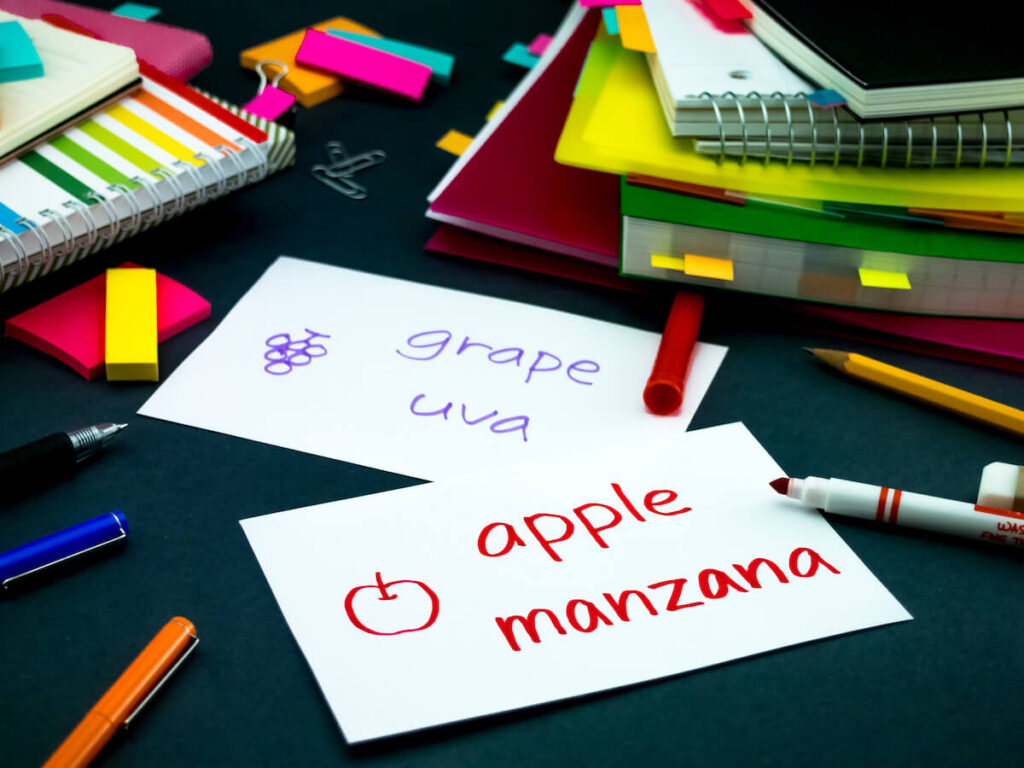
When I started teaching languages sixteen years ago, flashcards were all the rage – as they had been even when I’d been at school. I’d spend hours printing pictures and laminating them, then storing them in a folder ready to re-use whenever that topic came up again.
Over the years, interactive whiteboards and PowerPoint presentations replaced physical flashcards. I still have fond memories of using this resource and I’m sure there are some older teachers out there who still use theirs. They worked in language teaching for decades so they’re clearly a valuable resource!
Formal teaching aside, flashcards are a great way of learning Spanish vocabulary on your own. I’m sure there are places where you can buy flashcards but the most effective way of learning from them is to make your own — they don’t have to be A4 laminated ones like mine!
If you don’t want to make your own, there are some great flashcard apps like Quizlet, Memrise, Brainscape, and Anki.
2. Choose apps that are focused on vocabulary learning

Language learning apps have different approaches. Some are more focused on how to improve Spanish vocabulary than others. One great app is Drops. Drops is a fun, immersive that will help improve Spanish vocabulary learning. You can spend as little as five minutes a day on this app.
Drops works by creating visual links with over 2,000 items of vocabulary with its unique illustrations. You also get to review words you’ve already learnt so that they stay embedded in your long-term memory.
Other good apps for learning Spanish vocabulary are Babbel, Ling App, and Mondly. If you like the idea of learning new words and phrases from Spanish shows and movies, you should check out Lingopie.
3. Have a dictionary app or translation app on your smartphone

As long as you don’t rely too heavily on translation apps, it can be really useful to have one on your phone.
I would always recommend WordReference above a translator purely because it’s like having a large dictionary on your phone that allows you to understand the words you’re looking for.
For example, if you type the English word “brush” into Google Translate, you’ll be given the Spanish word “cepillo”. On WordReference, you’re given a long list of words, the context they’re used in, whether they’re a verb, noun, masculine or feminine, and an example of the word in use. For the word “brush,” it shows you three different nouns and a range of verbs.
4. Use a dedicated notebook just for your Spanish vocab

If you want to know how to increase your Spanish vocabulary, have a notebook that you carry around with you.
This will help you get into the habit of noting down new vocabulary as soon as you learn it. You can then review it whenever you get a moment. So, if you’re waiting for a bus, on a long commute, or just a little bored, you can always get the notebook out of your bag and flick through it!
Needless to say, if you’re enrolled in a Spanish course (pro tip: Coursera has great Spanish courses focused on boosting your vocabulary), it’s crucial to jot down new words you encounter.
5. Get into etymology

If you’re learning a language, the chances are you already have an interest in words and vocabulary. Knowing where words come from can really help you to remember their meanings. It can also help you learn linked words.
If we take the English word “surgeon” as an example, the Spanish word “cirujano” comes from the Latin chirugria, which originally carried the meaning ‘to work with your hands’ or ‘manual work’.
The word “bajo” (low) also comes from Latin. If you’re into music, you might know that the Latin word bassus means low – and it’s where we get the English word “bass” from too.
When you learn more about the word, it’s more likely to stick in your memory.
6. Get to grips with cognates

Cognates are like God’s gift to language learners because you don’t actually need to learn anything other than their pronunciation. You can learn hundreds of words in a very short space of time when they’re all cognates.
Common Spanish cognates include:
- Llama (as in the animal) – it’s pronounced “ya-ma” though. Llama also means “flame” and “call”.
- Bravo
- Problema – the same as English, just with an extra letter
- Radio
- Solo
- Bar – always a good one to know!
- Hospital – another good one to know!
- Possible
- Popular
- Perfecto
7. Try to practise each day

Have some sort of daily Spanish vocabulary list that you look at often. It doesn’t have to be a long list — you could have a five-word list in your pocket for a week and then switch it for a new one.
It takes a long time and lots of exposure to a new word to make it stick. Having a sticky note in your pocket with some keywords on can really help cement them in your long-term memory.
8. Do crosswords or play games

If you’re already a fan of games and crosswords, try them in Spanish. This will require a certain level of knowledge and is more suited to intermediate learners. The idea of playing word games or doing crosswords will mean you’re learning at the same time as having fun, which is always a good thing!
You could even search for some online word games that are aimed at Spanish children and adolescents so that they’re a little easier.
9. Turn the subtitles on

Even if you don’t want to watch a program in Spanish, having Spanish subtitles on when you’re watching your favourite TV shows in English will help.
You might only see the odd word you know and you might only pay attention a few times, but all exposure to Spanish vocab is good exposure and can improve Spanish vocabulary learning, as well as Spanish listening skills.
10. Find a Spanish vocabulary book

When I used to teach A-Level Spanish, I would always recommend my students get a Spanish textbook like Palabra por Palabra. In fact, I was using an older version of this during my A-Levels over two decades ago!
Unlike a dictionary, this is a great book that has word lists in themes and topics. There are also end-of-topic activities to do too.
Also read: 17 Best Spanish Vocabulary Books for Beginners and Beyond
11. Sing Spanish songs

Thankfully for English speakers, there are a few Spanish songs that have made it to the charts. Whether it’s Shakira, Enrique Iglesias, or Luis Fonsi that’s more to your taste, you can find the Spanish lyrics very easily online and sing along to the Spanish versions of their songs.
Even better, find Spanish language music online in your preferred genre and sing along on YouTube. As previously mentioned, when you’re having fun, you’ll learn a lot more.
12. Go mad with labels

Get those sticky notes out again and label things around your home. Stick one on your muebles (pieces of furniture), on your mesa de centro (coffee table), or on your cómoda (bedside table). You can go for a different theme each week. Here are some ideas to try:
- Label your cupboard items – pasta, rice, flour, sugar, etc.
- Label each room with a sticky note on the door
- Label the materials of items – e.g., wood, stone, fabric, plastic
- Label the colours of things – you could even introduce masculine, feminine, and plural colours on the appropriate items too.
13. Read for pleasure in Spanish

Depending on your level of Spanish, you can try to read for pleasure in the language. This will help to build up your vocabulary in no time.
When I was first learning Spanish, I chose to read a book that I’d already read in English and enjoyed – it was a Harry Potter book. I already knew what happened, which made it easier to grasp what was going on when the language got tricky.
What I loved about doing this – particularly with Harry Potter – was how the names of things changed too. For example, the Mirror of Erised, which allows people to see their heart’s desires (Erised is desire backwards as if reflected in a mirror) is called “el Espejo de Oesed” in Spanish – with “Oesed” being deseo in reverse.
Also read: 16 Best Spanish Novels and Storybooks for Beginners and Beyond
Final thoughts
Just being motivated and having the desire to improve your Spanish vocabulary is often enough to get things going. Once you’ve got some ideas that work for you, you’ll find yourself soaking up new words all the time.
If you can’t immerse yourself in a Spanish-speaking country, then the best thing you can do is to try and immerse yourself in Spanish as much as possible at home. With a little determination, you can see progress in how much vocabulary you know.