
Unless you’ve been around Portuguese speakers for a while, it’s very unlikely you will interpret sayings well. Things like ‘swallowing frogs’, ‘elbow pains’, and ‘burning eyelashes’ are idioms that really shouldn’t be taken literally.
Portuguese is the 2nd most spoken language in South America and the 6th most spoken language in the world. As such, this Romance language is riddled with plenty of historical and cultural remarks that might not make much sense to the foreign listener. And the more of these you learn, the more native you will sound. What’s the fun in textbook languages, anyway?

Today, we’ve put together a list of 35 Portuguese sayings and idioms that might come in useful one day. Rest assured that all of these are used in modern conversations in all the regions where the language is spoken. We’ve even included a few funny Portuguese phrases and short, easy-to-use ones.
So, take note and start incorporating these into your everyday vocabulary!
Portuguese sayings about animals
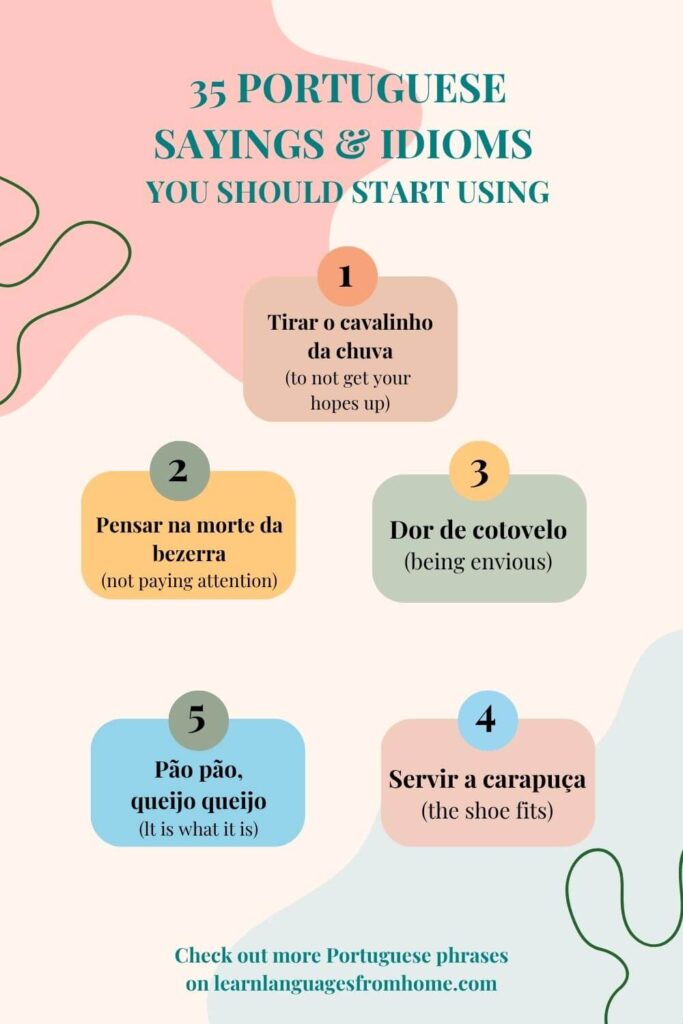
1. Tirar o cavalinho da chuva.
Literally: ‘taking the horse out of the rain‘. Meaning to not get one’s hopes up.
This expression is thought to have Brazilian origin. In the nineteenth century, when paying someone a small visit, their horse would stay directly outside the host’s main door. If the visit was welcome and appreciated, the host would invite their visitor to get their horse out of the rain. Somehow, it evolved to mean ‘giving up something’.
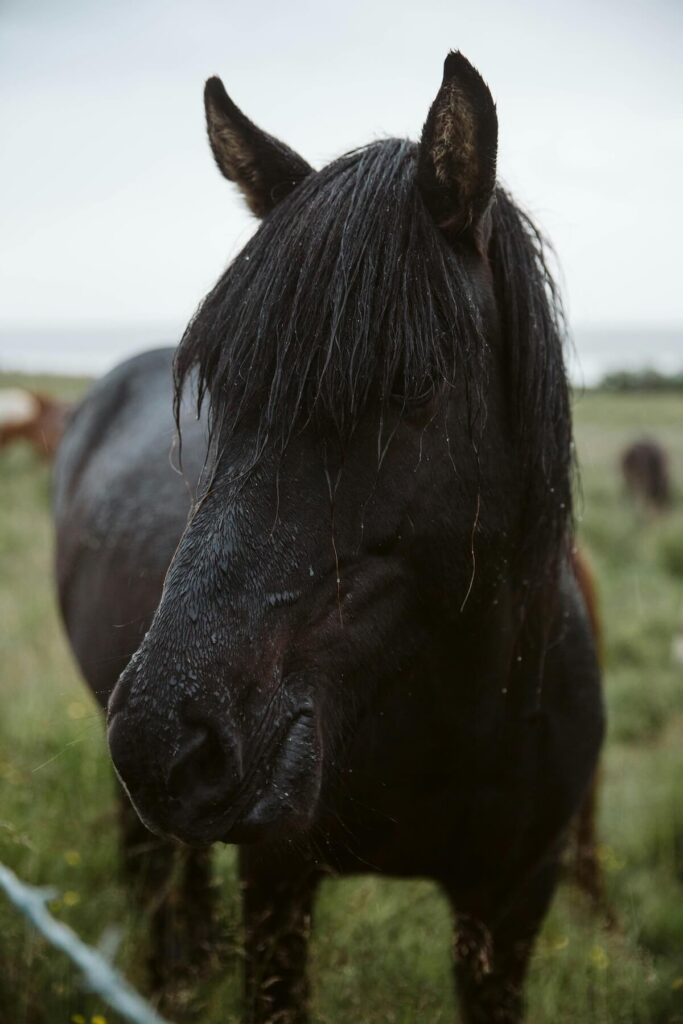
Nowadays, it’s mostly used in an ironic sense. You can tell this to someone who’s excited over something that might not go their way.
2. Ter memória de elefante.

Literally: ‘having an elephant’s memory‘. Meaning to have a really good memory.
You might have heard of a ‘goldfish memory’, but have you heard of an elephant’s? Well, it’s not the size difference that sets the tone here. It might be the fact that elephants are actually very smart animals.
So if someone says you have an elephant’s memory, it means you remember even the smallest details after a long time.
3. À noite todos os gatos são pardos.
Literally: ‘all cats are dark at night‘. Meaning ‘you should be careful‘.
This expression refers to street cats, which all look the same at night, as you can only see their eyes or teeth. It is mostly used to call people out on dubious folk or situations, dangers that we might not be taking into account.

4. Engolir sapos.
Literally: ‘swallowing frogs‘. Meaning ‘to have to endure something‘.
This saying is thought to derive from a biblical story about the Egyptian plagues. One of which was an invasion of thousands of frogs all throughout Egypt. While people prepared and ate their meals, the frogs would be there, even on their plates.
So, the expression means that sometimes we just have to endure difficult situations. This also works for ‘holding one’s tongue‘, keeping quiet even if we feel the need to say something we probably shouldn’t.
5. Pensar na morte da bezerra.
Literally: ‘thinking about the calf’s death’. Meaning ‘not paying attention.
There are various possible origins for this one. The most simple being that a calf is considered a farm animal, not a pet. As such, when a calf is butchered, it’s not considered to be that big of a deal.

So, whenever someone looks distracted and isn’t paying attention to what they’re told, you may say they’re thinking about the calf’s death.
6. Estar de trombas.
Literally: ‘having an (elephant) trunk‘. Meaning ‘to be in a mood‘.
Not that elephants are known to be moody. But no one can deny that the trunk is definitely the standout point of their face. So, if a person is a little cranky and it shows on their face, you may say they’ve got a trunk.

7. A pensar morreu um burro.
Literally: ‘a donkey died thinking‘. Meaning ‘thinking hard and reaching no conclusions‘.
In order for this to make sense, you should know that in Portuguese sayings, the word ‘donkey’ has the connotation of ‘being dumb’. This is not because the animal actually is dumb but instead because they are known to be stubborn.
So, even if someone dumb thinks hard about something, they might still not understand. With this expression, you’re not exactly calling someone dumb, just saying that they’re wasting their time thinking about something. It’s also used as somewhat of encouragement, along the lines of ‘don’t overthink it and just do it‘.
8. Vai pentear macacos.
Literally: ‘go comb monkeys‘. Meaning ‘stop getting on my nerves and go away‘.
Quite simply, you would say this to someone who is annoying you and you’d like to back off.

The expression is thought to be derivative of an older one that would trade monkeys for donkeys. In the seventeenth century, combing animals was seen as a useless task. This is because animals don’t need to look good to do what they’re supposed to do.
Portuguese sayings about body parts
9. Quem tem boca vai a Roma.
Literally: ‘that who has a mouth will get to Rome‘. Meaning ‘if you need help, ask for it‘.

This one is also quite humorous and telling of the Portuguese spirit. Nowadays, anyone can get their phone out and search for whatever they need an answer to. But back in the day, you would need to ask directions from locals when in unknown territory. So if you only asked, you could find your way to Rome.
Interestingly, it can also be used to call someone out on being passive. It’s good to motivate people to work out problems for themselves.
10. Dor de cotovelo
Literally: ‘elbow pain‘. Meaning ‘being envious‘.
It’s very widely used, even nowadays. This expression is often associated with envy. If someone is jealous of the achievements and accomplishments of somebody else, you will say that they have ‘elbow pain’. This is likely because it is quite an annoying and peculiar pain, but a lingering one.

11. Línguas de perguntador
Literally: ‘asker’s tongue‘. Meaning ‘curious‘.
Interestingly enough, this peculiar expression is used in a single situation. Parents and adults will often jokingly reply with this expression when children ask what’s for dinner.
It’s a good answer for people who are impatient regarding the meal they will have. Usually, it will shut them right up, as it implies that the chef will cook their tongue.
12. Não chegar aos calcanhares.

Literally: ‘to not reach the ankles‘. Meaning ‘to not measure up‘.
This is one of the meanest Portuguese sayings. You will tell someone that they ‘don’t reach someone else’s ankles’ when they’re not on the same level. It’s a subjective opinion of course, but it usually doesn’t leave the listener feeling too good about themselves.
13. Quem vê caras, não vê corações.
Literally: ‘that who sees faces does not see hearts‘. Meaning ‘do not judge a book by its cover‘.
It’s just like the popular English expression but this one only applies to people. It means that just because someone is good-looking, well-spoken, and charismatic, it doesn’t necessarily mean that they are well-intended or kind-hearted.
14. Queimar as pestanas.
Literally: ‘burning the eyelashes‘. Meaning ‘studying hard‘.
It’s quite similar to the English ‘burning the midnight oil’, but this one only applies to students. This is an older one, and it refers to a time before electricity when students had to use a candle to light their books. The light source wasn’t too good, so they would have to place the candles very close to the test, which could sometimes lead to a few burnt lashes.

15. Meter o rabo entre as pernas.
Literally: ‘to put your butt between your legs‘. Meaning ‘to get scared‘.
This is used when someone chickens out of something, realizes they’ve made a mistake and doesn’t do anything about it, or when they leave a place due to fear.
The expression mimics dog behavior, who literally hide their tail between their legs when they feel scared or embarrassed.
Portuguese sayings about food
16. Ferver em pouca água.
Literally: ‘to boil in little water‘. Meaning ‘to lose their temper‘.

The first expression in this category has nothing to do with food or cooking. Those who ‘boil in little water’ are irritable people, those who lack patience and are prone to losing their temper or not accepting unfavorable situations.
17. Muitos anos a virar frangos.
Literally: ‘many years turning chickens‘. Meaning ‘to have a lot of experience doing something‘.
If you haven’t tried Portuguese grilled chicken, take this as your memo to do so.
It is a very funny expression that is mostly used in a playful tone. What it means is that someone is pretty good at doing something because they’ve been doing it for years (or at least a very long time).

18. Comer muito queijo.
Literally: ‘eating too much cheese‘. Meaning ‘being forgetful‘.
Another funny one that is used to illustrate the relation that people used to perceive between being forgetful due to exaggerated dairy intake. This has obviously since been proven untrue, but people will still use it to point out that someone has a habit of forgetting things.
19. Sardinhas enlatadas.
Literally: ‘canned sardines‘. Meaning ‘feeling suffocated in crowded transport‘.
If you open a can of sardines (a very Portuguese delicacy), you will see them stacked on each other, with little to no space in between. This is precisely how it feels to be in a crowded train, bus, or subway – hence the expression.

20. Estar com os azeites.
Literally: ‘to be with the olive oils‘. Meaning ‘being cranky‘.
No one is quite sure if it’s because spilling olive oil was believed to bring misfortune or because it doesn’t mix well with water, always floating to the surface. To ‘be with the olive oils’ means to be in a bad mood, unable to be patient, and easily irritated.
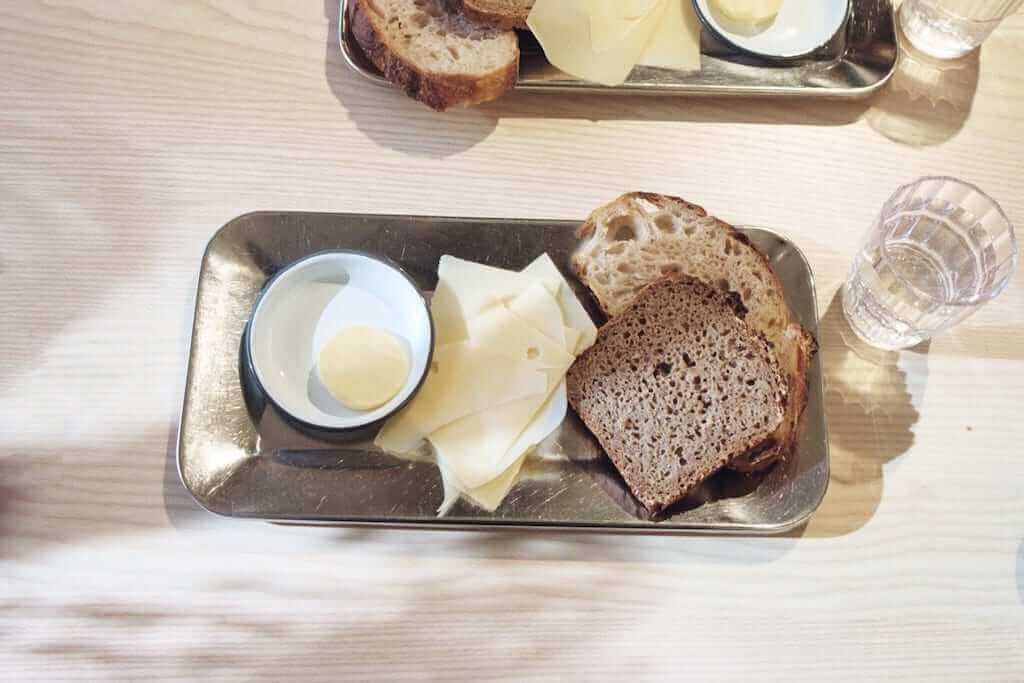
21. Pão pão, queijo queijo.
Literally: ‘bread bread, cheese cheese‘. Meaning ‘it is what it is‘.
This expression means that something was told exactly as it is, leaving no space for misinterpretation. ‘Bread bread’ means that bread is bread and cannot be cheese. So, what is said means exactly what it’s said and cannot be interpreted as anything else.
22. De pequenino se torce o pepino.
Literally: ‘when little, twist the pickle‘. Meaning ‘it’s better to be taught something from a young age‘.
Farmers who cultivate cucumbers needed to shape the produce the best way they could. They would remove small ‘sprouts’ so that the cucumbers could grow. If this wasn’t done, the cucumbers would grow deformed and wouldn’t end up tasting as good.
Just like farmers would pay attention to their cucumbers, parents should mind their children. It’s necessary to mold and educate kids from an early age.
Funny Portuguese idioms
23. Diz o roto ao nu.
Literally: ‘the torn says to the nude‘. Meaning ‘you’re one to talk‘.
Based on a kid’s book, this expresses the lack of morality of the accuser comparing to the accused. If someone accuses someone of doing something they do themselves, you can reply with this idiom.
24. Ficar a ver navios.
Literally: ‘to be stuck watching ships‘. Meaning ‘to fail‘.
It is used when someone is highly anticipating something but due to unforeseen circumstances, it never happens. It’s more of a passive action as if instead of getting on the ship, you’re stuck at port watching it sail away.

25. Coisas do arco da velha.
Literally: ‘things out of the old arc‘. Meaning ‘unbelievable, astonishing’.
This one is thought to have biblical roots, referring to Noah’s infamous arc. God created a rainbow to signify His alliance with Humans and to let them know he wouldn’t send such heavy rains ever again. The ‘old’ in the expression is meant to signify the old alliance between God and Men.
Alternatively, some people will say ‘arca da velha’, translating to ‘the old woman’s arc’. This is because old women are known to keep the most peculiar and extraordinary things.
Essentially, it is used when an action makes little sense or shows a lack of judgment on the behalf of who did it. It can also be used to describe an unjustified situation, or something fantastic and incredible.
26. Quem anda à chuva, molha-se!
Literally: ‘that who walks in the rain, gets wet‘. Meaning ‘you have to deal with the consequences’.
This one is pretty self-explanatory. All actions have consequences and you need to learn how to deal with them. Those who act without thinking, have a tendency to dislike what happens next. So, if you step out in the rain without an umbrella, you will likely get soaked.

27. Casa da Mãe Joana
Literally: ‘Mother Joana’s house‘. Meaning ‘a disorganized place or where everyone may enter’.
This is likely to have originated with the story of Joana I, Queen of Naples and Countess of Provence. She was accused of having a hand in her husband’s murder, so she took refuge for a while in Avignon. While there, she approved a decree that regulated brothels in the city. One of the articles in the decree went: ‘…and may there be a door through which everyone can enter’.
28. Onde Judas perdeu as botas.
Literally: ‘where Judas lost his boots‘. Meaning ‘an inaccessible or distant place’.
This is one of the less used Portuguese sayings that also as a few adaptions, such as the crude ‘butt of Judas’.
The story goes after betraying Jesus and receiving his 30 pieces of silver, he fell into a depression and hung himself out of guilt. However, he was found without his boots and his payment.
So, the soldiers left seeking the boots where the money was believed to be stored. No one knows what happened in the end, but the expression means an inaccessible or distant place nowadays.
Other short sayings
Here are a few other Portuguese sayings that either lack an origin story or require no long explanation.
29. À grande e à francesa
Literally: ‘massively and in the French way‘. Meaning ‘showing off, or putting on a spectacle’.

30. À sombra da bananeira
Literally: ‘in the shadow of the banana tree‘. Meaning ‘being lazy, not doing any work’.
31. Bater as botas
Literally: ‘knocking boots‘. Meaning ‘dying‘.
32. Servir a carapuça
Literally: ‘the hood fits‘. Meaning ‘the shoe fits‘.

33. Cara podre
Literally: ‘rotten face‘. Meaning ‘shameless, cheeky‘.
34. Dar tanga
Literally: ‘giving thong‘. Meaning ‘to have fun at someone’s expense‘.
35. Fazer de vela
Literally: ‘to be the candle‘. Meaning ‘thirdwheeling‘.

Now that you’ve learnt all these useful Portuguese sayings and idioms, you might want to spruce up your knowledge of the language a little further. If that is the case, how about you give these other articles a chance:
- Beleza: What It Means and How to Use This Portuguese Word
- How to Say “I Love You” in Portuguese and Other Romantic Phrases
- Days of the Week, Months and Seasons in Portuguese
Portuguese sayings and idioms – Pin it!

My mom shared with me a clever Portuguese saying, and I forgot the exact phrasing. (She has passed.) It goes something like, “The Devil covers with a mantle then rings a bell”? It means something like the Devil deceives us into thinking hiding a lie, mistake, sin is easy, yet just when we think we’re in the clear, he has exposed it – and us. I’d appreciate any news. My parents were from Feiteras, Sao Miguel, Acores.