
*This article may contain affiliate links. For full information, please see the disclaimer here.
Think back to high school language class. If your memories involve staring blankly at conjugations on a whiteboard or panicking over verb charts, you aren’t alone. For a long time, learning a language felt like standard homework.
But as your fellow language learner, I can tell you it is actually way cooler than that. Picking up a new tongue literally changes how your brain works, shifts how you see the world, and instantly connects you to people across the globe.

That’s why I’m listing these facts about language learning. Here, I’ll explore the surprising science of how your brain adapts, some unconventional study methods that actually work, and weirdly fascinating global language trivia. Let’s go!
Facts about the science and psychology of language learning
1. Intensive language learning physically changes your brain

It sounds like science fiction, but packing your schedule with rigorous vocabulary and grammar drills acts like a heavy weightlifting session for your gray matter.
Neuroimaging studies, including the comprehensive research by the Max Planck Institute, show that intensive language acquisition physically alters our brain’s structure. Specifically, it increases the size and connectivity of the hippocampus, which handles memory, and areas of the cerebral cortex responsible for speech.
This just proves that our brains are incredibly plastic—adapting, expanding, and rewiring themselves at any age just to help us connect.
2. There’s a critical age window for achieving fluency

As language learners, we’ve all heard the myth that if you didn’t pick up a language as a toddler, you’ve missed the boat. That’s not exactly true.
It is true that children absorb new words seamlessly thanks to a highly adaptable brain. But as it turns out, our window for effortless learning stays open much longer than we thought.
A massive, groundbreaking study led by MIT researchers revealed that your ability to master a new language’s grammar with high proficiency actually remains remarkably stable up until age 17 or 18. While the childhood brain is a sponge, your teenage brain is still fully capable of achieving near-native fluency before that specific biological learning rate drops.
3. Adults actually grasp grammar patterns faster than children

Now, grown-ups, no need to be jealous. While it’s easy to look at a toddler picking up words effortlessly and feel a bit envious, adults have a leg up in other areas.
Children are undeniable masters at mirroring native-sounding accents. However, when it comes to breaking down how a language actually works, adults hold a major advantage. Because of our mature cognitive frameworks, we can analyze complex, abstract grammar patterns much faster than a child can.
Studies have shown that adults can implicitly map out foreign grammatical structures with surprising speed, using existing logical tools to quickly unpack sentence rules that children usually take years to absorb.
4. Thinking in a second language makes your choices more rational

When faced with tough choices, switching to a foreign tongue can protect you from emotional bias. A study on language effects confirms that people are statistically more likely to make logic-based, utilitarian decisions when reasoning in a second language.
Why, you ask? This happens because a non-native language lacks the deep emotional resonance of our mother tongue. It provides a cooling-off period, shifting us from reactive gut instincts to a more deliberate, objective mode of thinking. Cool, right?
5. Being multilingual delays the onset of dementia

One of the most amazing benefits of learning a language is its power to shield your mind as you grow older. Research shows that speaking a second or third language acts like a continuous cognitive workout, building up a mechanism known as “cognitive reserve.”
This mental resilience physically protects your gray matter, delaying the onset of Alzheimer’s and dementia symptoms by an average of four to five years. A comprehensive study confirms that this lifelong bilingual exercise keeps the brain’s executive control network adaptable, ensuring that even when structural damage occurs, your mind continues to function smoothly for longer.
Facts about language learning methods and techniques
6. Timed intervals lock new words into your long-term memory
Having tested dozens of Spaced Repetition System (SRS) apps, I know cramming vocabulary never works. SRS works by testing you on a word right as your brain is about to forget it.
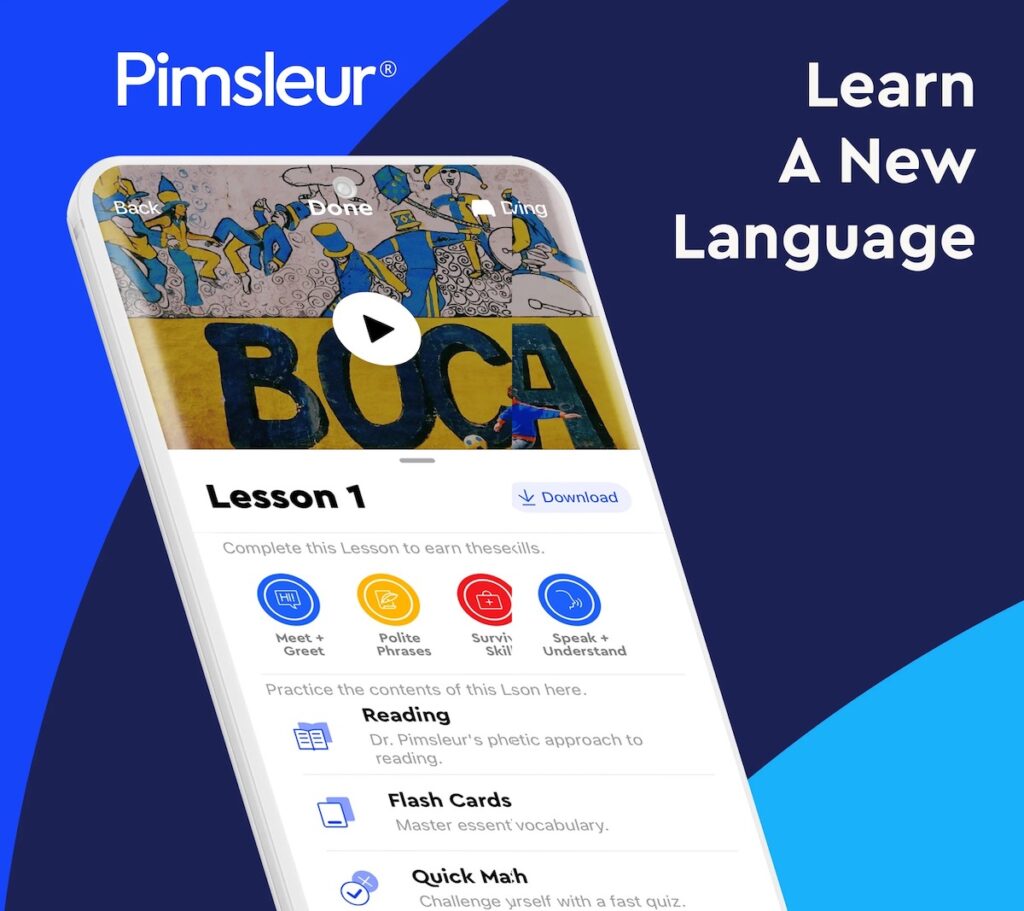
Pimsleur is one of the best apps that demonstrate this method. Its “Graduated Interval Recall” prompts review at expanding intervals—like 5 seconds, 25 seconds, then 2 minutes. Just as you’re about to forget a word or phrase, the system reminds you again. Over time, your mind adapts, shifting new words securely into long-term memory.
7. Learning complete sentences is better than studying isolated words
I hate to break it to you, but staring at standalone vocabulary lists with flashcards is a tedious, unnatural way to study. Modern linguistic frameworks—most notably the Lexical Approach—strongly advocate for acquiring full sentences instead.
This method relies on the idea that language consists of meaningful, multi-word “chunks” rather than single words pieced together by complex grammar rules. When you focus on complete statements, your brain implicitly picks up on context, syntax, and structural patterns all at the same time.
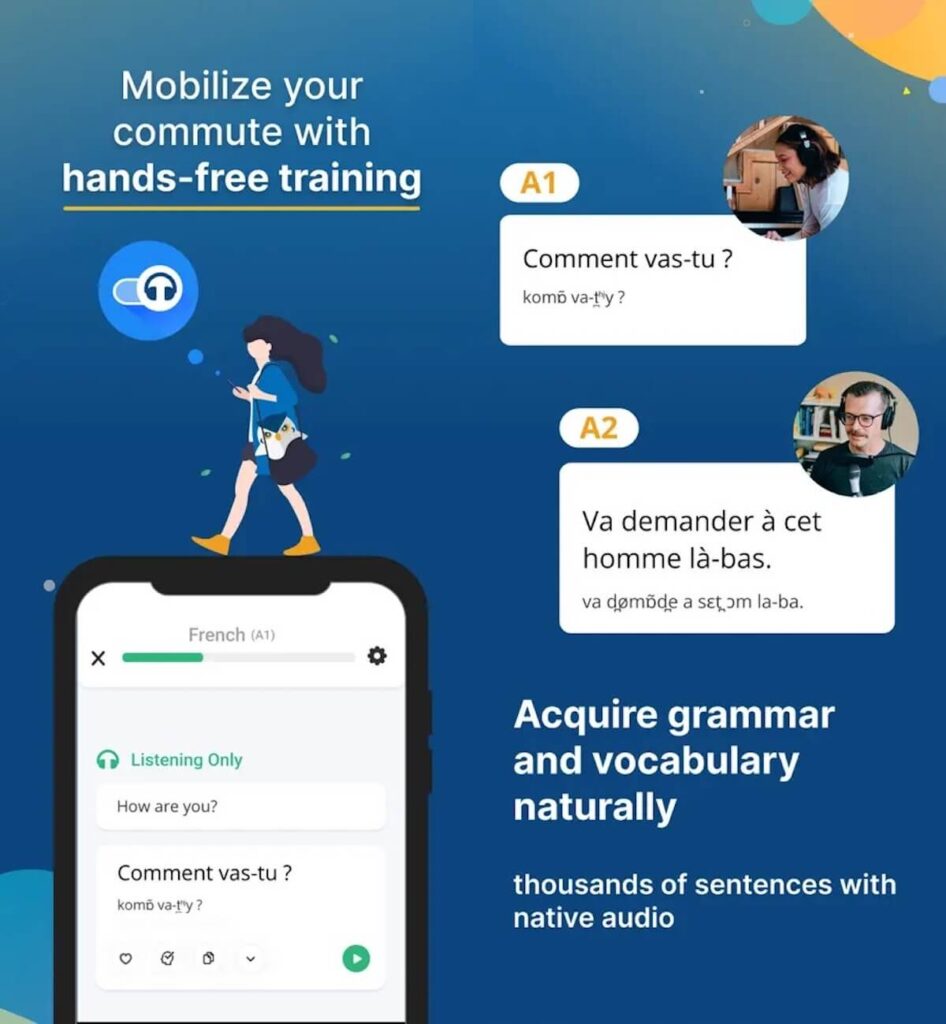
Apps like Glossika use this exact methodology. By presenting thousands of complete, native-spoken sentences, it trains your brain to internalize authentic patterns and construct functional thoughts intuitively, bypassing the robotic process of word-by-word translation.
8. A few weeks of immersion beats years of passive textbook study

True environmental immersion forces your brain to adapt out of absolute necessity, yielding incredibly fast results. Living in your target language engages both hemispheres of your brain, rewiring neural tracks to extract crucial auditory information from surrounding noise.
Let’s qualify immersion, though. True immersion means navigating daily life entirely in that foreign tongue—not sitting in a comfortable, English-speaking bubble abroad.
If traveling isn’t an option, you can replicate this productive pressure at home. Hire a 1-on-1 online tutor on platforms like Preply or italki, watch content in your target language entirely (K-Pop fans, here’s the perfect excuse for watching your bias’ Weverse lives without subtitles), or use language exchange apps to force active, real-world communication.
Here are more tips for immersive language learning.
9. Mastering just 1,000 core words unlocks most daily conversations

The Pareto Principle—frequently known as the 80/20 rule—heavily applies to linguistics. This is because in almost any language, a tiny fraction of total words does the vast majority of the heavy lifting.
Statistically, knowing just the top 1,000 high-frequency words allows you to understand roughly 80% of everyday, real-world speech. This is the ultimate shortcut to operational fluency.
To achieve this milestone efficiently, bypass traditional dictionaries and go for targeted vocabulary books. Also, download a curated frequency list or use Spaced Repetition apps to specifically drill high-frequency terms. Better yet, practice learning those core words within complete, functional sentences so you grasp context and sentence structure simultaneously.
10. Echoing a native speaker out loud vastly improves your speech rhythm

Fluency goes beyond knowing words. It also involves mastering a language’s unique cadence, stress patterns, and musicality. And if your rhythm is off, native speakers will struggle to understand you, even if your grammar is perfect.
That is where the “shadowing” technique comes in. This method involves listening to a native audio track and repeating what you hear out loud with a split-second delay.
By pacing yourself directly with the speaker, you train your brain and vocal muscles to mimic authentic intonation, effortlessly erasing a rigid, robotic accent.
Linguistic quirks and language trivia
11. English structurally remains a Germanic language

Because English is packed with Romance words, it’s easy to assume it belongs on the same family tree branch as French or Italian. Historically, the Norman Conquest injected a massive wave of French and Latin into the lexicon, so much so that over 60% of our modern vocabulary stems from those sources.
However, vocabulary is just decoration. English’s core DNA, grammar, and sentence structure remain strictly Germanic. Our most foundational words—like house, man, earth, and eat—along with how we conjugate irregular verbs, trace directly back to their ancient Proto-Germanic roots!
12. Your native tongue dictates how hard a new language will be

When figuring out how long it takes to learn a new language, everything comes down to a concept called “linguistic distance.”
One of the most fascinating facts about language learning, linguistic distance simply measures how close a foreign tongue is to your native language’s family tree. For English speakers, closely related languages like Spanish or Dutch share thousands of cognates and familiar grammar habits, meaning they only take about 600 to 750 hours of study to master.
But if you branch out into languages with zero shared roots, the timeline explodes. This means structurally distant languages like Arabic or Mandarin demand a massive 2,200 hours of intensive study just to achieve basic professional fluency!
13. Hungarian is considered Europe’s toughest language to master

If you are looking for a true European linguistic challenge, look no further than Hungarian.
For most Westerners, diving into Hungarian feels completely alien, and there is a massive historical reason why: it doesn’t belong to the Indo-European language family tree. Instead, it sits in the Uralic family, meaning it shares almost zero common roots or cognates with English, French, or Spanish.
On top of that, Hungarian grammar is notoriously brutal, featuring 18 distinct noun cases! Rather than using prepositions like “in” or “on,” you modify words with complex suffixes, forcing your brain to completely rewire how it builds a single sentence.
It’s not impossible to learn, though. I recommend downloading any of these apps to learn Hungarian. If you prefer the classic route, these Hungarian learning books should do the trick.
14. Tonal languages require your brain to use its musical hemisphere

When you learn a non-tonal language like English or Spanish, your brain’s left hemisphere does almost all the heavy lifting to process grammar and meaning. But did you know that if you decide to take on a tonal language—like Mandarin, Yoruba, Vietnamese, or Thai—the biological rules completely change?
Because changes in pitch change the actual meaning of a word in these languages, your brain has to recruit its musical right hemisphere to analyze the vocal frequencies. It’s a full-brain workout that literally bridges the gap between language and music.
15. An entire island population communicates using a whistled language

While most of us rely on spoken words, some communities have developed the incredible ability to whistle entire languages. Whistled speech exists worldwide, from the village of Kuşköy in Turkey to remote regions in Mexico, born out of a practical need to communicate across vast distances.
The most famous example is found in the Canary Islands. On the island of La Gomera, inhabitants use Silbo Gomero—a whistled form of Spanish. By mimicking the vowels and consonants of normal speech through varied pitches, locals can chat effortlessly across deep, rocky valleys up to five kilometers away.
Now, imagine trying to learn this language!
Vocabulary and cognitive shifts
16. Learning a new language introduces untranslatable concepts

One of the coolest parts of language learning is discovering words that simply don’t exist in your native tongue. Every language possesses unique vocabulary shaped by its culture, and learning these gives you access to specific human emotions and ideas that English can’t easily express.
Think of the German schadenfreude (finding joy in someone else’s misfortune), the Japanese ikigai (a reason for being), or the Filipino kilig (that sudden, romantic butterfly-in-the-stomach feeling). You also find terms like the Swedish lagom, meaning “just the right amount,” or the Portuguese saudade—a deep, melancholic longing for something or someone loved and lost.
Mastering these words doesn’t just expand your vocabulary. It literally gives you new frameworks for experiencing the world.
17. The intermediate plateau is a normal cognitive illusion

Hitting the “intermediate plateau” is one of the most frustrating phases of learning a language.
Early on, your progress feels explosive because you are mastering high-frequency words that pop up everywhere. But eventually, that rapid growth seems to stall out completely. It’s like your brain has just stopped absorbing new information.
In reality, it is a psychological trick. Your brain is simply transitioning into specialized vocabulary, nuance, and cultural context. Because these advanced words appear less frequently in daily speech, your progress becomes less obvious, even though your linguistic depth is expanding behind the scenes.
So, don’t feel bad. Instead, embrace the fact that progress looks different at every stage.
18. The human brain quickly discards the ability to recognize foreign sounds

When we are born, our minds are ultimate linguistic blank slates. Human infants are biological “citizens of the world,” fully capable of distinguishing all 800+ sounds that make up every language on Earth.
But our brains are also incredibly efficient pruners. If you don’t repeatedly expose a baby to specific phonetic sounds, the brain decides those pathways are useless. By around 10 to 12 months of age, this window slams shut.
The brain then systematically trims away the ability to perceive foreign audio contrasts, locking us into only the sounds of our native environment.
19. Your ability to mimic accents is directly tied to emotional empathy

Ever wonder why some people pick up a flawless native accent while others stay stuck with rigid pronunciation? It turns out it isn’t just about having a “good ear”—it’s actually an indicator of your emotional empathy.
Replicating native pronunciation relies heavily on your psychological empathy and a subconscious desire to blend into a new social group. When you actively tune into the feelings and behaviors of others, your brain naturally mirrors their speech patterns.
In this pioneering linguistic research, individuals with higher psychological empathy scores consistently achieved better pronunciation scores in a second language. This is because highly empathetic learners possess more permeable “ego boundaries,” allowing them to temporarily step out of their native speech habits to adopt a native speaker’s authentic accent. This openness lowers linguistic defenses, allowing one to absorb authentic intonation effortlessly.
20. Foreign languages reduce cognitive bias when you are gambling

Next time you are weighing a risky financial bet, try calculating your odds in your target language.
A fascinating psychological phenomenon known as the “foreign language effect” reveals that people think much more systematically when they step away from their native tongue.
According to research by psychologist Boaz Keysar and his team at the University of Chicago, operating in a second language significantly weakens our natural loss aversion—the irrational fear of losing money that normally paralyzes our decision-making. Because a foreign vocabulary requires more deliberate, conscious processing, it suppresses your immediate gut reactions, leaving you with a cool, analytical mindset that handles risk with purely logical calculation.
Global context and surprises
21. Apps build custom tracks based on your native tongue

The days of generic, one-size-fits-all vocabulary drills are officially over.
Today’s smartest language apps recognize that your native language heavily dictates how you process a new one. For example, a Spanish speaker learning English faces entirely different phonetic and structural hurdles than a Polish or Ukrainian speaker.
Because of this, modern software constructs personalized tracks to target your specific linguistic blind spots. If your first language doesn’t use English-style articles (the, a, an) or specific consonant clusters, the app adjusts—serving you tailored exercises that fix your exact native habits rather than wasting your time on rules you already intuitively grasp.
22. English is the most studied second language

While it is probably not a massive shock to hear that English dominates the globe, the sheer scale of its popularity is still noteworthy. Globally, well over 1.5 billion people are actively learning or speaking English as a non-native tongue.
This massive learning trend is fueled entirely by global connectivity. Because English serves as the undisputed lingua franca for international commerce, maritime communication, aviation, scientific research, and digital media, mastering it has become a baseline requirement for navigating the modern world rather than just an academic hobby.
Here at Learn Languages From Home, we’ve collated a whole range of English language resources, from apps and books to online courses and podcasts, and more. Why not share it with your fellow language learner?
23. Papua New Guinea is the most linguistically diverse place on Earth

If you think managing a bilingual household is tough, imagine navigating a country with over 840 distinct living languages.
Papua New Guinea holds the undisputed crown for linguistic diversity, packing more than ten percent of the world’s total languages into a single region. What makes this mind-boggling is the scale: this explosion of unique tongues is spoken across a population of just 9 million people!
This localized isolation happened over thousands of years as rugged mountains, deep valleys, and dense rainforests physically separated tribes. Instead of developing shared dialects, communities grew completely independent vocabularies.
While English and the English-based creole Tok Pisin serve as the nation’s unifying conduits, you will find entirely distinct indigenous languages like Enga, Huli, and Kuman spoken natively throughout the highlands.
24. Thousands of people successfully learn fictional artificial languages every year

You don’t need a country of native speakers to find a thriving linguistic community. Constructed languages or conlangs have stepped far out of the realm of pure sci-fi and fantasy.
Fictional systems like Klingon from Star Trek and High Valyrian from Game of Thrones are fully operational, rule-based languages with complex grammars and thousands of vocabulary words. Because they possess fully realized structural foundations, enthusiasts acquire them using the exact same methods you would use for French or Japanese.
The scale of this movement is massive. For instance, data from Duolingo revealed that at one point, over 3.2 million people registered to study High Valyrian on the platform, with over 500,000 users actively practicing it simultaneously. Meanwhile, the historical auxiliary conlang Esperanto boasts up to two million speakers worldwide, proving that a shared passion can build a real, functioning speech community entirely out of thin air.
25. Your passive memory will always outpace your active speaking skills

It is a common frustration: you can read a foreign news article or follow a movie dialogue perfectly, but the moment you try to speak, you suddenly can’t string a basic sentence together. Don’t beat yourself up. This gap isn’t a failure on your part; it’s a fundamental rule of linguistics.
In any language you take on, your passive vocabulary (the words you recognize when reading or listening) will remain significantly larger than your active vocabulary (the words you can recall on demand to speak or write). This is affirmed by a study on vocabulary development, which highlights that active lexical retrieval relies heavily on a much greater working memory capacity.
Recognizing a word requires your brain to merely scan for a familiar shape or sound. Actively producing a word, however, forces your mind to instantly retrieve the exact concept, correctly apply grammar rules, and physically execute the pronunciation. So, turning words you passively understand into words you can casually speak takes far more time, intention, and deliberate output practice.
Conclusion

Ultimately, taking on a new language is truly not just an academic exercise but a profound, structural upgrade to how your brain processes things and connects with the world. From altering cognitive biases to unlocking untranslatable cultural ideas, the process completely shapes your perspective.
But beyond the science, learning a language is an incredibly fun, creative adventure. Don’t let the daunting “intermediate plateau” or complex grammar patterns stall your momentum. Take the time to explore more of our resources, pick a methodology that genuinely excites you, and start learning today!