
As similar as the two languages are, there are essential differences between Portuguese and Italian that are worth noting if you’re planning to learn them or simply if you take an interest in foreign languages.
Both originated from Latin but went on to develop phonetic systems, vocabulary, and an overall structure that only to a certain extent resemble one another.
Tag along for the most comprehensive Portuguese vs Italian comparison you’ll find on the web! You’ll notice these will be valuable lessons for the next time you use apps to learn Italian or Portuguese learning apps.
Major differences between Portuguese and Italian
1. Italian has remained a lot closer to Latin than Portuguese has.
Portuguese and Italian lost fundamental elements of Latin grammar like case declension. That said, Italian consolidated itself as the closest language to Latin (with the possible exception of Sardinian), especially regarding phonetics, due of course to geographic proximity and a shortage of foreign influences over its early development.
Countless words it inherited from the language of the Romans have survived intact or almost so, as you can see in the following table.
| Latin origin | Italian word | Portuguese translation |
|---|---|---|
| catena (chain) | catena | cadeia |
| crudus (raw) | crudo | cru |
| filum (thread) | filo | fio |
| focus | focus | foco |
| frenum (brake) | freno | freio |
| gradus (degree) | grado | grau |
| lana (wool) | lana | lã |
| luna (moon) | luna | lua |
| persona (person) | persona | pessoa |
| referendum | referendum | referendo |
| vena (vein) | vena | veia |
| velum (veil) | velo | véu |
What’s more, Italians use Latin phrases like ad hoc (for a particular purpose), sui generis (unique), una tantum (lump sum), and in extremis (at the point of death) on a regular basis.
2. Portuguese is more diverse, geographically speaking.

That doesn’t necessarily mean Portuguese is richer when it comes to vocabulary, as each region of Italy speaks a local language that ends up having a huge influence over the way folks speak Italian there.
Still, in big cities like Milan and Rome — which feature prominently in the media and have a far more significant impact on modern Italian than the small towns — local languages have long fallen out of use. So it’s fair to say “standard” Italian is more homogeneous than Portuguese today.
It wasn’t always like that. Historically, Italians struggled so much to communicate with one another that they came up with 250+ gestures to aid interaction. But throughout the 20th century, the rise of literacy and the spread of television made Italian a more consistent national language.
Meanwhile, Portuguese is spoken in virtually 10 nations on four continents. In Brazil alone, you’ll find 10 to 15 regional dialects, which, coupled with Portugal’s handful of variants, plus the few African dialects like Mozambican and Angolan Portuguese, make Portuguese an insanely diverse language.
Read more: 25 Fun Facts About the Portuguese Language
3. You’re expected to speak a more formal register of Italian with folks you don’t know, compared to Portuguese.
As a rule of thumb, Italians are a lot more formal than Brazilians and even the Portuguese, who tend to be more reserved as well.
Asking a barista a harmless come stai? (“how are you?”) as you order your morning shot of espresso might trigger an awkward silence for a response.
First off, Italians aren’t that used to discussing their personal lives with strangers. Second, depending on the barista’s age and own preferences, they’d expect you to address them as lei instead of tu.
The formal treatment, namely o senhor/a senhora, does exist in Portuguese, as opposed to the colloquial tu and você. Yet it’s commonly only used with older people or a hierarchical superior.
Two forty-year-olds who are introduced in a business setting, for example, would hardly treat each other as o senhor/a senhora. In Italy, in turn, they’d definitely use lei until one of them asks if they should darsi del tu — to which the other person might reply they’d rather not.
4. While blasphemy is taboo in Italian, the concept doesn’t really exist in Portuguese.

If you want to sound truly rude in Italian, the best way to do it is by offending God and the Virgin Mary. This is not a thing adults normally do, but rebellious teenagers will sometimes shout stuff like Dio cane! and porca Madonna! — and be met with shocked faces from parents and teachers.
Up to 1999, bestemmia (i.e. “blasphemy”) was actually treated as a crime, yet since then it’s become a mere finable offense. Oddly enough, insulting Mary or any saints is allowed, as the law only applies to deities.
In the Portuguese-speaking world, blasphemy is not a problem. Swearwords are frowned upon and not something you’ll hear on TV or in a business meeting. That said, there’s no such thing as a special category of phrases that are widely seen as taboo on religious grounds.
5. Portuguese is generally more nasal than Italian.
Portuguese is notorious for featuring nasal vowels everywhere. These sounds are frequently, though not exclusively, represented by the diacritic ~, as in união (“union”) and ações (“actions”).
In Italian, even in words that are similar to Portuguese (e.g. unione and azioni), the nasal sound usually doesn’t spill over to the previous syllable, which means unione is pronounced /oo-nee-oh-nay/, not /oo-nee-ohn-nay/.
In Portuguese, on the other hand, a word as simple as cama (i.e. bed) is often pronounced /cahm-mah/ instead of /cah-mah/. It’s worth noting, though, that Brazilian Portuguese dialects are way more nasal than European Portuguese ones.
The table below will give you an idea of this distinction.
| Portuguese word | Italian translation with pronunciation key |
|---|---|
| anão (dwarf) | nano [/nah-no/] |
| cão (dog) | cane [/cah-nay/] |
| constante (constant) | costante [/coas-tahn-tay/] |
| feijão (bean) | fagiolo [/fah-gioh-low/] |
| instituição (institution) | istituzione [/ees-tee-too-tsioh-nay/] |
| multidão (crowd) | moltitudine [/moal-tee-too-dee-nay/] |
| paixão (passion) | passione [/pah-seeoh-nay/] |
| pão (bread) | pane [/pah-nay/] |
| são (sane) | sano [/sah-no/] |
| vulcão (volcano) | vulcano [/vool-cah-no/] |
6. Overall, only foreign words end with a consonant in Italian.
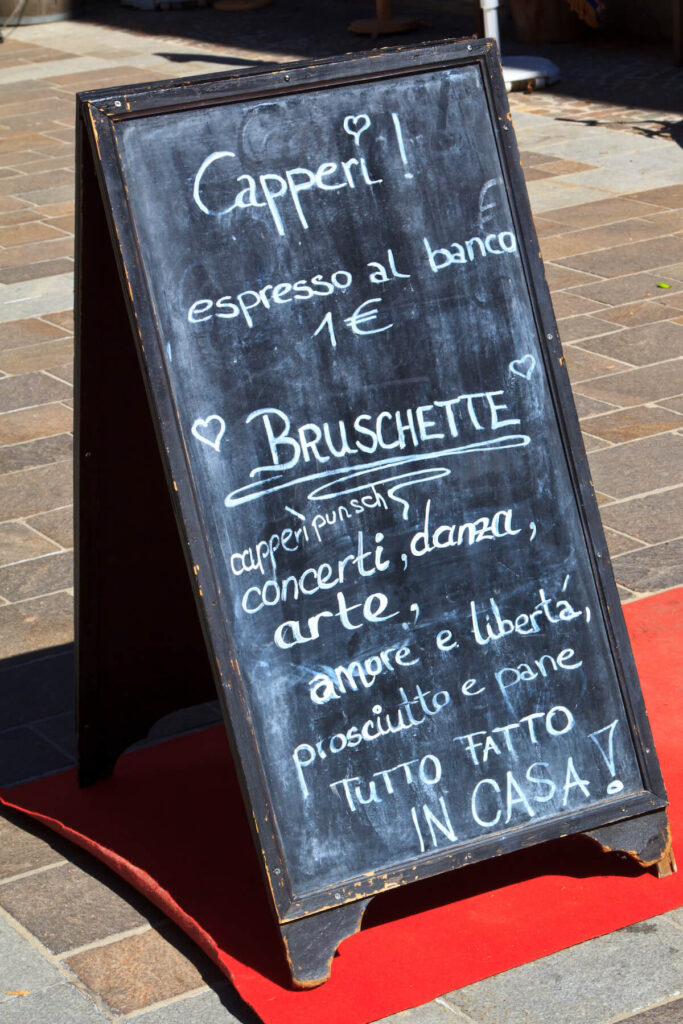
Grossly simplifying, tiny linking words like per (“for”), con (“with”), and il (“the”) are the only Italian words that finish with a consonant.
Then you have words that entered Italian from other languages like film, alcol (“alcohol”), autobus (“bus”), and mais (“corn”), as well as those that still sound 100% foreign like budget, show, and privacy.
Though Portuguese is a vowel-driven language too, words often end with L, M, N, R, X, and Z. Just to have a clearer picture, compare these common Italian words with their Portuguese translations.
| Italian words | Portuguese translation |
|---|---|
| amare (to love) | amar |
| animale (animal) | animal |
| feroce (ferocious) | feroz |
| fine (end) | fim |
| giardino (garden) | jardim |
| naturale (natural) | natural |
| orrore (horror) | horror |
| polline (pollen) | pólen |
| torace (chest) | tórax |
7. In Italian, double consonants are an institution; in Portuguese, they’re nowhere to be found.

Up until the early 20th century, Portuguese spelling was significantly more complex, as words displayed their Latin origin more proudly. Difícil (“hard”) was spelled difficil, much like the Italian difficile, and cavalo (“horse”) was cavallo like in Italian.
In 1911 and 1943, respectively, academia and the governments of Brazil and Portugal decided to get rid of all consonants that weren’t pronounced, in an attempt to streamline written Portuguese.
In Italian, that could never have happened for a simple reason: unlike French, English, and any other Western language that features them, double letters are pronounced. That allowed Italian to remain true to its source once again, as in the words in the table below:
| Italian word | Portuguese translation |
|---|---|
| anno (year) | ano |
| bello (beautiful) | belo |
| camminare (to walk) | caminhar |
| capelli (hair) | cabelo |
| cocco (coconut) | coco |
| frutta (fruit) | fruta |
| gatto (cat) | gato |
| latte (milk) | leite |
| notte (night) | noite |
| oggi (today) | hoje |
| sette (seven) | sete |
| zuppa (soup) | sopa |
8. Word stress is a bit easier in Portuguese.

English speakers are used to random word stress and, in fact, don’t typically fret too much about it. Proof of that is how the stress of words like “electoral” and “laboratory” changes depending on where you go.
In Romance languages like Portuguese, Spanish, and even French, however, many words are assigned a diacritic to mark the strongest syllable. If you memorize the intricate rules behind diacritics, you’ll always know how to pronounce a word.
For instance, the stress of jovem (“young”) is on the first syllable, because otherwise, it’d need an acute accent like também (“also”). Conversely, órfão needs a diacritic on the O or it’d be pronounced like fogão (“stove”).
Read more: Portuguese Accent Marks Explained: A Guide to Portuguese Pronunciation
In Italian, only the last syllable of a word is marked with a diacritic, as in lunedì (“Monday”), città (“city”), and affinché (“in order to”). So you’ll simply have to know that principe (“prince”) is pronounced /prìncipe/ while solitudine (“loneliness”) is read /solitùdine/.
Check out the table below and you’ll know how the same words in Italian usually give you a much harder time learning the stress relative to their Portuguese equivalents.
| Portuguese word | Italian translation with stress key |
|---|---|
| câmbio (exchange) | cambio [/càmbio/] |
| fácil (easy) | facile [/fàcile/] |
| hélice (helix) | elica [/èlica/] |
| história (history/story) | storia [/stòria/] |
| judiciário (judicial) | giudiziario [/giudiziàrio/] |
| órfão (orphan) | orfano [/òrfano/] |
| polícia (police) | polizia [/polizìa/] |
| sociedade (society) | società |
| táxi (taxi) | taxi [/tàxi/] |
| tribo (tribe) | tribù |
9. The simple past is a compound tense in Italian.
Take a look at the following sentences and you’ll notice one of the key differences between Portuguese and Italian:
- EN: I went to the beach last week.
- PT: Eu fui à praia semana passada.
- IT: Io sono andato al mare settimana scorsa.
- EN: We had dinner early yesterday.
- PT: Nós jantamos cedo ontem.
- IT: Noi abbiamo cenato presto ieri.
To conjugate the so-called passato prossimo, you’ll need to know the past participle of a verb and which auxiliary between essere (“to be”) and avere (“to have”) you should be using, much like in French.
In Portuguese, it’s a seemingly simpler affair. Yet verbs are conjugated according to six persons, and tons are irregular.
You do have a more compact past tense in Italian, the passato remoto. So the sentences above could be written as Io andai al mare settimana scorsa and Noi cenammo presto ieri. But normally the passato remoto is only used in literary contexts or informally in the South of Italy.
10. Portuguese is more flexible regarding object pronouns.

“Flexible” is perhaps an understatement; in Portuguese, we don’t really care too much about object pronouns.
For example: if we were to ask Você entregou (or Tu entregaste) o presente ao Pedro? (i.e. “Did you hand the gift to Peter?”), we’d typically reply Sim, entreguei. (literally “Yes, I handed [it to him]”).
In Italian, a similar reply wouldn’t make much sense. The question Hai consegnato il regalo a Pietro? would necessarily call for Sì, gliel’ho consegnato. for a response, where gliel’ stands for the contraction of the pronouns gli (“to him”) and lo (“it”).
Technically, these sorts of contractions also exist in Portuguese. The equivalent of gliel’ would be lho (lhe + o). However, that’s rarely used in Portugal and basically unheard of in Brazil.
Also read: Portuguese Pronouns: A Complete Guide for Language Learners
Final thoughts
These are all the major differences between Portuguese and Italian, but the more specific you feel like getting, the more distinctions you’ll come across.
Whether you want to learn Italian or learn Portuguese, knowing what sets these two languages apart will help you decide which you like better and want to master asap — even if you eventually end up studying both!
Key differences between Portuguese and Italian – Pin it!


Bravo! This is very helpful. I speak Portuguese and find myself frustrated by Italian