
Brazilian poet Olavo Bilac once hailed Portuguese as “the last flower of Latium, rustic and beautiful”. While it does sound sweet and mellow, my native language is also filled with suggestive and poetic words and phrases that foreign students typically love to learn.
So today I’ll give you a list of the most beautiful Portuguese words and sayings I could think of. It should either inspire you to learn Portuguese once and for all or keep you hyped to master it in case you’ve already taken your first steps in the language.
Vamos lá?
Beautiful Portuguese words that lack an accurate translation in English
1. Saudade
I had to start off our list with the one word Portuguese speakers are always proud to say only exists in their language. Saudade is a bittersweet mix of longing and nostalgia that features prominently in both our daily life and all of our literature and music.
Even though experiencing saudade can be sad and even make you cry, the feeling is revered as an essential part of our lives and relationships. It speaks volumes about this wistful identity of the Portuguese that Brazilians inherited to some extent.

2. Cadê
Cadê is an authentically Brazilian expression that stands for “where is…?”. It derives from the ancient que é de…?, which roughly means “what happened to…?”.
We do have the longer, standard version of the question, i.e. “onde está…?”. Yet cadê is way more common in everyday usage.
3. Cafuné
A cafuné is a caress on someone’s head, typically with a gentle finger-snapping movement. Pretty Brazilianly specific, huh?
4. Calorento v. friorento
Society has two kinds of people: calorentos and friorentos. If you’re particularly sensitive to heat, then you’re calorento (from calor, i.e. “heat” or “warmth”).
In case the cold bothers you more easily, you’re friorento (from frio, meaning “cold”). And there’s absolutely no middle ground!

5. Caprichar
One of the definitions of the noun capricho is precisely “caprice”, but the word is more frequently used to describe special attention to detail.
If you order a sandwich “capriciously” made, or no capricho, you’re making sure all of the ingredients will come in abundant portions.
So the verb caprichar means something like doing your best to ensure the best possible end result for whatever you’re doing.
6. Dengo
Dengo is a tricky one because it can be used as a pet name or as a general synonym for caress. Yet originally it means a sort of harmless and tender manipulation that a small child can try on their parents (or that you and your SO have probably used with each other aided by your cutest baby talk).
7. Enrolado
The literal translation of enrolado is either “rolled up” or “wrapped around”. But the word can also be used to describe two different things: when you’re snowed under with e.g. work or when someone you know can’t really be trusted because they’re such a mess.
8. Ouvido v. Orelha
This is a distinction I’ve only ever heard in Portuguese and Spanish. Ouvido is the inner part of your ear (the one that hurts), whereas everything that you can see is called orelha.
Food-related Portuguese words and expressions
9. Arroz de festa
Next time you’re invited to a party in Brazil, show up at least half an hour late or you might be called an arroz de festa, or a “party rice”.
While Brazilians are notorious for our lack of punctuality, serious affairs like business meetings normally start on time.
But fun isn’t supposed to be strict! So it’s polite to give hosts some extra time to get everything in order before any get-together. Most people will be over an hour late anyway!

10. Bolinho de chuva
There’s no hidden meaning or exciting story here, just plenty of memories from a Brazilian household.
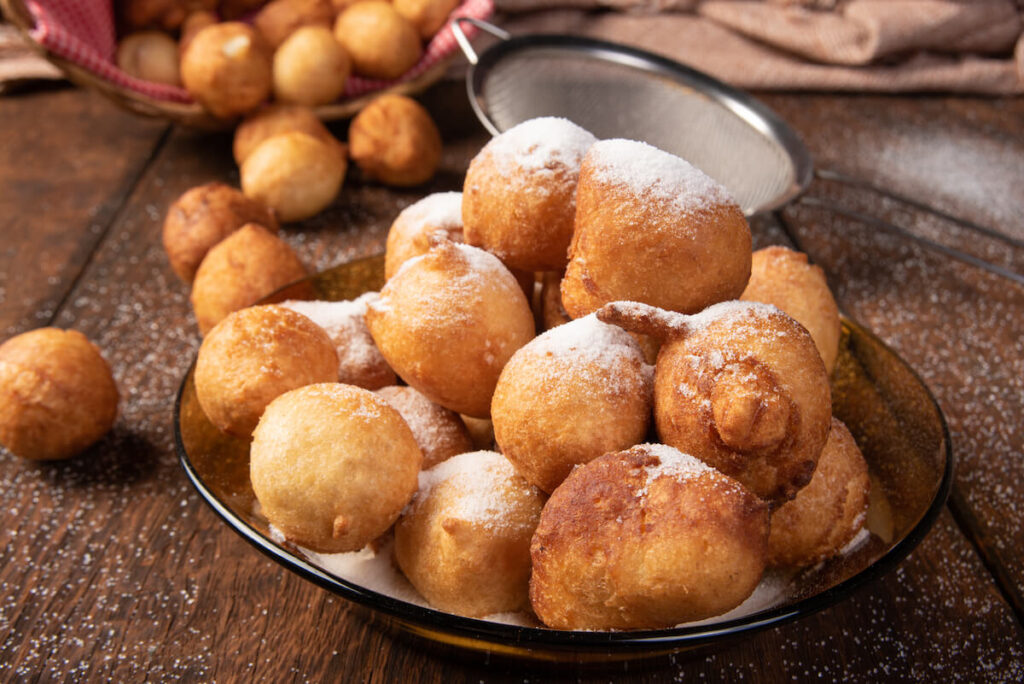
A “rain scone”, which is what bolinho de chuva means, is a simple fritter with sugar and cinnamon sprinkled on top.
That’s one of the mouthwatering dishes your Brazilian granny will have in stock for you when you pay a visit — often regardless of the weather.
11. Chá de cadeira
Giving someone a chair tea is making them wait for a long time. It’s typically used in business situations, like when you’re kept waiting for a meeting.
But you can give someone “a tea” of virtually anything if you want to imply there was a ton of that involved.
12. Chorar as pitangas
Pitangas are cherry-like berries you’ll only find in Brazil and a few neighboring countries. So Chorar as pitangas translates literally as “to cry one’s pitangas“.
We use this expression when someone’s complaining about their own misfortune. It’s usually mildly ironic; it’s almost like saying that person is feeling sorry for themself.

13. Encher linguiça/chouriços
German statesman Otto von Bismarck is thought to have stated that “laws are like sausages; it is better not to see them being made”. This saying seems to concur.
You stuff sausages (encher linguiça in Brazil or encher chouriços in Portugal) when you add fluff to, say, a business presentation. It’s something every one of us does but no one wants to be accused of doing!
14. Plantar bananeira
While doing a handstand is fun, it doesn’t sound as poetic as it does in Portuguese. We actually call it planting a banana tree, which in my opinion is as visually clear as it gets.

15. Toucinho do céu
The best-kept secret of the Portuguese-speaking world is the endless assortment of so-called conventual sweets that you’ll find everywhere in Portugal (and in specialized shops in Brazil).
The recipes for these tantalizing desserts were perfectioned by nuns in monasteries across the centuries. They’re mostly made from egg yolks and a generous amount of sugar with almonds and a handful of other ingredients thrown in here and there for good measure.
Yet apart from tasting amazing, many have also been given deliciously funny names such as toucinho do céu, aka “heaven’s bacon”.
Other great names include barriga de freira (“nun’s belly”), papo de anjo (“angel’s double chin”), travesseiro de Sintra (“pillow of Sintra”) and sardinha doce de Trancoso (“sweet sardine of Trancoso”).

Unique Portuguese greetings and interjections
16. Beleza? Tudo Joia!
This is one of my favorite ways to say “how are you?” in Portuguese. Beleza literally means “beauty”, while joia translates as “jewelry”. So if a Brazilian friend asks you tudo beleza? they’ll wanna know if everything’s good.
Despite sounding a bit outdated these days, joia is still perfectly understood and often used either as a question or as a reply, much like beleza.
17. Vai com Deus! & Fique com Deus!
Whenever someone’s leaving, you can wish them godspeed, or vai com Deus! in Portuguese. A common response would be Fique com Deus!, or “May God be with you!” in a less weird (though Star-Wars-y) translation than the literal “Stay with God!”.
I’d hear these two sayings all the time when I was a kid, yet nowadays it’s mostly seniors and religious folks who use them. A funnier but even less recurrent alternative would be Vai pela sombra!, roughly “Walk in the shade!”.
18. Mano do céu!
While this expression may sound like a not-so-respectful way to address the guy upstairs — it literally translates as “Bro in the heavens!” —, we’re not really talking about Him here.
Do céu is a humorous phrase you can add to a name when you’re about to say something bombastic, as in “Diego do céu, I just won the lottery!”.
Mano, in turn, is how people from São Paulo say “bro”. So Mano do Céu! simply means “Holy sh*t, dude!” or something along those lines.

Funny Portuguese expressions to describe someone
19. Maria-vai-com-as-outras
A “Mary-goes-with-the-other-ladies” is a joiner or a pushover. This is something your mom would definitely call you when you were up to no good with your gang, then happened to get caught.
20. Santo do pau oco
Legend has it this expression originated in colonial times. Back then folks would smuggle gold and cash from Brazil to Portugal inside wooden statues of saints (which is still a typical religious art form in Latin America).
If you call someone a santo do pau oco, or a “hollow-wood saint”, you’re saying they’re phony or, even worse, hypocritical. Though this is not a beautiful expression in the conventional sense, it’s interesting for the image it evokes.
21. Ter o rei na barriga
“To have the king in one’s belly” has nothing to do with eating too much (or maybe actually having the king for dinner?). This expression is used to imply someone is arrogant or conceited.
Apparently, it originally referred to a queen who was expecting the heir to the throne. Since during that time she would normally be more pampered and fawned over than usual, some people would start seeing her as self-important.
Like many other idioms, you won’t hear young people say it often because they think they’re too cool for that. Maybe they have a king in their belly; who knows?
Other beautiful Portuguese sayings
22. A ver navios
If you leave someone hanging, you can say you left them “seeing ships”, or a ver navios in Portuguese. The origin of this one isn’t clear, yet it may be safe to say it has something to do with a passenger who lost their ship back home.

23. Casa da mãe Joana
Joanna I was queen of Naples in the 14th century. She married four times, picked a fight with the pope, and ended up being excommunicated. She then fled her hometown and was eventually murdered.
It’s no wonder that a casa da mãe Joana, or “mom Joanna’s house”, is a messy place — often one where sleazy shenanigans take place. It’s normally used when someone wants to point out theirs is not mom Joanna’s house.
24. Chutar o balde
Kicking the bucket in Portuguese has a far less sinister definition in Portuguese. It means “to lose it” (in a bad way).
One possible origin of this saying is related to cow milking: it seems that an unhappy cow may literally kick the bucket the farmer’s using to collect her milk.
25. Faz-me-rir
“You make me laugh” can mean exactly what it does in English — which ironically is often said (or yelled) when you’re not amused at all.
Yet faz-me-rir is also an amazing slang for “money”. In this case, it couldn’t be closer to the actual definition of cash!

26. Onde Judas perdeu as botas
If something is located in the middle of nowhere, you’ll find it right “where Judas lost his boots”. But don’t waste too much time looking for them!
There are a few variants of this expression, and at least one of them is dirty. I’m sticking to the standard version here because I’m staying true to the “beautiful Portuguese words and sayings” in the title of this post!
27. Tirar o cavalinho da chuva
Don’t ever think someone who tells you to “get your little horse out of the rain” is worried about the well-being of your pet.
Oddly, they’ll in fact be telling you to give up on whatever you’re trying to do. We use it sparingly, however: it’s either too serious or too sarcastic.

28. Vaquinha
When folks chip in for a common cause, they’re “making a little cow” in Portuguese. I really don’t know why a kitty is called a vaquinha in Portuguese.
Given piggy banks are a thing in the Portuguese-speaking world as well, it would make a lot more sense to call it a porquinho (or a “piglet”).
Conclusion
One of the things I love the most about learning a new language is how you slowly but surely come to accept as natural all the nonsensical and one-of-a-kind sayings. That may even make you realize how your own native language also often defies all logic.
So hopefully this list will help you see that tons of words and expressions in Portuguese, stunning as they may sound, can’t actually be explained away. Just enjoy the coziness and warmth their meaning gives off and apply them in context if you can!
You can also learn funny Portuguese phrases or impress your friends with these cool Portuguese words.