
This article may contain affiliate links. As an Amazon Associate, I earn from qualifying purchases. For full information, please see the disclaimer here.
Maybe it’s BTS. Or Parasite. Or Squid Game. If you are learning Korean, you’ve likely started because of Hallyu or the Korean Wave that has and continues to take the world by storm.
Aside from pop culture though, there are lots of other reasons to study Korean. From helping you land an international career to making you smarter, learning Korean has a long list of benefits. It’s not an exaggeration to say that it’s one of the best languages to learn for the future.
It then makes sense to look for a Babbel Korean course. Babbel, after all, is one of the best language learning apps in the market. Alas, the language is not (yet) part of Babbel’s roster.
Lucky for you, fellow Korean learner, you’ve still got several great options! Let’s take a closer look below.
What is Babbel?

First off, what is Babbel and why do I wish the app offers a Korean course?
Babbel, as I’ve said in this review, is one of the best apps I’ve used. Using real-world conversations voiced by native speakers, users can learn to read, write, speak, and understand a new language quickly. Combine this with the app’s effective SRS review system and you’ve got a gem in your hands.
Babbel doesn’t skimp on exercises that target all core skills. You will be asked to type and spell correctly, pronounce words as close to the native accent as possible, match images with the right words, and so on. There are even stories, games, and podcasts to keep you engaged.
What’s more, Babbel courses cater to learners of all levels. You can be a complete newbie or an advanced learner who needs some refresher courses — you’d benefit from the app either way.
The downside is that Babbel has a mere 14 languages on offer, most of which are European languages.
The best Babbel alternatives
And that is why we look for alternatives. There’s no Korean on Babbel but there are plenty of Korean learning apps at your disposal. For starters, these are three that can help you quickly learn Korean.
1. Mondly

Quick, fun, and effective. These are three words often associated with the best-selling app Mondly. It takes only 10 minutes per day to get started. But those 10 minutes would feel too short because of how enjoyable Mondly’s lessons are!
Mondly helps improve reading, listening, and speaking skills through dialogues and audio guides featuring native speakers as well as chatbot conversations. While Mondly Korean doesn’t explicitly teach Hangeul, the Korean alphabet, it can help you be more familiar with the characters.
A feature that I like is the leaderboard. This does not directly teach you any Korean but if you’ve got a competitive streak in you, you’ll get lots of motivation from beating other learners on the app.
Check out this comprehensive review of Mondly for more deets. Better yet, sign up and get complete access to Mondly’s lessons at a discount!
Key features:
- Quick, enjoyable lessons
- Teaches the basics through simple but relevant vocabulary
- A well-rounded set of exercises
2. Pimsleur

Try Pimsleur Korean for FREE today
The standard Korean language is syllable-timed, meaning each syllable is spoken with the same amount of stress. This is different from English, which is a stress-timed language. Also, while Hangeul is easy to learn, the pronunciation of basic, aspirated, and tense consonants is a common stumbling block.
All this to say that spoken Korean requires a different set of skills. You’ll naturally want an app that can help you improve your pronunciation, nail that accent, and gain confidence in speaking. Pimsleur is your best bet.
Pimsleur is the best Babbel alternative if you like audio lessons that can get you speaking from day one. It features native Korean speakers for authentic and immersive listening and speaking practice. No more awkward sounds and weird rhythms!
Find out why I love Pimsleur with this in-depth review. You can also try this app for free!
Key features:
- A well-established and science-backed technique of learning languages
- Learn authentic pronunciation and accents from native speakers
- Relevant themes and topic categories
3. Rocket Languages

Learn Korean on Rocket Languages
If learning how to write Hangeul is a top priority, Rocket Korean is the app for you. Although Rocket Languages is mostly audio-based, it has a feature that many beginners will find useful: writing lessons.
The course teaches the Korean alphabet in pairs via video lessons. As for the audio lessons, you can learn greetings, basic words, and commonly used phrases — all with high-quality pronunciation guides and the option to record yourself.
What’s more, this app hits the spot when it comes to politeness levels, honorific titles, and informal speech. Knowing these and getting the cultural context gives you a firmer grasp of the language.
I reviewed Rocket Korean here. Find the latest Rocket Languages promo for big savings!
Key features:
- A comprehensive program that covers all core skills
- Ample downloadable audio content and extensive writing lessons
- Includes levels of speech and cultural insights
Other great resources to learn Korean
I think the best thing about learning Korean is that it’s so easy to find Korean learning resources online. Apps, Korean learning books, online courses and tutors, YouTube channels, podcasts — you name it, you can easily find it! Here are some of my favorites:

Preply: Whether you need beginner lessons, conversational practice, or intensive classes on grammar, you can find highly-rated and reliable Korean tutors on Preply. Plus, if you’re not satisfied with your trial lesson, Preply gives you a free replacement with another tutor or a full refund.
Ling app: Learn Korean through quick, bite-sized lessons and engaging mini-games. It’s perfect for building a consistent learning routine. You can practice all four language skills, with native speaker audio for pronunciation, plus a clever chatbot feature
italki: For more tutor options, go to italki, where you can find hundreds of certified Korean teachers to get personalized lessons from. Simply filter them by location, lesson price, lesson type, and schedule.

Cudoo: For beginners with no background in Korean, Cudoo’s three-level curriculum is ideal. Learn common expressions like self-introduction, asking for directions, talking about food, and more. There’s also a Business course which teaches lessons on business terms, banking and accounting, and phrases for business travel.
LingoDeer: Korean was one of the first courses that LingoDeer launched, so you can say that it’s one of their more developed offerings. Here, you can learn Korean vocabulary, grammar, pronunciation, Hangeul, and culture through short but informative lessons.
Rosetta Stone: This time-tested app teaches Korean using its famous Dynamic Immersion method, where you learn with zero translations, relying on pictures and context instead. This process forces you to start thinking in Korean right away. The course includes real-life scenarios and the important TruAccent speech recognition feature, which listens to you and helps you perfect your pronunciation against native speakers.
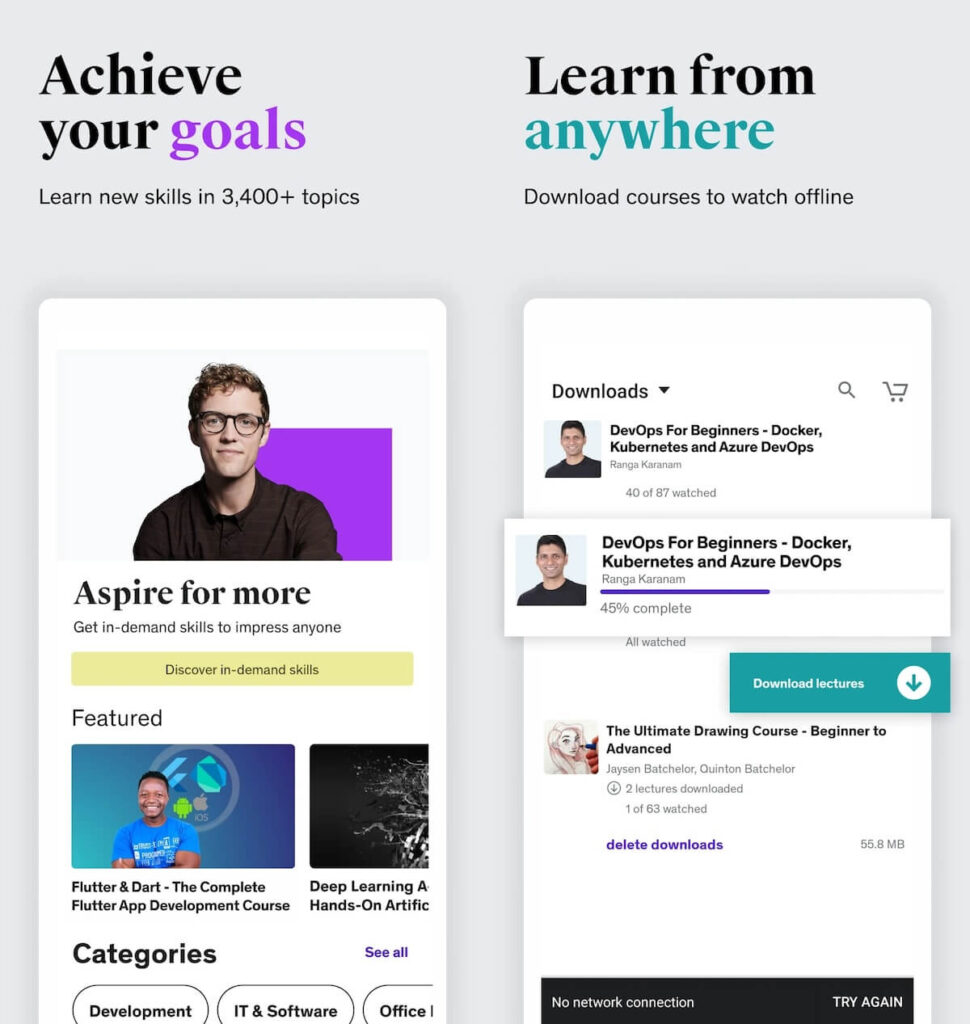
Udemy: This popular site has tons of on-demand Korean video courses taught by different, real-world instructors. You can find options for everything from mastering the Hangeul alphabet to advanced conversational fluency. The best part? You can learn at your own pace!
Lingopie: Pick from a collection of dual-subtitled Korean TV shows and movies, click on any Korean word, and learn the word’s meaning and pronunciation. You can even save your favorite words and turn them into flashcards!
Talk To Me in Korean: TTMIK is a multimedia resource for Korean learners. It has a series of bestselling paperbacks, eBooks, audio downloads, an audio app, a podcast, free and paid online courses, and a popular YouTube channel. TTMIK is also pretty generous as many of its contents are available for free and cater to all learning levels.
How to Study Korean: An oldie but goodie, this website is a one-stop resource for learning Korean for free. The course starts with writing and reading lessons and then dives into vocabulary and grammar. It’s not the most visually-appealing course out there (you’d have to read long pages of text) but it’s one of the most comprehensive. I first learned Hangeul from this site and I can’t recommend it enough!

Tandem: Another great way to learn from locals is through a language exchange app like Tandem. With this free app, you can find a native Korean speaker who can help you go beyond 안녕하세요 (annyeonghaseyo)and 감사합니다 (kamsahamnida). The catch? You’ll have to help him/her learn your native language, too.
Talkpal: This powerful AI language app focuses on helping you achieve fluency in Korean through realistic conversation. Using GPT technology, it lets you chat with an advanced AI via voice or text in diverse scenarios, like a mock phone call. It’s all about active speaking practice, and you get real-time feedback on your grammar and pronunciation to help you improve rapidly.
Memrise: I used Memrise to memorize Hangeul back when the app was still known for ‘mems’ (mnemonics, images, and funny texts that aid memory). It has since become an app to learn languages with videos and audio clips featuring local speakers. Different methods but still an excellent app to learn Korean.
No products found.
Korean Made Simple by GO! Billy Korean: One of the most popular resources to master Korean, this book packs over 1,000 vocab words and phrases in 20 in-depth lessons. There are three books in the series catering to beginners and intermediate learners. The website is also very helpful!

Netflix: Although not a learning tool per se, Netflix is a big platform that carries lots of Korean films and shows. No one will dare accuse you of being a couch potato if you say you’re ‘immersing in the language’, right?
Conclusion

A Babbel Korean course would have been a great tool to learn the language. But the above apps and resources are just as great, and maybe even better at achieving your goals.
At the end of the day, these resources can only help you achieve fluency if you’re also willing to put in the hours. The best apps and tools, along with motivation, immersion, and discipline, will get you there. And while on it, don’t forget to have fun!