Arabic is a fascinating and incredibly rich language that has consistently distinguished itself as one of the most popular among language learners. But how much do you know about the Semitic family’s most world-famous member?

From the thought-provoking to the unexpected and from the fun to the obscure, I’m sure that many of today’s true Arabic language facts are going to only reinforce your enthusiasm for learning this one-of-a-kind tongue!
Without further ado, let’s get right to it!
General interesting facts about the Arabic language
1. Arabic counts a whopping 360 million native speakers

It’s true! This huge figure puts Arabic in the top five of the most widely-spoken languages in the world (and one of the best languages to learn for the future).
In addition to the roughly 360 million native speakers, there are also between 250 and 275 million people worldwide who speak Arabic as a second language. That makes for more than 500 million Arabic speakers, all in all!
2. The Arab diaspora is one of the world’s largest
Of course, plenty of the world’s languages with the highest number of speakers, like Mandarin for instance, are highly localized: the vast majority of their speakers reside in one particular area. Not so with Arabic!
There are few countries worldwide without at least a minor Arabic-speaking diaspora community. For example, did you know that there are a whopping two million people who self-identify as Arab living in Argentina? While not all of these people will be fluent in Arabic or speak it as their first language, many do.
That means there’s probably no need to fuss over finding a study buddy, a tutor, or a language exchange partner for learning Arabic wherever you may live!
3. Arabic is so much more than one language

I don’t merely mean this in the social sense. Yes, Arabic as a language forms a large part of Arab identity for hundreds of millions of people around the world – more than just a means of communication, it’s a gateway to an entire culture and way of life!
However, Arabic is also more than a language in a literal sense. Actually, it’s a whole bunch of languages! While there exists a standardized form of Arabic based on the Quranic language, called Fusha by most speakers, this is not the native language of most Arabs.
Instead, the vast majority of native Arabic speakers communicate in a vernacular dialect native to the place they’re from. Foreign linguists tend to put these dialects into just a few groups – the languages of Lebanon, Syria, Palestine, and Jordan are often called “Levantine Arabic”, for example, because they all share some strong similarities.
However, in truth, Arabic dialects are incredibly diverse. Some towns have their own unique dialects that might be nearly unintelligible when compared to faraway dialects from other towns in the same country!
Of course, when in doubt, any two Arabic speakers always have Fusha to fall back on. That’s why studies generally treat all “Arabic speakers” as one group, even though someone from Morocco may have a different mother tongue than someone from Saudi Arabia!
4. Arabic is one of the working languages of the United Nations

Arabic, specifically Modern Standard or Fusha, is one of the official languages used in all written and spoken communications of the United Nations, both internally as well as in material available to the general public.
Unlike the other five – Chinese Mandarin, French, Russian, English, and Spanish – Arabic did not become official neither in the 1920s under the League of Nations nor in 1945 at the time when the modern-day UN was formed. Instead, it was added much later in 1973, owing to the growing geopolitical importance and the vast number of native speakers in the Arab world.
5. It’s also an official language in 22 countries

This amazing figure makes Arabic one of the most institutionally widespread languages on the globe, more common than Spanish and close behind French with its 29 countries and territories.
However, none of these can match the status of English, which is recognized as an official and/or state language in an unbelievable 67 territories!
6. Arabic uses its own script

Though it’s part of the Semitic language family, meaning it shares a lineage with languages like Hebrew and Amharic, Arabic uses a unique script not shared with its linguistic siblings.
The Arabic alphabet has 28 letters and is written right-to-left (like the scripts of other Semitic languages) in a standardized cursive style that is relatively uniform across the Arab world.
According to most counts, the Arabic script is also the second-most used across the globe, right behind Latin!
7. Many languages have adopted words (or much more) from Arabic

Whether you like your morning coffee with a pinch of sugar or prefer some fine alcohol, and whether you’re wearing clothes made of cotton or satin, you already know a bunch of Arabic words! Through the Arab world’s immense political influence over the centuries, especially via trade and diplomatic relations with Europe, tons of Arabic words have entered languages like English and French.
However, Arabic contact with foreign languages goes much further than that. Some languages, like Farsi and Urdu, were so heavily influenced by their interactions with Arab nations and the religion of Islam that they adopted the Arabic writing system for their own language!
A similar thing happened with the Turkish language, which for centuries under the Ottomans used a modified Arabic alphabet before switching to Latin in 1928.
Where these languages adopted the writing system whilst keeping the sounds and words of their own native tongues, elsewhere the opposite occurred. Sicilian, Catalan, Bengali, and many other languages from around the globe have adopted massive amounts of Arabic vocabulary over the centuries, to a much higher extent than comparable regional languages with which they are more linguistically related!
8. The Arabic script does not have any capital letters
Unlike the modern Latin script I am using to write this article, and very much like some other scripts like those used for Hebrew or Japanese Kanji, there is no such thing as uppercase or lowercase in Arabic.
By ruling out so many pesky spelling mistakes that are possible in languages which are case-sensitive, this really does make life easier, doesn’t it?
Fun facts about the Arabic language and its grammar
9. Arabic letters are not always as they appear
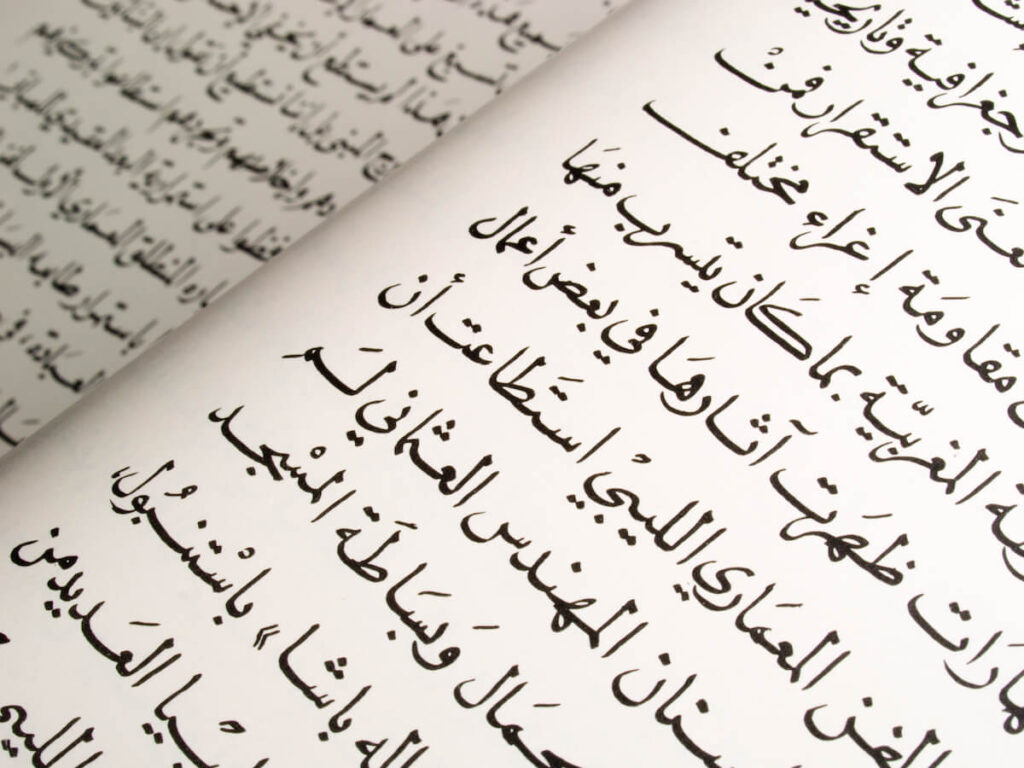
As I mentioned just before, Arabic only exists in a cursive script that looks more or less uniform whether handwritten or typeset. Part of what makes this cursive-only style so special is that all of the Arabic letters exist in a handful of different forms.
That is, letters in Arabic change shape depending on where they are placed inside each word.
These changing shapes ensure that all Arabic words maintain a certain visual “flow” – pay close attention, and you’ll notice that almost all the letters smoothly connect to their neighbors to the left, a fact that’s made possible by this shape-shifting system.
10. The Arabic alphabet knows no vowels
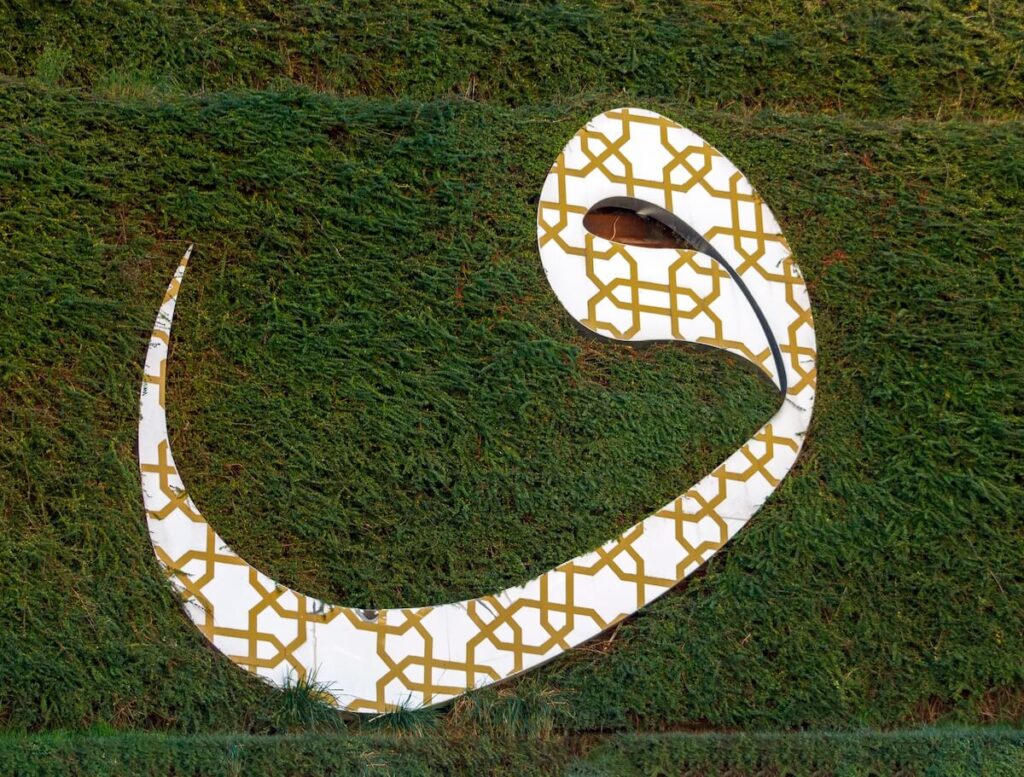
While it’s fairly common to refer to the Arabic writing system as an alphabet, some nitpicky linguists would rather have you call it an abjad instead.
An abjad is a distinctly Semitic kind of writing system where letters represent consonants, but not vowels. Just like in Hebrew, a fellow abjad, Arabic has a few auxiliary diacritic markings that you can use to “spell out” the vowels in a word.
However, outside of religious scripture and specific contexts (like preventing confusion between very similarly-spelled words), these markings are rarely used. This means that you need to know the vowels of Arabic words in order to decipher the consonant-only spelling.
11. Arabic utilizes a Semitic root system
As for how native speakers manage that feat, it’s got to do with another uniquely Semitic grammatical feature of the Arabic language. Arabic uses a so-called root system, where pretty much every word corresponds to a “root” base of three (sometimes four) letters.
You can imagine these letter-roots as a sort of “word family”. Two words in the same root will share a certain relationship with each other; for instance, the words meaning “book” and “writer” share the same root.
Roots don’t just make learning Arabic vocab a very unique experience. They also govern its vowel system. Every root can fit into a certain number of patterns which determine the class of the word (verb, adjective, noun), its tense, and more.
It is the root-pattern combination that determines where the vowels go, meaning all you need to know are the basic pattern “templates” and what they look like in order to predict the vowel structure of any Arabic word. Neat, huh?
12. There is a long-standing debate about the number of words in Arabic

Myths, legends, and academic debates continue to spread throughout the Arabic-speaking world concerning the number of words in the language. Arabic is known for being very rich and expressive, but how hard can it be to put a number on its lexicon, you ask?
Turns out it’s very difficult indeed. Several different approaches have been taken – some include adding up all the possible combinations of vowel patterns and consonant roots, others are more conservative and only include the combinations that are legitimately in use, or have been at certain points in time.
Part of the debate also includes the question of how to count different words for the same thing shared across the huge number of Arabic dialects, or whether to only consider Fusha vocabulary.
Depending on whom you ask, then, Arabic has anywhere from 100,000 to a few million words!
Facts about the Arabic language history
13. Arabic has picked up countless influences as it spread
Of course, it’s impossible to spread across a vast stretch of the globe like Arabic has without picking up something from the native languages of the regions it came into contact with along the way.
The Arabic dialects of just about every country contain countless influences from various other languages. For example, the variants of Arabic spoken throughout the former Ottoman empire, like Jordanian and Syrian, contain a lot of Ottoman Turkish and Aramaic influence.
Palestinian Arabic has understandably adopted a lot from Hebrew. Meanwhile, Moroccan and Algerian still experience lots of loanwords and expressions borrowed from French, a nod to their colonial past, in addition to a unique pronunciation and grammar structure that heavily draws on the Berber languages of North Africa.
Egyptian likewise contains a lot of European loanwords – many French ones, but also some Italian ones. For example, take a look at the word for gloves, جوانتى, which sounds almost identical to the original guanti. However, Egyptian Arabic is special in that it also has a large vocabulary base consisting of Coptic words, descendants of the ancient Egyptian language of classical times!
14. Some “cousins” of Arabic remain elsewhere in the world today

There are many languages that retain a close relationship with Arabic, even if they are not formally considered dialects.
These languages are much more closely related to Arabic than other living Semitic languages such as Hebrew, but they maintain different grammatical features, pronunciation, and vocabulary.
Maltese, for example, is a direct descendant of an older North African form of Arabic which, upon its arrival and development on the small island of Malta, blended with both Arabic varieties of Sicily and the local Italian languages spoken there.
Malta was eventually forcibly re-Christianized during the Middle Ages, which meant that the Maltese language would go on to exhibit very heavy Latin influences, going as far as adopting the Latin alphabet for its written form. According to many modern-day estimates, Maltese the way it’s spoken today actually contains more Italian and Latin vocabulary than Arabic-derived words!
15. Egyptian became the most widely-understood Arabic dialect in the 20th century

The lingua franca of the Arab world by definition is Fusha, taught at public schools in every Arabic-speaking country. However, if you restrict yourself to dialects alone, then the most widely-understood variety of Arabic by far is Egyptian.
That might sound a bit odd at first glance, considering that Egyptian Arabic doesn’t have so much in common with the Mashriqi (Eastern) dialects like Iraqi or Syrian. Nor is it at all similar to the Maghrebi (Western) dialects like Moroccan, Libyan, or Tunisian.
The dominance of Egyptian in the Arab world is a lot more political in nature than purely linguistic. During the 20th century, especially following the Egyptian revolution, Egyptian music, theater, and cinema were aggressively exported all throughout the Arab world.
Under its leader, Gamal Nasser, Egypt saw itself as the up-and-coming leader of a so-called pan-Arab union. Making Egyptian culture and entertainment a regional standard was an important aspect of that grand plan.
Whilst the politics of North Africa and West Asia have changed significantly since then, Egyptian soap operas still run on every major channel from Casablanca to Baghdad!
Fun facts about the Arabic language
16. Arabic calligraphy is a highly revered art form
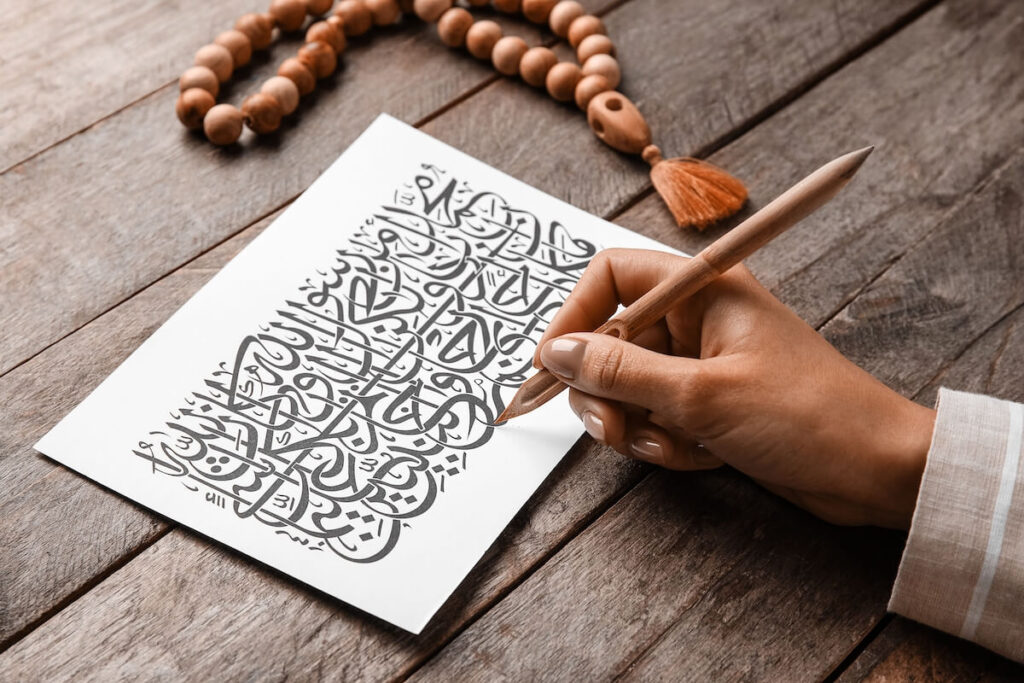
If you’ve ever handled a physical copy of the Quran, you are probably familiar with the look of highly ornamental, classical Arabic calligraphy, which is often used for the cover pages of Islamic literature.
Arabic calligraphy remains one of the most well-respected forms of Arab art, only trailing poetry by a small distance! Due to the inherently cursive nature of the Arabic script, very creative arrangements of letters and words are possible, which continues to inspire countless artists to this very day.
17. Its unique sounds are a matter of pride and frustration in equal measure

Arabic contains a number of sounds that are not readily found in other languages. For example, the letter ح, which is an emphatic H-like sound produced in the back of the throat, is shared only with a few other Semitic languages.
However, the rarest of all Arabic phonemes is ص, usually transcribed as “Ssad” in English. Its sound is like a very emphatic S – close to being a “ts”, but not quite! The Ssad is so unique to Arabic in particular that “the language of the Ssad” has become a popular way for Arabs to refer to their mother tongue!
18. Arabic is one of the hardest languages to learn
While determining how difficult a language is to learn is no easy task, some have tried – and Arabic comes out on top.
At least according to the Foreign Service Institute, which trains American diplomatic officials for missions overseas, Arabic is one of the hardest languages in the world for native, monolingual English speakers to learn.
Lots of factors combine to determine this rating, ranging from Arabic’s unique script to its Semitic root system, unique pronunciation, and many of the other features we have looked at today!
Don’t despair though: no matter how hard the FSI says it is, no language, even one as rich and daunting as Arabic, is too difficult for anyone to become fluent in!
19. You have Arabic to thank for math class

It was the ancient Arabians who pioneered a lot of the mathematics that we use today. Many of our most fundamental mathematical concepts, such as the use of the number 0, were first described by Arab scientists and mathematicians.
As you can imagine, plenty of words relating to maths and sciences also entered English via Arabic, including, funnily enough, mathematics itself in addition to algebra!
20. …And yet, Arabic uses its own, unique numerals

Your old middle school teacher might have introduced them to you as Arabic numerals, but the numbers we use in our everyday life in most of the world (1, 2, 3, 4, 5…) are actually not the only ones found in the Arab world!
All of the so-called Arabic numerals ultimately stem from the Hindu number system, with their physical appearance changed and adapted by Arab scribes. Our Western Arabic numerals emerged in North Africa and Spain over 1,000 years ago, and they are the most common variant in the world today.
In most Arabic-speaking countries, a different, so-called Eastern Arabic numeral system is used, however. Even though all the numerals themselves are one-to-one equivalents of the Western ones, the transition can still be a bit messy for those moving to Arab countries for the first time!
Conclusion

I hope you found these facts about the Arabic language as fascinating as I did! The sheer richness and the many intricacies of Arabic are but some of the many things that keep motivating me to study this beautiful language.
Even if the number of dialects and the learning curve can be a bit intimidating at first!, its spiritual, political, and cultural significance, as well as the beauty of its song, poetry, and art only make the choice to learn Arabic so much easier.