
With over 400 million speakers, Arabic is not just one of the most widely-spoken languages on the planet – it is also among the most popular targets for language learners.
The reasons why one might study Arabic are plentiful, but many who are interested in this beautiful and rich language are put off by claims of how difficult it is.
But why is Arabic hard to learn? Is there any solid reasoning backing these kinds of claims? And should you reconsider your learning goals accordingly?

Precisely that is going to be the topic of today’s guide. Let’s take a look at all that makes Arabic so unique and narrow down exactly what it is about this language that does or does not make it a challenge to pick up!
Why no language is hard (or easy) to learn

Before we dive more deeply into the elements of the Arabic language, let’s take a step back. What are we asking about when we say “Why is Arabic so hard to learn”?
The idea that languages can be easy or difficult depending on certain features sounds intuitive – unfortunately, it is by no means grounded in some kind of objective reality.
Around the globe, children pick up the language of their parents (and sometimes one or more on top of that) in the same way. Hence, there are no standardized criteria you could use to measure how difficult a language really is.
Now, I am not saying this to conclude that difficult (or easy) languages are an illusion.
Rather, it’s to show how ultimately, how hard it will be for you to learn Arabic or any other foreign language is up to you – your existing knowledge, skills, environmental factors, learning style, and most importantly the other languages that you already know.
The following points will explore some of the aspects of Arabic in particular that demonstrate this relationship between the language, the learner, and the sense of difficulty.
Why is Arabic hard to learn?
1. Arabic is (probably) unrelated to the languages you are familiar with
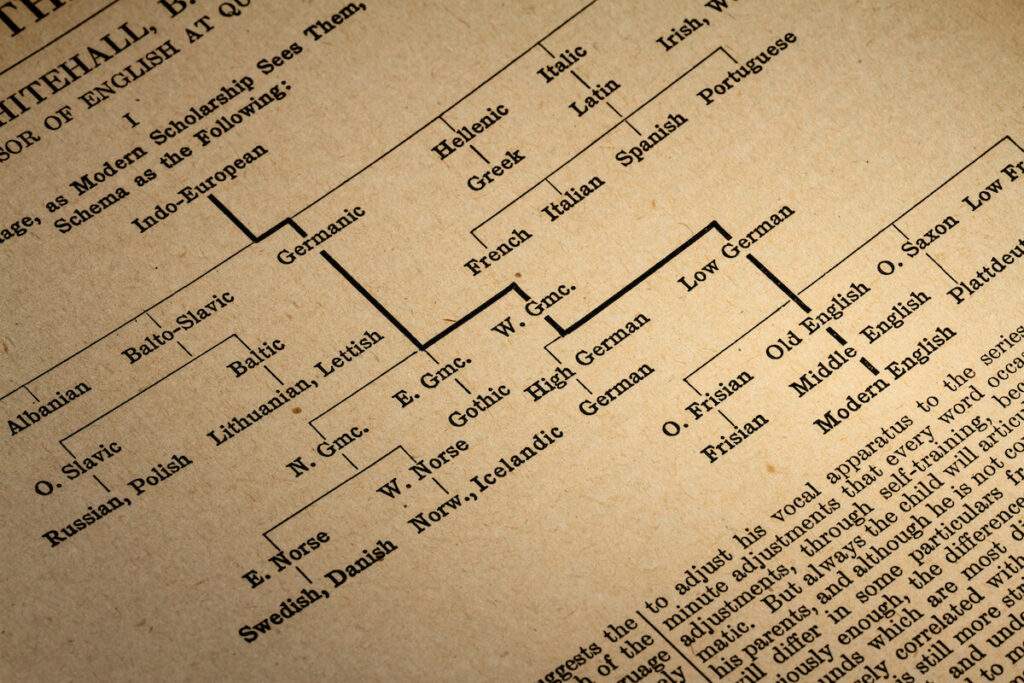
Here’s an interesting question: why do English speakers pick up Spanish so easily, often reaching a conversational level within a few months, but the same doesn’t happen often with Arabic?
The answer has to do with the way languages are related to each other. Both Spanish, a Romance language, and English, a Germanic language, are part of the wider Indo-European family.
This is a so-called primary language family, meaning that it does not belong to any larger families. Every Indo-European language therefore directly descends from one common ancestor.
By comparison, Arabic is part of an entirely different primary family, the Afro-Asiatic one. This alone means that most of the logic and structure you might be used to from Indo-European languages flies right out the window.
But that’s not all – even if you do know an Afro-Asiatic language already, it won’t help you a whole lot! This is because Arabic is the only member of its little subfamily.
Hebrew, while probably the closest language to Arabic still spoken today, does still belong to a different branch of the Afro-Asiatic family, called Canaanite.
The same goes for Amharic – it is found in the Ethiosemitic sub-family, again related to but distinct from Arabic.
Long story short, Arabic is fairly isolated, even compared to some of its closest relatives. So, no matter where you’re coming from, it is very likely to feel fresh and unusual, and leave you little of a reference frame to work with!
Also read: 20 Fun Facts About the Arabic Language
2. The Arabic script is cursive-only

To really master the Arabic language, it’s necessary to at least have a working grasp of the writing system. This is another point where many people run headfirst into a wall – the Arabic script can be quite tough to read and write fluently!
There are a few separate reasons for this which we will all go into today, but the first and most serious one is that Arabic is written and read only in a cursive script.
Learning not only to write but also to read in this elegant longhand can be confusing for those who don’t really use similar cursives in their daily lives. This is especially true because the shapes of many Arabic letters change depending on their position in each word.
That sure helps aesthetically, but it can be a nightmare for new learners to wrap their heads around!
3. Arabic is a gendered language

Many of the world’s languages have no concept of grammatical gender. Others, like German for instance, have three: a masculine, a feminine, and a neuter!
Arabic strikes a balance here with only two genders, masculine and feminine. However, the way it uses these grammatical genders is different even from Romance languages like Italian that, on paper, feature the same division.
In Arabic, not only does every noun have its own gender – the plural endings (and endings for the genitive case, for example) are also completely different depending on whether it is masculine or feminine! And what’s more, the same goes for verb endings and adjectives, too!
Because of this, there are four ways to say “I am talking to you” in Arabic, depending on your gender and that of the person you are addressing. Actually, there are eight if you consider that “you” can be both singular and plural in English, whereas in Arabic there are separate words for that!
It’s understandable that many beginners struggle at first with this mechanic – if you’re not used to it, it adds a whole lot of complexity to an already dense language.
4. Wht, n vwls?

This is another crucial way in which the Arabic writing system differs from Latin, for example.
Instead of having every sound in the language mapped to at least one of the letters, Arabic only really uses the letters for expressing consonants. The vowels are left out!
At first, this can seem really counterintuitive. How are you supposed to know how a word is pronounced if you have to guess the vowels?
The answer is, of course, that it’s not about guessing.
Rather, Arabic employs a system of consonant patterns that teach you which vowels tend to go where. There are also special diacritics that can help out, just in case.
Collectively, this is referred to as an abjad writing system as opposed to an alphabet.
Only other languages from the Semitic family, like Hebrew and Aramaic (including Syriac), use abjads, making them a really rare concept that not many learners will be familiar with.
5. The pronunciation system can be tricky

Another area where Arabic distinguishes itself is in how words and letters are pronounced.
While most of the sounds in Arabic will be familiar to many people (especially those familiar with other languages from the same family), there are some that are unique.
For example, the letter Sawd (ﺹ), similar to a very strong, emphatic s, is so unique to Arabic that the language itself is sometimes referred to as “the language of the Sawd”!
Other letters might give you some trouble depending on where you’re coming from, but thankfully all you need to master these kinds of things is enough exposure and practice. No matter how foreign, there is no such thing as an “impossible to pronounce” letter or word.
6. It is read right-to-left

Another Semitic trademark is the fact that Arabic, like all the other abjad scripts, works right-to-left instead of left-to-right. If you’re used to reading and writing the other way around, this will require some mental re-wiring!
There are also practical concerns. Even though most media in the Arab world has switched to digital formats since the turn of the millennium like in other places, computer software was developed first and foremost for left-to-right languages.
This means that formatting can often be tricky, and glitches are hard to avoid sometimes. You can double that for texts where both Latin and Arabic characters appear side by side!
7. It is easy to get yourself mixed up

There’s an old joke that goes something like, “Only in Arabic does every word have at least four meanings: its most common definition, the opposite of the same, something to do with the human body, and something to do with the desert”.
While that’s obviously an exaggeration, Arabic is indeed rich in homophones and homonyms – both words that sound the same but mean different things, and words that mean the same thing but sound different.
And then there are the countless close calls, words that only differ in one letter but change the meaning of a whole sentence very dramatically!
8. It experiences very strong diglossia

In English-language media, we expect a news anchor on TV to speak in a certain tone, using a different vocabulary than we might in casual conversation.
In Arabic it’s the same – except the difference between the vernacular and the “formal” way of speaking is much greater! In books, movies, television, radio, and in the world of politics and law, Fusha Arabic is spoken. Depending on who you ask, this is either a dialect or a completely separate language altogether.
The word Fusha means something like “eloquent”, and it denotes a standardized form of the Classical Arabic that the Quran is written in. Nobody speaks Fusha as their first language per se, but almost every Arabic speaker will understand it since it is so universally widespread.
This phenomenon, where the everyday language is different than the one used in other (usually more formal) contexts, is called diglossia.
While diglossia is pretty common across languages around the world, the degree of diglossia in Arabic-speaking countries might be jarring for some.
9. It’s not just one language

And it doesn’t just stop at the distinction between Fusha and the “everyday” Arabic, either!
The truth is that the concept of Arabic as one language is a bit imprecise.
Rather, Arabic the way it is spoken by native speakers today exists as a loose group of closely related languages (sometimes called dialects) that range from perfectly mutually intelligible to worlds apart!
While every single Arabic dialect is different, and there are some dialects only spoken in very small, local areas, there are a few major groups of languages that are generally considered mutually intelligible.
They are the Maghrebi languages (North African Arabic such as Moroccan, Tunisian, Libyan etc.), the Levantine languages (Lebanese, Jordanian, Syrian…), and the Khaleeji languages (Saudi, Qatari, Bahraini…).
Egyptian is so distinct as to be counted separately in many cases! Likewise, Yemenite and Iraqi are also fairly unique, with varying levels of intelligibility depending on the context.
Others simply categorize all Arabic languages as either Mashriqi (Eastern) or Maghrebi (Western), with Egyptian serving as the dividing line between the two. Obviously, this is less precise, but it is true that any two Mashriqi speakers will have an easier time understanding each other than a Mashriqi and a Maghrebi speaker.
This diversity can create a huge hurdle for some learners who “just” want to speak Arabic without having to study (or choose between) many different languages!
Why Arabic is still worth learning
If you are feeling somewhat discouraged after reading this list, don’t be! Arabic has its challenges, just like any other language, but that doesn’t mean that you should give up on your learning journey.
Here are some top reasons why Arabic still deserves to be on your learning list.
Arabic is a useful language like few others

Arabic is an incredibly rich and valuable language to learn. Not only is it of incredible cultural and religious significance, but it is also hugely important in the world of international relations, business, and media, making it a great language to learn for the future.
This is also true beyond the Arab world — linguistically unrelated languages such as Farsi, Urdu, Kurdish, and even Malay still use a slightly modified Arabic script for their own languages, a relic of the immense cultural influence that Arabs have had over these regions.
You can learn to adapt to its idiosyncrasies and learn from them

Studying Arabic also pays off in other ways. A lot of the reasons why Arabic can be so hard that we went over above have to do with its unusual, unique, or foreign features and complexities.
By actually engaging with the language and familiarizing yourself with it, you can get your brain used to those previously unknown features and make them click!
Not only can this make other languages easier for you in the future, but it will also improve your brain’s capacity to learn and pick up new concepts – and who wouldn’t like that?
There is a huge support network
Because almost half a billion people speak Arabic and thousands choose to learn it every single day, you have the benefit of a truly gigantic support network. Arabic native speakers and communities are generally not hard to find, whether online or in your local neighborhood.
And unless you focus on a very specific, rare dialect, books, and other learning media are readily available, too.
This can greatly lessen the blow of some of the trickier aspects of learning the language that we talked about just earlier.
“Complexity” is an illusion
Just like it’s not strictly true that one language can be harder or easier than another, the same holds true for the idea that languages can be more or less “complex”.
A lot of the reasons why Arabic is hard to learn for some people include claims of complexity – the dense grammatical gender inflections, the cases, the consonant patterns of the writing system, and so on.
While it’s true that some of these elements might be more complicated than what some of you may be used to from your native languages, the truth is that every language is ultimately a balance of complex elements and not-so-complex elements. Where complexity arises in a certain context, it is to balance out a lack of complexity elsewhere.
In other words, there are just as many things that are easy about Arabic as there are things that are hard!
For example, the root system, also featured in other Semitic languages, makes picking up new vocab incredibly easy by making sure that each word is automatically associated with all the other words sharing the same root.
Arabic also has very simple tenses – Romance learners can insert their sigh of relief here.

The list goes on, but the bottom line is: Arabic is a beautiful language, and if you are really seriously motivated about studying it, don’t let anyone stop you!
“the language of the Sawd”- this is wrong. It is called “the language of Dhaad”- لغة الضاد (ليس الصاد)
indicating the peculiarity of the letter ض and not ص.
“Mashriqi (Western) or Maghrebi (Eastern)”
This is wrong. It’s vice versa.
Mashriqi (Eastern) or Maghrebi (Western),
Thanks for pointing this out, Ahmad. We’ve corrected the error. Have a great day!