
“How long does it take to learn Portuguese?” is one of the first questions someone may wonder when thinking of taking to studying Portuguese.
As a native Portuguese speaker, I never really had that issue with the language. Still, I’ve learned four foreign languages thus far, so I’m familiar with the uncertainty.

With that in mind, I’ll help you understand what exactly you need to factor in to estimate how long it might take you to become fluent in Portuguese.
Before that, though, I’ll tell you why being an English speaker works in your favor and that your definition of fluency will be crucial in the process.
Factors to consider in advance
Speaking English is already a head start.
How long does it take to learn Portuguese? According to the Foreign Service Institute (FSI), it takes about 600 to 750 hours (about 24 weeks) to learn Portuguese, making it easy to learn for an English speaker.
FSI, which prepares government personnel to serve abroad, categorized the most spoken world languages into four tiers, which aim at determining how many hours it’s expected to take for an English speaker (whether native or not) to reach fluency.
Here’s a clearer picture of the classification:
- Group 1 (600-750 hours): Danish, Italian, Portuguese, Romanian, Spanish, Swedish, French (750 hours)
- Group 2 (900 hours): German, Indonesian, Swahili
- Group 3 (1100 hours): Farsi, Greek, Hebrew, Hindi, Polish, Russian, Tagalog, Vietnamese
- Group 4 (2200 hours): Arabic, Chinese, Japanese, Korean
Alongside the other Group 1 languages, which are all Romance or Anglo-Saxon in origin, Portuguese is therefore as easy as it gets. Compare it to Arabic or Japanese, for example, which may require four times as much dedication.
Still, this doesn’t mean that Portuguese and Spanish require the same amount of time and effort. Because Portuguese is spoken on four continents, Portuguese dialects can vary more widely than Spanish’s, for instance.
Taking the above classification into consideration, about five weekly hours spent studying Portuguese should lead you to fluency in about two and a half to three years, tops.
Alternatively, if you only manage to commit three language learning hours a week to your studies, you may need up to five years to get there.
It all depends on your end goal.
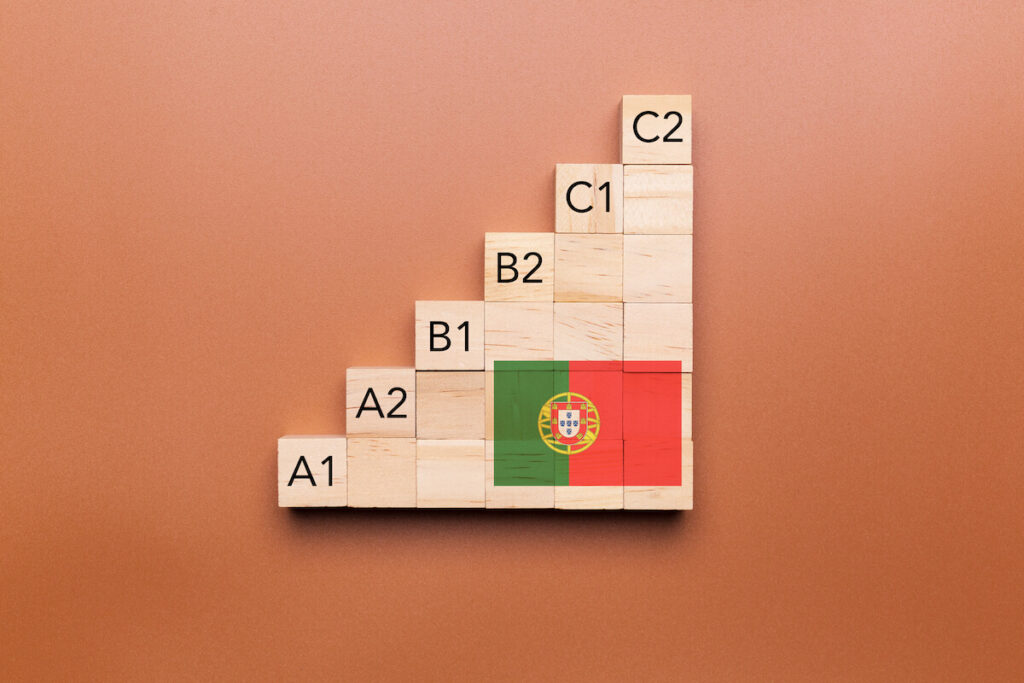
In November 2001, the European Union wrapped up a project that had been in the works for more than 10 years.
That was the Common European Framework of Reference for Languages, which from then on has been the bible of language learning standardization both on the Old Continent and across the globe.
Basically, it groups the learning process into six levels, A1, A2, B1, B2, C1, and C2, where each letter accounts for basic, independent, and proficient speakers, respectively.
I’m bringing this up to help you understand you don’t have to be able to write an academic paper to be considered fluent in Portuguese.
At the B2 level, for instance, you’ll waltz through simple interactions and at least get by in deeper conversations.
If you’re planning to attend college in a Portuguese-speaking nation, you may be asked to provide proof of C1-level proficiency. And in case you won’t settle for less than almost-native Portuguese, you’ll have to target C2.
Things that will impact your learning
Your motivation

I’m sure you’ll be excited about studying Portuguese from the get-go (particularly if you take note of the tips in the next section and follow them to a T).
You do need to know, however, that the road to fluency is a bumpy one. This is meant to encourage you, as challenges are the raw material of an exciting and fulfilling life.
The first breakthroughs are amazing, but after that, it may take you a while before you make concrete progress once again. Eventually, you’ll make it to intermediate Portuguese and will subsequently need the determination to bridge the gap to the advanced level.
If you’re looking to move at a more casual pace and learn Portuguese over, say, five years, motivation will hardly be an issue. Otherwise, though, you’ll have to keep pushing yourself throughout.
The method

Did you know there are around 10 distinct methods that you can use to learn Portuguese or any language? Each revolves around a different aspect of the language or main activity.
A classic approach like audio-lingual learning, for example, focuses on dialogues, whereas the structural method is more about grammar rules than any other.
Then you have the more “offbeat” approaches like the natural method, which normally avoids correcting mistakes and sheds light instead on how similar Portuguese is to your own language. In the direct method, on the other hand, all lessons are taught in Portuguese from the start.
Most successful approaches will blend in a few methods in a carefully planned way. Naturally, what that means is you should do substantial research on the method of a textbook or course before choosing it — or trust a tutor to do it.
By the way, finding out whether you’re a visual, auditory, or physical learner is a major part of the process too.
Your age

As controversial as this may sound, kids and teens are better positioned when we’re talking about becoming fluent in a foreign language, including Portuguese.
That’s because their brain is developing, they’re not done learning their native language, and usually have more free time to study a second language too.
Sure, you probably know a thirty-something who mastered a language or even a senior. Despite never being an unsurmountable obstacle, age can set you back a bit.
In fact, science tells us that a native speaker may still be learning their own language when they turn 30. Hopefully, this piece of trivia will make you realize it could get somewhat harder as time passes, but it’s never too late to take to studying Portuguese!
Your skills and environment
You’re already aware that being an English speaker is a heck of an advantage when you start studying Portuguese, as Portuguese is relatively easy to master.
In addition to that, if English isn’t your first language, the path your brain will need to follow is already there for whenever you decide to learn a foreign language.
If you’re fluent in another Romance language, you can expect that learning Portuguese will be like a walk in the park. Just check out how mutually intelligible it is with its cousins:
- Spanish, 89%;
- Catalan, 85%;
- French, 75%;
- Romanian, 72%.
I often mixed stuff up while learning Italian after becoming fluent in Spanish, I’ll give you that — and it might also happen to you. That said, grammar concepts will come way faster to you.
How to become fluent in Portuguese faster
Make it about the process.
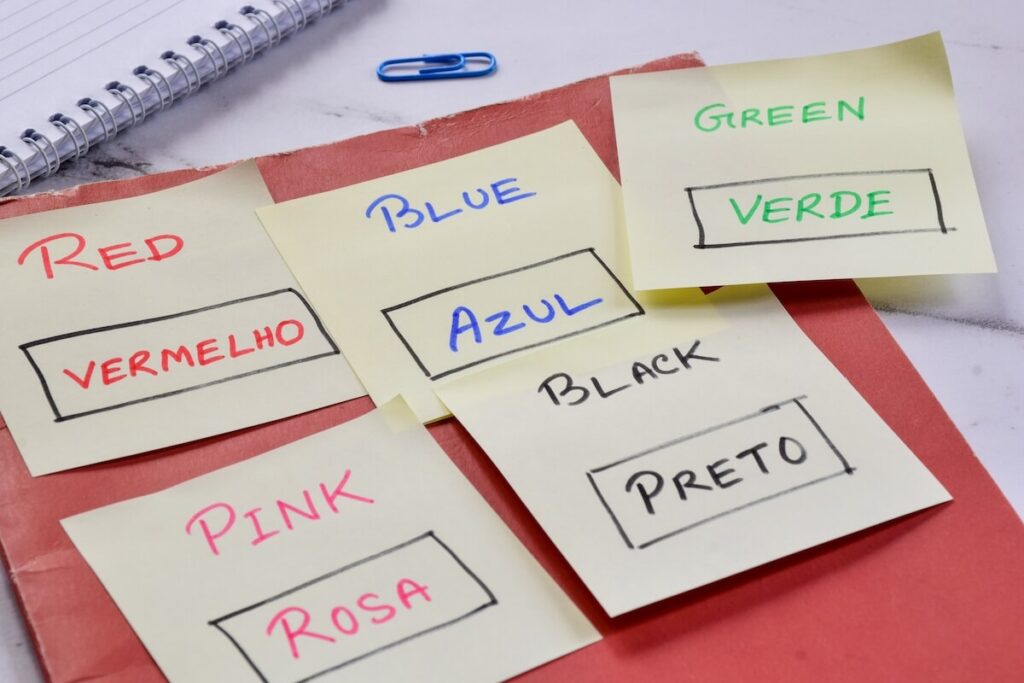
You’ll see my last tip is about dedication, which I swear doesn’t actually clash with this one. Being focused and setting achievable goals is of course essential, yet as with everything else in life balance is key when learning Portuguese.
Instead of a grueling climb uphill, picture your studies as a thrilling roller-coaster ride. At times, the thought of “what am I doing here?” may cross your mind, only to be forgotten a second later thanks to an exhilarating drop.
If you’d rather I cut to the chase, let me say this: you’ll keep making mistakes regardless of your level of language. Even native speakers are forever learning, so why would it be any different for you?
When you make peace with that fact, the feeling is liberating. You stop fretting about that tricky grammar concept you’ve been failing to grasp or about that spelling you can’t seem to dodge.
Don’t be afraid to use a bunch of different tools.
The best way to learn Portuguese — or any language for that matter — is to count on a wide range of resources. Luckily the internet is jam-packed with top-notch tools, many of which are 100% free.
Keep in mind that the finest textbook on Earth isn’t error-proof. Plus, you might get bored or overwhelmed more easily if you follow a single source throughout your learning path.
So diversity, like pretty much everywhere else I daresay, is a major part of the equation here. For lesson time, use books and apps to learn Portuguese. Find a Portuguese tutor or enroll in Portuguese online courses if you feel it could help.
When you’re done with the grammar and might as well use a break, play a game, watch a movie, or listen to a song. Try to include a podcast in Portuguese in your morning routine. There really is no magic formula!
Let the culture win you over.

You might have a career-related motivation to learn Portuguese, which works just fine too. If you don’t, the no. 1 way to make the process a lot more pleasant and smooth is by letting yourself fall in love with the fantastic culture you’ll be exposed to.
The Portuguese-speaking world, the “Lusosphere”, encompasses the tropical exuberance of Brazil, the poetic and multicolored landscapes of Portugal, and the rugged charm of African nations like Angola and Mozambique.
What’s even better is that you don’t have to focus on the “serious”, well-thought-out stuff if you don’t feel like it. Brazilians, for instance, take pride in their mad meme game.
Occasionally, this fascinating universe pops onto the mainstream. Yet only by learning Portuguese will you gain direct access to it, whenever you want and to a far deeper level.
By doing that, the whole affair of taking in new words and mastering grammar concepts — which, let’s be honest, is often tough — will become natural. It won’t feel like you’re actually studying, but rather decoding a culture.
Be committed.

Though studying Portuguese should definitely be an exciting and hassle-free experience, taking it seriously is just as important to become fluent.
I’m not saying you have to treat it as a chore, because that will take all the fun out of it. However, your brain requires consistency through repetition in order to absorb all the new information successfully.
Despite being far more complex than a muscle, your brain also needs to be trained for efficiency and strength.
If thirty minutes of Portuguese is all you manage to squeeze into your schedule every week, that’ll have to do. You can pick up a show or podcast in Portuguese to make up for it. Joining a language exchange community is effortless and extremely useful as well.
Before you know it, Portuguese will have turned into a basic part of your routine, which is one of the fundamental steps on your way toward fluency.
Final thoughts

To answer the question “How long does it take to learn Portuguese?”, you should know that elements like your age, your language background, and your resolve to reach fluency will strongly affect your studies.
That doesn’t mean you can’t overcome potential disadvantages that you may have and master Portuguese in a fast and efficient way.
Some of the things you must do to get there include relying on a good mix of resources, taking an interest in the culture of the Portuguese-speaking world, and keeping yourself motivated without pushing yourself too hard.