*This article may contain affiliate links. For full information, please see the disclaimer here.
The majority of the world’s population agrees that learning a foreign language is important in today’s global society. However, there are many people who’ve not been successful in their attempts to learn a foreign language.
This could be down to many reasons but it often isn’t due to a lack of ability – after all, we’ve all managed to learn our mother tongue, right? If you find yourself struggling to learn another language, it might be time to try a scientifically proven method.

Here are ten of the best language learning methods and techniques as proven by science.
1. The Pareto Principle
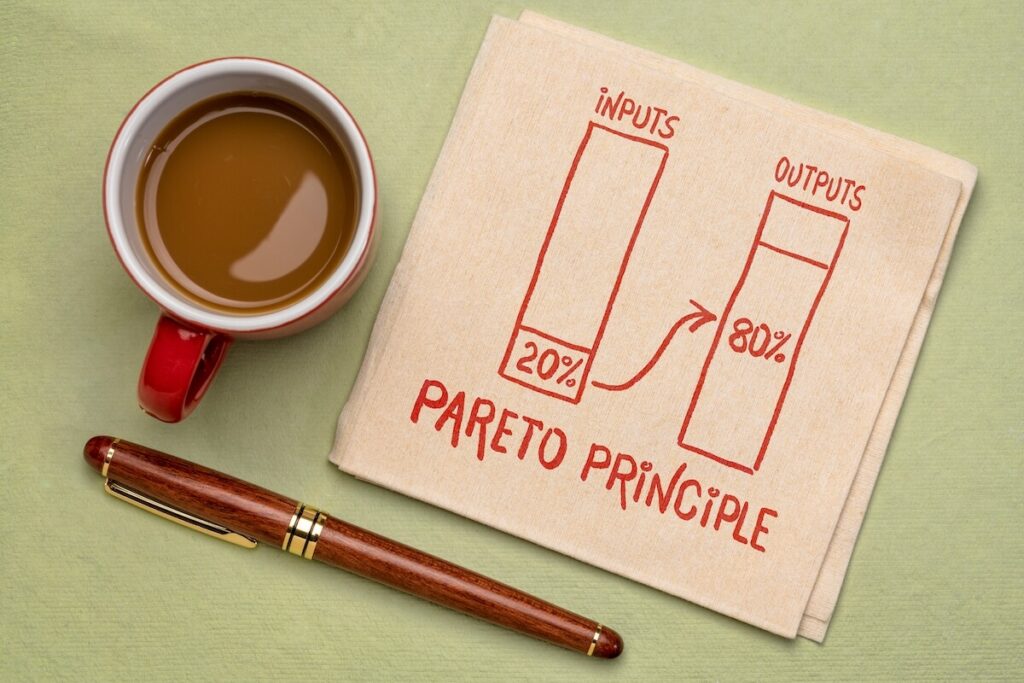
The Pareto Principle is also known as the 80/20 rule. What it means is 80% of results or consequences come from 20% of actions for many events and occurrences.
Vilfredo Pareto, an Italian economist during the 19th and 20th centuries, first observed this in action when he realised that 80% of the income of Italy was distributed to just 20% of Italians. This rule concept can be applied to many situations, including quality control, economics, business, and language learning.
The Pareto Principle in language learning
We can apply the Pareto Principle quite easily in language learning. What it means is that we need to focus our efforts on the areas that are going to have the biggest impact. For languages, this is all about learning high-frequency words – around 2,000 of them.
Let’s take French as an example. There are estimated to be about 130,000 different words in French according to Larousse. A typical native French speaker will know approximately 15,000-20,000 lemmas (a lemma is a word family of a root word, for example, happy, happier, happiest).
This doesn’t mean a French learner needs to know that many words, though. It is possible to achieve 80% proficiency in French conversation with just 2,000 words. Now, we’ve broken it down, learning 2,000 words doesn’t seem like such a huge task.
2. The CLIL Method
Another one of the best language learning methods is the CLIL method.
CLIL is an acronym meaning Content and Language Integrated Learning. This is a complete immersion method that aims to teach other subjects like history, geography, art, and science through a foreign language. It’s quite common in France where students will learn histoire-géo in English.
The idea behind CLIL methodology is not perfection but communication. It promotes education, not through instruction, but rather construction. For language acquisition, it means you aim for fluency over accuracy.
3. The Spaced Repetition System

The SRS or spaced repetition technique is scientifically proven to aid learning and memory. If you’ve tried learning anything before, you’ll know that you never remember everything after only seeing or hearing it once.
The spaced repetition system means you revisit previously acquired material often to embed it into your long-term memory. By practising this technique, you’re essentially preventing things from being forgotten.
The best way of working with the Spaced Repetition System for learning a language is to expand the intervals as you progress. For example, you might revisit new vocabulary after 24 hours, then again after 30 hours, and again after 48 hours.
When I was teaching languages, one of the reasons I fought not to have one three-hour language lesson instead of three one-hour lessons a week was due to this need for repetition for learning.
Popular apps like Babbel, Pimsleur, and Glossika use SRS to varying degrees.
4. Method of Loci

You might have heard of the Method of Loci before as it’s a popular strategy for enhancing memory by using visualisations of a familiar environment. It’s also known as the ‘mind palace’ technique and was used in both Ancient Greece and Ancient Rome.
With the Method of Loci, you learn to remember items of vocabulary by association. This might be on a familiar walking route, or walking through rooms of your house, for instance.
The theory behind the success of this is that we will learn more effectively if we associate new vocabulary or information with already acquired pieces of information.
5. The transcription method

The transcription method has been backed by studies and so is one of the language learning methods you know will work!
To learn using the transcription method, you involve yourself in two parts. The first one is transcribing what you hear when you listen to a recording and the second one is to record yourself saying the text you’ve typed. After this, you must repeat both parts until the text you’ve typed is correct and you’ve mastered it all.
What’s good about this technique is that it’s an active way to practise all four language skills: you’re listening and writing, then reading and speaking!
6. The Immersion Method

If you’ve read any of my articles before, you’ll know I’m keen on immersion as a technique (but I’m also realistic about how difficult this can be!). However, immersion is the best language learning method I’ve come across.
If you can’t up sticks and move country, you can immerse yourself in the foreign language as much as possible by changing language settings on your phone, tablet, computer, and TV, for instance. If you can immerse yourself even more by meeting up with and socialising with native speakers, even better.
7. Pimsleur Method

Another one of the best language learning methods is widely known as the Pimsleur Method.
This method is world-famous and is often referred to as the “Einstein of learning languages.” It was created by Dr. Paul Pimsleur who created the method after seeing people struggling to learn a language.
The technique is based on scientifically proven principles. You learn in small chunks by repetition and from native speakers and you focus on learning essential vocabulary.
The method is an audio-based approach, which goes something like this:
- You hear a phrase in the foreign language.
- You hear an explanation of the phrase in your language.
- You repeat the new phrase.
- You’ll be tested: You’ll be in a situation where the phrase needs to be used and you’ll need to recall what the phrase was. After a short pause to allow you to think, you’ll then hear the right answer.
Here at Learn Languages From Home, the Pimsleur app, which is based on this method, is one of our favorite ways of learning languages.
8. The Michel Thomas Method

Michel Thomas (born Moniek Korskof) was a Nazi concentration camp survivor, a decorated war veteran, and a polyglot. He developed his system after emigrating to the U.S. following WWII.
This method is somewhat unusual among different language learning methods in that it doesn’t encourage students to try to memorise the language. There are also no books, no writing, and no homework!
The idea behind this method is that it works with your brain’s preference in how it receives, stores, and retrieves information. In this technique, the learning is the teacher’s responsibility and not the students, this means that students aren’t worried about failing or making mistakes. In turn, this lack of stress means they take in more.
Ultimately, the foreign language is presented by interleaving new material with old. It focuses on generalisation and contextual diversity.
Michel Thomas was one of the greatest language teachers in the world, having mastered an impressive ten languages fluently in his lifetime!
9. Task-based learning

Task-based learning, or task-based language teaching (TBLT), is a way of learning by using authentic language to carry out meaningful tasks. With this method, you focus on making meaning instead of being accurate. As such, if you get the intended meaning across, you are successful.
The focus of task-based learning is conversation. This is the key to language acquisition and is seen as the most crucial aspect of learning a new language. Examples of the types of activities might be:
- Ordering a meal in a café or restaurant
- Making a doctor’s appointment on the phone
- Ordering train tickets
- Solving a problem
Besides being a good way to learn a language, this method has many specific advantages. Firstly, it helps learners to develop implicit language knowledge. What this means is that they learn organically how to form and use the foreign language without being taught explicitly. It also allows for incidental learning and meaningful learning while accomplishing the set tasks.
10. Communicative approach

When languages first started being taught, they were considered to be a matter of memorising and learning by rote. However, later practice tells us that language learning is more socio-cognitive. In other words, it can be learned through social interaction.
The dominant method of language teaching and learning nowadays is the communicative approach (CA), or communitive language teaching (CLT). This approach emphasises that, while interaction is the ultimate goal of learning a language, it’s also the means of learning it.
In the past, teaching was done through grammar and grammatical competence was the Holy Grail of knowing a second language. Many of us of a certain age will remember learning Latin verbs by rote, for instance, and not doing a lot with them.
Nowadays, it’s all about communication in the language with peers and with the teacher. Learners are encouraged to incorporate their own experiences into their language learning and their goal is to be able to communicate in the new language.
With this method, the teacher is not seen as an instructor but rather a facilitator. They generally won’t use a textbook but will begin with developing verbal skills before reading and writing come into play.
Final thoughts

So, there you have it, the ten best language learning methods as proven by studies, science, and experience. Some of these language learning methods are down to a teacher’s style, so if you’re taking a language class, you likely won’t have much say in your teacher’s approach.
That said, you’ll still be able to make use of things like the Pareto Principle, the Spaced Repetition System, the transcription method, the Method of Loci, and the immersion method, so there are lots of things to try!
Best language learning methods and techniques – Pin it!

