
*This article may contain affiliate links. For full information, please see the disclaimer here.
In the crowded world of language learning apps, there’s no shortage of options all vying for your attention. Many of these platforms promise to get you speaking a new language in just a few minutes a day, using a simple and game-like approach.
Among the most popular contenders are Ling and Duolingo, two apps known for bite-sized, interactive lessons. For anyone just starting out, or even those looking to switch up their routine, the choice between them can be a bit confusing. So, how do you decide which is the right tool for you?

This article aims to settle the Ling vs Duolingo debate by taking a closer look at what each app has to offer. We’ll break down the key features, discuss their respective strengths and weaknesses, and help you figure out which platform is best suited to your learning style and language goals.
Ling vs Duolingo: A head-to-head comparison
Both Duolingo and Ling are popular language-learning apps that use gamification to make the process engaging, but they take different approaches to learning.
Duolingo offers a comprehensive app that covers vocabulary, listening, reading, and speaking in a structured, highly engaging path. Ling, on the other hand, focuses on a more immersive experience with interactive chatbots and real-life dialogues, particularly for less-common Asian and Eastern European languages.
While Duolingo is known for its wide range of languages and quirky, memorable sentences, Ling’s strength lies in its extensive library of over 60 languages and essential topics, many of which aren’t offered on other major platforms.
Here’s a quick comparison of Ling and Duolingo based on their language offerings and features:”
| Points of comparison | Ling | Duolingo |
| Languages offered | 61 languages | 42 languages |
| Learning methods | Interactive, gamified lessons and exercises focusing on vocabulary, listening, speaking skills; finger-tracing writing drills; Focus on active recall | Gamified approach, with emphasis on translated sentences and building vocabulary, reading, writing, listening, and speaking skills |
| Course structure | Level-based learning with five levels per language (beginner, intermediate, upper intermediate, advanced, expert); core lessons covering vocabulary introduction, speaking practice, and a dialog section; writing drills; a short exam; grammar notes, and culture notes | Thematic units with linear path; alphabet lessons for non-Latin languages; review lessons; daily/weekly/monthly challenges |
| Pricing | Freemium model with tiered subscription options. 7-day free trial | Free model with ads; $12.99/month; 14-day free trial |
| Free features | Introductory lessons (1-2 units of any language) free for 7 days | All content is available for free, with a limit on mistakes |
| Other features | Review section with flashcard option; Dialog section with native speaker audio and chatbot; Statistics and achievements for progress tracking; Ad-free interface | Alphabet charts, Stories, DuoRadio, Duolingo Adventures, AI-powered chatbot, podcasts |
While this chart gives you an idea of which app might meet your needs better, a closer look at each app’s features will help you arrive at an informed decision. So, let’s keep digging, shall we?
Ling vs Duolingo: Languages offered
The first step in choosing a language app is making sure your target language is actually on it.
Duolingo offers an impressive 42 languages (with 40 available for English speakers), covering popular choices like German, French, and Italian, as well as a few less-studied ones such as Vietnamese, Haitian Creole, and Czech. The app is also known for its conlangs or constructed languages like Klingon and Esperanto.

On the other hand, Ling provides courses for 61 languages, including the usuals, such as Spanish, Portuguese, Arabic, and English. However, its main strength is its focus on less mainstream languages that are often hard to find resources for, especially in Asian and Eastern European countries, like Burmese, Khmer, Georgian, and Lithuanian. You can even find courses for African languages such as Amharic and Yoruba.
Ling and Duolingo don’t just differ in their course offerings but also in the way these courses are structured. Ling’s courses are consistently laid out in five levels (Beginner, Intermediate, Upper-Intermediate, Advanced, and Expert) regardless of the language you choose.
Duolingo’s courses, however, vary in length and structure. The number of units or sections can differ greatly from one language to another. For example, its French course has 8 sections, while its Korean course has 3, and Latin has just 2.
Duolingo’s curriculum can feel a bit uneven depending on the language you’re studying. This means Ling is a good Duolingo alternative if you plan to study multiple languages and want a more predictable learning path.
Ling’s learning methods and course structure
Ling’s approach to language learning is rooted in interactive, gamified lessons that focus on active recall to build a solid foundation in vocabulary, listening, and speaking. The app uses a mix of exercises to keep things fresh, from matching words and flashcards to fill-in-the-blanks, sentence ordering, and quizzes.

For languages with non-Latin scripts, like Thai or Khmer, there are even finger-tracing writing drills to help you practice your characters. And while Ling doesn’t explicitly teach grammar rules in the main lessons, it does have a handy “Grammar” section that offers a quick breakdown of key concepts, helping you understand the “why” behind the language’s structure. It also has a “Culture Notes” section that talks about various aspects of history, customs, and traditions.

As I mentioned earlier, the app’s course structure is consistent across all of its languages, with a straightforward, level-based system. Each language is divided into five proficiency levels—Beginner, Intermediate, Upper-Intermediate, Advanced, and Expert—and each level contains ten units. Within each unit, you’ll find four core lessons that introduce new vocabulary and useful, real-world phrases.
A standout feature is the dialogue exercise at the end of each lesson, where you hear a conversation between two native speakers and then have to fill in the missing words. There’s also a feature that allows you to be part of the conversation by making you choose from possible responses. For speaking practice, the app uses speech recognition and a voice recording function, allowing you to try out your new phrases.

While Ling does have some gamified elements like progress statistics and achievements, it doesn’t push them as heavily as Duolingo does, keeping the focus more on the learning process itself rather than on competition.
Duolingo’s learning methods and course structure
Duolingo’s learning method is built around quick, bite-sized lessons that feel more like a game than a classroom. The core of its curriculum focuses on translated sentences to build vocabulary, as well as reading, writing, listening, and speaking skills.
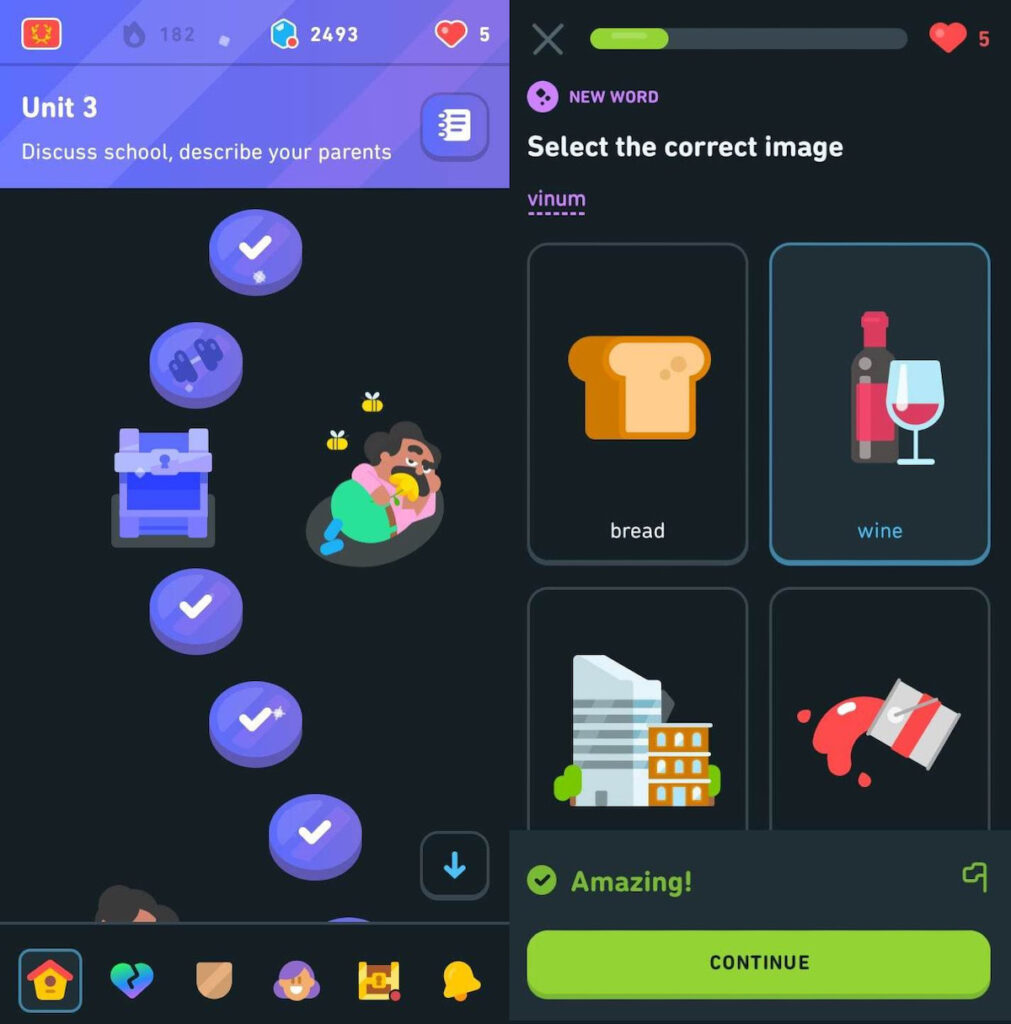
But Duolingo is best known for being heavily gamified, with features like daily streaks, experience points, leaderboards, and achievements designed to keep you motivated and coming back for more. It’s also famous for frequent and often humorous (depending on who you ask) reminders from its green owl mascot, Duo, and other characters.
While grammar is mostly taught implicitly through context, some courses include short lessons at the beginning of each section to provide a quick overview of key rules.

Duolingo’s course structure is designed to guide learners through a linear path of CEFR-aligned lessons, with many courses aiming to get you to a proficiency of A2 or early B1. Within the main path, the app has immersive features like Stories, short interactive tales that test your comprehension, and DuoRadio for listening practice.

For languages with non-Latin scripts, like Japanese or Korean, Duolingo provides Alphabet and Reading Charts to help you practice writing and pronouncing new characters. Its “Adventures” feature also offers a kind of “mini-game” experience, though this is currently only available for a few of its most popular languages.
Ling vs Duolingo: Pricing and free features
Price is often a deciding factor when choosing a language app, and Ling and Duolingo both operate on a freemium model, albeit with some distinct tiers.
Ling has various paid subscription tiers. A monthly subscription costs $14.99, a three-month plan is $29.99, and an annual subscription is priced at $79.99. All these plans provide access to all 61 languages offered by the app.
Duolingo, on the other hand, is well-known for its generous free version, which allows you to access any language course without a time limit. However, the free version comes with a few restrictions, such as a cap on mistakes and ads that appear every so often.
For those who want a more streamlined experience, Super Duolingo removes ads, provides unlimited hearts (so you can make unlimited mistakes), and unlocks exclusive features like practice hubs and mistake reviews.
A Super Duolingo subscription costs $12.99 per month or $83.99 per year, while the “Super Family” plan, which can be shared with up to five other users, is $119.99 per year. Additionally, Duolingo has a more advanced, AI-powered tier called Duolingo Max, which starts at $30 per month.
Ling: Pros and cons
So, what did I like (and didn’t like) about Ling?
First off, Ling is a powerhouse when it comes to practical language learning. I love that it focuses on vocabulary and phrases you’ll actually use in daily life. The multi-skill approach also helps you improve all the core language skills, from listening and speaking to reading and writing.

I also appreciate that the app comes with dialogue practice, high-quality audio featuring native speakers, and the ability to control playback speed. These features are uber helpful in perfecting your pronunciation and comprehension. Plus, the app is super flexible. Although there are five difficulty levels, you can skip ahead to more challenging lessons if you feel like you have knowledge and experience with the language.
The Culture Notes, although text-heavy, are also a nice touch. This feature gives more context to the vocabulary you’re learning.
However, Ling isn’t perfect. One of the biggest drawbacks is the lack of individual word translations within a sentence, something many other apps have. The app also falls short on grammar explanations, leaving you to figure out the rules on your own.

While Ling does teach you to write characters for languages with non-Latin scripts, it doesn’t give you much practice putting those characters together to form words. So, while it’s great for vocabulary and listening, you might need to supplement with other resources for deeper writing and grammar practice.
Duolingo: Pros and cons
When it comes to gamified language learning, Duolingo is king. It has truly done a great job at turning daily practice into a fun and even addictive experience. Plus, the lessons are short and manageable, perfect for squeezing in a quick session on your commute or during a coffee break.

I also love that Duolingo has lots of immersive features like Stories, Adventures, and DuoRadio for select languages, which help bring the lessons to life. Over the years, it has also added more speaking exercises and improved its overall interface.
But perhaps, Duolingo’s biggest draw is that it’s mostly free, with the majority of its content accessible without a paid subscription.
However, Duolingo has a few quirks. You’ll often encounter bizarre, non-essential sentences early on that feel a little out of place. The app also follows a very strict, linear path, so you’re not able to skip ahead easily.
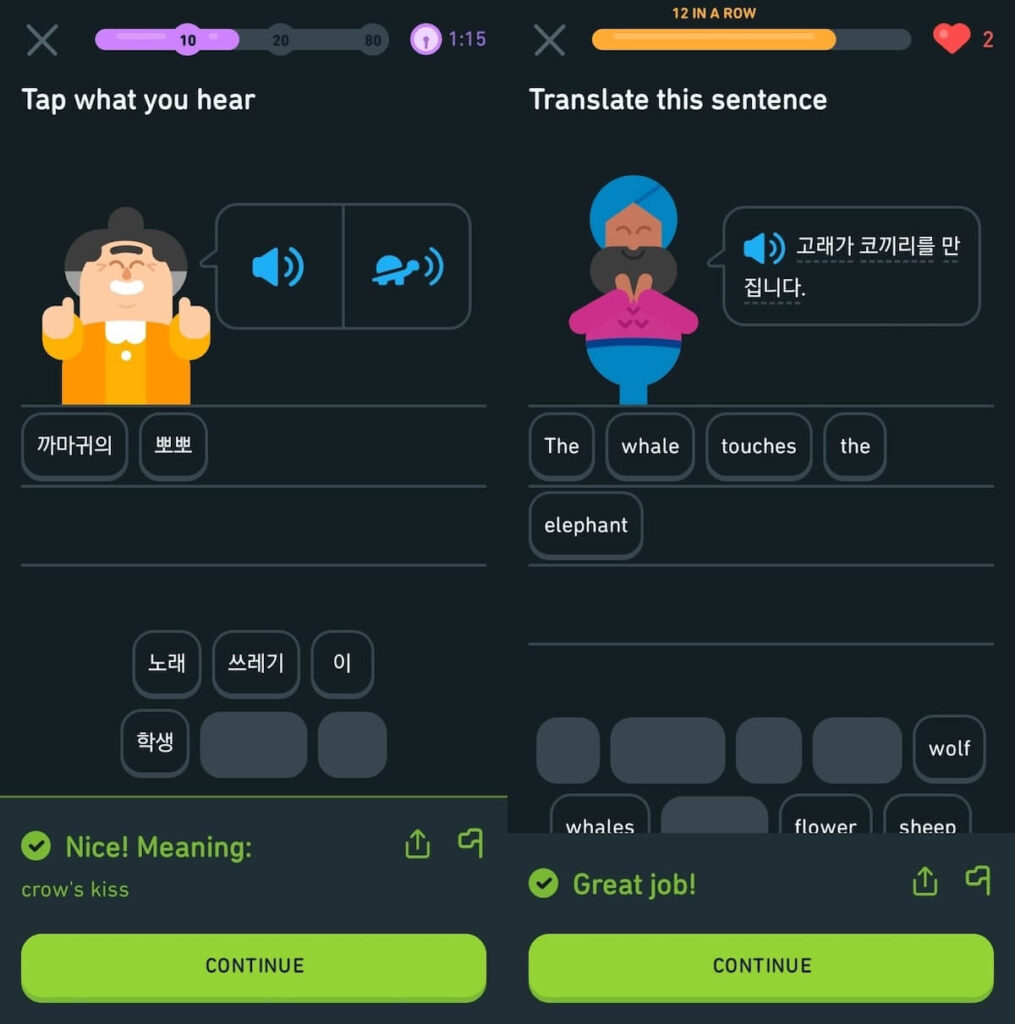
It also lacks explicit grammar and cultural lessons, so you won’t get a deep understanding of the “why” behind the language. The quality and quantity of the content can also vary wildly depending on the language you’re learning, with some courses being much more developed than others.
Ling vs Duolingo: Which is better?
Deciding between Ling and Duolingo comes down to your learning style and goals. Neither app can make you fluent overnight, but they both do an excellent job of lowering the barrier to entry and getting you started on your language journey.
While both incorporate gamification, Duolingo has a knack for making learning feel like a truly immersive and engaging game, with its short, well-rounded lessons and fun features like Stories and Adventures.
On the other hand, Ling takes a more direct, no-nonsense approach. It focuses on practical, real-world vocabulary and uses a variety of exercises to build your core skills. Ling’s dialogue section is a standout feature, proving to be a fantastic tool for developing listening comprehension and contextually expanding your vocabulary. Plus, its Culture Notes add a nice layer of context to your learning.
It’s also undeniable that Duolingo’s free tier is a major plus, but Ling also offers discounts that make its premium features more accessible. Ultimately, if you’re a beginner who wants a fun, game-like experience, Duolingo is a great choice. But if you prefer a more focused, practical approach, Ling might be the better fit.

Mondly is another gamified app that you can try out. It covers a lot of topics, lets you practice with a chatbot, and has useful conjugation tables. That said, if you’re looking for more options, especially for advanced learners, I recommend the following:
- For extensive lessons that cover speaking and grammar, try Babbel or Rocket Languages.
- For conversational practice, use Pimsleur or Glossika.
- For private lessons with a native speaker, hire tutors on Preply or italki.
Ultimately, the best way to know which app is right for you is to simply try both. Since Duolingo offers a free tier and Ling has a free trial, you can explore each one to see which better fits your learning style.
Once you’ve settled on an app, remember to supplement your learning with other resources like books, podcasts, or even language exchange meetups for a well-rounded approach. The key to fluency is to find a mix of tools and methods that work for you. Embrace the process, experiment with different resources, and find the path that makes learning a language fun and effective!
Ling vs Duolingo: FAQ
Which app is better, Ling or Duolingo?
This depends on your learning style and goals. Duolingo is perfect for beginners who want a fun, gamified experience, with short, manageable lessons and immersive features. Ling is great for those who prefer a more straightforward, practical approach, focusing on real-world vocabulary, and offering in-depth dialogue practice with native speaker audio and cultural notes.
Can Ling make you fluent?
While Ling provides a solid foundation with its practical vocabulary and conversational exercises, it’s not a magic bullet for fluency. Apps alone aren’t enough; true fluency requires a multi-faceted approach. To truly master a language, you’ll need to combine Ling with other resources like books, podcasts, online courses, or a tutor. Most importantly, you need immersion and real-world conversations with native speakers.
Is Ling app free?
Ling is a paid language-learning app, though it does offer a 7-day free trial. After that, you can choose from a few subscription options: a monthly plan for $14.99, a quarterly plan for $29.99, or an annual plan for $79.99.
Can you become fluent with Duolingo?
While Duolingo is a fantastic tool for getting started, it’s not a one-stop shop for fluency. It excels at building a habit and introducing basic vocabulary and grammar in a fun, gamified way. However, to achieve true fluency, you need to supplement it with other learning methods, such as language exchanges, books, podcasts, and real-life immersion.
What is the difference between Ling and Duolingo?
The core difference lies in their approach. Duolingo is a master of gamification, making language learning feel like a fun, addictive game with features like streaks, leaderboards, and rewards. Ling, on the other hand, is more focused on practical, real-world applications. It teaches essential vocabulary through a variety of exercises and high-quality native speaker audio.
Can I learn a language effectively using only Ling or Duolingo?
While both Ling and Duolingo are excellent starting points for language learning, they are unlikely to make you completely fluent on their own. To achieve true fluency, it’s best to use them as part of a more comprehensive approach.
Supplement your app-based learning with additional resources like books, podcasts, and online courses. Most importantly, seek out opportunities for real-life practice with tutors from platforms like Preply or italki, or with language exchange partners.