
*This article may contain affiliate links. For full information, please see the disclaimer here.
During my fifteen years as a Spanish teacher, one of the things my students commented on most frequently was the speed of spoken Spanish. Arguably all languages sound fast when you’re not fluent but when it comes to Spanish, they actually had a point.

Research has shown that native Spanish speakers say more syllables per second than English speakers. This means it can feel impossible for learners to keep up in a conversation. In this article, we’ll put worrying about speed aside and concentrate on how to improve Spanish speaking.
What do we mean by ‘fluency’?

Whenever you talk about speaking another language, people often ask you if you’re fluent. But what does this mean? Is it complete perfection?
Thankfully not! Two different people can class themselves as being fluent yet one might be more competent than the other in terms of their achieved level.
Being fluent is a range. Essentially, if you’re able to explain your way around a word you don’t know, you’re fluent. For example, let’s say you can’t remember the word for bell pepper but can describe how it looks so that someone understands what you mean and can tell you the word you’re looking for, you can describe yourself as in the range of fluency.
Tips on how to improve Spanish speaking
1. Put grammar perfection to the back of your mind

Yes, we all know that grammar matters – it does!
But when you’re speaking, particularly with native speakers and not other learners, the most important thing is that you communicate your message. A social situation, for example, doesn’t require impeccable grammar. Prioritising fluency and delivery speed over perfection is a good idea.
It can be hard to let go of striving for perfection but the more you speak and practise with speed, the more perfect your utterances will get naturally and organically.
That said, when you feel it’s time to dig deeper into grammar, you can explore these Spanish grammar books.
2. Focus on pronunciation

If being self-conscious about speaking Spanish is preventing you from speaking to more people, working on your pronunciation is a surefire way of building confidence.
In the majority of social situations, good pronunciation and confidence matter more than anything. You will sound more fluent with a good accent! The good old phrase ‘fake it ‘til you make it’ really applies in speaking a new language!
A good way to hone your pronunciation is by watching Spanish movies and TV shows. Make it an even more intentional activity by using Lingopie, which not only features great Spanish content but also comes with interactive learning tools like clickable subtitles and a speech recorder. You can check more Spanish speaking apps here.
3. Read a Spanish book aloud

If you have to read a Spanish text as a part of your course, reading it aloud is a great way to grasp what’s going on while also working on your speaking skills. If you don’t have a text to study, even better – you can choose any book you’d enjoy and read it aloud.
When I was a student, I chose to read the Harry Potter books in Spanish purely for the fact that I’d already read them in English and so it was easier for me to understand what was going on. (As an aside, it was also fascinating to see how names and places had been translated too!)
Reading aloud helps to train your muscles and mouth to make unfamiliar sounds and pronounce unfamiliar words. As you read, you’ll get faster at saying the words and improving the sounds, which will help your fluency. This is a great way to practise speaking without having to also think of what you’re saying too.
Also read: 17 Best Books to Learn Spanish for All Levels
4. Rehearse and plan ahead

If you’re going to be in a situation where you know you’re going to need to speak Spanish, it can be really helpful to prepare what you might need to say. For some people, learning phrases almost like a script can be useful. Others who are more confident might just look up a few words they think they might need in the situation.
Preparing a few lines beforehand can make the difference between being nervous and being confident.
5. Sign up for an audio-focused course

If you’re learning on your own, it can be difficult to practise speaking. Unless you’re a fan of speaking to yourself in the mirror, you’re going to need something more.
Signing up for a course online is a good idea but it’s better to choose one that is audio-focused like Pimsleur and Rocket Spanish. Both are comprehensive courses that train your conversational skills.
6. Use Spanish learning apps that target speaking

Another way of improving your Spanish speaking skills is by using a learning app that incorporates speaking. It’s hard to practise speaking on an app but this is something that Duolingo has managed to do.
Their speaking activities use AI voice recognition that grades how close your pronunciation is. This means you get feedback on your accent in real-time. When your pronunciation is good enough, the word turns blue.
Babbel is also a good learning website. They have award-winning courses for self-study as well as live online language classes with world-class teachers. They have a speech recognition tool, which is a core part of the courses.
You can also check out Cudoo for well-structured Spanish courses that cover the essentials or Skillshare for short, easy-to-digest clips on Spanish vocab, grammar, and more.
7. Listen to Spanish podcasts

If you enjoy listening to podcasts, there are loads available in Spanish on every topic you can think of. There are even ones designed for language learners from beginners upwards. This includes:
- Notes in Spanish (available on Spotify and Apple) – transcripts are available for paid subscribers.
- Coffee Break Spanish (available on Spotify and Apple) – transcripts are available for paid subscribers.
- Duolingo Podcast (available on Duolingo, Spotify, and Apple)
- Unlimited Spanish (available on Stitcher and Apple)
8. Look for online tutors

If you really want to improve your Spanish speaking skills, an online tutor is a great way to make progress quickly.
Italki is an excellent website that links online tutors with learners. Lessons start from as little as £4 for a trial lesson. You can choose someone who suits you. Each teacher has a blurb about themselves and the pricing is very clear. Preply and Lingoda are worth checking out too!
9. Find a language exchange partner

If money is tight, a cheaper option is to find a language exchange partner. This is easier if you’re close to a large city where there’s a native population of Spanish speakers in a university, for example.
The idea behind a language exchange is to meet up with someone who speaks Spanish and wants to improve their English. You talk half of the time in Spanish and half of the time in English so that you both get to practise your conversation skills in your 2nd language.
10. Find an online language exchange
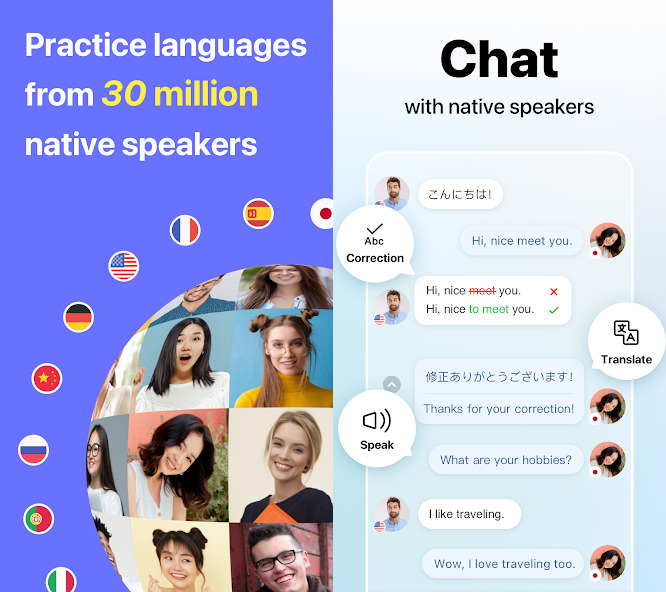
If you’re quite rural and can’t look for a language exchange partner in your local area, the wonders of the World Wide Web mean you can find a language exchange partner quite easily online.
HelloTalk and Tandem are free language exchange sites and apps where you can chat with people via text, calls, and messages. Obviously, if you’re looking to improve your Spanish speaking skills, calls and video calls are the way forward here!
11. Pretend you’re giving a speech
You learn most when you’re doing something you’re passionate about. So, if you’re keen on improving your Spanish speaking skills, why not pretend you need to give a speech? Choose a topic that interests you – it could be the royal family, the European Union, or kangaroos, it doesn’t matter.
When you’ve chosen your topic, plan out and write your speech. You can rehearse and deliver your speech (even if it’s just to yourself). If you’re keen on improving your pronunciation, record your speech and play it back to yourself to see how it sounds.
12. Have realistic expectations but also reflect on progress

It’s great that you want to improve your Spanish speaking skills but it’s important to be realistic about how long it takes. By all means, aim high and set yourself goals but also know how long it takes to become fluent in a language.
It can be easy to become disheartened when you’re learning too. A good way to check your progress is by recording yourself on audio or video speaking the language.
Doing this once a month will mean you see just how much better you’re getting. You don’t need to do or say anything specific, just whatever comes into your head but you’ll notice improvements in language and pronunciation quite quickly! You might even cringe at the mistakes you used to make too!
Final thoughts on ways to improve your Spanish speaking skills

No matter where you are in your journey to learn Spanish, there will always be improvements you can make! Being able to speak Spanish to native speakers is arguably the main reason so many of us choose to learn the language in the first place.
Hopefully, these 12 tips will give you some ideas on how to improve and make progress quickly. Good luck!
Where do I find similar info for speaking Italian?
Hi, Gerald! We don’t have the same article for Italian (although I think some of the tips can apply to any language), but these apps might help: https://learnlanguagesfromhome.com/italian-speaking-apps/