
*This article may contain affiliate links. For full information, please see the disclaimer here.
For many people who are hoping, planning (or wishing) to live in an English-speaking country, the IELTS exam is a necessary hurdle for immigration, job hunting, school applications, and more.
Necessary, yes. But also, the IELTS exam is (in)famously difficult! So, to help you reach your goals and move on with your life, I’ve developed this handy guide on how to pass the IELTS exam.
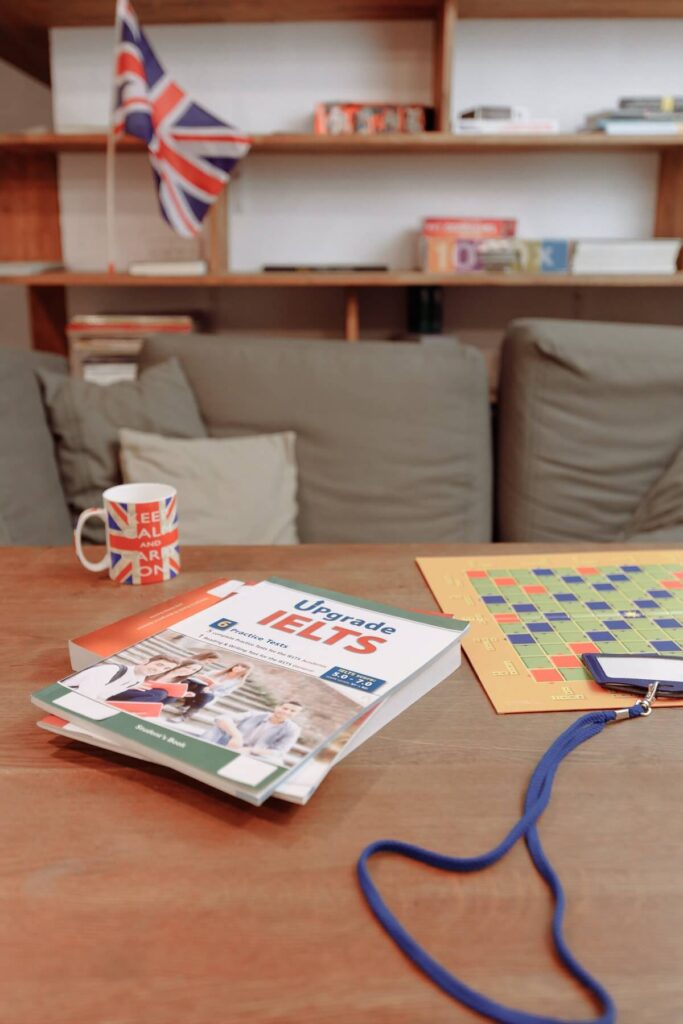
Because you can most definitely pass this exam! All it takes is some dedication, practice, access to a variety of different materials, and time.
So, let’s go! Here are 16 tips to help you pass the IELTS exam.
What is the IELTS Exam?

Before we jump into the tips, I want to cover what the IELTS exam is, and why you might need to take it.
The International English Language Testing System (IELTS) Exam is the test you need to pass in order to study, work, or migrate to an English-speaking country.
The IELTS is widely accepted throughout the English-speaking world, including Australia, New Zealand, the United Kingdom, Canada, and certain institutions in the United States.
The IELTS is split into four sections: Listening, Reading, Writing, and Speaking. The exam is graded on a scale of 1-9—the higher, the better! Different institutions and countries have different passing requirements, so make sure you know this before you take the test.
Below is the IELTS scoring scale, to help you familiarize yourself with what each band score means.
IELTS Scoring Scale
| Band score | Skill level | Description |
| 9 | Expert user | The user has full command of English and shows fluency, competence, and appropriate skills. |
| 8 | Very good user | The user has almost-full command of English, with very occasional inaccuracies or misunderstandings. |
| 7 | Good user | The user has an operational command of English with occasional inaccuracies or misunderstandings. |
| 6 | Competent user | The user has an effective command of English, with some inaccuracies or misunderstandings. |
| 5 | Modest user | The user has partial command of English and is able to handle basic communication. |
| 4 | Limited user | The user has a basic command of English, primarily in familiar situations. |
| 3 | Extremely limited user | The user has a very basic command of English, with many miscommunications and misunderstandings. |
| 2 | Intermittent user | The user lacks fluency and understanding of English. |
| 1 | Non-user | The user has no fluency or understanding of English, minus the occasional words or phrases. |
Now that you know the basics of the IELTS and what you need it for, let’s get to the good stuff: how to pass the IELTS!
Tips on how to pass the IELTS exam
1. Get a tutor

To pass the IELTS, you will need a lot of study and practice. One thing I recommend? A tutor! There are many tutors out there who specialize in helping you study for the IELTS.
One of the best parts of an IELTS tutor? They will identify any areas of improvement you may have, and personalize your lesson plans to help you get the IELTS score you need. Don’t you just love it when things are personalized specifically to you?
Caveat: Of course, this is not the cheapest option on the list, but this is an investment that will certainly pay off. You can find affordable English tutors on sites like italki, Preply, TutorABC, and AmazingTalker.
2. Take practice tests

One handy thing about the IELTS is that it’s such a common test, there are many study materials available (often for free, or for low cost). So, hunt down every practice test you can find, set up a timer, and see how you do.
And make sure to take a full practice test, as well as practice each section individually.
3. Know the test structure

The practice tests will also help you learn this vital piece of information: the test structure!
Even if you know all the material, an unfamiliar test structure can throw you off in the moment, and can even impact your score (and not in a good way). Practice tests will help you avoid any surprises on exam day.
4. Be aware of time constraints

Another thing that can surprisingly impact your test score is timing. You could be completely prepared, but if you can’t finish an answer in time, you just won’t get the credit you deserve.
The practice test will help you understand the time constraints for each section: Listening (30 minutes), Reading (60 minutes), Writing (60 minutes), and Speaking (11-14 minutes).
In total, the test takes around 2 hours and 45 minutes, although the Speaking section generally takes place on an earlier day than the rest of the sections.
5. Familiarize yourself with the scoring

It’s important to know what score you need on the IELTS exam. Every country, school, job, or institution will likely have different score requirements. Once you know the score you need, you also know where to aim!
Of course, trying to improve your English fluency as much as possible will only be beneficial for your new life in an English-speaking country, so I would recommend aiming higher than you need.
6. Diversify your sources

The better you can read in English, the better you will score on the IELTS—and not just on the reading section, either! To truly grasp the English language (and pass the test), it’s best to diversify your English sources.
Practice reading a variety of authentic English sources, including test materials, news articles, books, short stories, and even social media. This will improve your reading skills, writing skills, listening, and your overall English fluency.
Also read: 12 Best Books to Learn English for Beginners to Advanced Learners
7. Develop multiple reading skills

In addition to a variety of reading sources, practice different types of reading, such as skimming, focusing on detail, identifying opinions, and understanding arguments.
Reading comprehension is a key skill you will need during the reading section (and during the writing section, too). Truly understanding what you’re reading, and the ability to analyze text will help you ace the reading section.
This is because, in the reading section, you aren’t just answering multiple choice questions, but you’ll also need to complete sentences, answer questions about the text, diagram sentences, and analyze the facts.
8. Drill that vocabulary

Even if you consider yourself fluent in English, the IELTS exam is known for utilizing some challenging vocabulary. So, drill, drill, drill!
Flip through dictionaries, expose yourself to passive vocabulary via reading and listening, scan articles and circle words you don’t know, and then, make flashcards—they’re a classic for a reason.
Read more: How to Improve Your English Vocabulary: 13 Effective Tips
9. Study with official IELTS materials

Although there are a ton of useful IELTS study materials out there, make sure to at least use some straight from the source such as the British Council website or Cambridge textbooks.
It’s helpful to study with official IELTS materials because these are the only ones that will have actual exam questions pulled from past tests.
10. Don’t forget the accents

One thing many people forget when studying for the IELTS? The accents!
Most of the test utilizes British English, but as the test aims to be inclusive, you’ll likely encounter accents from other English-speaking countries, such as Australian, Irish, or Canadian.
11. Work on your essay skills

Many people struggle with the writing section of the IELTS, partly because it’s graded by actual humans, not just with an answer key.
Find some former essay questions, practice organizing your essay and writing it within the time frame, and then, if possible, have an English speaker look over it and mark any mistakes.
Then, rewrite the essay, fixing your mistakes! It’s a great way to truly understand what areas you need to polish. Here are more tips on improving your English writing skills.
12. Record yourself

I know it can be cringe-worthy to record yourself speaking and then play it back…but it can truly help when you’re learning a new language!
Listen to yourself, see if it makes sense, and write down any mistakes you may have made. It’s also a great way to improve your English pronunciation.
13. Immerse yourself in English

It may not be possible to completely immerse yourself in English (you’re probably not living in an English-speaking country quite yet if you’re taking the IELTS), but do your best to surround yourself with it if possible!
Find an online tutor, watch English TV and videos on YouTube, FluentU, or Lingopie (the dual subtitles and vocab lists will help tons), listen to English audiobooks, read in English whenever possible, or even practice speaking with family and friends.
14. Work on your conversational skills

Practice your English conversational skills as much as possible before you take the IELTS exam. If you can’t afford a tutor for the IELTS specifically, you may be able to find a more budget-friendly tutor that just focuses on conversational English. You may also have friends or family that speak some English—practice with them!
In addition, chances are there is someone in your country who speaks English and wants to learn your native language. So, swap! They can help you speak English, you can help them speak (insert your native language here). It’s a win-win!
Language exchange apps and websites can also be a great way to find conversation partners and make new friends.
15. Identify your weak points

During every practice exam, tutor session, recording, essay review, or English conversation, make sure to note what areas you struggle with. Chances are, there will be a pattern, which will help you identify any weak points.
Knowing which areas need improvement can help you focus your IELTS study time on efficacy and efficiency!
16. Practice makes perfect

It’s a classic cliche for a reason: practice makes perfect. The more you practice, the better you will get; it’s just a fact of life.
This will also serve you well when you do pass the IELTS and head off to Australia or the US for your new job/school/life. Because once you arrive, you’ll definitely need to know English just in your day-to-day!
Conclusion

I know the IELTS exam can seem daunting. I get it—a lot is at stake, after all, so who could blame you for being intimidated? However, with proper preparation and study, you should be able to pass the IELTS without issue.
These tips are designed to help you succeed in the IELTS, and to help you learn English, period. Which is kind of the whole point.
Now, young grasshoppers, go forth and learn English (and ace that test). And, don’t forget: practice, practice, practice…and all of your hard work will pay off in the end. You’ve got this!