
*This article may contain affiliate links. For full information, please see the disclaimer here.
If you’re wondering how to improve your English writing skills, welcome to an insightful journey dedicated to just that. In this post, I’ll explore effective strategies that can elevate your writing style.

We will dive into key techniques that will empower you to express your thoughts with clarity and grace. From mastering grammar fundamentals to expanding your vocabulary, each step will be a cornerstone in your path toward becoming a proficient writer.
Grab your pen and paper and join me on this expedition to refine your English writing skills!
Top tips on how to improve your English writing skills
1. Read nonstop.

Reading is like devouring a delicious buffet of words, where every page is a new flavor waiting to be savored. When you dive into reading, you’re serving up a feast for your brain and supercharging your English writing skills in the process.
Think of reading as a secret ingredient that adds depth and richness to your writing. It’s like building a linguistic toolkit that you can draw from when crafting your own content.
The more you read, the more you’re exposed to different writing styles, sentence structures, and vocabulary. The more words you encounter, the closer you get to proficiency.
With every page you turn, you’ll unlock new writing techniques, discover fresh perspectives, and unleash your inner wordsmith.
Also read: 20 Effective Tips on How to Improve English Reading Skills
2. And do it in an active way.

Picture yourself not just as a reader, but as an active participant in the literary realm, flexing those mental muscles and honing your writing abilities along the way.
While you can simply absorb words on a page as you focus on the content (i.e. passive reading), active reading is about diving deep, engaging your brain, and dancing with the author’s ideas instead.
As you read actively, you’ll learn to analyze and dissect the writing. Pay attention to the author’s style, the structure of sentences, and the clever use of literary devices. It’s like peeking behind the curtain and discovering the magic tricks that make great writing tick.
Active reading is also about engaging in a conversation with the text. Highlight, underline, and scribble in the margins. Ask questions, challenge ideas, and jot down your own reflections.
It’s like having a lively debate with the author, expanding your thinking and developing your own unique writing voice.
3. Practice summarizing and paraphrasing.

Summarizing is like creating a tantalizing trailer for a movie. You take a chunky paragraph or a lengthy article and squeeze it into a concise and captivating snapshot. It’s all about capturing the essence, the juicy bits that matter most.
Paraphrasing, in turn, is like putting your personal spin on a classic tale. You take someone else’s words and give them a fresh coat of paint. You maintain the core meaning but present it in your own voice, like a master storyteller adding your own flair.
Practicing these skills helps you hone your ability to express ideas in a straightforward and original way. It’s like playing with words, molding them into different shapes and sizes, and finding the perfect fit.
It’s not just about storytelling, though; summarizing and paraphrasing are essential tools for academic and professional writing too. They help you condense complex ideas, demonstrate your understanding, and present information in a clear and compelling manner.
4. Journal.

Keeping your own journal is like having a secret conversation with yourself, where you can let your thoughts roam free and explore the vast landscapes of language.
Think of your journal as a trusty companion, always ready to listen to your ideas, dreams, and daily escapades. It’s a playground for your words, a sanctuary where you can experiment, stumble, and ultimately grow.
When you journal, you unleash the power of self-expression. You can put down your thoughts, describe your experiences, and even create whimsical tales.
Not only does journaling improve your fluency and vocabulary, but it also serves as a time capsule of your growth. You can look back on your earlier entries and marvel at how far you’ve come.
5. Experiment with different genres.

Experimenting with different genres as you read and write in English allows you to venture beyond your comfort zone and expand your linguistic horizons.
You learn to adapt your writing style to fit the needs of different genres, honing your skills in the process. It’s like adding a diverse arsenal to your writing toolkit.
Not only does experimenting with genres enhance your versatility, but it also nurtures your understanding of different writing techniques.
You’ll discover the power of vivid imagery in poetry, the art of storytelling in novels, and the precision of concise language in the news.
6. Start with an outline.

An outline is like a blueprint for your written piece. It’s the secret weapon that brings order and structure to your ideas. It works almost like a GPS that guides you through the maze of sentences and paragraphs, ensuring a smooth and coherent journey.
With an outline, you can organize your thoughts, identify key points, and establish a logical flow for your writing. It’s like building the scaffolding before building a tower of words.
Besides helping you navigate the vast expanse of your thoughts, an outline will save you precious time as well. By outlining your ideas in advance, you can avoid the dreaded writer’s block and the endless cycle of staring at a blank page.
7. Proofread everything you write.

By proofreading, you can catch those wayward commas, spot those mischievous homophones, and banish those rogue apostrophes from your text.
It’s like arming yourself with a magnifying glass to scrutinize every nook and cranny of your writing and guarantee its clarity and coherence.
Other than that, proofreading enhances your language skills too. As you carefully examine each sentence, you train your eye to spot patterns, improve sentence structure, and refine your grammar and vocabulary.
8. Rely on online tools for help.

When it comes to tips on how to improve your English writing skills online tools are like trusty sidekicks, ready to lend a helping hand.
First off, you have spelling and grammar checkers. They swoop in, scanning your text for spelling blunders and grammatical hiccups, saving you from embarrassment. Tools like Grammarly and QuillBot have a fantastic ability to spot the tiniest typos that slip past your eyes.
These apps and websites nudge you towards better word choices, help you tame run-on sentences, and even throw in some punctuation suggestions.
And let’s not forget plagiarism checkers like SmallSEOTools, which scan the vast corners of the internet to protect your work from unintentional similarities and ensure your ideas shine with authenticity.
9. Focus on the message above all else.

When you write, embrace the power of communication and let your ideas take center stage. Don’t fret over every grammatical quirk or word choice dilemma. Instead, channel your energy into expressing your thoughts with clarity and conviction.
Remember, even native speakers stumble on the occasional grammar blunder. So, prioritize putting across your message, wielding coherence and cohesion as your allies.
It’s all about making your ideas connect like puzzle pieces, making sure your reader never gets lost in a maze of confusion.
10. Seek feedback.

Receiving feedback on your writing is your golden ticket to discovering areas where your writing shines and where it could use a little polish. Feedback helps you see through the eyes of others by gaining fresh insights and valuable opinions.
Whether you reach out to fellow writers, teachers, or even a friendly neighborhood grammar geek, they’ll provide a keen eye and offer suggestions to enhance your writing.
Constructive criticism is the secret ingredient that strengthens your writing, helping you grow and evolve. Remember, even the greatest writers sought feedback. From J.R.R. Tolkien to J.K. Rowling, they all knew the power of outside perspectives.
11. Interact with native speakers.

Native speakers are the masters of their craft; by interacting with them, you get a front-row seat to authentic expressions, idiomatic phrases, and cultural nuances that will make your words come alive and will help you improve your receptive skills in English as well.
Chat with them, exchange ideas, and watch your writing grow stronger daily. These days, there’s no shortage of opportunities to connect with native speakers.
You coin language exchange programs, participate in online communities like Tandem, or hire an English tutor on top-notch platforms like Preply and italki.
Savor the linguistic encounters and watch as your writing turns into a symphony of words with the guidance of those who truly know the language.
12. Keep up with grammar.
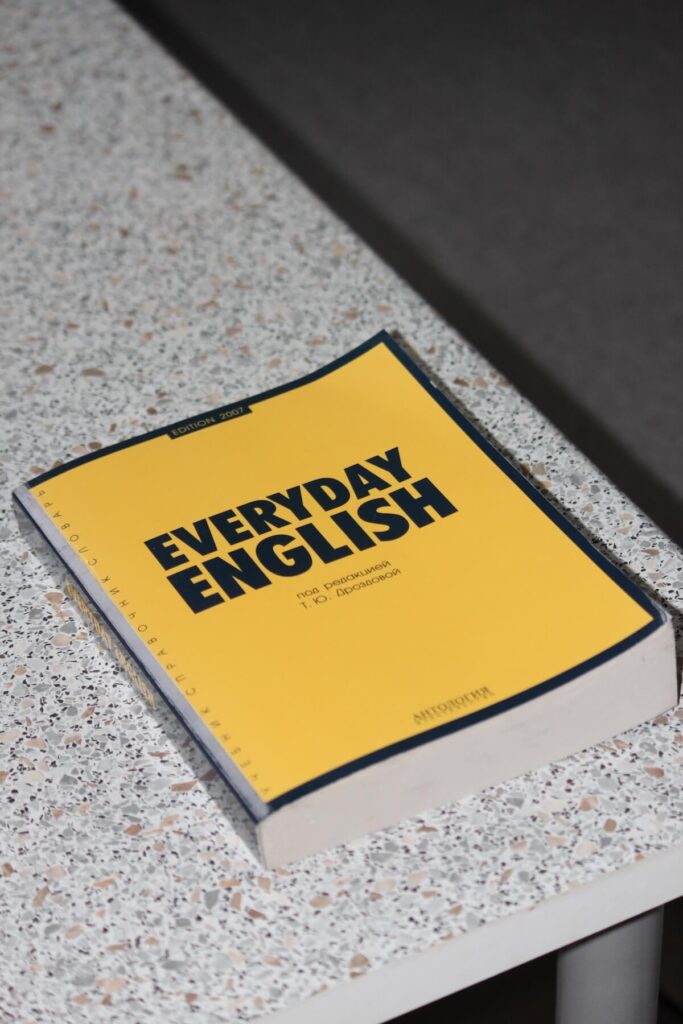
Studying grammar is like unlocking the secret code to fluent and effective writing. By delving into the depths of grammar, you’ll become a master of syntax, punctuation, and sentence structure.
Understanding grammar allows you to navigate the huge landscape of English with confidence. It’s like having a trusty map to guide you through the writing; you’ll know when to use a comma, and apostrophes and how to craft a sentence that sparkles.
And in case you’re wondering, studying grammar doesn’t need to be a tiresome task. Engage with it like a curious explorer, uncovering its secrets one rule at a time.
Surround yourself with grammar resources, be it audio courses like Pimsleur, books, or apps to learn English like MosaLingua and Babbel. Soon enough, you’ll find yourself weaving sentences with ease.
13. Use creative ways to expand your vocabulary.

Building an expansive vocabulary will open up a world of possibilities to express yourself with elegance and flair. Be it through movies, music, flashcards, or conversations with native speakers, engage in the joy of discovery, as each word becomes a tiny victory in your learning path.
You can experiment with mnemonics, word association, and word games, and let your vocabulary bloom and blossom like a vibrant garden.
14. Challenge yourself.

By pushing yourself beyond the boundaries of your comfort zone, daring to tackle more complex structures, exploring diverse topics, and experimenting with different writing styles, you’ll unlock a hidden potential within yourself.
Embrace the unknown, as that will let you truly grow. When you grab something to read, for instance, pick a book or an article that’s slightly above your language level.
And when you’re writing, take on meaty topics that make your brain tingle and your fingers dance across the keyboard.
15. Don’t forget to have fun.

Writing doesn’t have to be a chore. Rather, it can be a canvas where your imagination runs wild. So, as you set out on this journey, remember to sprinkle a generous splash of fun along the way.
Enjoy the ride, just like you would on a roller coaster. Play with language, bend it to your will, and create literary concoctions that bring a smile to your face.
Play word games and linguistic puzzles on websites like Ba Ba Dum; explore puns, double entendres, and wordplay. Embrace the beauty of language with a playful spirit, and watch your writing soar to new heights.
Final thoughts

Following this exploration into how to improve your English writing skills, you’re now equipped with a collection of valuable strategies to embark on your own writing journey.
Remember, whether it’s journaling, experimenting with genres, or seeking feedback, each step you take brings you closer to full mastery of this intricate craft.
Embrace the challenges, push your boundaries, and celebrate the small achievements along the way. And bear in mind that even in the pursuit of excellence, it’s essential to have fun and enjoy the process.