
*This article may contain affiliate links. For full information, please see the disclaimer here.
“How long does it take to learn Chinese?”
If only I had a dollar for every time my friends have asked me that question, I’d probably be on the next Forbes list of millionaires! Okay, yes, it’s an exaggeration, but it’s undeniably true that many language learners have thought about that question at least once or twice.

The most common answer I offer, sometimes in jest, is “a lifetime”. However, that’s also partially true. Even though I’m a native speaker and have been all my life, I sometimes still come across words or phrases I’d never seen before.
But, there IS technically an answer to the question, “How long does it take to become fluent in Chinese?”. So, let’s find out.
How long does it take to learn Chinese?

To achieve native-level fluency requires at least 2,000 hours, which is about three years if you study two hours daily. However, to be fluent enough to have simple conversations, you only need about 600 or so Chinese characters, which would take about half a year if you dedicate at least two hours per day to studying Chinese.
This is based mostly on both the Foreign Service Institute (FSI) and the Hanyu Shuiping Kaoshi (HSK) scales, which provide an estimate of how many hours of study and how many Chinese characters one needs to know respectively to achieve a certain level of fluency. That said, you can learn Chinese much quicker if you zero in on certain fields or topics.
For example, if you’re trying to learn only Chinese words used in the culinary scene, you can probably be fluent enough to run your own restaurant with just one year or two years of dedicated study. On the other hand, if you want to be just fluent enough to travel to Beijing for a week, I reckon six months is plenty. It depends on your ultimate goal.
What to know about learning Chinese
Chinese is one of the toughest languages to master
Perhaps a question that prospective language learners might ask, before diving into an array of Chinese textbooks or Chinese learning apps, is simply this: Is Chinese hard to learn? In short? Yes. In fact, the Chinese language is considered one of the toughest languages to learn, especially for English speakers.
According to the Foreign Service Institute scale, Chinese (Mandarin) is categorized as a Group IV language. This means that, on average, you’ll need around 2,200 language learning hours (or 88 weeks) of active learning to reach native or bilingual proficiency.
In contrast, Group I languages (Spanish, Italian, etc.) require around 750 hours; Group II languages (like German) require 900 hours; and Group III languages (like Greek and Russian) require 1,100 hours.
To put it into perspective, let’s say you study Chinese for two hours per day. At that rate, it will take you around three years to reach native fluency, and that includes studying during the weekends!
Measuring your Chinese proficiency and fluency

For most foreign languages, one of the most reliable scales to use to determine your fluency in a foreign language is the Common European Framework of Reference for Languages (CEFR). Consider it a grading system that categorizes learners into six fluency levels ranging from A1 (beginner) to C2 (native).
While the CEFR system is extremely common when it comes to European languages, I, for one, think that the HSK (Hanyu Shuiping Kaoshi) is a much better scale for judging one’s level of fluency in Chinese.
Essentially, the HSK is China’s version of the CEFR — it is the official Chinese (Mandarin) proficiency exam for non-native speakers in China. Like the CEFR, it includes six levels that range from beginner to advanced proficiency and provides a basis for how long one would take to learn Mandarin.
I’ll tell you now, even for native speakers, the advanced HSK exam is a really tough nut to crack! Hence my “it takes a lifetime to learn Chinese” remark.
What does fluency in Chinese mean?
While it’s well and good that there are ways to measure one’s Chinese proficiency, I’m sure you’ve noticed that I’ve yet to actually tell you how much time it takes to learn Chinese. The honest answer is that it depends on how you define fluency, which is a subjective concept in and of itself.
For some, simply being able to read, understand, and order off the menu of a Chinese restaurant is already a satisfactory level of fluency. For others, fluency means being able to chat up prospective dates at a bar, albeit with minor grammatical errors.
Assuming you’re not trying to discuss Sun Tzu’s Art of War with a random passerby on the streets of Beijing, I consider HSK Level 4 to be decently fluent. At this level, you’ll be able to recognize between 1,000 to 1,200 Chinese characters and can hold regular conversations with native speakers.
Factors that affect how long it takes to learn Chinese
The difference between Chinese and your native language

Part of the reason why Chinese is so challenging is because of the differences between Chinese and English. Chinese characters and the Chinese writing system look nothing like the alphabets English (and most other European languages) speakers are familiar with.
What’s more, while there are Romanized spellings (called Hanyu Pinyin), Chinese characters have a different tonal pronunciation system that non-native speakers might struggle with initially. I would say that mastering the basics of Chinese pronunciation would require around 50 language learning hours.
After that, you’ll also need to contend with grammatical differences (although in the case of Chinese, grammar is much more straightforward), and the vast vocabulary of the Chinese language. To be proficient enough to string simple sentences together, I reckon you’ll need to know about 180 Chinese characters (HSK Level 1).
Your motivation and goal for learning Chinese

Another factor that influences how long it takes to learn Chinese is your motivation and goal for learning the language in the first place. What does success look like to you when it comes to learning Chinese?
For those who are learning the language for technical purposes (such as for business or securing a place in a Chinese university), it’s safe to assume you’ll need a solid six to eight months of active learning to achieve the required level of fluency. This would be around the HSK Level 4 that I mentioned earlier.
However, if you’re trying to dive into classic Chinese literature or read a newspaper (yes, even just a newspaper), you’ll likely only achieve your goal once you reach HSK Level 6, which is around 3,000 characters or more!
What dialect you’re trying to learn
When language learners ask how long it takes to learn a language, I’m pretty sure their next question isn’t “What dialect”. But in Chinese, that is only a logical, albeit oft-forgotten follow-up.
You see, Chinese simply refers to the language of the…well, Chinese people. It is made up of several different dialects that are spoken in different regions of Mainland China, Taiwan, Hong Kong, and other locations in the world where there is a Chinese community.
The most common dialect (and the one that is synonymous with the word “Chinese” itself) people learn is Mandarin. However, one could also try to learn Cantonese, Hokkien, or Teochew, which are all major dialects of the Chinese language, all of which require different amounts of time to master.
Your environment plays a big part

Apart from pouring yourself into an endless amount of lessons and resources, your surroundings also play a part in determining how long it takes you to master Chinese.
Consider the difference between someone who studies Chinese for two hours but then has no more contact with the language for the rest of the day vs someone whose friends speak Chinese regularly vs. someone who lives in China. Clearly, the latter would pick up the language quicker.
But of course, not everyone wants to move to China just to learn a language. Instead of uprooting your life, you can create an immersive environment for yourself by watching some Chinese movies or tuning in to Chinese podcasts or radio. While this may not seem to have a huge effect, it actually helps improve your Chinese listening, thus enabling you to learn more quickly!
Your natural aptitude for learning languages
Finally, it’s undeniable that some people simply learn foreign languages quicker and more easily than others. This is especially the case when it comes to learning Chinese if you already know another Asian language (like Korean or Japanese).
Different people learn differently, so while there are benchmarks like the HSK and FSI scales, you may realize that each language learner has a different answer to the question “How long does it take to learn Chinese”. The key factor is understanding HOW you are learning the language.
How to learn Chinese fast
Rely on a wide range of resources

We’ve established that learning Chinese certainly takes an ample amount of time. Thankfully, there are a ton of Chinese learning resources that you can rely on to master the language.
For those who prefer self-learning, there are plenty of books to learn Chinese that you can find on the market ranging from general grammar books to Chinese workbooks to help you practice. There are also the aforementioned textbooks and a multitude of apps like Drops that you can use to expand your vocabulary.
For those who want a more methodical approach, consider signing up for online courses like Rocket Chinese or Pimsleur where lessons are more structured. If you’re up for it, you can also get connected with a tutor (italki or Preply) or simply get in touch with a native speaker on a language exchange platform.
The more ways in which you diversify your approach, the easier it is to learn Chinese holistically, allowing you to properly develop your proficiency in the language.
Focus on the basics first
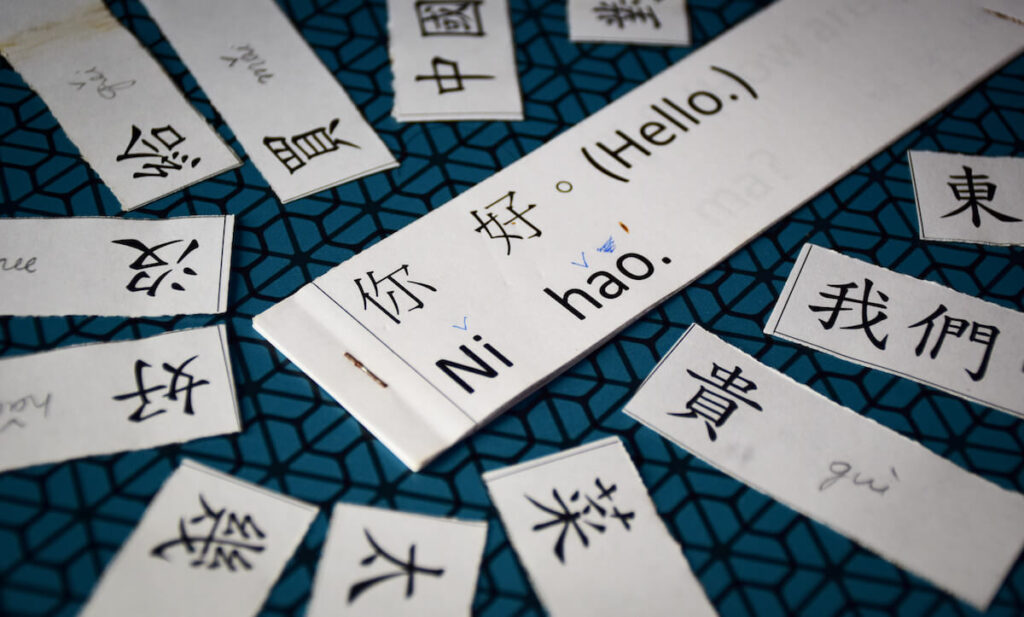
This is one of my personal tips to learn Chinese fast: Start slow. Sounds counterintuitive, I know, but it makes sense. When learning a new language, most people opt to concurrently learn a little bit of everything concurrently — learning beginner vocabulary with beginner expressions and beginner grammar.
Don’t do that when learning Chinese. Instead, take as much time as you need to focus on mastering the basics, specifically Hanyu Pinyin, basic vocabulary, and radicals. In fact, mastering radicals is quite literally the “key” to understanding Chinese characters.
Not only do radicals help you look up words in the dictionary but they can also help you learn, read, and understand Chinese characters quickly. Notice how the characters 猫 (cat), 狗 (dog), 狼 (wolf), 狮 (lion) all have the same radical on the left. This particular radical is usually associated with an animal or animalistic behavior. So even if you’ve never seen a particular character, the radical can clue you in as to what it might mean.
In addition, focus on building your vocabulary in the early stages of your learning. Since Chinese is a language where each character has its own meaning, you won’t get very far if you don’t have a grasp of basic vocabulary!
Set realistic milestones for yourself
With there being so many benefits to learning Chinese, I’d understand if you want nothing more than to rush through it and become fluent in the language. However, as I just said, the key to learning Chinese quickly is actually to take a slow and steady approach.
Chinese (Mandarin alone) is a vast and complicated language. You are bound to mess up every now and then. Don’t beat yourself over it. Instead, set realistic progressive milestones for yourself. Be clear about what success looks like. Don’t say “I want to achieve HSK Level 2 in three weeks”. Rather, commit to learning 50 new words per week, for example.
Take your time and practice regularly. As I said, even native speakers like myself are learning new things about the Chinese language every day!
Embrace Chinese culture and history

Truthfully, this is another one of my personal tips to learn Chinese fast. Given how ancient the Chinese language actually is, any interest in its history or culture will spur you on to learn the language more quickly.
And that’s not only because of the knock-on effect of being enticed by the subject matter! Because Chinese characters can be traced back thousands of years, loving Chinese history and culture can also help your understanding of Chinese characters, not to mention the origins of idiomatic expressions, nuances, and more.
Plus, who doesn’t like enjoying some Chinese food once they’re tired of studying?
Final thoughts
So, do you now have an idea about how long it takes to learn Chinese? I’m sure somewhere along the way as you read through this article, you’ve already found an answer, however clear or vague it might be.
Yes, Chinese is one of the most challenging languages to learn for English speakers. But that is somewhat mitigated by the multitude of resources available to avid language learners.
While it may take some time, as long as you set realistic goals, and focus on building a strong base, I’m sure that you’ll soon be able to improve your fluency in Chinese!