
The Chinese language is one of the most beautiful, challenging, and historical languages spoken today. And I’m not just saying that because it’s my mother tongue. In truth, there are many intricacies of the Chinese language that also shapes Chinese culture as a whole.
Today, I’m tapping on my years of Chinese proficiency to share with you 32 fun facts about the Chinese language that will either blow your mind or convince you to start learning the language yourself!
Interesting facts about the Chinese language
1. Chinese is probably not the language you think it is
First off, let’s start with this obvious fact about the Chinese language: Chinese itself isn’t the language that you hear when you visit China. What you’re hearing and what you thought was “Chinese” is actually Mandarin, the most commonly-used Chinese dialect.
Chinese, as a language, actually encompasses several main dialects including Cantonese and Hokkien.

2. Mainland China has a literacy rate of over 96%!
This is arguably one of the most impressive facts about the Chinese language. Despite having over a billion people, China has one of the world’s highest literacy rates. In 2018, it was at 96.8%!
That means that regardless of age or economic and social status, most people in China can read Mandarin.
3. The word Mandarin doesn’t exist in…well, Mandarin
Did this fun fact about the Chinese language come as a shocker? Yes, there is no actual word that translates to Mandarin in Chinese (unless you mean mandarins as in the juicy fruits!). Instead, most native speakers refer to Mandarin as putonghua.
4. Over 1.3 billion people speak Mandarin
No surprise here! This well-known Mandarin language fact is one of the reasons why so many people, including celebrities like John Cena and Mark Zuckerberg, choose to learn Mandarin.
In fact, it’s estimated that one in every six people speaks Mandarin. What’s more, it’s also one of the official working languages of the United Nations! Time to start picking up the language!
5. April 20 is Chinese Language Day!
I’ll be honest, this is one of the interesting facts about the Chinese language that I only recently found out. Since Mandarin is now an official UN working language, April 20 is now Chinese Language Day!
This annual celebration was apparently established in 2010 by the UN Department of Public Information to celebrate the Chinese language being part of the UN organization.

6. Mandarin speakers have different accents
Mandarin may be the most common Chinese dialect, but did you know that there are also different accents? Just like how English speakers sound different depending on where they’re from, the same goes for putonghua.
People in northern Mainland China sound gruff and like to emphasize the “r” sound. It’s also commonly considered the “standard” way to speak Mandarin.
Southerners (including people in Hong Kong speak with an accent that’s closer to that which is spoken in Taiwan, Malaysia, and Singapore. Each character is annunciated more clearly in this case.
7. There are also different writing systems
This interesting fact about Mandarin is probably quite well-known. There are two different sets of Chinese characters: Simplified Chinese and Traditional Chinese.
Simplified Chinese is mainly used in Mainland China, Singapore, and Malaysia. It is also almost exclusively used in Mandarin text. Traditional Chinese, on the other hand, is used in Hong Kong and Taiwan and can be used for Cantonese as well as Mandarin.
8. Different Chinese dialects aren’t often mutually intelligible
You might think that different dialects in Chinese sound different but are largely interchangeable. Unfortunately, they’re not. In fact, very often you’ll find that people who speak different Chinese dialects can’t understand each other at all.
For example, I speak Cantonese because I live in Hong Kong. However, a Mandarin speaker who doesn’t speak the dialect wouldn’t be able to understand what I’m saying because of how different the two sound!
9. Ni hao isn’t actually used among friends
This is one of the Mandarin language facts that truly grinds my gears.
Now, I’m not saying all the books and language apps that teach you ni hao as a greeting are wrong. But let’s get one thing clear, ni hao does not mean “hello”. It’s more like a “how do you do” that you say to someone you’re meeting for the very first time or someone you’ve not seen in years.
Let’s put it this way. If my close friend suddenly comes to me and says ni hao, my immediate thought would be that he’s trying to sell me something. Instead, if you’re meeting a friend, just say “hi”! And yes, there is a Chinese word for that: 嗨 (pronounced hai).
10. The nuances of the language permeate daily life in Chinese communities
The Chinese language is embedded so deeply in the daily life of native speakers, that it has also birthed certain superstitions.
For example, the number four (四) is often avoided in buildings and on car plates because it sounds like the word “die” (si).
Another example involves the taboo of gifting clocks to other people, especially elders. The verb for gifting a clock is 送钟 (song zhong) which sounds disturbingly like 送终 (same pronunciation) – making funeral arrangements.
Fun facts about learning Chinese
11. There are around 220 common radicals that make up the crux of Chinese characters
Here’s a fun fact about the Chinese language: It doesn’t have an alphabet. Instead, it has a collection of over 200 radicals (or strokes if you want to call them that).
These radicals are what make up Chinese characters. They’re quite an important aspect of the language to master since most dictionaries work using radicals as a point of reference.

12. In total, there are an estimated 50,000 characters in the Chinese language
With the 200-ish radicals, you can combine them to produce over 50,000 characters in the Chinese language. Each character has a unique meaning and some of them share similar sounds.
To make it even more mind-boggling, you then combine these 50,000 characters with each other to form words that have their own meanings that may be completely different from the original characters! It’s no wonder Chinese is considered one of the hardest languages in the world to learn!
13. The most complicated Chinese character is biang

This is one of those fun facts about the Chinese language that’s good to know but also one that I hope you shall never need for practical reasons.
Out of all the 50,000 characters in the language, the most complicated one is biang. It contains 62 strokes and is so complicated that you can’t even type it on a computer!
Thankfully, the “supercalifragilisticexpialidocious” of Mandarin only appears in one word: Biangbiang Mian, a popular noodle dish in the Shaanxi region.
14. However, you only need to know about 3,000 characters to read the newspaper
Good news! You don’t actually need to memorize all the characters in Chinese to actually be able to read or communicate. In fact, on average, knowing just about 3,000 characters will allow you to speak fluently.
If you want to sound more professional and profound, you just need to learn about 1,000 more specialized words. If you know 8,000 characters, you’re probably already at the level of a well-learned native speaker.
15. There is a romanized version of Mandarin
This Mandarin Chinese fact is welcome news for English speakers who want to learn the language.
While Chinese characters might look completely alien to you, language learners can actually learn Chinese pronunciation using Hanyu Pinyin, a romanization of Mandarin that uses alphabets and tone accents to teach new learners how to pronounce Chinese characters.
16. But Pinyin might not be the best way to learn Mandarin in the long term
While Hanyu Pinyin makes reading Mandarin much easier for English speakers, I personally don’t think it’s a good way to master the language.
That’s because, despite the romanized spellings, Mandarin isn’t a romanized language in essence. If you listen closely to Chinese conversations, you’ll realize there’s sometimes a slight difference between the Pinyin “spellings” and what you actually hear.
That’s because Chinese is more of a tonal language that emphasizes tone rather than pristine pronunciation.
17. There are actually more than four tones in the Chinese language
For Mandarin learners, one of the most famous Chinese language facts is that Mandarin has four basic tones: rising, flat, falling, and falling-rising. This is especially the case if you study Hanyu Pinyin. However, did you know there’s actually a fifth neutral tone?
Called qing1 sheng1 in Mandarin (literally meaning light sound), neutral tones are often very subtle and quickly glossed over. As a native speaker, I’d even say that neutral tones only exist in writing. Since it appears so briefly in conversation, most people don’t even pick up on it even though it’s quite a common aspect of Mandarin.
More importantly, different dialects in Chinese have their own tones as well. For example, Cantonese has a whopping nine different tones while Taiwanese has eight!
Also read: 10 Key Differences Between Mandarin and Cantonese

18. Different tones can vastly change a word’s meaning
This is likely one of the most well-known facts about the Chinese language. One of the reasons why it’s important to master the tone of Chinese characters is because a different tone can mean something entirely different.
What’s more, because there are many Chinese characters that sound the same despite meaning different things, mispronouncing a single character can lead to extremely embarrassing situations.
For example, if you say shui3 jiao3 yi4 wan3 duo1 shao3 qian2 (水饺一碗多少钱), you’re asking how much a bowl of dumplings costs. But if you mispronounce just the first two words, it will sound like you said, shui4 jiao4 yi4 wan3 duo1 shao3 qian2 (睡觉一晚多少钱), which means, how much does it cost to sleep over for one night!
19. But native speakers would probably still understand!
Even though Mandarin is a tonal language, the good thing about it is that even if you mispronounce the tone, most native speakers can still understand what you’re saying, provided there’s proper context.
For example, if you’re ordering a bowl of beef noodles, and instead of saying niu2 rou4 mian4, you say niu2 rou2 mian4 (a cow kneading dough), you’ll probably still be able to get what you ordered without any issues.
20. Heteronyms are rare in Mandarin but they do exist
One thing I like about Mandarin is that pronunciations are very straightforward…most of the time.
While most Chinese characters are pronounced the same way regardless of where they appear, there are a few heteronyms to take note of. For example the character 会. Generally, it is pronounced hui and means either “able to” or meeting/see depending on how you use it. However, in the word 会计 (meaning accounting), the same character is pronounced kuai.
That said, I wouldn’t worry too much because heteronyms are truly a rare occurrence in Mandarin. In fact, the previous example is so rarely seen that even some native speakers pronounce it incorrectly!
21. Chinese grammar is surprisingly simple
Here’s a fact that language learners will like about the Chinese language: Chinese grammar is quite basic.
As many native speakers will tell you, grammar isn’t all that important in Chinese, especially Mandarin. That’s because there are hardly any rules to remember.
For one, there is no such thing as plural nouns in Chinese, articles practically don’t exist, and changing verb tense is as simple as adding words like “yesterday” or “tomorrow” to your sentence.

22. Some Chinese dialects have their own characters
As if memorizing a few thousand characters in Mandarin isn’t hard enough, some dialects in the Chinese language have their own unique characters! I don’t mean it like some Mandarin characters are pronounced or mean something else in a different dialect, I’m saying these characters don’t exist outside of their own dialects!
For example, in Cantonese, there’s the character word 冇 (pronounced mou) means don’t have. While there is a technical Mandarin pronunciation (mao), the word is hardly ever used outside of the Cantonese context!
23. There are different kinds of idioms
For those looking to master Mandarin, here’s something you should know about the Chinese language. There are different types of idioms.
The most popular one, especially among language learners, is cheng yu, four-word idioms. However, there’s also a more advanced type of idiom called ming ju. Directly translated, this means “famous sayings”.
These are the more poetic kind of idioms, often quoted from sages like Kong Zi or from famous literary works. While not often used in daily conversation, they do add a level of flair when used in the right scenarios!
24. Chinese has some interesting translations for specific names
Here’s one of the funnier facts about the Chinese language. While it is possible to phonetically translate any English or foreign-sounding names into Chinese, it can sometimes be a real mouthful. That’s why in Chinese, certain names of celebrities and even countries sound vastly different than in English.
For example, the U.S.A is called 美国 (mei guo) meaning, the beautiful country. Another example is Cristiano Ronaldo, one of the world’s most famous footballers and sporting personalities. His name, if phonetically translated into Mandarin, should have been 克里斯蒂亚诺·罗纳尔多 but instead, he’s simply called C罗 (C.Luo)!
Facts about the history of the Chinese language
25. China used to be a fragmented land with different languages
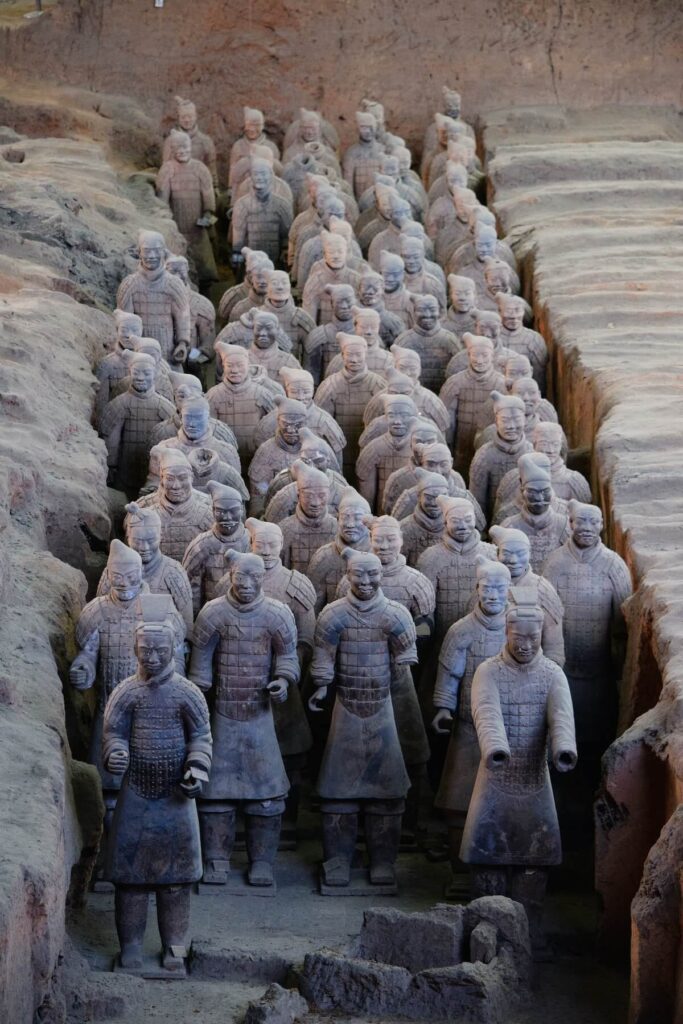
What if I told you, before the year 222 B.C. China didn’t exist at all? Instead, it was a collection of several warring “countries” (though they were more like states) that each spoke their own language and had their own writing system.
That was until Ying Zheng (better known as Qin Shi Huang, the first emperor of China) from the State of Qin conquered and unified all the warring states and established the Qin Dynasty. He then set about establishing a uniform language and writing system that laid the foundations for the Chinese language to evolve over the years into what it is today.
26. Chinese is one of the oldest languages in the world still in use
Here’s a historical fact about the Chinese language that will blow your mind: Some of the Chinese characters you see today can be traced back to over 3,000 years ago when characters were invented based on images.
Much like ancient Egyptian hieroglyphics, Chinese characters were developed based on how certain things look. Some of the characters today remain unchanged from when it was first invented for the very first time! For example, the word 山 (meaning mountain). Notice how the three vertical strokes resemble the peaks of a mountain ridge?
This makes Chinese the only surviving pictographic language in use today and one of the oldest surviving languages in the world!
27. In the past, Chinese was written and read from right to left!
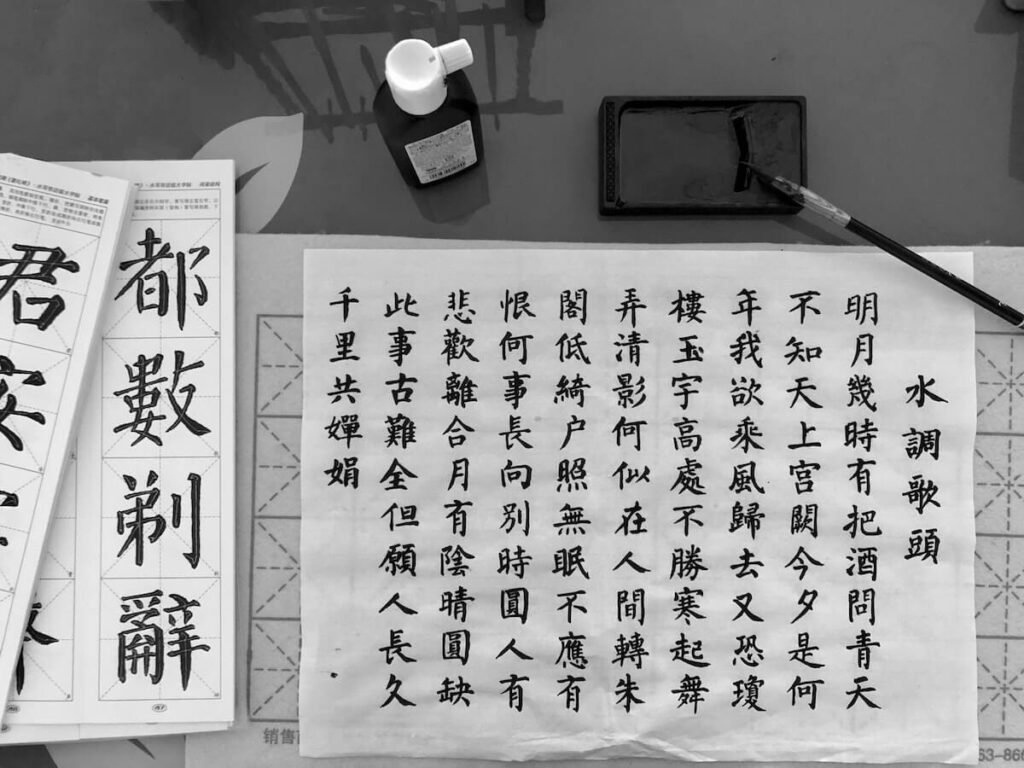
Here’s a fun fact about the Chinese language you probably didn’t know about. In the past, Chinese texts were written vertically from right to left. In fact, you can even find some books that still use this system!
This is because historically, Chinese text was written using brushes and ink. Writing from right to left was much more convenient as it prevented accidental smudging. In addition, some of the earliest Chinese texts were written on bamboo slats, so writing vertically was much easier.
28. Listen or read closely and you’ll find Chinese characters in other Asian languages
This interesting fact about the Chinese language probably isn’t all that surprising to avid language learners. After all, those who also study Japanese will no doubt have seen Chinese characters appear frequently in Japanese texts, especially when reading Kanji characters.
Because of how dominant the Chinese language was in the past, you can often find Chinese influences in plenty of Asian languages such as Japanese, Korean, and even Vietnamese. Some of the words don’t only sound the same but they also mean the same thing.
For example, the Korean word 부모 (bumo), meaning parents, is borrowed from the Chinese word 父母 (fumu).
29. In fact, some English words have Chinese roots!
This is probably one of those Chinese language facts that will catch most people unaware. Believe it or not, there are certain words in English that can be etymologically traced back to Chinese roots!
Some of these words include tea (an Anglicized pronunciation of the word teh in Hokkien), typhoon (borrowed from the word da feng or tai feng meaning strong wind), and brainwashing, which was literally translated from the Mandarin word, xi nao!

30. The most famous historical period in China was made famous by a historically-inaccurate novel
The era of the Three Kingdoms is easily the most famous historical period in China. There are books, novels, movies, TV series, and even anime adaptations based on that period of time!
However, the reason that era of Chinese history blew up around the world was because of the historical novel, Romance of the Three Kingdoms (ROTK), penned by Luo Guanzhong in the 14th century.
And yet, despite its fame, it’s not even historically accurate! While the story is largely based on available records of events that occurred during the Three Kingdoms era, large portions of the novel were either romanticized accounts of what actually happened or simply pure fiction!
31. That said, the novel is one of the most important pieces of Chinese literature
Despite being historically inaccurate, ROTK’s fame in China greatly influenced the language, giving birth to plenty of idioms and philosophical debates about politics. There were also certain stories in the novel that highlights just how eloquent the Chinese language can be.
One such example I remember is when Xun Yu, a strategist serving under the warlord Cao Cao, committed suicide after receiving an empty fruit basket from his master. You’ll have to read the novel for the full context but the theory is that the fruit basket was actually a hidden message.
Supposedly, Cao Cao was saying, “盒中无果,请君自采” – there is no fruit in the basket, please pluck it yourself. The word 自采 zi4 cai3 (pluck it yourself) sounds like 自裁 zi4 cai2 (suicide). Xun Yu, upon seeing the basket, understood the message and decided to end his own life rather than risk being executed by Cao Cao himself. I got literal goosebumps the first time I was old enough to understand!
32. There are four novels that are known as the Four Great Classical Novels
Along with ROTK, there are three other Chinese novels that have gained international renown. They are Journey to the West, Outlaws of the Marsh, and Dream of the Red Chamber. Collectively, these four works are known as the “Four Great Classical Novels” – 四大名著.
I highly recommend giving these novels a read, either in Mandarin or in English. Yes, they’re so popular that all four of these novels have been translated into English and other major languages!
Conclusion
Even as a native speaker, some of these fun facts about the Chinese language still leave me in awe every time. While there were times I loathed having to study such a complicated language, I am quite glad that I can speak the language fluently now.
If you’re trying to learn Mandarin, check out some of our top tips to learn Mandarin effectively, or search for the best resources to help you get started here.