
Out of all the different Chinese dialects, none are as widely-used as Mandarin and Cantonese. In fact, whenever we watch movies or consume media from China, most of them are in one of the two dialects.
However, have you ever wondered if there are any differences between Mandarin and Cantonese? As someone who speaks both dialects pretty well, I can definitely confirm that there are! Let’s check them out!
1. Mandarin and Cantonese have different tones

One of the key differences between Mandarin and Cantonese that you’ll notice first is that both dialects have different tones. Those who study these Chinese languages will know how important it is to master them. That’s because different tones convey different meanings.
In Mandarin, there are five tones while Cantonese has nine, although one can also say there are only six because three tones are simply there to incorporate syllables ending in p, t, or k sounds. If you ever wondered why Mandarin and Cantonese speakers sometimes struggle to speak each other’s dialect, now you know!
As a speaker of both dialects, I can confirm that the Cantonese tones are much more complicated but it’s something that one gets used to the longer they practice it. I recommend using some Cantonese learning apps to get the hang of it.
2. Both dialects have their own Romanization systems

Another major difference between Mandarin and Cantonese is the Romanization system. For those who study Mandarin, you are no doubt familiar with the Hanyu Pinyin system, and perhaps you the Zhuyin or Bopomofo systems if you’re studying Mandarin in Taiwan.
The Cantonese system trumps them all! There are over seven Romanization systems in Cantonese, which led to some confusing moments for me as a kid. That said, the Jyutping system is the most commonly used one in daily life, as most typing systems use that keyboard.
However, if you’re learning Cantonese from scratch, I recommend the Yale or Cantonese Pinyin system as they are more similar to Hanyu Pinyin.
3. Most words are also pronounced differently

One of the more amusing differences between Mandarin and Cantonese is the different pronunciation of certain words. If you study Mandarin and visit Hong Kong, you’ll notice certain words using similar characters but sounding different.
That’s because the pronunciation system in both dialects is different too, with certain initials in Mandarin (such as zh, ch, sh, and r sounds) not found in Cantonese, which also has its own exclusive initials such as the gw, kw, and ng sounds. What’s more, there are more ending sounds in Cantonese (53, compared to 35 in Mandarin), such as the “uk” and “it” sounds which aren’t found in Mandarin.
As a result, the pronunciation of some words is vastly different. For example the character, 肉 (meat). In Mandarin, it’s pronounced “rou” while in Cantonese, it’s pronounced “yuk”.
4. There is also a difference between Mandarin and Cantonese vocabulary

Taking it a step further from different pronunciations for the same character, some Mandarin and Cantonese vocabulary are just entirely different from one another. You’ll notice this immediately when you’re reading Cantonese books.
Some of the most interesting Mandarin vs Cantonese vocabulary that I can think of are:
- 哭 (ku – Mandarin) vs 喊 (haam – Cantonese), meaning cry
- 睡 (shui – Mandarin) vs 训 (fan – Cantonese), meaning sleep
- and 球 (qiu – Mandarin) and 波 (bo – Cantonese), meaning ball=
The funny thing is all three of the Cantonese characters in the example above have their own meanings in Mandarin: 喊 (to scream), 训 (to train or lecture), 波 (wave)!
What’s more, Cantonese also has its own colloquial vocabulary, such as 靓 (leng) which means pretty, and 陰功(jam gung) which means pitiful.
5. The Cantonese vocabulary is a little more colorful than Mandarin

This is one difference between Mandarin and Cantonese that I only found out after my friend from Ningbo, China pointed it out to me: There are a ton of words in Cantonese that are actually borrowed from English!
While there are some mutual loanwords in Mandarin and Cantonese, such as coffee 咖啡 (ka fei and kaa fe), there are some loanwords that you will only hear in Cantonese.
Off the top of my head, I’m thinking of 士多啤梨 (si do be lei), strawberry; 爹哋 (de di), daddy; 波士 (bo si), boss; 的士 (dik si), taxi; and 芝士 (ji si), cheese. In Mandarin, these words (in chronological order) are more commonly known as 草莓 (cao mei), 爸爸 (ba ba), 老板 (lao ban), 出租车 (chu zu che), and 奶酪 (nai lao).
There’s also a difference between expletives and curse words between Mandarin and Cantonese. The most common word in Mandarin is 操 (cao) while the most common curse word in Cantonese is 屌 (diu). What do these words mean? Let’s just say the first is a biological verb while the latter means a male-specific organ.
6. Code-switching is much more common in Cantonese

Following on from the Mandarin vs Cantonese conversation with my friend from Ningbo, I also came to realize that, people who speak Cantonese, especially people in Hong Kong, tend to code-switch a lot, especially when it comes to using English words in conversation.
For example, a Mandarin speaker might say 我要去购物 ( I want to go shopping) while a Cantonese speaker would say 我要去 shopping. In daily conversations, I realize my friends in Hong Kong would also just use the word “friend” rather than 朋友 (pang yao), and “local” instead of 本地 (bun dei).
I hadn’t realized it until my friend highlighted it but this rarely ever happens in Mandarin conversations. And I do think it’s because of the education system in Hong Kong and the city’s history. After all, Hong Kong was once owned by the British. Even today, English is quite an important subject in most schools and a big part of daily life here.
7. Mandarin uses Simplified Chinese while Cantonese uses Traditional Chinese

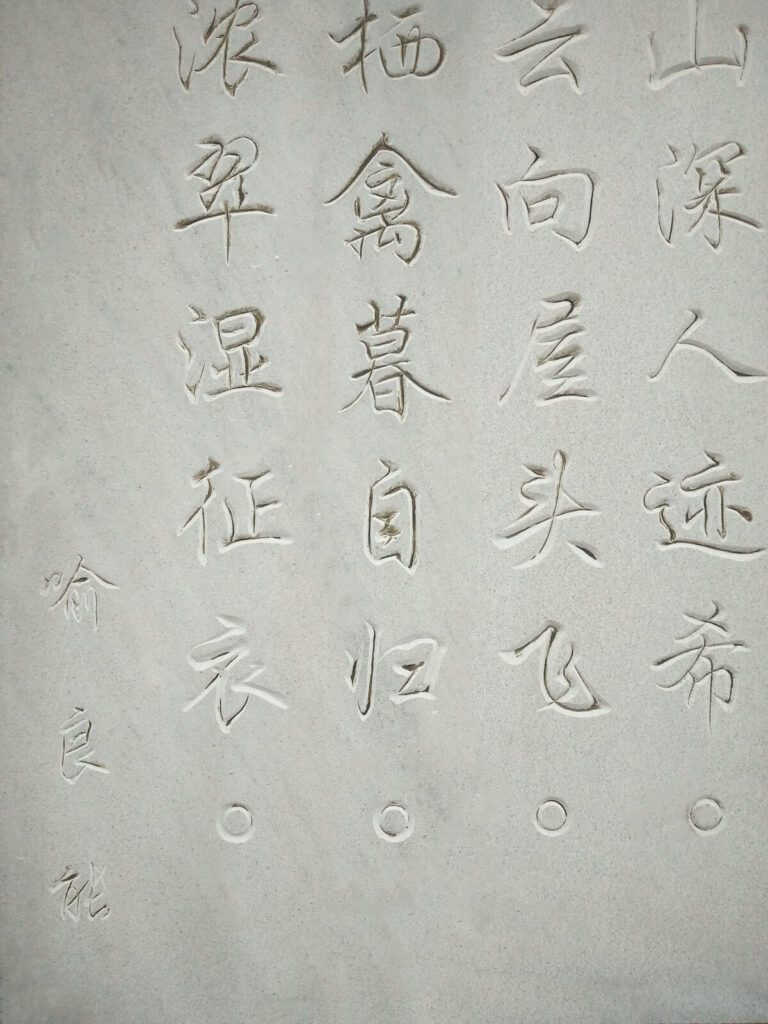
Another clear difference between Mandarin and Cantonese is found in written text. Even though both dialects are using Chinese characters, Mandarin uses the more modern, Simplified Chinese system while Cantonese continues to use the Traditional Chinese system.
Let me illustrate the difference using just one character: dragon. In Simplified Chinese, it looks like this: 龙, while in Traditional Chinese, it looks like this: 龍. Interestingly, both characters are pronounced the same (long) in both dialects!
Those who have studied either dialect for a while will usually be able to start recognizing characters in both systems but it does take a while. As a start, learn Mandarin and try to improve your Chinese handwriting!
8. Mandarin and Cantonese have slightly different grammar rules

More importantly, Mandarin and Cantonese have slightly different grammar rules. While the difference isn’t such a huge contrast that it would cause a communication breakdown, it can also lead to some awkward situations.
For one, in some Cantonese sentences, you will find an adverb appearing after the verb (like in English), but these almost never happen in Mandarin sentences. So for example, in Mandarin, one would say, 你先睡 (you-first-sleep) but in Cantonese, it’s usually 你睡先 (you-sleep-first).
There’s also the difference in sentence structure when it comes to double objects. In Cantonese, the direct object goes before the indirect object — 畀杯熱咖啡我 (give-hot-coffee-(to)-me). For Mandarin, it’s the indirect object that comes first — 给我热咖啡 (give-me-hot-coffee).
9. Most of China uses Mandarin while Cantonese is mainly used in the South

A more practical difference between Mandarin and Cantonese that language learners should take note of is where both dialects are used.
Mandarin is pretty much used throughout Mainland China (including Hong Kong) and Taiwan while Cantonese is often mainly used in the south (Guangdong and Guangxi Provinces, Hong Kong, Macau etc.). In 2020, there were roughly 84 million native Cantonese speakers, vs 933 million Mandarin speakers in China.
Both dialects are also widely used in countries where there are large Chinese communities like Malaysia and Singapore.
Fun fact: Guangdong Province used to be called Canton. Hence, Cantonese!
10. Mandarin is seen as a more “official” dialect while Cantonese is more culturally significant

Finally, the difference in perception between Mandarin and Cantonese. While Cantonese is more widely spoken than Mandarin in places like Hong Kong and Macau, you’ll notice that most official documents use Mandarin instead.
That’s because with it being more widely used in business and professional settings, and the fact that it is the official dialect of China, Mandarin is often seen as a more “official” dialect while Cantonese has a more cultural nuance to it. This is especially true when you think of the loan words and code-switching in the dialect.
While Cantonese was arguably the main dialect of the Chinese entertainment scene (think Cantopop and the rise of TVB in Chinese television) for a long time, more and more producers are now churning out media in Mandarin. That said, Cantonese remains a big part of the cultural identity of Hong Kong, Macau, and the Guangdong/Guangxi regions.
Final thoughts: Which should I learn?
And there you have it, 10 differences between Cantonese and Mandarin!
Perhaps one question you might have right now is, which dialect should you choose to study? While I love Hong Kong and the Cantonese dialect, I recommend that you learn Chinese (Mandarin) first before exploring the Cantonese dialect.
Not only is Mandarin more widely-used but it is also much simpler to master compared to Cantonese. And once you’ve done that, you would already have a foundation in the language that makes picking up Cantonese much easier! To get started, check out these incredible Mandarin learning apps!