
Spanish and Portuguese are mutually intelligible between half and 80% of the time. But don’t be fooled into thinking mastering one will automatically make you speak the other. I’ve put together this list of differences between Portuguese and Spanish so you’ll see how vastly unlike they can be.

Spanish and Portuguese are fraternal twins that tons of people swear are actually identical. I’ll show you why they aren’t, as their differences span a distinct approach to grammar, phonetic systems that are often worlds apart, and much more.
Major differences between Portuguese and Spanish
1. The geographic diversity of Spanish is a lot bigger.
Besides Spain, one African (Equatorial Guinea) and 18 Latin American nations have Spanish as their official language. Although Equatorial Guinea was only occupied by Spain from the late 1700s, the others were colonized by Spain as early as the 16th century and went on to develop their own national dialects of Spanish throughout the centuries.
With Portuguese, it’s a whole nother story. Brazil was indeed colonized in the 1500s as well, yet Portugal would just take possession or fully occupy the rest of its colonies like Angola and Mozambique in the mid-to-late 19th century.
While those countries eventually gave rise to their own linguistic varieties too, their dialects had less time to split off from European Portuguese as radically as Brazilian Portuguese did.
Plus, they’re way fewer: a mere eight nations on the entire planet speak Portuguese, and in several cases, it serves as a lingua franca rather than a national language.
2. Spanish has deep ties with Arabic, whereas Portuguese is more closely tied to French.

Portugal was one of the first western nations to become unified in 1139. From the Enlightenment in the 18th century all the way to the mid-20th century, both the European country and Brazil chose France as their civilizational role model, and as such imported increasingly more words and phrases from it.
Spain, in turn, would only manage to end the Arab occupation of its territory, which had lasted for over 700 years in 1492. Naturally, the Arabs left behind an immense architectural, cultural, and linguistic heritage.
In the following table, you can have a glimpse of how strongly each language impacted Spanish and Portuguese:
| Arabic > Spanish | Portuguese equivalent | French > Portuguese | Spanish equivalent |
|---|---|---|---|
| adoquín (sett) | paralelepípedo | abajur (lamp) | lámpara |
| albahaca (basil) | manjericão | batom (lipstick) | pintalabios |
| albañil (builder) | pedreiro | berço (crib) | cuna |
| alfil (chess bishop) | bispo | beterraba (beet) | remolacha |
| alquiler (rent) | aluguer (PT); aluguel (BR) | boné (cap) | gorra |
| ataúd (casket) | caixão | cassetete (cudgel) | porra |
| azafata (flight attendant) | hospedeira (PT); aeromoça (BR) | crocante (crunchy) | crujiente |
| enchufe (socket) | tomada | gorjeta (tip) | propina |
| mono (monkey) | macaco | greve (strike) | huelga |
3. The conjugation of pronouns of address is less complex in Portuguese than in Spanish.
English once had two forms of address that varied according to the formality of the interaction. In the language of Shakespeare, the distinction disappeared many centuries ago, but both Spanish and Portuguese have preserved it.
In Portuguese, the colloquial pronoun will be either tu or você depending on where you are (roughly tu in Portugal and você in Brazil), while the formal one is generally o senhor/a senhora.
In Spanish, you also have tú and vos (which is widespread in Argentina, Uruguay, Paraguay, Nicaragua, and Costa Rica and used to a lesser degree in other nations across Latin America) for informal usage and usted for formal situations.
Still, the thing is tu has its own conjugation, and você and o senhor/a senhora use the exact same verb forms. With Spanish, however, tú, vos, and usted are each conjugated differently in tenses like the Present Simple and the Imperative. What’s more, the conjugation of vos often changes depending on the country.
Check out a few examples of how that works in practice:
- English: Do you want to eat, Paul?
- Portugal, informal: Tu queres comer, Paulo?
- Brazil, informal: Você quer comer, Paulo?
- Portuguese, formal: O senhor quer comer, senhor Paulo?
- Spain, informal: ¿Tú quieres comer, Pablo?
- Argentina, informal: ¿Vos querés comer, Pablo?
- Spanish, formal: ¿Usted quiere comer, don Pablo?
4. Unlike Portuguese, Spanish spelling mirrors pronunciation almost religiously.

I say almost because some Spanish dialects will, for instance, pronounce the final S in words like the /h/ sound in “hospital” or even delete it altogether. In the meantime, zapato (“shoe”) is /thah-pah-toe/ in most of Spain and /sah-pah-toe/ in Latin America.
Yet overall, despite local variations on pairs like v/b, s/z, and ll/y, Spanish is unusually consistent in terms of the correspondence between what you write and what you read. Tomate (“tomato”) and pecho (“breast”), for example, are pronounced the same way across the Spanish-speaking world.
The Portuguese equivalents tomate and peito, on the other hand, change dramatically between Portugal and Brasil. Brazilians will say /tomah-chee/ and /pay-too/, whereas the Portuguese will pronounce them /t’maht/ and /pie-tə/.
5. Portuguese has more vowel sounds than Spanish.
English leaves nothing to be desired here, as depending on the dialect and how you count them it has 15 to 20 vowel sounds.
European Portuguese is slightly richer on that turf than Brazilian Portuguese. That said, both have around 15 vowel sounds as well.
Spanish, however, has roughly ten of these sounds: an oral and a nasal version of A, E, I, O, and U. Most famously, it lacks a few modulations in the sound of A, E, and O that characterize Portuguese phonetics.
For example: in Spanish, the E in both café and feo (“ugly”) is pronounced like the A in “bay”. In Portuguese, feio is /fay-oh/, but the E in café sounds like the A in “bad”.
Read more: 25 Fun Facts About the Portuguese Language
6. Portuguese has lost a lot more consonants in the words it inherited from Latin.

When he first came in contact with Portuguese, Hungarian-born Brazilian linguist Paulo Rónai thought it was “a version of Latin that kids and seniors speak, or in any case toothless folks”.
The humorous definition was prompted by the lack of consonants Rónai found in several words that derived from Latin. Here go a few examples together with their Spanish equivalents, which kept those same consonants:
| Portuguese word | Latin origin | Spanish equivalent |
|---|---|---|
| cadeia (chain) | catena | cadena |
| cru (raw) | crudus | crudo |
| fio (thread) | filum | filo / hilo |
| freio (brake) | frenum | freno |
| grau (degree) | gradus | grado |
| lã (wool) | lana | lana |
| lua (moon) | luna | luna |
| mau (bad) | malus | malo |
| meio (middle) | medius | medio |
| pessoa (person) | persona | persona |
| pôr (poner) | ponere | poner |
| teia (web) | tela | tela |
| veia (vein) | vena | vena |
| véu (veil) | velum | velo |
7. The two languages are quite similar; still, false friends can be tricky.
When I started to learn Spanish, finding out new words that had totally divergent definitions from similar or identical words in Portuguese, then using them in conversation, was one of my favorite parts about the whole thing.
You may not feel that’s as much fun as I did back then, but if you’re studying or planning to study both languages you should memorize at least the list below, where I’ve added words you’ll probably hear or use on a regular basis.
| Spanish | English | Portuguese | English |
|---|---|---|---|
| berro | watercress | berro | scream |
| borracha | drunk | borracha | rubber |
| brincar | to skip | brincar | to play |
| cachorro | cub | cachorro | dog |
| cadera | hip | cadeira | chair |
| cena | dinner | cena | scene |
| dirección | address | direção | direction |
| embarazada | pregnant | embaraçada | embarrassed |
| engrasado | greasy | engraçado | funny |
| enojado | upset | enojado | disgusted |
| exquisito | exquisite | esquisito | weird |
| oso | bear | osso | bone |
| padre | father | padre | priest |
| pelado | bald | pelado | naked |
| polvo | dust | polvo | octopus |
| quitar | to take off | quitar | to pay off |
| rato | moment | rato | mouse |
| saco | blazer | saco | bag |
| salada | salty | salada | salad |
| salsa | sauce | salsa | parsley |
| vaso | glass | vaso | vase |
| zurdo | left-handed | surdo | deaf |
8. In Spanish, some grammar rules exist only to avoid cacophony.

Spanish grammar is unusually concerned with euphony, i.e. how pleasant the language should sound. While that’s charming and poetic to an extent, it can make the life of foreign students a tad harder.
For instance, the conjunction y (“and”) becomes e if the element following begins with an /i/ sound. So you’ll write and say jamón y queso (“cheese and ham”) and Tomás y Mariana, but Juan e Isabel and aguja e hilo (“needle and thread”).
Likewise, o (“or”) turns into u in phrases like verano u otoño (“summer or fall”) and uno u otro (“one or the other”).
Even more complicated is how feminine nouns starting with an /a/ sound use a masculine article in their singular forms, such as el agua (“the water”) and el hada (“the fairy”), as opposed to las aguas and las hadas.
These sorts of shenanigans are unheard of in Portuguese. “And” will always be e, “or” is consistently ou, and nouns keep their article regardless of their initial sounds — you’ll just have to memorize their (pretty random) gender!
9. At least two Portuguese tenses don’t exist in Spanish.
I’m talking about the Conjugated Infinitive and the Future Subjunctive, which may sound like expletives if you’ve never studied a Romance language before. But their usage will become a bit clearer in a minute.
In Portuguese, when we want to say something like “For us to manage to work, you guys need to be quiet.”, we’d normally use the Conjugated (or Personal) Infinitive), as in Para nós conseguirmos trabalhar, vocês precisam fazer silêncio.
In Spanish, you’d use the Present Subjunctive instead: Para que nosotros consigamos trabajar, ustedes necesitan hacer silencio. A similar construction is possible in Portuguese (Para que nós consigamos…), yet it would sound slightly stilted.
Now though the Future Subjunctive does exist in Spanish, you’ll find it in courtly legalese. Everywhere else, you’ll also use the Present Subjunctive to translate a sentence like “When I leave, I’ll shut the door.” into Cuando me marche, cerraré la puerta., whereas in Portuguese you’d say Quando eu for embora, fecharei a porta.
10. Spanish loves object pronouns; Portuguese not so much.

In Spanish, if you ask ¿Le diste el sobre al señor López? (i.e. “Did you give the envelope to Mr. López?”), a common reply would be Sí, se lo di. (literally “Yes, I gave it to him”). In total, that’s an astonishing three object pronouns between question and reply.
In Portuguese, on the other hand, you’d typically say Você deu (or Tu deste) o envelope ao senhor Lopes? and Sim, dei. (literally “Yes, I gave”, though it’d be correctly translated as “Yes, I did”).
Did you notice the Portuguese interaction uses absolutely no object pronouns? We’re not really into them, to be honest. Unless they’re strictly necessary, as in Eu te vi ontem. (“I saw you yesterday”), we’ll do without them.
The Portuguese tend to be more sympathetic to object pronouns and reply with Sim, lho dei instead (where lho is a contraction of lhe and o, i.e. “to him” and “it”). Still, in Brazil, such a phrase at best create confusion and at worst utter incomprehension.
Final thoughts
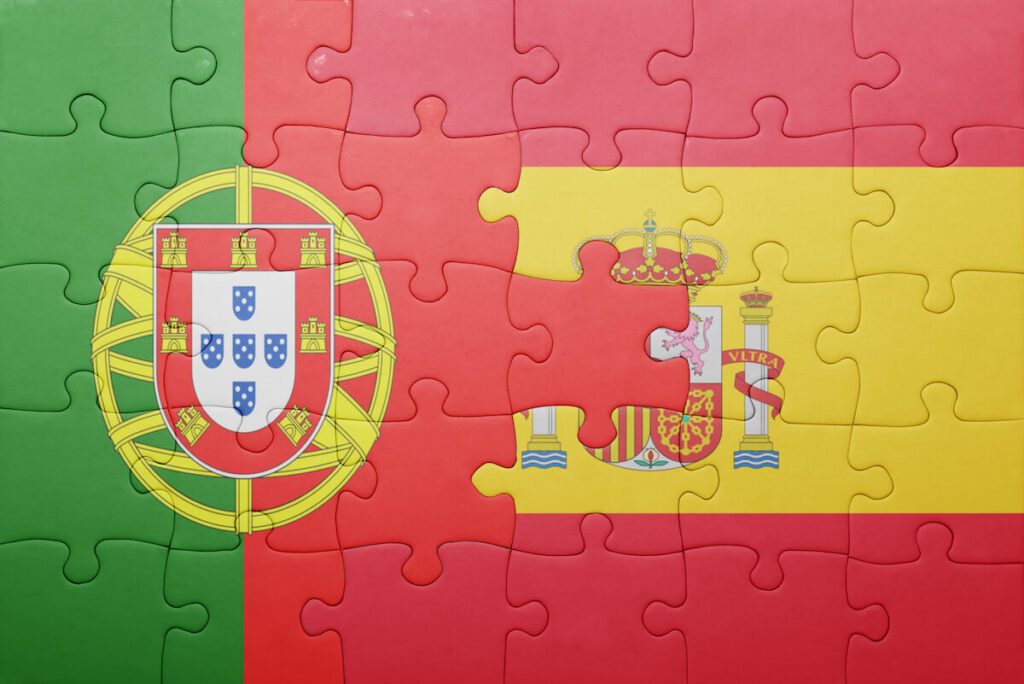
The list of differences between Portuguese and Spanish could go on forever, but then I’d have to go into specifics that would probably not interest you that much.
Though both languages stemmed from Latin and were born in the Iberian Peninsula somewhere in the Late Middle Ages, they would eventually develop separate grammar, spelling, and pronunciation, as well as come under the influence of distinct languages.
And in case you’re wondering whether to study Portuguese or Spanish first, the fact that they’re so similar should encourage you to learn Portuguese and Spanish — you’ll notice one will be way easier after you’ve mastered the other, especially if you rely on the best apps to learn Portuguese and Spanish learning apps.