
This article may contain affiliate links. As an Amazon Associate, I earn from qualifying purchases. For full information, please see the disclaimer here.
Cantonese is easily the second most widely spoken Chinese dialect in the world (after Mandarin). It is the main language spoken in Hong Kong, Macau, and large parts of Southern China. Even some Malaysians and Singaporeans speak it!
The good news is that Cantonese is much easier to pick up compared to Mandarin…as long as you have a solid understanding of the basics. And to do that, the best way is to pick up some good books to learn Cantonese and lay a firm foundation for your Cantonese learning journey.
Here are 14 of the best books to teach yourself Cantonese that I, a native speaker since birth, genuinely recommend.
Best Cantonese books for beginners
1. Daily Vocabulary Cantonese-English: Learning Conversational Cantonese for Kids


As adults, it might feel a little weird to pick up a book that’s meant for kids. But trying to master a foreign language, children’s books are actually some of the best tools at your disposal.
While this colorful vocabulary book caters specifically to children, it’s actually one of the best books to learn Cantonese for beginners. It features essential words and phrases that are written in traditional Chinese characters and accompanied by English translations so you can understand the meaning as you learn.
The book also comes with Jyutping pronunciation (Cantonese romanization system) and an audio CD to help you get the pronunciation just right. As an added bonus, the sentences are also color-coded so that you can get an early introduction to Cantonese sentence structure!
This book is best for:
- Total beginners who are just starting to learn Cantonese
- Building a bank of essential vocabulary
- An introduction to the Jyutping pronunciation system
2. Interesting Cantonese

Another great Cantonese book for beginners is Interesting Cantonese by Susanna Ng. Like the Daily Vocabulary book, this is a great book to teach yourself Cantonese words and phrases.
The big difference is that Interesting Cantonese doesn’t just stop at basic words or phrases. It has a much wider archive of words that are often used in daily conversation across a different number of fields. Basically, it’s a vocabulary book that’s suitable for both beginners and intermediate learners.
Like most books to teach yourself Cantonese, Interesting Cantonese comes with a number of audio CDs to help you effectively learn the proper pronunciation of the words you see in the book. Highly recommended.
This book is best for:
- Quickly expanding your range of Cantonese vocabulary
- Learning essential and practical expressions in daily conversation
- Improving your pronunciation of commonly used Cantonese words
3. My First Everyday Words in Cantonese and English

Another book that I highly recommend to beginners is My First Everyday Words in Cantonese & English. I’m sure you can already guess what this book is about based on the title alone.
This colorful picture book is another publication that caters to children. However, I feel that it also highlights plenty of essential nuances of the Cantonese language that will greatly benefit foreign language learners. Most importantly, apart from teaching you new words and phrases, the book also weaves in elements of Cantonese culture in its beautifully illustrated chapters.
You will learn the most basic conversational words, phrases, and questions that will get you speaking basic Cantonese in next to no time.
This book is best for:
- Learning basic questions and phrases to engage in simple conversations
- Understanding Cantonese culture to a certain extent
- Gaining the fluency to speak basic Cantonese
4. Illustrated Hong Kong Cantonese

- Amazon Kindle Edition
Rounding up my pick of the top three books to learn Cantonese vocabulary is Illustrated Hong Kong Cantonese.
Much like the other two books already mentioned, this book is best used by beginners to expand their word bank. Featuring essential words in five different categories (Basic, Eating, Living, Shopping, and Having Fun), the book allows you to learn Cantonese words using a number of different languages such as Mandarin, English, Korean, and more.
For those who already have a basic grasp of Cantonese, you can use this book as a revision tool and pick up another language along the way!
This book is best for:
- Learning Cantonese using a language of your choice
- Mastering essential vocabulary for daily conversation
5. Reading & Writing Chinese: A Comprehensive Guide to the Chinese Writing System

There isn’t such a thing as “Cantonese characters”. I’m sure many of you know this already. But just in case you’re not aware, Cantonese uses Traditional Chinese characters as its main script.
If you want to be able to read Cantonese without Jyutping romanization, you’ll need to first learn to read Traditional Chinese. To that end, Reading & Writing Chinese is one of the best books to study Cantonese because it doesn’t just teach you the characters, it also considers the Cantonese context.
Basically, even though Cantonese uses Traditional Chinese characters, the way Cantonese words are formed and arranged is sometimes different from Mandarin. With this book, you can learn over 2,000 characters and over 2,500+ Cantonese combinations within just 352 pages.
This book is best for:
- Learning how to recognize Traditional Chinese characters
- Reading and writing Cantonese words
Best Cantonese books to improve your fluency in Cantonese
6. Basic Cantonese: A Grammar and Workbook
No products found.
You might wonder why I listed a book that teaches basic Cantonese grammar in the middle of this list of books to learn Cantonese rather than at the beginning. The honest, personal answer is that unlike in English or other Asian languages, grammar isn’t all that complicated in Chinese languages. Improving your vocabulary is way more essential in mastering Cantonese.
That said, if you want to speak Cantonese fluently, it is still worthwhile to pick up a book about Cantonese grammar and sentence structure. This book is arguably the best book to learn Cantonese grammar. Despite focusing on a rather dry topic, the book’s clear explanations and interesting examples keep the learning process engaging and rewarding.
It breaks down complex sentences into separate parts to help you understand the fundamentals behind their structure so that you can apply it yourself when you speak Cantonese. To check your progress, simply make use of the quizzes in the book to test and review what you’ve learned periodically.
This book is best for:
- Improving your Cantonese sentence structure
- Improving your proficiency when conversing in Cantonese
- Supplementing other learning materials for a more holistic learning experience
7. Learn to Speak Cantonese I: A Beginner’s Guide to Mastering Conversational Cantonese

While listening to native speakers converse in fluent Cantonese is an important part of your journey in mastering the language, some learners can sometimes feel a slight disconnect. After all, certain local references may just fly over the head of foreign learners.
That is precisely why Learn to Speak Cantonese is such a refreshing book to learn Cantonese. Rather than only presenting staged conversations by native speakers, this book follows the story of an American boy, Gabriel, who is on a quest to impress his girlfriend’s mother in Hong Kong by learning Cantonese.
What ensues is an engaging story-centric learning journey punctuated by natural conversations about daily life in Hong Kong. You can also download flashcards from the related website to further supplement your learning.
This book is best for:
- Immersing yourself in an engaging Cantonese environment
- Picking up nuances in daily Cantonese conversation
- Learning practical words that can be used when visiting Hong Kong
8. Complete Cantonese: Beginner to Intermediate Course 1st Edition

- Hardcover Book
- Baker, Hugh (Author)
- English (Publication Language)
- 432 Pages – 03/01/2016 (Publication Date) – Teach Yourself (Publisher)
Even though this book is marketed toward both beginners and intermediate learners, I do feel that it is best suited for those who already have a basic understanding of Cantonese and wish to further improve their Cantonese communication skills.
Written by two of the best certified Cantonese teachers with plenty of experience between them, Complete Cantonese uses authentic conversations to help learners further develop their vocabulary bank, master Cantonese grammar, and improve their general fluency in the language. Along the way, you’ll also learn about the fascinating culture of Cantonese communities in Hong Kong, Macau, and Mainland China.
You will learn to read, write, listen, and speak articulately, or at least enough to survive in Hong Kong. Test yourself with the course review exercises at the end of each chapter to gauge your progress and work on areas that need attention too! Also, check out the 2nd Edition of this series which features 24 thematic chapters.
This book is best for:
- Progressing from beginner to intermediate mastery of Cantonese
- Building a strong foundation in all aspects of the language
- Improving your overall proficiency in Cantonese
9. A Dictionary of Cantonese Slang: The Language of Hong Kong Movies, Street Gangs, and City Life

If you’ve read our list of apps to learn Cantonese, you’ll know why A Dictionary of Cantonese Slang is one of the books I’ve included to study Cantonese. If you haven’t, basically, one important thing to understand about Cantonese is that it is a constantly evolving language that’s reflective of the latest trends and cultures.
For example, back in the late 2000s and early 2010s, popular Hong Kong actor Raymond Lam was often described using the word “chok” which meant electrifyingly handsome. For a while, the word went viral and everyone seemed to be using it. If you used this word in 2022 in Hong Kong, people might look at you funny because it’s now an outdated expression.
This unique dictionary/book curates and discusses various Cantonese slang words that are often seen in movies, comics, and vernacular Cantonese speech. It provides a historical background to the colorful language that Cantonese is known for today and teaches you plenty of urban slang terms that can help you sound like a local.
This book is best for:
- Further deepening your understanding of current conversational Cantonese
- Learning slang terms that locals tend to use
- Improving your conversation skills in Cantonese
10. Colloquial Cantonese (Colloquial Series)
No products found.
This is one of the best books to learn Cantonese if your goal is to be able to speak Cantonese colloquially and fluently.
As the name suggests, Colloquial Cantonese is a Cantonese textbook that helps learners familiarize themselves with written and spoken Cantonese. With topics organized by subjects to facilitate easier learning, the book teaches you the essential vocabulary (with pronunciation), phrases, and grammar to be able to communicate effectively in Cantonese.
While it may sound like a book that’s designed for beginners, personally I find it to be just a little more challenging than the typical beginner-friendly guidebooks. As such, it’s better for those who already have a good base in Cantonese and are looking to further improve.
This book is best for:
- Improving your fluency in Cantonese
- Perfecting your pronunciation
- Advancing to a higher level of proficiency beyond beginner level
Best Cantonese books for advanced learners and Mandarin speakers
11. 邊學邊用:粵語聽說教材 (Cantonese in Communication: Listening and Speaking)

- Amazon Kindle Edition
When it comes to progressing from intermediate level to advanced level Cantonese, as a local boy, I can tell you that no one does it better than the Chinese University of Hong Kong (CUHK). Their publications are often the most reputable in the city, and the same goes for their books for learning Cantonese.
Cantonese in Communication: Listening and Speaking is one of the top books to study Cantonese that’s suitable for those who already have a strong understanding of the language. You’ll learn more advanced vocabulary and phrases that are used in real-life conversations and situations in Hong Kong.
The catch is that you will hardly find ANY English instruction in the book. Instead, the key is to get the learner comfortable with reading and writing fully in Cantonese. If you got this far, this book will help you progress even more quickly towards mastering the language.
This book is best for:
- Advanced learners who want to reach maximum proficiency
- Picking up more sophisticated Cantonese vocabulary and everyday phrases
- Improving reading and writing in Cantonese
12. 粵語速成(高級教材)

Another great Cantonese textbook published by CUHK is the YueYuSuCheng Series. In English, it generally translates to Fast Cantonese.
Unlike the previous book, this one is actually a beginner-level book that introduces the learner to Cantonese, its pronunciation system, conversational nuances, and basic grammar. The catch is that all the instructions and teaching material are in Mandarin.
So if you’ve already mastered Mandarin and would like to try learning Cantonese using Mandarin instructions, this series is for you. In fact, I would recommend you do so since you’ll be able to better appreciate the differences between the two dialects.
The book is best for:
- Learning Cantonese using Mandarin
- Spotting the subtle differences between Mandarin and Cantonese
- Forming a fundamental understanding of Cantonese
Other books to learn Cantonese
13. Essential Cantonese Phrasebook & Dictionary: Speak Cantonese with Confidence
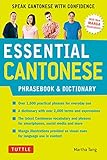
If your goal isn’t to give a moving five-minute speech in Cantonese and you just want to travel Hong Kong “like a local”, then it would be better to skip the usual Cantonese textbooks and just pick up this book of essential Cantonese phrases.
The words and phrases feature Jyutping pronunciation, so even if you’ve never seen a Cantonese word in your life, you’ll still be able to learn the proper pronunciation of what you’re reading.
While you probably won’t be as fluent as a native speaker using this, you’ll be able to master enough Cantonese to order food, shop, and maybe even bargain in the local dialect.
This book is best for:
- Learning essential phrases for a trip to Hong Kong
- Looking up specific words in English
- Casual learners who just want to pick up some Cantonese as a hobby
14. Periplus Pocket Cantonese Dictionary

Like Mandarin, one of the most important books to learn Cantonese is simply a dictionary!
While I don’t expect anyone to treat a dictionary like a textbook, it certainly is a useful tool to have whether you’re a beginner student or a traveler who needs emergency translation for certain words or phrases.
This particular dictionary relies on Jyutping romanization so you don’t have to worry if you don’t read any Cantonese or Mandarin at all. And, as an added bonus, the book is quite small so it fits into your pocket!
This book is best for:
- Translating and looking up the meaning of certain words and phrases
- Learning basic vocabulary
Tips & tricks for learning Cantonese
As a Hong Kong boy through and through, I’ll be perfectly honest: Learning Cantonese from scratch may actually be a little more challenging than learning Mandarin. Even though Cantonese is easier to pick up, there aren’t as many resources available to foreign learners.
That said, there are some ways (apart from using these books) that you can use to supplement your Cantonese learning journey.
Be clear about what you hope to achieve
In this case, most language learners simply yearn to be fluent in the language they are learning. If that’s the same for you when learning Cantonese, then I have some good news for you. You don’t really need to spend too much time learning how to read and write.
Cantonese, like Taiwanese, is a language that is more regularly spoken than written or read. So what you want to do is focus on expanding your vocabulary, and learning how to pronounce each word and phrase clearly enough to be understood. If you can do that, you’ll be able to speak Cantonese relatively fluently in no time!

Use an app to keep learning Cantonese fun
Needless to say, given the age that we live in today, Cantonese learning apps are one of your best companions if you’re looking to improve your proficiency in Cantonese.
While there are plenty of good apps, for me personally, the best apps are audio-centric apps like Pimsleur or vocabulary apps like Drops. In addition, if you want to be able to read Cantonese, learn to write and read using apps like Skritter.
Speak Cantonese with a friend
Cantonese is a verbal language more than anything. The more you speak it, the more fluent you become, even if you can’t read a single word of Cantonese. Because of this, one way to drastically improve your Cantonese is to find someone who can speak with you in the language.
My best recommendation is to download HelloTalk and find a language exchange partner on the app. If you’d prefer to have 1-on-1 tutoring sessions, you can find Cantonese tutors on Italki or Preply.
Watch all the TVB dramas you can find!
Okay, I admit, that’s a slight exaggeration. And also because some TVB dramas are so trashy I feel ashamed that I used to enjoy watching them. That said, one of the best ways to improve your Cantonese is just to watch Cantonese dramas or movies.
In fact, I have a friend from Singapore who learned to speak Cantonese fluently just by watching Cantonese shows since his childhood!
Most importantly, take it nice and slow
Learning a new language is definitely a challenge, especially one that’s as complex as Cantonese. However, I’ve seen my fair share of foreigners who mastered the language in just a matter of months. It’s the kind of language that, once you find a suitable way of learning, can be easily picked up by anyone.

So don’t be hard on yourself if you can’t speak Cantonese after two or three lessons. Just enjoy the process and eventually, you’ll be fluent enough to converse even with native speakers! And, if you find yourself in the mood for learning more, check out these books to learn Mandarin too!