*This article may contain affiliate links. For full information, please see the disclaimer here.
Being bilingual (or multilingual) is the dream for many of us. I’m sure I’m not the only one who wants to travel abroad without the need for translator apps, watch foreign films without subtitles, and read books in their original languages.
Let’s be honest though. Traditional methods like attending classes and poring over textbooks aren’t exactly convenient or fun. This is where language learning apps like Babbel and Mondly come in.

Two of the most popular language learning apps today, Babbel and Mondly are often pitted against each other. But which one is better?
In this Babbel vs Mondly showdown, we’ll be dissecting their learning approaches, content, features, and pricing to help you find the right (or better) language-learning app. Read on!
Babbel vs Mondly: A head-to-head comparison
Babbel and Mondly are both known for bite-sized lessons that aim to equip you with practical language skills. Both feature engaging exercises, visually appealing interfaces, and accurate speech recognition engines. Mondly highlights gamification while Babbel uses spaced repetition.
This chart lets you see how each app fares at some points you need to consider:
| Points of comparison | Babbel | Mondly |
| Languages offered | 14 languages | 41 languages |
| Learning methods | Focuses on grammar and vocabulary building through spaced repetition, with emphasis on speaking and writing practice; | Gamified approach, focus on visuals and audio, emphasis on practical phrases |
| Course structure | Structured courses ranging from beginner to advanced levels, thematic lessons and review sessions with listening, speaking, writing, and reading exercises; | Thematic units with gamified elements, vocabulary module, daily lessons, chatbot conversations |
| Pricing | Paid subscription with varying tiers | Freemium model with limited content; $12.90/month; 7-day free trial |
| Free features | First lesson in each course | Daily lessons, entire “Hello” category, one chatbot conversation |
| Other features | Games and podcasts (vary per course) | Conjugation tables, specialized courses, Mondly VR |
You’ve taken a glimpse, now it’s time to dig into the nitty-gritty.
Babbel vs Mondly: Languages offered
When choosing a language learning app, the number of languages offered can be a major deciding factor. How do Babbel and Mondly stack up in terms of language variety?

Babbel offers a curated selection of languages, prioritizing those with high learner demand and practicality for travel and business. These 14 languages are Spanish, French, Italian, German, Russian, Portuguese, Dutch, Swedish, Turkish, Polish, Norwegian, Danish, Indonesian, and English.
It’s worth noting that, unlike many apps that simply translate the course content into various languages, Babbel has unique content for each course. This is because the courses take cultural context into account. But course length varies too, and some language courses go up to beginner or intermediate level only.
Mondly, on the other hand, boasts a wider range of languages, catering to a broader spectrum of learner interests. It offers courses in 41 languages including all the languages Babbel offers, plus more obscure or less common choices like Hungarian, Vietnamese, Hebrew, Finnish, Afrikaans, Croatian, Romanian, Bulgarian, and Hindi.

If you’re studying a particular language, it’s best to find out if either of these apps has that language on offer. But if you’re an aspiring polyglot with no specific language in mind and the sheer number of languages is your top priority, then Mondly is the clear winner. For those focused on popular, widely-spoken languages and who want a well-developed course, Babbel might be the better choice.
Babbel’s learning methods and course structure
Babbel steers away from a rigid, one-size-fits-all method. This means you’ll work in manageable chunks that combine all sorts of exercises — speaking practice, matching pictures to words, writing drills, etc.

While courses are labeled with corresponding proficiency levels, you don’t have to take them in succession and you can start from the level you’re comfortable in. You can also find courses focusing on specific interests such as traveling and business. And as I said above, the language’s distinct features and cultural contexts are integrated into the course content, along with vocabulary and grammar.
That said, Babbel does stress two things: practical application and spaced repetition.
Babbel’s lessons are pretty immersive, prioritizing real-world scenarios and ensuring you learn practical vocabulary and grammar. You’ll encounter expressions you can use while traveling, shopping, dining out, or doing business with native speakers. When I was taking the French course, I even came across sentences you can use in dating app profiles!

To make lessons even more authentic, audio clips feature native speakers and not machine-learning bots. And to get you speaking, pronunciation drills use a speech recognition engine.
Babbel’s use of spaced repetition also makes it unique. You’ll find review lessons between every couple of lessons, as well as in the Practice section of the app.
Each item you learn goes through “stages” of review. Each time you answer a question correctly, that item moves up a stage. If you keep getting it correct, the interval for that item’s review increases. Get it wrong and it’ll move down a stage. The goal is for the item to reach stage 6, which signifies that you’ve committed it to long-term memory.

This review of Babbel explains the ins and outs of this app, go check it out!
Mondly’s learning methods and course structure
Like Babbel, Mondly also doesn’t have a strictly linear structure. Instead, it features theme-based modules centered around practical topics like greetings, shopping, dining out, using public transportation, and more. This means you can start from any module you prefer.

In fact, Mondly focuses on practicality, teaching vocabulary relevant to everyday situations. This is done through typing exercises, fill-in-the-blank questions, picture-to-word (and vice versa) matching exercises, listening and speaking drills, and translation quizzes. While the core of each lesson is vocabulary building, there’s a separate vocabulary module and word lists at the end of each unit.
To train your conversational skills, Mondly has a hands-free mode and chatbot with whom you can practice with.
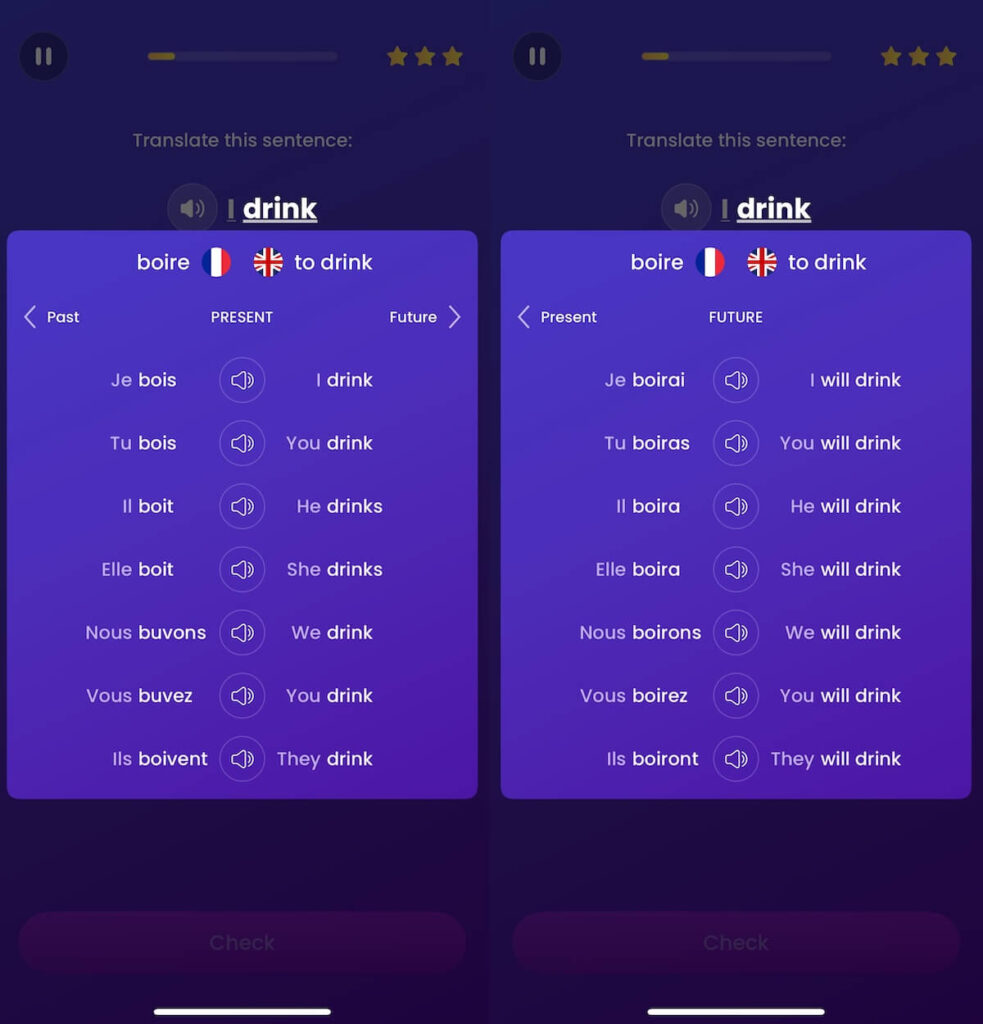
As for grammar, it’s not explicitly taught except in a few modules. Instead, Mondly integrates grammar lessons into conversation practice and you’ll learn from context. There are conjugation charts, however, for every verb that’s introduced in the lessons.
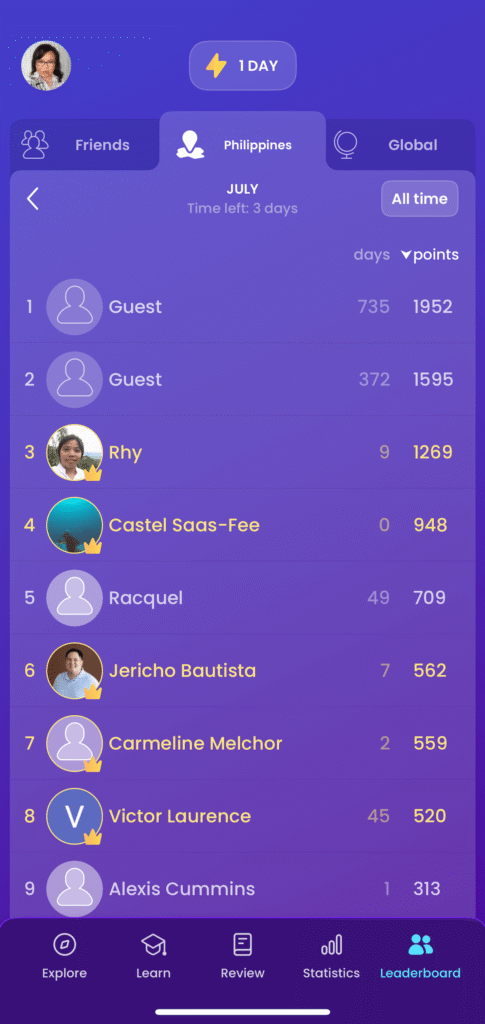
If you’ve already used Duolingo, you’ll find that Mondly is one of the closest in terms of its gamified structure. Mondly’s lessons take just about five minutes to complete. There are weekly tests and monthly challenges too. And if you’re the competitive type, earning points from your lessons and these challenges can help contribute to your standing on the leaderboard.
Want to know more about Mondly’s best features? Read this comprehensive Mondly review.
Babbel vs Mondly: Pricing and free features
Both Babbel and Mondly operate on a paid subscription model while also offering limited free features.
Babbel offers tiered subscriptions with varying lengths (1 month, 3 months, 6 months, 12 months) and prices. Generally, the longer the commitment, the lower the monthly cost (ranging from around $7 to $10 per month).

Babbel also has a one-time payment for lifetime access to all languages, which usually goes on sale. It promises a 20-day money-back guarantee too.
Mondly, on the other hand, works on a freemium model. A subscription for one language costs $12.90/month or $61.92/year. You can also get a lifetime subscription to all 41 languages at a discount (as of writing, this costs only $105). Mondly Premium is also free for 7 days.
When it comes to their free features, Mondly has the upper hand. The app has a free version that lets you access one daily lesson, the whole introductory section, vocabulary builders, and one chatbot lesson. On the other hand, Babbel’s free offering is limited to a single lesson for each language course. Still, this allows you to get a taste of their teaching style and content before committing.
Babbel: Pros and cons
If you’ve read my review of Babbel, you’d know that I love this app. It has many things I think should be present in language learning tools: challenging exercises, practical content, and immersive content.
Babbel’s lessons feature a variety of level-appropriate exercises that target all core skills, including writing. These exercises are just challenging enough to keep you engaged. The app’s speech recognition engine is particularly impressive as it requires near-perfect, if not perfect, pronunciation. I found this frustrating at times as I had to repeat some phrases over and over again, but it proved useful in improving my speech.

The vocabulary that Babbel teaches is also useful. You won’t find random words strung together. Instead, lessons are based on real-life scenarios and conversations. Sometimes, you’ll encounter singular words but this will always be followed by phrases or whole sentences that show how that single word is used. This means you’re not learning within context.
Even grammar is taught this way, but with concise explanations that you don’t often find in other apps.
Speaking of context, Babbel also does a great job of incorporating cultural context into its lessons. You’ll get a lot of cultural tidbits explaining customs and traditions and how some words are used in particular settings.

Another thing Babbel is great at is its use of spaced repetition. Not only does it encourage you to review a minimum of 10 words daily but also allows you to choose a review technique. Whether you feel like reviewing through listening exercises only or by using flashcards, it’s up to you.
Babbel’s not perfect though. Its biggest disadvantage is that offers fewer languages compared to Mondly and other apps, with a particular lack of Asian languages.
As mentioned before, content quality also varies across language courses. Some languages like French, Spanish, German, Italian, and Swedish courses have well-designed and comprehensive courses that take you from newcomer to advanced level. The same can’t be said for the Danish, Indonesian, and Norwegian courses.
Finally, if you’re looking for gamified courses, it’s best to look for Babbel alternatives. While it features bite-sized exercises, it doesn’t have the points and rewards system that gamified apps have.
Mondly: Pros and cons
When it comes to gamification, Mondly’s a solid option. Its leaderboard and competitions add a fun element to learning. Unsurprisingly, lessons are kept short and quick. You can easily finish a Mondly lesson in as short as five minutes, making it ideal for learners with busy schedules.
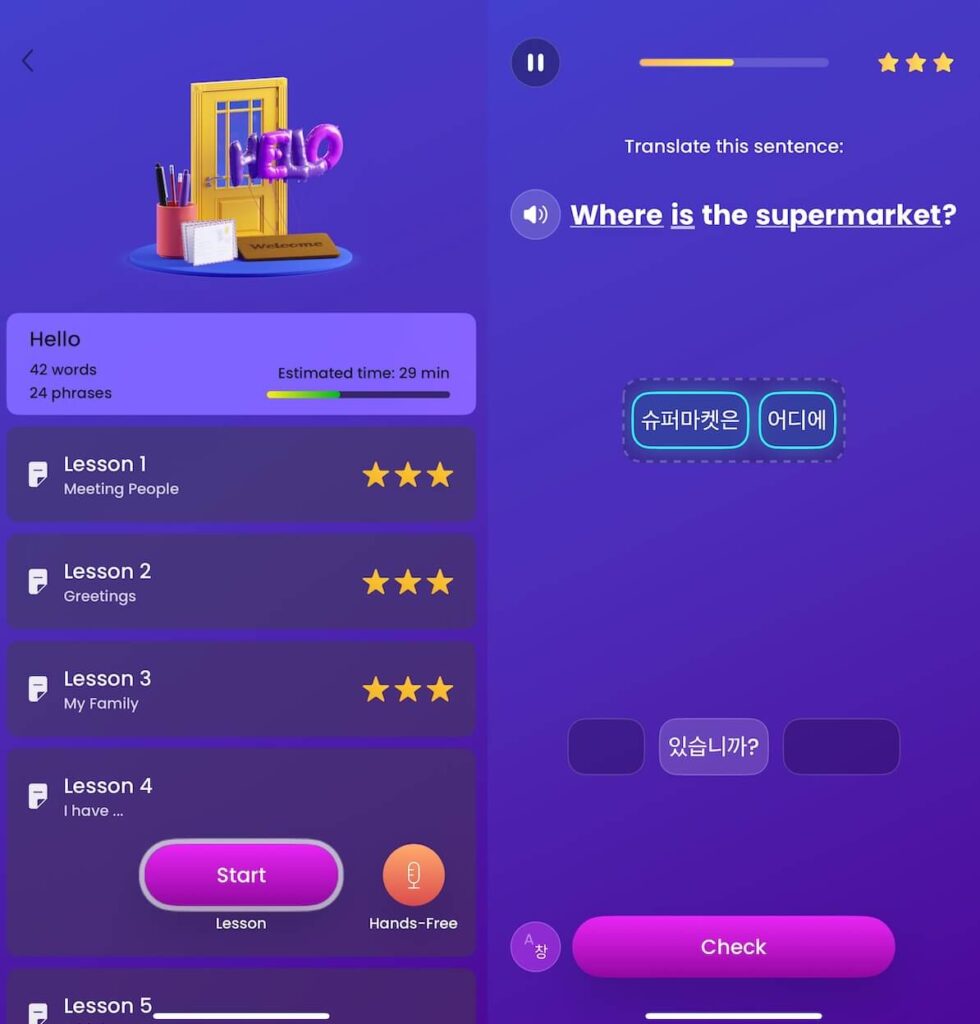
Its theme-based structure also means you don’t have to stick to a linear path. You’re free to choose topics that interest you. This can be helpful if you want to learn a specific set of phrases for traveling, for instance, and you have no time to go through vocabulary that you might not need for your trip.
Mondly’s also a great app for learning pronunciation. The hands-free mode is designed to help you learn on the go but I find that it also helps strengthen listening and speaking skills, especially if you’re an auditory learner. This, along with the chatbot feature, makes Mondly an immersive learning tool.
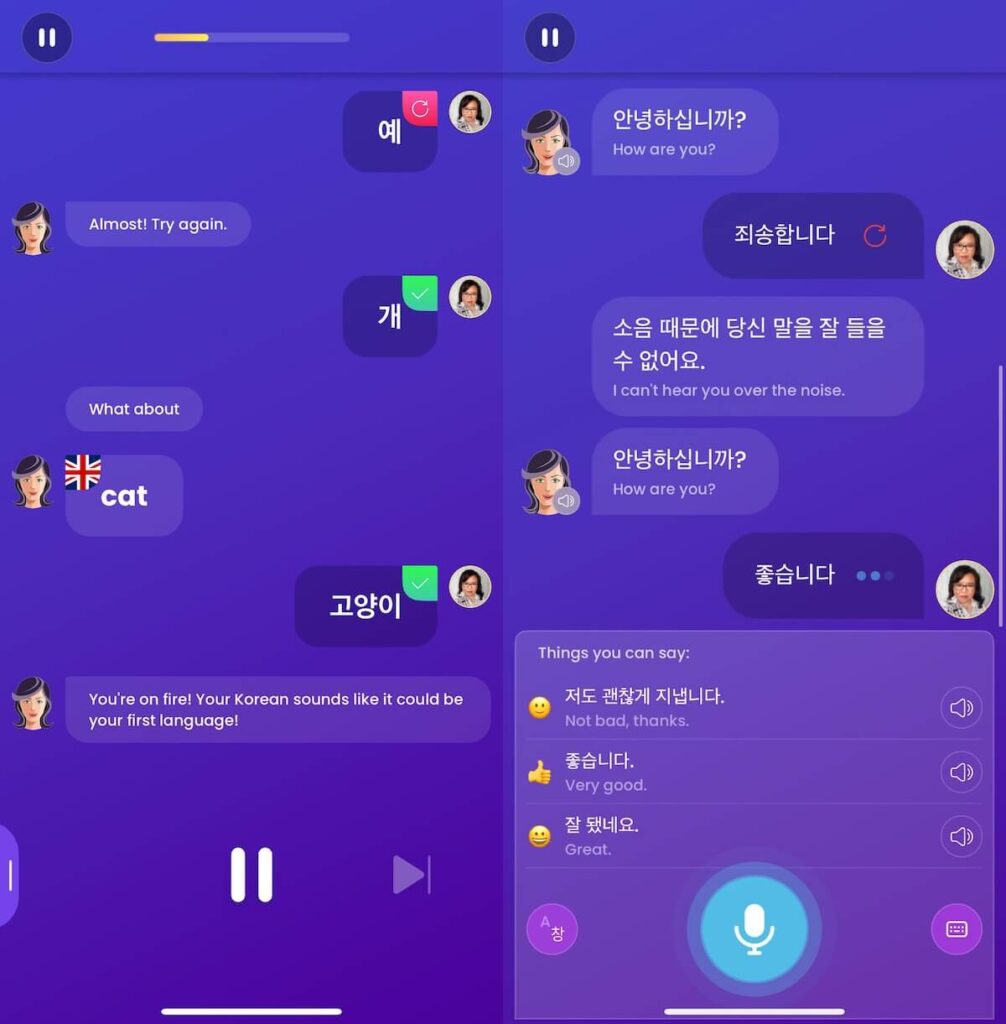
And, let’s not forget one of Mondly’s biggest advantages — the sheer number of languages it offers. Not only does Mondly have 41 languages on its roster, but it also gives you the flexibility to choose your base and target language. This means you don’t have to learn languages from English.
My biggest gripe about Mondly is its limited grammar focus. Apart from the three grammar modules and verb conjugation charts, the lessons don’t dwell on grammatical rules and structure. This is why I think Mondly is better suited for beginners and lower intermediate learners and not advanced learners.

Mondly also doesn’t explicitly teach writing for languages that use a non-Latin script. There are no writing drills, no built-in keyboards. If you already know how to read and write in your target language’s script, you can take exercises in the said script. But if you’re a complete beginner, you’ll either have to rely on Romanization or learn from another resource first.
Babbel vs Mondly: Which is better?
Babbel and Mondly offer distinct approaches. Ultimately, deciding which one is better for you depends on what you want to get out of your language learning experience.

If you want more focus and depth, Babbel’s comprehensive approach will prove more effective. It offers well-structured lessons that cover vocabulary, grammar, writing, listening, and speaking in equal parts so you develop a strong foundation in the language.
For gamification and variety, choose Mondly. It uses more vibrant visuals, leaderboards, and chatbots to keep you engaged. Its lessons are also shorter and focus heavily on vocabulary building through pictures and interactive exercises.
Both apps are great for learners aiming to build a vocabulary base and conversational skills but Mondly’s lack of grammar explanations can deter those who want a deeper understanding of the language. Babbel, with its focus on grammar and comprehensive lessons, has an edge in this area. For select languages, its courses can help achieve fluency, something I can’t confidently say about Mondly.
My advice is to try both apps first. Mondly offers a 7-day free trial while Babbel has free introductory lessons. Test their features first and see which one fits your goals and learning styles.

Do remember that no single app is perfect and it’s best to combine resources for a more holistic learning experience. You can pair Babbel or Mondly with comprehensive courses like Rocket Languages, audio platforms like Pimsleur, private coaching from italki, and even podcasts or books. Build your own language learning “toolbox”, practice daily, and you’ll soon find your way to fluency!
Babbel vs Mondly: FAQ
What is the difference between Babbel and Mondly?
Babbel offers structured lessons focusing on grammar, vocabulary, and conversation. Babbel’s spaced repetition system helps strengthen recall. Mondly leans towards gamification and vocabulary acquisition through pictures and phrases, making it ideal for beginners who want to learn the basics in a fun way.
Which app is better, Babbel or Mondly?
It depends on your goal and learning style. Babbel provides a more structured curriculum with a focus on grammar and speaking, making it ideal for building a strong foundation. Mondly, with its gamified approach and focus on vocabulary, is a good starting point, but might not be enough for serious learners.
Can you become fluent with Mondly?
While Mondly is a great tool to build vocabulary and gain basic conversational skills, fluency is likely out of reach with just this app. Mondly focuses on memorizing phrases and doesn’t offer deep dives into grammar or nuanced sentence structure.
Can you become fluent with Babbel?
Babbel’s focus on grammar, vocabulary, and speaking practice helps you achieve fluency but not in isolation. For well-rounded fluency, you’ll need to pair it with other resources, consume media in your target language, and converse with native speakers or tutors from italki.
Are Babbel and Mondly free?
Neither Babbel nor Mondly are completely free. Babbel allows you to try the first lesson of each language course for free. Mondly has a limited free version that lets you explore some basic features, but for ongoing access to multiple languages and advanced lessons, both require a paid subscription.
What is the best language-learning app?
Different apps cater to various learning styles and goals. Mondly, Ling, and Duolingo are great for gamified basics, while Babbel and Rocket Languages offer well-structured courses. Busuu and uTalk excel at vocabulary acquisition, while Pimsleur, Glossika, and italki help develop conversational skills. Consider your preferences and needs to find the app that best suits you.