You’ve learned how to start a conversation in Korean by saying hello. Now it’s time to take the learning further by learning how to say “goodbye” in Korean.
Like many Korean greetings and expressions, there are lots of ways to bid farewell in Korean. Phrases vary depending on who is leaving and staying. There are also various ways of saying “goodbye” in formal Korean, as well as informal.

A recap on Korean speech levels or politeness levels
In the article on how to say “hello” in Korean, we discussed the importance of formality and politeness in the Korean language. The phrase you say may differ based on the age and social status of the person you’re talking to. Your relationship or level of intimacy with this person will also dictate the politeness level, as you can be informal with people you’re close with.
To recap, there are three common levels of speech in Korean:
- Formal – Use this to show respect to a person of authority (i.e. a government official or your boss), customers (if you’re working in the service industry), in a very formal business setting, or someone older who you’re not close with. Formal speech is also commonly used in historical dramas and formal public broadcasts.
- Standard Polite – This is what you will commonly hear in Korea. You can use it in everyday speech, with people at work, or someone you don’t know very well.
- Informal or Casual – Use this only if you’re among close friends, somebody younger than you, or to children.
How to say “hello” and “how are you” in Korean

Before you learn how to say “goodbye” in Korean, you should learn how to say “hello” properly first. There are many ways to say “hello” in Korean but 안녕하세요 (annyeong haseyo) is the standard and most common.
But in more formal settings, you can say 녕하십니까 (annyeong hasimnikka). When in the company of close friends, you can be casual and say 안녕 (annyeong), which incidentally, is also an informal way to say “goodbye” in Korean.
It’s always nice to follow up “hello” with a polite “how are you?”. To do this, you can say, 잘 지냈어요? (jaljinaesseoyo?) or 잘 있었어요? (jal isseosseoyo?), which are both standard forms of “how are you?”.
And with these out of the way, you can finally learn how to say “goodbye” in Korean!
Also Read: How to Say “Hello” and “How Are You” in Korean
Ways to say goodbye in Korean + other Korean greetings
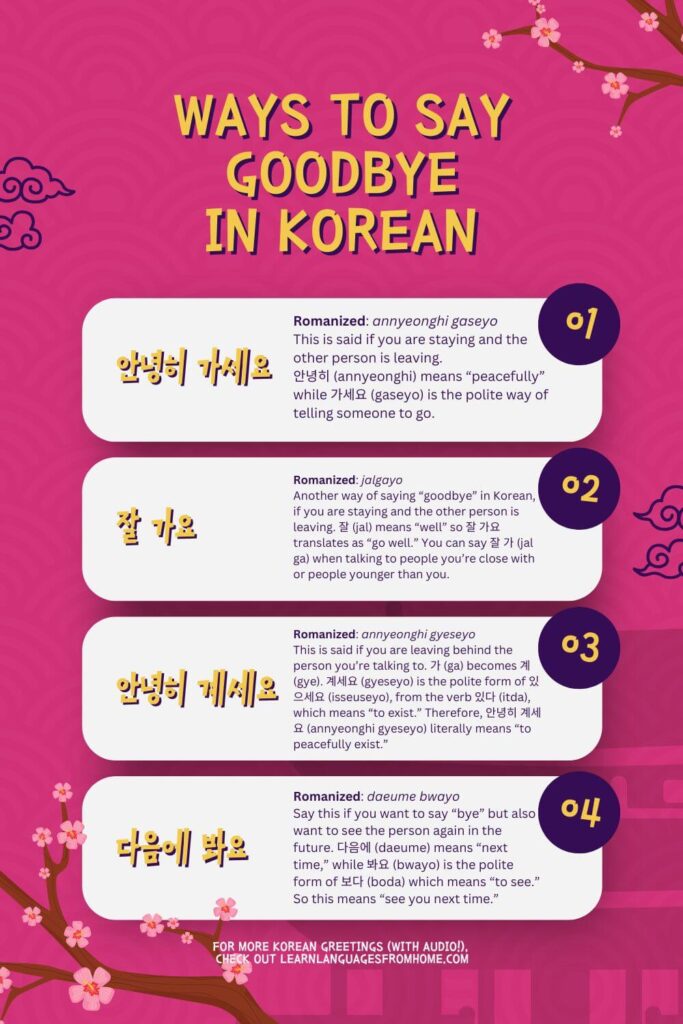
안녕히 가세요 (an-nyeong-hi-ga-se-yo) – Goodbye, if the other person is leaving

To say “goodbye” in Korean, you have to know first who is leaving. Is it you or the person you’re talking to? If you are staying and the other person is leaving, you should say annyeonghi gaseyo. 안녕히 가세요 is “goodbye” in Hangul.
Like in 안녕하세요 (annyeong haseyo), 안녕 means “well-being” or “peace”. In annyeonghi gaseyo, the 히 (hi) turns annyeong into an adverb so 안녕히 becomes “peacefully.”
There is no single Korean word for “goodbye,” but the word 가 (ga) is the closest. It means “go” or “leave” and 가세요 (gaseyo) is the polite way of telling someone to go. Put together, 안녕히 가세요 means “go peacefully.”
Here are other ways of saying “goodbye” in varying formality levels:
- 안녕히 가십시오 (annyeonghi gasipsio) – formal
- 가세요 (gaseyo) – shortened, and is commonly used by older people towards younger people
- 안녕 (annyeong) – informal
잘 가요 (jal-ga-yo) – Goodbye, if the other person is leaving
Another way of saying “goodbye” in Korean, if you are staying and the other person is leaving, is 잘 가요 (jal gayo). 잘 (jal) means “well” so 잘 가요 translates as “go well.” You can say 잘 가 (jal ga) when talking to people you’re close with or people younger than you.
안녕히 계세요 (an-nyeong-hi-gye-se-yo) – Goodbye, if you are leaving

Say you are leaving behind the person you’re talking to. To say “goodbye,” you can 안녕히 계세요 (annyeonghi gyeseyo). 가 (ga) becomes 계 (gye). 계세요 (gyeseyo) is the polite form of 있으세요 (isseuseyo), from the verb 있다 (itda), which means “to exist.” Therefore, 안녕히 계세요 (annyeonghi gyeseyo) literally means “to peacefully exist.”
And here are its other forms:
- 안녕히 계십시오 (annyeonghi gyesipsio) – formal
- 잘 지내 (jal jinae) – informal, translates to “stay well” and is used if you are not going to see the other person for quite some time (i.e. a few weeks)
- 잘 있어 (jal isseo) – informal. Use this to wish the other person well if you will see him/her in a few days.
The pronunciation of 안녕히 가세요 and 안녕히 계세요 can seem confusing at first. But with enough practice, you’ll be able to easily differentiate the two. And when you listen to native Koreans speaking these phrases, they usually speak fast so you won’t even notice the difference and just understand based on the context.
나 먼저 갈게 (na-meonjeo-gal-ge) – Goodbye, if you are leaving
Another way of saying “goodbye” in informal Korean is 나 먼저 갈게 or na meonjeo galge, which means “I will go first.” If you’ve been watching K-dramas or Korean variety shows for quite some time, this should be familiar to you because it is a phrase is frequently said in Korea. 나 먼저 가요 (na meonjeo gayo) is the formal way of saying it.
빠이 (ba-i) – Bye
The Korean language has a lot of Konglish (Korean + English) words and 빠이, pronounced as ba-i, is one of those. It is simply “bye” in Korean and since it’s a casual word, you can only use this to your close friends or close family members.
다음에 봐요 (da-eum-e-bwa-yo) – See you next time
If you want to say “bye” in the Korean language, but also want to see the person again in the future, you can say 다음에 봐요 (daeume bwayo).
다음에 (daeume) means “next time” in Korean, while 봐요 (bwayo) is the polite form of 보다 (boda) which means “to see.” So 다음에 봐요 means “see you next time.” In informal settings, you can say 다음에 봐 (daeume bwa).
If someone told you 다음에 봐요 and you want to say it back, you can respond with these:
또 (do) means “again” so 다음에 또 봐요 (daeume ddo bwayo) just means “see you again” or “see you again next time.” 또 봐요 (ddo bwayo) is its shortened but still polite version.
나중에 봐요 (na-jung-e-bwa-yo) – See you later

Another way of saying “goodbye” in Korean is 나중에 봐요 (najunge bwayo) which means “see you later.”
나중에 (najunge) means “later.” To make the phrase informal, you just have to remove 요 (yo) and make it 나중에 봐 (najunge bwa). Remember to use this only with close friends!
And just like with 다음에 봐요 (daeume bwayo), you can also add 또 (do) to make it 나중에 또 봐요 (najunge ddo bwayo), which means “see you again later.”
내일 봐요 (na-eil-bwa-yo) – See you tomorrow
If you’re saying goodbye to someone but you’ve made plans to meet up again the next day, you can say 내일 봐요 (naeil bwayo). 내일 (naeil) is the Korean word for “tomorrow” so 내일 봐요 (naeil bwayo) translates to “see you tomorrow.”
There are two other ways of saying this expression:
잘 들어가세요 (jal-deu-reo-ga-se-yo) – Go in well or enter well
Common greetings like “hello” and “goodbye” in Korean are also ways to wish for the well-being of the other person. Aside from saying the requisite “goodbye,” you can also say 잘 들어가세요 (jal deureogaseyo). You can say this when you are both leaving.
잘 (jal) means “well” while 들어가 (deuroga) means “to enter” so 잘 들어가세요 literally means “enter well.” You can use this phrase when the other person is going home or going back to school or work, or wherever it is he or she came from. 잘 들어가 (jal deureoga) is its informal version.
조심히 가세요 (jo-shim-hi-ga-se-yo) – Leave safely or have a safe journey

Another way to say “goodbye” in Korean, if the other person is leaving, is 조심히 가세요 (joshimhi gaseyo). The adverb 조심히 (joshimhi) means “carefully” so saying 조심히 가세요 is like wishing for safe travels for the other person.
조심히 가 (joshimhi ga) is the informal way of saying this. You can also say 조심히 들어가세요 (joshimhi deureogaseyo) if the other person is going home. Notice that this is a variant of 잘 들어가세요 (jal deureogaseyo). The difference is just the use of 잘 (jal) and 조심히 (joshimhi) but they virtually mean the same thing.
저 가야겠어요 (jeo-ga-ya-ge-sseo-yo) – Gotta go or gotta run
In English, we sometimes substitute “gotta go” or “gotta run” with “goodbye.” Koreans do the same by saying 저 가야겠어요 (jeo gayagesseoyo). When saying this to close friends, you can drop the 요 (yo) and say 가야겠다 (gayagetda).
끊을게요 (kkeunh-eul-ge-yo) – Goodbye on the phone

You’ve learned that to say “hello” on the phone, you have to say 여보세요 (yeoboseyo). But how do you say goodbye?
There are a number of ways of saying “goodbye” in Korean when ending a phone call. A common expression is 끊을게요 (kkeunh eulgeyo), as well as its informal counterpart 끊어 (kkun-heo). To say this in a formal way, like if you’re talking to your boss, you can say 끊겠습니다 (kkeunh gessseubnida). These phrases literally mean “I’ll hang up.”
Interestingly, 들어가세요 (deureogaseyo) is also used when saying “goodbye” on the phone. You can also say 다음에 또 연락드릴게요 (daeume ddo yeonlagdeulilgeyo), which means “I’ll get back to you later”. You can say this when the person on the line has a question or concern that you’re not able to attend to right away.
But perhaps, the most common way of ending a phone call in Korean is by saying 네~ (ne~), which means “yes.” 네 is a versatile Korean word – it can be used as a response but it can also be a question and in this case, it can be a way to punctuate a conversation.
잘 자요 (jal-ja-yo) – Good night
Finally, if you’re saying bidding someone farewell at night, you can also say “good night.” The most common way of saying this 잘 자요 (jal jayo) but there are plenty of other ways to say it:
- 안녕히 주무십시오 (annyeonghi jumusipsio) – formal
- 안녕히 주무세요 (annyeonghi jumuseyo) – standard polite
- 편안한 밤 되세요 (pyeonanhan bam doeseyo) – formal
- 좋은 꿈 꿔요 (joeun kkum kkwoyo) – standard polite
- 잘자 (jalja) – informal
- 굿나잇 (gun nait) – informal, Konglish
- 굿밤 (gut bam) – informal, slang. 밤 (bam) means “night” in Korean
Now you know the different ways of saying “goodbye” in Korean! You’ve definitely added handful of new entries in your Korean vocabulary.
Want to learn Korean but don’t know where to start? We have an extensive list of resources, including apps, online courses, books, podcasts, and online tutors for you to choose from! Happy studying and 다음에 봐요!
How to say ‘goodbye’ in Korean – Pin it!