
When you begin to learn Spanish, it’s easy to get overwhelmed with new vocabulary and grammar points. Sometimes, it’s nice to sit back and learn something more relaxed and interesting while you take a breather.
In this article, we’ll introduce you to 20 fun facts about the Spanish language. We’ll talk about language and alphabet development, pronunciation, history and much more! Keep reading for all the Spanish language facts you need!

1. There are 592 million speakers
There are around 592 million fluent Spanish speakers. Of these, 493 million are native speakers. Added to this, there are 99 million speakers who have limited capacity, with around 22 million being students.
With these figures, it’s the second-most spoken language after Mandarin.
2. Spanish is an official language in 20 countries
Believe it or not, Spanish is the official language in 20 countries around the world! This is either de facto or by law. In these 20 countries, Spanish is the main language used by the population and it’s the primary medium used in school.
Included in the 20 are Mexico, Colombia, Spain, Argentina, Peru, Venezuela, Chile, Guatemala, Ecuador, Bolivia, Cuba, Dominican Republic, Honduras, Paraguay, El Salvador, Nicaragua, Costa Rica, Panama, Uruguay, Puerto Rico, and Equatorial Guinea.
In addition, it is a significant language in Andorra, Belize, Gibraltar, and the United States.

3. Spanish is Castilian
In Spain (and other areas), Spanish is called castellano (Castilian) to contrast it against other languages that are spoken in Spain like Asturian, Aragonese, Basque, Galician, Occitan, and Catalan.
The 1978 Spanish Constitution uses this term to define this language as the Spanish State’s official language with the other Spanish languages being official in their Autonomous Communities.
4. Spanish has its roots in Latin
Spanish language history is so interesting!
Spanish is a Romance language and thus, descends from Latin. Compared to other Romance languages, Spanish differs from Latin to a small degree, similar to Italian and Sardinian. There is around a 20% difference.
Around three-quarters of modern vocabulary comes from Latin and there are also borrowing from English, French, Ancient Greek, and Arabic.

5. Spanish is heavily influenced by Arabic
Between 711 and 1492, the Iberian Peninsula was under Muslim rule. This has influenced both the language and the architecture.
Around 8% of Spanish words have an Arabic origin. One of the most frequently used words is the interjection ¡Ojalá!, which is difficult to translate into English but is derived from “if Allah wills [it].”
6. Spanish is ruled by the Real Academia Española (Royal Spanish Academy)
The Real Academia Española has existed since 1713 and was designed to ensure the Spanish language was kept pure. Essentially, it maintains the formal language of the country.
Back in November 2010, the RAE announced some changes to the official language. Despite being considered so since the 1800s, the letters “ll” and “ch” are no longer classed as official letters of the alphabet.
Another change was that the accent was removed from the word solo. Before the changes, sólo meant only and solo meant alone.
7. Spanish is a phonetic language
What makes Spanish so easy to learn as an English speaker is that it’s a phonetic language. This means that it’s very easy to pronounce correctly from the written word. If you know the spelling of a word, you will know how to say it.
However, if you know how a word is pronounced, you still might not be able to spell it correctly due to silent h or confusion between b and v.

8. The Spanish language inverts question marks and exclamation marks
Spanish (along with some other of Spain’s minority languages) is the only language to use inverted exclamation marks and question marks.
This is quite a new invention and was recommended for the first time by the Real Academia Española in 1754 in the second edition of the publication Ortografía de la lengua castellana (Orthography of the Castilian language).
9. Spanish grammar became official in 1492
In the very same year that Christopher Columbus arrived in the Americas, Elio Antonio de Nebrija published the first Spanish grammar, Gramática de la Lengua Castellana. This set Spanish grammar in stone and was the first such study of its kind.
10. The pronunciation of the letter ‘c’ varies depending on where the Spanish is spoken
Depending on where you go, the letter ‘c’ in Spanish is pronounced differently.
In Latin America, the Canaries and some parts of Andalucia, when the ‘c’ comes before “i” or “e”, it is pronounced like an ‘s’. This is called seseo. Conversely, in the majority of Spain, the letter ‘c’ is pronounced like ‘th’. This is called ceceo.
11. Spanish sentences are generally longer
It is well-known among translators that when translated, texts in Spanish are between 15% and 25% longer. This isn’t down to how many letters are in each word, rather it’s that the Spanish language needs more words to say the same thing.
For example, in English, we describe something as going “clockwise”. In Spanish, you need to say “in the direction of the clock’s needles” or en el sentido de las agujas del reloj.
This isn’t unique to Spanish; all Romance language texts are generally 1/4 to 1/5 longer than the same text in English.
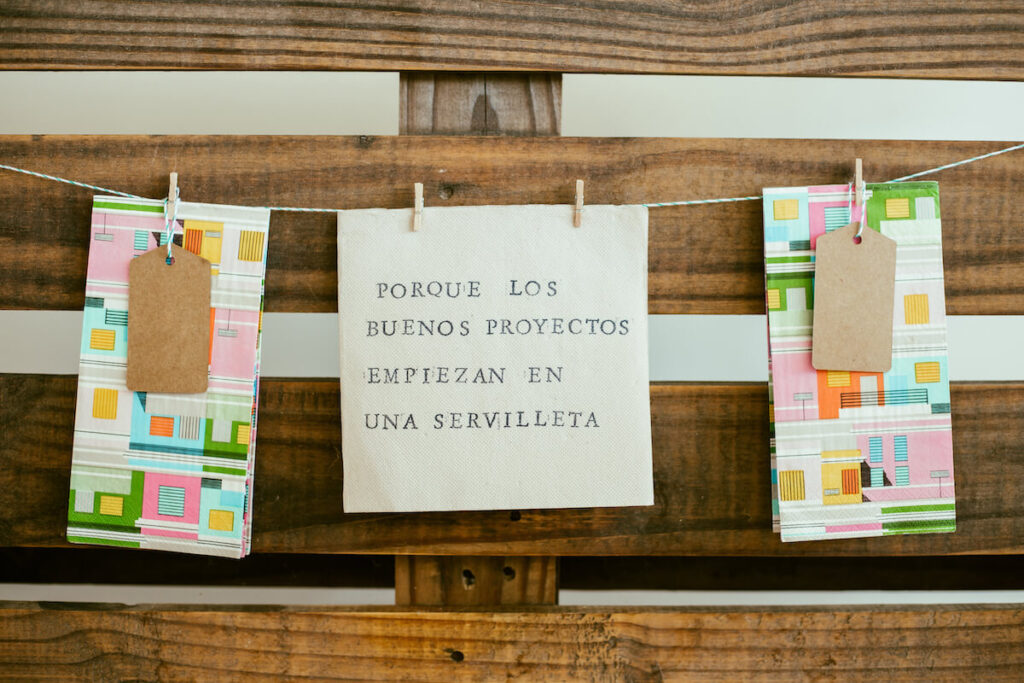
12. The earliest texts in Spanish were written more than 1000 years ago
For many years, it was believed that the first written texts in the Spanish language dated back to 964. The Glosses of Saint Emilianus or Las Glosas Emilianenses were notes written onto a Latin religious manuscript. It’s believed that the author was a Suso monastery monk.
However, in 2010, the RAE announced that the Cartularies of Valpuesta from Burgos were the first examples of Spanish in text form. These were written in medieval times around 800 A.D.
13. There are Spanish words that have no translation into English
Sometimes, you just can’t find the right word for your translation… maybe that’s because there just isn’t one!
Here are some examples of Spanish words that just can’t be translated into English with a single word:
- Sobremesa = after-dinner conversation
- Puente = lit. bridge (but not in the physical sense). A puente is when a public holiday falls on say a Thursday or a Tuesday. Many workers would put a day’s holiday in on the Friday or Monday respectively to ‘bridge’ the gap and make the most of the long weekend. We don’t have this in the UK because our public holidays are usually always on a Monday, and we don’t have many of them either compared to Spain!
- Consuegro/consuegra = the father/mother of your son/daughter-in-law. For example, “this is Jane, she is my consuegra” means this is Jane, she is the mother of my son/daughter-in-law. Confused yet?!
14. Accents on letters matter and can change the meaning of the word
Accent marks in Spanish are important. This is because an accent’s placement can make a sentence change its meaning.
When I was a Spanish teacher, one of the first phrases I would teach new learners was how to say their age – e.g., tengo once años. Inevitably, when it came to marking their work, I’d often see tengo once anos. When I informed them of the meaning of ano (anus), it got quite a lot of giggles – and they did remember the accent in future!
Other similar words include:
- El (the) – él (he)
- Mi (my) – mí (me – object pronoun)
- Se (reflexive pronoun) – sé (I know)
- Si (if) – sí (yes)
- Te (you – object pronoun) – té (tea)
- Tu (your) – tú (you)
15. One word can mean two different things
As well as accents changing the meaning of a word, gender can too! Here is a list of some common Spanish words that have different meanings depending on whether you use ‘el’ or ‘la’.
- La cometa (kite) /el cometa (comet)
- La pendiente (slope)/el pendiente (earring)
- El cura (priest)/la cura (cure)
- La coma (comma)/el coma (coma)
- La frente (forehead)/el frente (front)
- La papa (potato)/el papa (pope)
- La parte (portion)/el parte (document)

16. There are 30,500 Spanish words that contain all five vowels
Another one of our interesting facts about Spanish language is that there are 30,500 words that contain all of the vowels a, e, i, o, u.
Here are some examples:
- Murciélago = bat
- Abuelito = grandpa
- Ruborizarse = to blush
- Sanguinolento = bloody/bloodshot/bloodstained
17. There are two words that both mean “to be”
Spanish can be confusing for English learners, and nothing quite beats the confusion students have when they realise there are two verbs that both mean “to be”. These are ser and estar.
Ser is used for permanent states like physical features – e.g., soy baja = I am small.
Estar is used for temporary states like the location or a feeling – e.g., estoy en casa = I am at home.
However, despite death being 100% permanent, the Spanish language uses estar, e.g., está muerto= he is dead.
18. The Spanish word for “I” can be pronounced in different ways
Depending on where you’re from, the pronunciation of the Spanish word for “I” differs.
In Spain, for instance, it would be pronounced as it’s written “yo”. In Argentina, this would be more like sho. In Mexico, you might hear jo.
19. The phrase “I love you” is different depending on who you’re saying it to and why
In Spanish, there are two ways of saying “I love you”. These are te quiero and te amo. The former is said between close relations, while the latter is usually said in a more romantic way – though it can be used with a very close relation.

20. The letter ñ is the only letter of Spanish origin
The Spanish language uses the Latin alphabet. Back in the 12th century, Spanish scribes began placing the tilde over the ‘n’ to indicate that it was a double letter. For example, the Latin word for the year was annus, which eventually got written as año in Spanish.
Final thoughts on our 20 Spanish language facts
So, how many did you already know?!
Learning a language is so interesting and Spanish is no different. Learning about the language’s nuances and peculiarities adds another dimension to your studies too!
If you fancy exploring these facts more, why not see how many more words you can find that contain all of the vowels? Or find some words that mean something else if gender or accents are altered?
Have fun!