
*This article may contain affiliate links. For full information, please see the disclaimer here.
Do you have fond memories of language learning in the past or have you enjoyed traveling in foreign climes? Then you might fancy trying your hand at learning a language.
When people are interested in learning a language, the first thing that springs to mind is going to classes. While this might work for some, for people with changing shift patterns or low budgets, it’s just not possible. The good news is that you can learn a language without even leaving your house!
Read our step-by-step guide on how to learn a language at home.
Step 1: Design a learning schedule and strategy
As with most things in life, you’re more likely to get the results you want if you plan things in advance. It’s no good saying I’m going to learn Spanish from home if you don’t know what that’s going to look like and how you’re going to do it.
When you have a strategy, you’re empowered and have control over your language learning. As a result, you’ll be more motivated and will see quicker results.
To design your program, you need to think about your goals and how you are going to build good habits. Everyone has their own motivations, so what worked for your friend might not work for you.
If your goal is to travel around Argentina, you’ll want to master the language and skills that you’ll need for that trip. If your goal is to be proficient in German for work, you’ll have different needs in vocabulary, structures, and formalities.
Deciding your goal is much easier than building up the habits you need to achieve that goal. Work out how much time you can allocate to your learning each week and then break it down into small chunks (it’s much better to learn this way as language learning requires a lot of repetition before it sinks in).
Step 2: Learn at your level

If you’ve already got some basic knowledge of the language, you won’t need to start from scratch. Doing so would be off-putting.
Beginners wanting to know how to learn a new language from home should probably begin with the basics. This includes the most important and common verbs, high-frequency adjectives, and things like numbers. However, if you’re really interested in a specific topic, you could just start with that – that’s the beauty of learning from home!
Step 3: Incorporate a fun element

You’ve chosen to learn a language from home, which means you’re the teacher and you decide how you get to learn!
When you’re having a good time, you’re more likely to learn well and remember the content. When learning is engaging, it’s memorable. What you find fun is quite personal. You might find fun in listening to engaging online content like YouTube videos or you might enjoy trying to follow an authentic recipe in a foreign language.
Essentially, try to incorporate the activities you find enjoyable in your native language into your language learning. I love watching the English (bilingual French) comedian Paul Taylor on YouTube as he explores the French language and French people in funny comedy sketches. As an English speaker learning French, it’s very entertaining.
Pro tip: Apps like Lingopie and FluentU make learning much more fun by using TV shows, movies, YouTube videos, music videos, and other entertaining content to teach languages.
Step 4: Use language apps
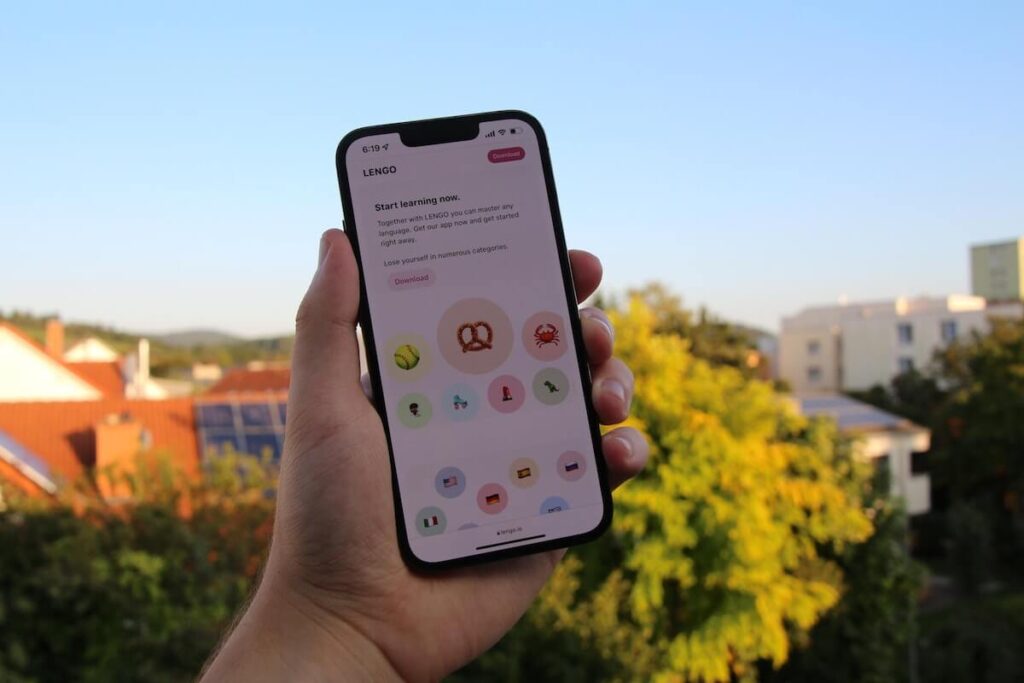
Language apps like Babbel and Duolingo are excellent for language learning – and they’re also fun.
Duolingo is a free app that has dozens of different languages on offer. What’s great about it is that it incorporates all of the different elements of language learning into the app: you’re required to listen, read, write, and even speak. If you’re learning on the go, you can even choose to skip the listening or speaking elements temporarily.
Essentially, Duolingo makes learning easy to incorporate into your everyday routine (and it will also remind you if you haven’t accessed it for a while).
Ling and Mondly are also great gamified apps that you can explore.
Step 5: Tune in to audio

If you’re interested in how to learn a language at home using authentic resources, here are some ideas. Thanks to the internet, it’s really easy to stream radio stations from all over the world. The website TuneIn provides access to hundreds of foreign radio stations. You can find podcasts, talk radio, contemporary music, and much more.
Building on this idea, there is an amazing website called News in Slow. Here, you can learn Spanish (Spain or Latino), French, Italian, or German by listening to current events and news spoken slowly. There are three different levels for each language: beginner, intermediate and advanced.
For podcast-like lessons that really hone your conversational skills, do check out Pimsleur and Rocket Languages.
Step 6: Review your learning

When learning a language, you can’t just park a topic after you’ve learned it. If you really want to learn a language and retain it, you need to review prior learning frequently.
Make it a habit to spend some time reviewing a previous topic each week. Even if it’s only ten minutes of reviewing per week, it will go a long way to get the language stored in your long-term memory.
Step 7: Immersion

One of the best ways of learning a language is to immerse yourself in it as much as possible. If you’re learning the language for work or travel, you’ll already know that you learn so much more when you’re there and immersed in the language.
Immersing yourself at home can be done too to a certain extent. Essentially, you should surround yourself with as much of the language as you can this could be:
- Switching your phone settings to the language
- Watching your favourite shows and films on Netflix in the language (with subtitles)
- Writing your shopping list in the language
- Listening to the radio in French/Spanish/German etc.
- Reading books in the language
You could also try labelling things around your home with their Spanish/Italian/Mandarin etc. names. So, for French, you’d stick a sticky note on the door with the word “la porte” written on it.
Step 8: Don’t do too much

When starting to think about how to learn a new language at home, it can be tempting to go in with huge amounts of time allocated to your new hobby. However, this can end up being counterproductive.
You might think back to your days of language learning and think you need to do blocks of one hour three times a week. In reality, it’s much better to study for 15 minutes each day.
Binge learning makes you tire very quickly and it’s also not good for progress either. You’re much more likely to stick with it if you do your learning in short bursts.
Step 9: Get a tutor or language partner

While getting a tutor isn’t a necessity (you can learn very well without one), many people choose to hire one. Even having 30 minutes a week with a tutor can help as it’s someone who will check in on you.
Being accountable to someone is motivational – and so is receiving feedback that you’re improving. A professional tutor will also highlight your weaker areas so that you know where to focus when you’re learning at home by yourself.
You can find affordable tutors online on sites like italki and Preply.
If you would like input like this but can’t afford a tutor, you might be able to find someone who is willing to do a language exchange with you. This is usually more likely if you live close to a university where there are international studies or in a diverse city with international residents.
When you set you a language exchange, you will usually meet the person in a café or library, spend 30 minutes speaking English with them (so they can practise), then spend another 30 minutes speaking their native language (so you can practise).
It’s also a really effective way of getting to know their culture too because you can talk about anything you like!
Step 10: Don’t neglect the culture

An important part of learning a language is learning the culture too. Even if you do this in English, to begin with, it’s a huge element of what makes up a language and why language has evolved in a certain way.
In Japan, for example, body language is a huge part of communication and is often the only way an idea, thought, or emotion is communicated. For Westerners, this can be even harder to learn than the language itself!
Learning culture is just as essential as learning vocabulary and grammar. It can be really fun too.
Final thoughts
The wonderful thing is you want to learn a language from home! The fact that you have a desire to learn means you’re going to get some success out of it.
When I was a teacher, the hardest part of my job was motivating learners who didn’t want to be there! But a desire won’t get the language in your head. Just like most important things in life, planning is essential.
Don’t just set off with good intentions and hope for the best. Make a strategic plan of how you’re going to learn the language from home and you’re much more likely to achieve your goals. Check out these language learning resources too—they’ve been helpful in my journey. Good luck!