
This article may contain affiliate links. As an Amazon Associate, I earn from qualifying purchases. For full information, please see the disclaimer here.
Whether you’re planning a trip to Korea, interested in K-pop and K-drama, or eyeing career opportunities in Korea, knowing the language will definitely enrich your experience. Let’s face it though: Knowing a few Korean greetings and common phrases isn’t enough in the long run.
On my visit to Seoul, a shop attendant once asked me if I could speak Korean and I answered “조금“ (jogeum or a little). Our definitions of “a little” clearly differed though as she eventually uttered strings of sentences that I absolutely didn’t understand. The memory remains vivid in my head because that’s the moment I realized how lacking my Korean vocabulary was!

The reality is that you’ll need an expansive vocabulary to achieve some degree of fluency. This is a must if you want to study or work in Korea, but it also comes in handy when watching Korean shows — no need for subtitles!
Korean learning books are great resources that can provide a structured and comprehensive approach to the language. In particular, the best Korean vocabulary books not only teach you the words but also provide context, usage examples, and even exercises to help reinforce your learning.
The list below features books that’ll help you expand your vocabulary whether you’re a beginner just starting out or an advanced learner looking to speak like a native. A couple of these books include lessons on Hangeul (the Korean alphabet) and grammar but most of these target vocabulary building.
But first, here are some things to take note of when studying Korean vocabulary.
About Korean vocabulary

Korean vocabulary is rich and diverse, reflecting the country’s unique culture and history. It consists of words derived from native Korean, Sino-Korean (words of Chinese origin), and loanwords from other languages such as English.
Native Korean words are typically used in daily conversations while Sino-Korean vocabulary is often used in both daily and formal (or academic) contexts. Native and Sino-Korean are both used in the number system (a common source of confusion among learners, but that’s a story for another day).
Meanwhile, English loanwords are commonly used in modern and technological contexts. Words like 카메라 (camera) and 컴퓨터 (computer, pronounced keompyuteo) fall into this category. There are also Konglish words, which aren’t really loanwords but more like Korean-style English. Examples include 리모콘 (rimokon, Konglish for remote control) and 노트북 (noteubuk, Konglish for laptop).
Another unique aspect of Korean vocabulary is the use of honorifics. In Korean, the way you speak and the words you use can change depending on your relationship with the person you’re speaking to. This system of honorifics is deeply ingrained in the language and reflects the importance of social hierarchy in Korean culture.
For example, there are different words for ‘eat’ depending on whether you’re speaking to a friend (‘먹다’), an older person or someone of higher status (‘드시다’). This makes learning Korean vocabulary a fascinating exploration of both language and culture.
And now, let’s dive into the list!
Top books to learn Korean vocabulary
1. My First 500 Korean Words (Book 1)

Talk to Me in Korean is known for its YouTube channel, podcast, and collection of Korean learning books. This platform is a huge part of my ongoing Korean learning journey. So, it’s not surprising that TTMIK’s vocabulary book is the first one I’m recommending.
My First 500 Korean Words aims to help you improve your language skills by teaching you 500 basic Korean words that are often used in everyday conversation.
These words are organized into 50 units. Each unit contains a simple story using 10 unconjugated words with English translations. You’ll learn their definitions as well as several related words and expressions. Then, in the review section, you’ll see the same story but this time in full Korean.
The units are meant to be taken as daily lessons, which means you’ll finish the book in 50 days if you don’t miss a day. After that, you can re-read from the start or move on to Book 2.
What I like about this book:
- The Korean words are presented to you through context, through a story
- Easy-to-follow format for daily lessons
- Review sections and quizzes to reinforce learning
2. 2000 Most Common Korean Words in Context
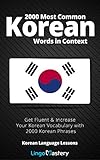
2000 Most Common Korean Words in Context by Lingo Mastery is a comprehensive guide to learning the most frequently used Korean words. While it’s not recommended for absolute beginners, it’s great for intermediate and advanced learners who are looking to understand Korean literature and spoken Korean.
As you can assume from its name, this book contains a list of 2,000 Korean words organized by frequency of use, along with their translations and example sentences in both Korean and English. There are romanizations for the Korean word in focus, but not for the whole sentence. You’d have to know how to read Hangeul before going into this book.
This book also comes with an introduction that provides tips and tricks on how to improve your learning. This section covers the basics of Korean grammar and pronunciation and strategies for memorizing new words.
What I like about this book:
- It’s a well-organized list of frequently used Korean words
- Offers useful tips and tricks on learning new words
- Sample sentences provide context for usage
3. Korean Picture Dictionary

If you identify as a visual learner, the Korean Picture Dictionary is for you. This book is an extensive visual guide that contains over 1,500 of the most useful Korean words and phrases, each accompanied by a photograph and a Romanized version to help with pronunciation.
The dictionary is organized into 40 different topics, including daily routine, home, office, healthcare, music, nature, food, animals, world, social media, and technology. Each topic is presented clearly and concisely, with easy-to-read Korean words and translations. The book also includes an English-Korean index for quick reference.
One of the unique features of this dictionary is that it provides an introduction to Korean pronunciation and grammar. This makes it an excellent resource for beginners who are just starting to learn the language. Additionally, the book includes online audio recordings by native Korean speakers for all words and sentences, which is a great way to practice listening and speaking skills.
What I like about this book:
- It covers useful words and topics
- Lots of examples to show how words are used
- Accessible to learners of all levels and ages
4. Korean Short Stories for Beginners

A great resource for those who want to learn Korean vocabulary in an engaging way, Korean Short Stories for Beginners contains 20 easy-to-read, compelling, and fun stories that will allow you to expand your vocabulary and give you the tools to improve your grasp of this wonderful language.
Each chapter possesses a funny, interesting, and/or thought-provoking story based on real-life situations, allowing you to learn a bit more about Korean culture. The goal is not just to improve your vocabulary but also your comprehension, so the book provides the same story twice — one version fully in Korean and the other version with English translation added below each paragraph.
The chapters also include a summary of what you just read, both to review the lesson and for you to see if you understood what the tale was about. At the end of those summaries, you’ll find a vocabulary list, as well as slang and sayings that you may not have understood at first glance.
What I like about this book:
- It has a variety of easy-to-read but fun stories so you won’t get bored
- Allows you to gain vocabulary within a narrative context
- Comes with a vocabulary list and questions
5. Collins Korean Essential Dictionary


You can’t learn every Korean word there is, but you can definitely develop a comprehensive lexicon by keeping a Korean dictionary handy. One such resource is the Collins Korean Essential Dictionary.
This aptly-named dictionary is one of the most popular Korean vocabulary books. And no wonder — it has over 26,000 translations, providing extensive coverage of Korean (and English). Plus, it comes with detailed definitions and examples so you learn in context.
Entries include words and phrases that you can use in everyday situations, as well as idioms. It helps if you can read Hangeul but romanizations are also included.
What I like about this book:
- Over 26,000 Korean-English translations
- Covers essential words and phrases, idioms, and some grammar points
- It’s comprehensive and up-to-date
6. My Weekly Korean Vocabulary

My Weekly Korean Vocabulary is a book that’s designed to help you learn Korean words and phrases, not just memorize them. This is because it’s a lot more focused than most vocabulary books.
The book is structured around daily lessons. Each day, you get one keyword and 20 additional phrases and sentences using this keyword. There are a total of 84 keywords, which means you can complete this book in 12 weeks.
After you’ve read books 1 and 2 of TTMIK’s My First 500 Korean Words, I recommend moving on to. Due to the complexity of the sentence structures in this book, it’s ideal for learners who are more familiar with Korean grammar.
What I like about this book:
- Well-structured lessons
- The keywords and sentences progress in difficulty, providing challenging lessons
- Lots of examples and usage notes
7. Short Stories in Korean for Intermediate Learners

Written by foreign language expert and teacher Olly Richards, Short Stories in Korean for Intermediate Learners contains eight unconventional and captivating short stories, making it an interesting read for learners in the low-intermediate and intermediate levels.
These stories are written in a simple and easy-to-understand language, making it an ideal resource for those who want to improve their reading comprehension and vocabulary. Plus, it covers a variety of genres, including science fiction, crime, history, and thriller, so you’ll likely find a story that’ll appeal to you.
Each story in the book is accompanied by a glossary of vocabulary words and expressions, which makes it easier for learners to understand the meaning of the words used in the story. The audiobook format can also be accessed on Audible — highly recommended if you want to improve your Korean listening skills too!
What I like about this book:
- Uses the 1,000 most frequently used Korean words
- Relevant dialogues
- Accessible grammar structures
8. Lonely Planet Korean Phrasebook & Dictionary
No products found.
Lonely Planet is known for its travel guides but its phrasebooks and dictionaries aren’t meant just for travelers. Even if you’re studying Korean now with no travel plans yet, you can benefit from the Lonely Planet Korean Phrasebook & Dictionary.
What’s great about this pocket-sized book is that it doesn’t just teach the language but also helps you immerse in the local culture. It contains a collection of useful Korean phrases and vocabulary for all your travel needs, including survival phrases for on-the-fly cues.
The book is organized by travel scenario categories, making it easy for learners to find the phrases they need. It also includes a full-color layout and maps, which makes it easier for learners to navigate menus and understand Korean script.
What I like about this book:
- User-friendly layout
- Covers the basics and survival phrases
- It includes essential tips on culture and manners
9. Essential Korean Vocabulary

An important resource for Korean learners, Essential Korean Vocabulary goes beyond the typical dictionary. It’s packed with useful extras, including relevant linguistic and cultural information, tips on Korean grammar and modern colloquial usage in South Korea, and specific tips about tone, nuance, and correct usage of terms.
This user-friendly book provides a graded spectrum of the most useful words in sequence from beginner to advanced level. It includes 8,000 of the most common Korean words and phrases organized into 36 different subject areas.
To help you get a deeper understanding of Korean words, this book includes English translations, clear explanations, sentences that demonstrate usage, Hangeul spellings, and romanizations. Highly recommended for serious learners!
What I like about this book:
- Extensive vocabulary of about 8,000 words
- Includes grammar and usage tips
- A thematic organization that includes 36 subjects
10. Fun and Easy! Korean Vocabulary Quiz Workbook

Featuring over 400 Korean words and a variety of exciting exercises, Fun and Easy! Korean Vocabulary Quiz Workbook is a great tool for learning and testing yourself.
The exercises in this book include “Word & Picture Matching”, “Fill in the Blanks” tests, and “Matching Homonyms/Synonyms/Antonyms”. The latter are particularly for understanding the nuances of the Korean language, including words that sound the same but have different meanings, different ways to say the same thing, and words that have opposite meanings.
This book also has crossword puzzles and multiple-choice questions. Do note that while beginners can use this workbook, the complex problems fit upper intermediate and advanced learners instead.
What I like about this book:
- Wide collection of vocabulary
- Fun and engaging tests that reinforce knowledge
- Great for understanding nuances and context
11. Korean Slang: As Much as a Rat’s Tail

Looking for a Korean vocabulary book that’s unconventional? There can’t be a better candidate than Korean Slang: As Much as a Rat’s Tail.
This unique guide to modern Korean slang consists of colorful and dynamic expressions of not just the language but also culture. The book is divided into several chapters that cover topics such as food, drinking, sex, relationships, and more.
Each chapter introduces a variety of slang words and phrases (including Konglish), along with their meanings, usage, examples, and cultural notes. The book also provides explanations of uncommon words and unusual usage, as well as insights into how Koreans think, speak, or act in different situations.
The book even includes expressions of swearing. That said, the book is not meant to offend or disrespect anyone, but rather to celebrate and appreciate the diversity and richness of the Korean language and culture. Without a doubt, it’s meant for those who want to go beyond the formal and standard language taught in textbooks and classrooms.
What I like about this book:
- It covers a wide range of topics that are not usually discussed in other books
- Includes illustrations and exercises
- Provides detailed explanations of the meanings, usage, examples, and cultural notes
12. Korean Made Simple
No products found.
While it doesn’t exclusively teach Korean vocabulary, Korean Made Simple is one of the best books to learn Korean and should therefore be a part of any Korean learner’s repository.
This bestselling book covers the Korean writing system, Korean culture, and even history, providing a comprehensive introduction to the language. It’s also a great resource for learning basic Korean grammar.
As for vocabulary, this book contains 1,000 vocabulary words and phrases. Plus, you can download audio files from the publisher’s website to learn pronunciation.
What I like about this book:
- Comprehensive resource for improving core Korean skills
- Covers 1,000+ vocabulary words and phrases
- Includes grammar and comprehension lessons
13. Let’s Study Korean

An essential supplement for your Korean study, Let’s Study Korean is a well-designed workbook covering Hangeul spelling, vocabulary, grammar, and reading comprehension.
The book is structured to become more challenging as you progress towards the end, helping you to build your skills along the way. It contains over 600 questions on various topics, so you’ll definitely grow your vocabulary.
That said, this book doesn’t just expand your vocabulary but also helps you avoid common mistakes and gives you a deeper understanding of Korean.
What I like about this book:
- Fun quizzes that teach vocabulary and other skills
- Worksheets for writing Hangeul
- Lessons on reading comprehension help cement what you’ve learned
Tips on how to improve your Korean vocabulary
The above Korean vocabulary books are great for learning new words and phrases and, eventually, reaching fluency. But you’ll need to develop good study habits to make the most out of whatever learning resource you have.
Here are some tips you can consider, from one learner to another:
Make word lists. Research has proven that writing by hand helps you remember information better. Making vocabulary lists and reviewing them regularly can help you retain what you’ve learned. You can also make flashcards with Korean words on one side and their meanings on the other. Keep reviewing these and soon, even the difficult words will go to your permanent memory.
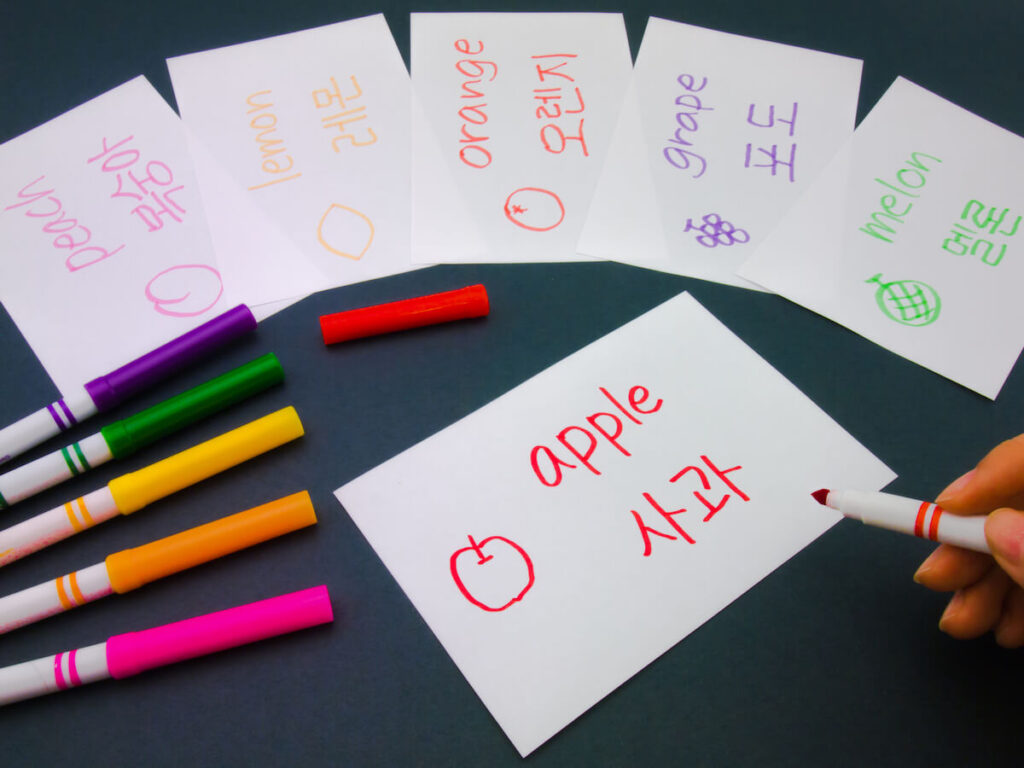
Learn words in context. Words are rarely used alone. They are used in a context with other words, phrases, and grammar patterns. Just knowing the meaning of a word is not enough; you need to know the ‘who’, ‘where’, ‘when’, and ‘how’ of the word. This is especially important with Korean homonyms.
Look up words in a dictionary. Try to get rid of the habit of finding an alternative way of expressing yourself when you don’t know (or can’t recall) the appropriate word. Instead, keep a dictionary handy and look up words you don’t know (if time permits). Doing this helps you remember the words for the next time you need them.
You can choose from the dictionaries I recommended above or use an online dictionary.

Immerse yourself in Korean content. Read Korean news articles, books, blogs, and other materials to expose yourself to more Korean words.
Use Korean learning apps, listen to Korean podcasts, and subscribe to Korean YouTube channels. Watch or listen to word lists like this. And of course, this is when those K-dramas and K-pop prove useful!
Practice speaking and writing. Using the new words you learn in your conversations and writing will help you remember the words better and also improve your overall Korean language skills. Using Korean speaking apps help too!
Conclusion

Words are the building blocks of thoughts and ideas. So, if you want to develop your Korean communication skills, you’ll need a wide vocabulary.
These Korean vocabulary books can certainly help. But remember, the best way to learn a new language is to practice regularly and immerse yourself in it as much as possible. Keep studying and enjoy the process while you’re at it!