
This article may contain affiliate links. As an Amazon Associate, I earn from qualifying purchases. For full information, please see the disclaimer here.
Reading in a foreign language is an exciting and effective way to learn a language. Reading can improve your vocabulary, your grasp of spelling and grammar, and your understanding of the written language.
And, just like any other language, it’s true for Italian too. No matter how long you’ve been learning Italian, there’s a huge variety of resources like apps and textbooks that can help you build your language skills.
But reading in a foreign language for the first time can also be difficult and disorientating. What are some good books to learn Italian? Is there such a thing as an easy Italian book? And how do you even know which books are best for your language level and interests?
No fear, because I’m here to help you find the best resources. With the help of this article, you’ll be on the road to reading in Italian in no time.
How to read in Italian

But, first, how do you even read in Italian? What’s the best way to really get the most value and language learning out of your reading?
The most important advice: it’s always best to read what you most enjoy! Whether it’s classic fiction, comic books, romance novels, science-fiction, newspapers, or biographies – reading will be most rewarding and useful when you enjoy it and feel motivated to do it.
Also, when I’m reading in a foreign language, I like to switch between what’s called active reading and passive reading.
Active reading involves really analyzing the book. You’ll research and write down vocabulary you don’t know, and pay close attention to grammar and structure. This will help you develop your language skills.
On the other hand, passive reading involves reading while trying to avoid looking up specific vocabulary or focus on language learning.
By mixing between active and passive reading, you can ensure you make good language progress while still enjoying what you’re reading. After all, this is the most important part, because you won’t want to read anymore if you don’t find it fun!
So, now that’s out the way, we’re ready to jump into the books. Andiamo!
Italian storybooks and short stories for beginners

A great place to start on your reading journey is with Italian storybooks for beginners. Reading short stories can really ignite your initial Italian skills, allowing you to apply your learnings and knowledge.
Though there’s no such thing as “easy” Italian reading for beginners, short stories can be very accessible and often the most rewarding for beginner learners.
And because these stories are short, you can take them at your own pace without feeling lost or overwhelmed. Try some of these short stories and storybooks below to kickstart your Italian learning.
1. Short Stories in Italian for Beginners by Olly Richards


These stories are written with beginner learners in mind, specifically targeted at English-speaking Italian learners so they can get to grips with the language through storytelling.
The stories include a variety of genres for all audiences, and crucially contain the 1000 most common Italian words to get your Italian started in the right way.
The book also comes with a glossary of words, comprehension questions after each story, and plot summaries to make the process of learning the language as easy as possible.
2. ll Colombre by Dino Buzzati

Dino Buzzati was a prominent novelist, journalist and poet. He wrote one of the most famous Italian novels, Il deserto dei Tartari.
But Buzzati also wrote many short stories throughout his career, which are great for beginners to learn Italian and learn about Italian culture.
In my opinion, his best collection of short stories is Il Colombre, which contains 51 different stories. The language in this particular collection isn’t too complex and the sentence structure is manageable.
The main story is also called Il Colombre and focuses on a sea monster spotted by the son of a sailor. It’s a great introduction to modern Italian literature and Buzzati for those who are still in the early stages of learning Italian.
3. Salsicce by Igiaba Scego
This short story by Igiaba Scego is a great way to learn about modern Italian culture and migrant issues while still working on your beginner’s Italian.
Written in 2003, the short story Salsicce (Sausages) explores Scego’s trip to a butcher, where she finds herself buying sausages as a Sunni Muslim.
As a second-generation immigrant from Somalia, the story explores her life and identity as a black and Muslim Italian woman, in a European society where immigration remains much lower than that of other European societies.
The language is a bit more intermediate than beginner, but the short length of the story should make it easier to read in its entirety (with a little help from a dictionary or other resources). There is also an English translation online, so you can directly compare phrases and vocab.
And if you like this story and Scego’s work, she has written a large number of short stories, as well as longer novels, dealing with the migrant experience in Italy.
Children’s books in Italian
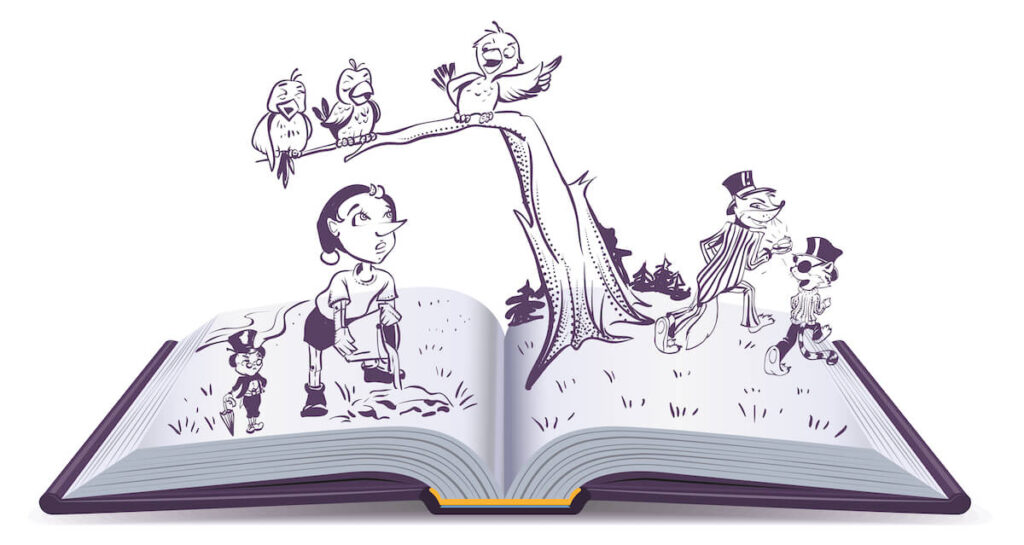
Another genre of books that can help you work on your Italian is children’s books. Due to their more simplistic language that aims to help children to read, these books can also be a great resource for adult Italian learners.
And just because they’re children’s books doesn’t mean that children’s books are overly simplistic or boring. There is a wealth of really enjoyable children’s books out there, as you will see below.
4. Geronimo Stilton by Elisabetta Dami
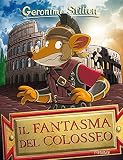
- Amazon Kindle Edition
The Geronimo Stilton books follow the adventures of titular mouse, Geronimo Stilton, in New Mouse City. Against his wishes, he is drawn into exploring fictional and real places with his family.
Elisabetta Dami started writing the books after volunteering at a children’s hospital. For this reason, the books are designed to not only be entertaining for kids, but also for their parents.
The books have seen wide success among kids and adults alike, and are very accessible for new learners of Italian. After all, many kids in Italy read the books not only for entertainment, but also to learn.
5. Le avventure di Pinocchio by Carlo Collodi

The most famous Italian children’s book is, of course, Pinocchio (or The Adventures of Pinocchio, in its full title). The book has had an incredible impact on world culture and Pinocchio is one of the most famous characters in children’s literature.
It has been translated into an estimated 260 languages, and even adapted into Disney’s iconic film, Pinocchio.
Though the language and plot are largely simple, it is true that the style is a bit more old-fashioned. After all, the book was written in 1883.
But, on the whole, it’s very accessible for such a famous and classic children’s book. I think it’s well worth the read, and your Italian language skills will thank you for the initial persistence.
6. Divina Avventura by Enrico Cerni and Francesca Gambino

Dante’s Divina Commedia (Divine Comedy) is the most famous work of Italian literature ever written. And it’s not just important to Italian culture, but also across the world. Sadly, you may be quite far from being able to read it right now, as it’s written in very ornate 14th-century Italian.
But, if you want a look into this masterpiece of Italian literature while still working on your Italian, Divina Avventura (Divine Adventure) is a great read.
Written for kids to understand, it translates the main stories of the Commedia into modern and simplistic Italian, making it accessible for beginner learners of Italian as well.
Italian novels for beginners

Italian novels for beginners may be hard to find, as novels are often a bit harder in difficulty. Often, you may be better off reading short stories or children’s books as suggested above.
But, sometimes, you can find some really great Italian books to read for beginners that really do tick the boxes for learning. Though they may not be easy Italian texts, they’re definitely worth the effort. Check them out below.
7. Corto Maltese by Hugo Pratt

The Corto Maltese graphic novels are famous around the world, and also make for a great way to learn Italian. The first edition, Una ballata del mare salato (The Ballad of the Salty Sea), is so good that it even made it onto Le Monde’s “100 Books of the Century”.
The value of these graphic novels, other than their great storytelling, is the simple Italian and the accompanying pictures. The language is never too long or complex, meaning you can get to grips with simple Italian sentences, while still enjoying the story.
8. Io Non Ho Paura by Niccolò Ammaniti
No products found.
Ammaniti’s novel tells the story of a nine-year-old boy in rural Italy who discovers that his father has committed a horrible crime. It is an encapsulating story of growing up and the loss of innocence.
The way that Ammaniti writes in a simple style and in the first-person to mimic the innocence of the boy protagonist makes it a very accessible novel for beginner learners of Italian. At around 200 pages, Io Non Ho Paura (I’m Not Scared) is also a great length for your first full-length Italian novel.
Italian novels for intermediate learners

Once you’ve aced the Italian reading for beginners above, or maybe if you’re fancying a challenge, you can move on to books of more intermediate difficulty.
These are often classic or contemporary novels that, for whatever reason, have language that’s a bit more simple or accessible.
But in no way are these books of lesser value. Some of Italy’s greatest masterpieces are available for intermediate Italian learners, as you’ll see below.
9. Lessico famigliare by Natalia Ginzburg

Ginzburg’s semi-autobiographical novel Lessico famigliare (Family Lexicon) explores family life in her home between the period of 1920 and 1950.
It’s a captivating snapshot into the life of middle-class Italy during this period, from the start of Mussolini’s dictatorship up until the end of the Second World War and beyond. It’s so good that it won the prestigious Strega Prize in 1963.
The book is good for intermediate learners because of its understandable but not too simple language, and its slightly more complex grammatical constructions. It’s a great introduction to more advanced Italian language and Italian culture of the war period.
10. Se questo è un uomo by Primo Levi

- Audible Audiobook
When I was learning Italian at university, this is the first full book that we had to read. And I’m so glad we did, because it’s a masterpiece of modern Italian literature.
The narrative tells the true story of Levi’s experience in Auschwitz, as an Italian Jew deported to the concentration camps under Mussolini’s Fascist regime.
It explores themes of humanity (the translation of the title is If this is a man), reality, and comradeship. It is a great way to learn more about Italian history during the period of WWII and the Holocaust.
Due to Levi’s simplistic style, where he seeks to describe the concentration camps in brutal and direct honesty, the language is accessible to intermediate learners, with a bit of an initial push. It’s well worth the effort.
11. Fiabe italiane by Italo Calvino
No products found.
Calvino is another one of my favorite Italian authors. I even wrote one of my undergraduate dissertations on his most famous novel, Se una notte d’inverno un viaggiatore (If on a winter’s night a traveler).
But, while Se una notte can be quite complex in its language and plot, Fiabe italiane (Italian Fables) is a great introduction to Italian literature and culture for beginner learners.
With each region of Italy having different dialects and individual culture, Calvino took the stories and fairy tales from each region and translated them into modern standard Italian. As a result, they’re a lot more accessible than the original versions. I’m sure you’ll recognize a lot of them.
Other novels by Calvino perfect for beginners include Marcovaldo ovvero le stagioni in città and Il Barone Rampante.

Quindi, there’s my advice for the 11 best novels and storybooks for learners of Italian. Now, you’re ready to start reading in Italian and dive into Italian culture. In bocca al lupo (good luck)!