
You might be aware that not all languages are created equal. Italian specifically is consistently ranked one of the sweetest and sexiest languages on Earth, despite not being as widely spoken as English, Spanish, or Chinese.
So today I’ll give you a bunch of cool and thought-provoking facts about the Italian language that will make you fall in love with the language of Dante (more on that later) or prove to you once again you’ve picked the right language to learn.

Major Italian language facts
1. Italian is spoken by around 85 million people worldwide…
It’s either the 20th or 21st most spoken language on the planet depending on the source. There are circa 65 million native Italian speakers, 15 million who speak it as a second language, and approximately 5 million foreigners who are fluent in Italian.
2. …And is the fourth most studied language on Earth.
Over 2 million people across the globe are studying Italian right now. In the U.S., by contrast, Italian is the 5th most popular language, behind Spanish, French, American Sign Language, and German.
3. It’s the official language of a single country.
Ironically, Italian only has official status in the microstate of San Marino, a 1,700-year-old enclave in northeastern Italy. While it is the de facto national language of Italy, there’s no mention of an official language in the country’s constitution.
Other than that, Italian is used for communication purposes in the Vatican (whose official language is Latin) and has official status in Ticino, a canton (region) of Switzerland. It’s also recognized as a minority language in certain parts of Brazil, Croatia, and Slovenia.

4. It’s hard to count the number of dialects spoken across Italy.
UNESCO, however, estimates there are 31 of them. These dialects are so distinct from one another that they’re officially called “languages” within Italy.
Although there are two main linguistic groups in the country (the northern and the central-southern), mutual intelligibility is low even within the same group.
And if you think dialects are maybe restricted to illiterate communities in the countryside, you couldn’t be more wrong: over 45% of Italians speak the language of their region, and approximately 14% use primarily a local dialect to communicate.
5. French- and German-speaking Italians are a thing.
Areas along the Italian Alps have historically had substantial linguistic minorities. So, in the Aosta Valley region, French has official status, while German is widely spoken in the South Tyrol (which borders Austria).
6. How old is the Italian language?
It’s 1,000+ years old! Three documents vie for the title of oldest text written in Italian. You have the Placiti Cassinesi, a collection of juridical papers from 960-963; the Veronese Riddle, which was added to a prayer book in the late 8th or early 9th century; and the Commodilla catacomb inscription, which dates back to the beginning of the 9th century.

Facts about the Italian language history
7. Italian descends from so-called vulgar Latin…
Classical Latin was taught in schools and spoken by the elites. But the language of soldiers, peasants, and the provinces, aka vulgar Latin, proved to be more resilient.
During the Middle Ages, it was incorporated into the many languages used throughout the former territories of the Roman Empire, which ultimately developed into the Romance languages we know today.
8. …Yet its basic structure is based on the Florentine dialect.
Dante Alighieri, who wrote the Divine Comedy in the 14th century, is hailed as the father of the Italian language. His masterpiece marked the first time that the version of vulgar Latin (by then unrecognizable) spoken in Florence made it into literature.
In the 16th century, Venetian grammarian Pietro Bembo led a campaign to elevate the Florentine dialect to the status of national language in the Peninsula (rather than Roman). Eventually he won that fight, though he didn’t live to see that day!

9. Modern Italian was born with I promessi sposi.
The Romantic novel by Alessandro Manzoni, published between the early to mid-1800s, raised the bar for literary works written in Italian (or, to be accurate, the Florentine dialect).
It soon came to be one of the symbols of a newly unified nation in search of linguistic identity. Because it was groundbreaking on several fronts, I promessi sposi is still the most widely read Italian novel to this very day.
10. It would remain a literary language until 1861.
1861 was the year Italy finally became a unified country. From then on, the state took to turning Italian into a national language. Before that time, ordinary citizens would only speak their local dialect, and royal courts often communicated in French, as it was fancy to do so.
11. Television spread the word.
The state tried to curb the use of local dialects for over a century following the unification of Italy. Still, illiteracy rates remained high, which contributed to the survival of those languages.
Television, while criticized for homogenizing the language, was actually responsible for teaching Italian to generations starting in the 1950s.
It taught millions of Italians how to read and write as well: a single show called Non è mai troppo tardi helped 1.5 million people get their elementary diplomas in the 1960s.

Facts about Italian grammar
12. The Italian alphabet has just 21 letters.
That’s because no Italian words feature either j, k, w, x, or y. But foreign words that have these letters keep their original spelling.
Oddly, though, a bunch of surnames starting with i are alternatively spelled with a j, such as Jannacci and most famously Jacuzzi.
13. The subject often isn’t mandatory in a sentence.
Since all verb conjugations clearly indicate which grammatical person (I, you, he,…) is being talked about, subject pronouns are usually omitted from a sentence; they’re predominantly used for emphasis.
The Italian equivalent of “it”, by the way, is generally restricted to formal usage. When you mention a thing or animal twice in a row, chances are you’ll have to omit both the pronoun and the noun (to avoid sounding repetitive), which may come off as strange to English speakers.

14. The vast majority of words end in a vowel.
Only foreign words like film and autobus (i.e. “bus”) end in consonants, and even then the final letter is pronounced so strongly that it’s almost like there’s a semivowel hidden at the end of the word.
That is sometimes an issue for poets and songwriters, who will turn amore into amor and cuore into cuor for the sake of the verse structure (especially in older poems and songs).
15. The longest word has 26 letters.
That’s the astonishingly long precipitevolissimevolmente, which ironically means “in an extremely fast way”. We’re leaving technical terms out here, as the scientific realm is known for having tiresomely extensive words in every language. If we do include them, 30-letter psiconeuroendocrinoimmunologia (a medical specialty) snatches the trophy.
16. Italian has its fair share of untranslatable words.
A few of my favorites include
- Culaccino: an obscure word for the wet mark left by a glass on a table;
- Dietrologia: making up theories for what the alleged ulterior motive behind something might be;
- Gattara: not your regular cat-lady, but one who specifically takes care of stray cats;
- Magari: either “perhaps” when in the middle of a sentence or “I wish” when used as a standalone interjection;
- Mammone: a mamma’s boy who lives with his parents well into adulthood;
- Menefreghismo: something like a “couldn’t-care-less attitude”;
- Meriggiare: a literary word that means “to take a nap in the shade” (oddly specific, I know);
- Prego: a polite phrase that is used in multiple situations, from saying “you’re welcome” to giving your turn to somebody else in line;
- Spaghettata: an informal spaghetti meal eaten with friends.
17. Many of the words you use every day come from Italian.
Some of these words are ballerina, broccoli, diva, fiasco, graffiti, influenza, lava, motto, scenario, volcano,… and even America, which is a tribute to the Renaissance-era merchant and explorer Amerigo Vespucci.

18. But you may be saying a few Italian words wrong.
The plural in Italian is quite tricky and overrun with exceptions, yet there’s a general rule: words ending in -o have plural forms in -i, while those that end in -a will have the a replaced by an e.
That means words like panini, paparazzi, and salami are the plural forms of panino, paparazzo, and salame respectively. That said, the wrong spelling is so widespread in English that you risk sounding pretentious if you spell them as Italians would.
19. Peperone isn’t really what you think it is.
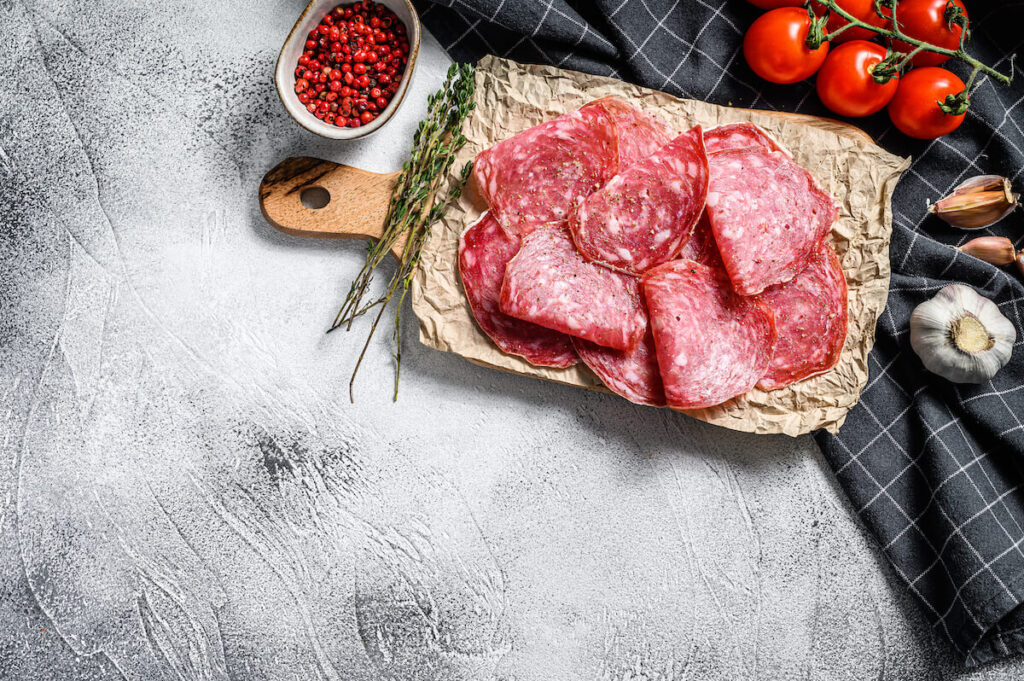
Peperone (not pepperoni) is actually the Italian word for bell pepper. You won’t find the American pepperoni anywhere in Italy, though they do have a similar salami (a-ha!) called salame piccante (literally “spicy salami”). But salame piccante isn’t as huge in Italy as pepperoni is in America.
20. Italian has a ton of imported vocabulary as well.
Apart from words loaned from the business and tech worlds, which typically enter the language too fast to get a proper translation, Italians are constantly replacing countless words and phrases that they do have in their native language with foreign ones.
That’s the case with weekend (fine settimana), ticket (biglietto), workshop (seminario), trend (tendenza), just to mention a few. Many Italians oppose the full-blown invasion, yet there’s hardly anything they can do to stop it.
Other fun facts about the Italian language
21. Plenty of celebrities you love speak it.
The list includes those who married Italians (Colin Firth and Vincent Cassel), the ones who learned it thanks to work (Jodie Foster and Penélope Cruz), the certified polyglots (Audrey Hepburn and Viggo Mortensen), and even the late Kobe Bryant, who lived in Italy between ages 6 and 13.
22. And so do opera and classical music.
Italian composers made a name for themselves beginning in the 17th century (when the Baroque flourished). It wasn’t long before the terms they used to classify things like the tempo, the techniques, and the repeats of a piece took over the scores of musicians throughout the continent.
Now, words like soprano and adagio are part of everyday use in conservatories and theaters in virtually all countries.

23. Italians use around 250 hand gestures every day.
The instantly recognizable 🤌, which perfectly illustrates the characteristic impatience of Italians, is merely one in a complex and fascinating code.
A great deal of these gestures may owe their creation to the absence of a common language in Italy between the fall of Rome and the country’s unification — a 1,400-year gap.
Yet overall southern Europeans notoriously use their hands a lot more as they speak than northern Europeans.

24. Accademia della Crusca works as a sort of oracle.
Founded in 1585, the oldest linguistic academy in the world has been committed to protecting the “purity” of Italian from its inception (good luck with that!).
It’s headquartered in Florence, which itself serves as an unofficial guardian of Italy’s cultural heritage, and inspired the creation of other such institutions across the globe, most notably the Académie Française.
25. Italian is arguably the sexiest language on the planet.
While this of course depends on personal preferences, Italian consistently tops these kinds of rankings alongside Spanish and French.
Yet there has been at least one serious study about the matter, which concluded that Italian is indeed the sexiest language on Earth.
How did they find that out? Basically, participants had their heart rate measured as they listened to flirtatious clips in different languages. Ingenious, huh?
26. It’s among the easiest languages to learn too (for English speakers).
It should take you between 575 to 600 hours of study time to master Italian, which is roughly the same as other Romance languages.
Then you have German (750 hours), followed by the majority of Eastern European and Asian languages (900-1,100 hours). Arabic, Chinese, Korean, and Japanese, in turn, require at least 2,200 hours of dedication before you become fluent.

Conclusion
These most interesting facts about the Italian language never cease to amaze me, honestly. They remind me of why I decided to learn Italian in the first place. Italian sounds beautiful and is filled with history.
It’s also intricately tied to one of the most charming cultures on Earth, one that gave us fantastic food, timeless art, and world-famous monuments.