
Are you dreaming, or maybe just thinking, of moving to a Spanish-speaking country to teach English? Or perhaps you are simply wondering how different or difficult teaching English to Spanish speakers is.

Well, either way, this article is for you! I’m going to talk about the challenges you could face and then give you 20 effective ways on how to teach English to Spanish speakers.
What are the challenges if you want to teach English to Spanish speakers?
We know that learning another language is a challenge in itself.
One of the key reasons is that your native language influences how you think and what you say when learning that new language.

There are a lot of similarities between English and Spanish, such as sharing almost the same alphabet, some similar grammatical structures, and words that are spelled the same.
On the other hand, they can also be problematic because despite having the same alphabet, the sounds are very different and accented. And let’s not forget the “ñ” with atilde.
This makes pronouncing words very difficult for Spanish speakers, even if the word is spelled the same in English.
Conjugating verbs and adding the ‘s’ when using the third-person singular present tense verbs is a challenge. For example, she shop vs she shops.
I have just highlighted a few challenges. This article focuses on more key differences between the two languages.
Regardless of the obvious challenges of teaching any language, there is a real sense of satisfaction when we are teaching and our students grasp the point and give excellent examples when asked.
Here are some tips to become that fantastic teacher and obtain that satisfying feeling.
Tips to teach English to Spanish speakers
1. Get to know your students
Do you want to teach English to Spanish adults or children? Whoever you end up teaching, you need to make sure our lessons are beneficial to them.

By getting to know your students you can deliver the best lessons and resources to them. You must learn what their expectations are and what they need from the lessons.
Make the first class an introductory class to find out as much as you can about your students.
Find out the answers to these questions:
- What are their needs or desires concerning learning English?
- Have they had any experience with learning English before?
- What are their interests?
This can help you come up with an effective plan to help them learn English.
2. Create effective lesson plans

Once you have established why they are learning English and what they wish to do with that knowledge, you can create effective lesson plans to help them reach their goals.
I strongly encourage you to plan for each lesson. It gives you an objective, or goal, for each lesson and keeps you and your Spanish learners on task.
Remember it is ‘their’ lesson plan, so make it with your learners in mind.
English lessons for Spanish speakers require a lot of examples of the vocabulary or subject being taught and plenty of time for them to practice.
3. Use Spanish in the lessons
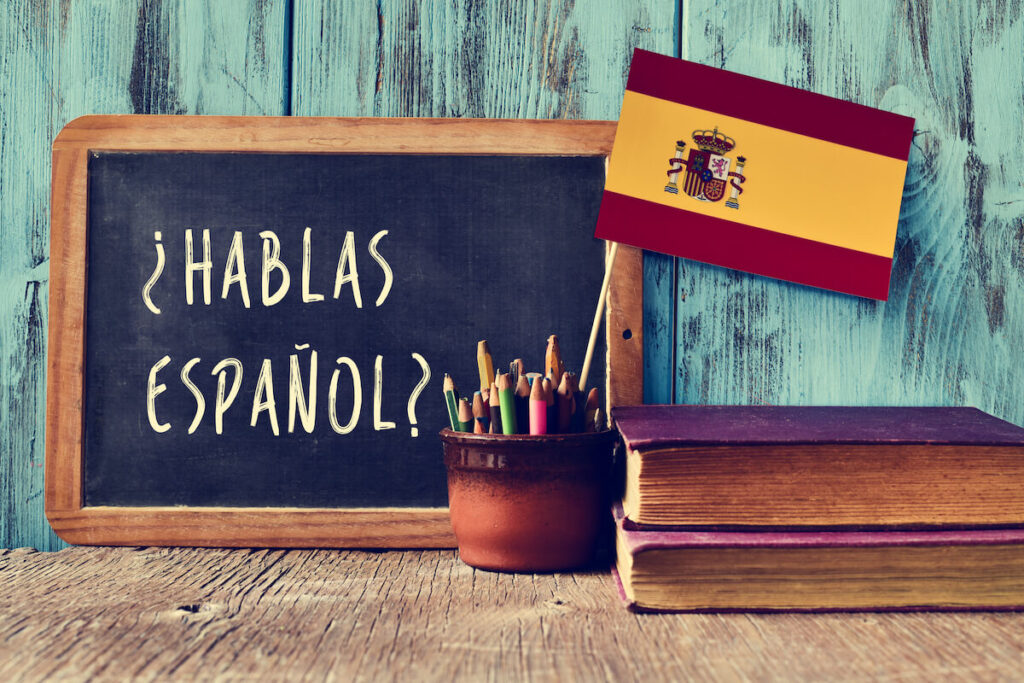
There are several schools of thought on using the student’s native language in class.
I know teachers that use a lot of Spanish in the classroom because it comforts the learner when they get frustrated, and I know some that are against it because it becomes a crutch.
Therefore, getting to know your students is such an important step because they will let you know if they want you to speak Spanish in the classroom.
Depending on their English level, some Spanish learners will prefer if you say the odd word in Spanish, but others may prefer you only to speak English. Find out before you start throwing out any Spanish.
Also, bear in mind, especially if you are teaching kids, that once they know that you can speak Spanish, they will end up speaking to you in that language all the time. Why should they speak English if the teacher speaks their native language?
If this ends up being the case, when they speak to you in Spanish, make sure to ask them to say it again in English. Guaranteed it will annoy them at first, but not only will they get used to it, but they will also end up only speaking to you in English.
However, if your students don’t mind you using the odd word, then make sure you are well-prepared.
When you are creating your lesson plans, write down the vocabulary words in English and Spanish.
4. Start with what they know
ESL for Spanish speakers can be hard, so why not make it easier for them by starting the lessons off with what they already know?

There are many similar words in English and Spanish. When teaching the vocabulary or target language for the lesson, start with those similar words.
Students will comprehend very quickly what the lesson will be about. It will also surprise them how many words they may already know in English. This will be a big boost to their confidence.
5. Establish classroom language

Classroom language is another area that should be taught earlier on. The learners must know how to express themselves when they need help or to ask for something.
Questions like:
- Could/Can you repeat that, please?
- Can I go to the bathroom?
- How do you say……in English?
- Can you help me with…..?
A good suggestion is to put the common questions on the wall of your classroom to remind them what or how to ask for something or for you to point to if needed.
6. Use specific vocabulary
We’ve touched on this subject a bit in point four, but I think it is important to clarify a bit more.
Teach vocabulary words that are used in everyday life. If you are given a book to use in your classes, it could be outdated or irrelevant. This is why it is so important to prepare for your lessons beforehand.
Review what is to be covered in the lessons and adapt it to your learners that you are now familiar with, and use vocabulary that we as native speakers use.
Help your learners to see how useful the new words are, and how they are used in phrases, and practice them.
7. Work on understanding and usage

Reading, listening, speaking, and writing are the core skills involved in learning a language.
Some learners may understand extremely well but they could struggle with their output, or in other words, their speaking.
Therefore, make sure you pay attention to your student’s strengths and weaknesses. This will help you to pair or group them up accordingly.
Incorporate all the above skills in your lessons. Encourage the learners to work on certain areas for homework.
8. Let’s work on grammar
We touched on the similarities between English and Spanish but how about the differences?

English grammar for Spanish speakers can be challenging. Several structures will be difficult for them to grasp. For example, personal pronouns or the sentence order of adjectives and nouns, etc.
Use and elicit lots of examples when teaching grammatical points.
Depending on the learners, it may be necessary to teach them the rules when going over grammar points or encourage them to take the time to learn the rules at home.
There are so many websites that offer excellent explanations of various English grammar concepts and they can usually be read in the student’s language for better understanding.
Also read: How to Teach English Grammar: 16 Helpful Tips
9. Teach how to use phrasal verbs
In case you aren’t sure, phrasal verbs are the two-part verbs we use in English that include a verb + particle (preposition), such as “get up, put away, go off, etc.”
You do not realise how often native English speakers use phrasal verbs until you are teaching your new students and get stuck trying to find an alternative word for the phrasal verbs that are floating in your head.
Phrasal verbs do exist in Spanish but not at the same level as in English, and tend to be more literal.
Therefore, when you are preparing for the lessons make sure you think of alternative and more natural ways to teach your subject points.
For example:
Let’s review the points from the last lesson.
Let’s go over the points from the last lesson.
Do not be afraid to use phrasal verbs! Spanish speakers will pick it up and will understand the difference between the formal and more natural ways of speaking English.
10. The trouble with pronunciation
Spanish is a phonetic language, which is great if you are learning it because you can simply sound out a word by reading it, and the majority of the time you’ve said it correctly.

Unfortunately, the same can’t be said for English. Take a moment to think of the silent letter ‘e’ and the long and short ways of sounding it.
What about “though, through, and tough”? Confusing, right? More so for Spanish speakers who are used to their consistent phonetic language.
Here are a few examples of mistakes you will hear:
- Are we angry or hungry? (Remember the letter H is silent in Spanish)
- Is it a kitchen or a chicken? (This confuses most learners anywhere)
- Victory or bictory? (They pronounce the V sound as B)
You get my drift, right? Correction is very important from the get-go. If you notice a student who is struggling with it, encourage them to slow down to focus on making accurate sounds.
Again, there are many videos and online resources that can also help in this regard.
Also read: How to Improve Your English Pronunciation: 13 Key Tips
11. Beware of false friends
Not all words that look the same in both English and Spanish have the same meaning; this is what we call a false friend.
Here’s an example I often hear my students say: “I’m feeling very constipated today.”
Wow, that’s too much information, right? This is because the Spanish word for congested is: constipado, but isn’t it quite similar to the English word constipated?
Not something you want to get confused though, is it?
There are many ‘false friends’ lists that can be reviewed, downloaded, or printed to help you know when to be careful.
12. Encourage concise writing

Sometimes things your students say or write may not be so “wrong”, but it sounds quite unnatural.
In English, we can say: “It may be at my mother’s house.” but in Spanish, they say: “It is possible that it is in the house of my mother.”
This is just a simple example but already you can see that Spanish speakers will struggle with conciseness.
Encourage your students to try doing different concise writing exercises online. They can also review writing tips to help them become more concise.
13. Know how to deal with direct translations
It is natural for learners to directly translate from their native language to English. However, literal translations can produce grammatical errors.
A few Spanish common errors are:
“She has six years old.” instead of “She is six years old.”
“I am agree.” instead of “I agree.”
“Depends of” instead of “depends on.”
“I have sleep/dreams” instead of “I am sleepy.”
“I have hungry” instead of “I am hungry.”
We do not want these errors to become a bad habit. Correction is needed from the beginning and, if necessary, write them up around the classroom and point to them when needed.
14. Identify words that have many meanings
English for Spanish speakers is tricky. For example, the Spanish word, ‘hacer’ means both make and do. You can guess that many mistakes are made when the Spanish learner has to use make or do in English.
There are many more examples, and it can be very discouraging when the learner is not sure which word to use, or they keep making the same mistake. Lots of drilling and repetition will be needed.
Be understanding and always praise the student for trying. If they are still struggling after the lesson, give them some helpful online suggestions and practice tests to help them get over this challenge.
15. Talk, talk, and more talking

Encourage your students to speak in English. Many times, they do not realise how much they have learned and how their speaking has improved.
Let them tell a story or speak about an experience. Pair or group work is good for them to communicate their thoughts and practice their fluency.
Make sure to monitor them and give corrections if needed or note if they need to work more on a particular grammatical point.
Adults or kids believe that they have made progress by how much they can speak, so make sure to give them that opportunity to practice what they have learned. They will end up participating more if they notice their improvements.
This article has some effective tips on teaching spoken English.
16. Create fun and interactive classes
Learning grammar is not so much fun, is it? So, remember to always combine the bad with the good.

Classes should have many other interactive activities, for instance, doing role-plays, playing games, singing songs, watching movie clips, telling stories, or doing presentations, etc.
In the lesson plans, there needs to be an output section to practice what the subject of the lesson is about.
And let’s be honest, all learners are there to speak. When you have found out your students’ interests, base your lessons on that.
The lessons will be more enjoyable for them. Kids will remain more focused, and all will want to come back to the next lesson.
Check out these effective methods on how to teach English to kids.
17. Encourage all to get involved
We’ve established that it’s not easy learning a new language so why not encourage your learners to involve their family members or friends?
Hold occasional reading or English activity events where the learners’ family and friends can also come along. This will highlight the progress the students have made and motivate them to continue studying English.
18. Find resources for teaching English to Spanish speakers
Remember you are not alone! There are a ton of online resources out there to help you.
Whether you need help with grammar, English speaking activities, or games, everything you need is just a click away.
I recommend looking at ESL Games Plus if you are teaching kids or teens. It provides so many great activities and games that will really engage your younger learners.
However, for the older ones check out English Speaking Course on YouTube. It has so many stories and conversations on relatable topics to practice English.
There’s also Kahoot or Baamboozle where you can make and adapt different English games. Plus, there are tons of apps to help students learn English, as well as fun ESL games!
19. Learn outside the classroom
Becoming fluent in any language takes more than a few classes a week. Encouraging all to get involved in learning outside the classroom and encouraging your students to do just that little more in English.

They can do a language exchange, read books or watch a film in English with subtitles, depending on their level.
I know in Spain, there are even some English bars where they converse with each other in English.
Encourage your learners, young or old, to find different activities they can do in their city in English to help improve their level and expose them more to English.
20. Motivate your students
We’ve covered a lot in this article but I believe I saved the best for last.
The key point is this: Interesting classes motivate the learners to keep coming back to the lessons.
Create some wonderful and interactive lesson plans based on your learners and give plenty of examples of grammatical points.

Provide lots of opportunities to practice what they have learned. Incorporate different games and activities. Provide extra resources if necessary and direct your learners to practice exercises online. Keep the classes moving, build a great rapport with your learners and be observant.
Final thoughts
I know these tips will help you become a more confident teacher of English to Spanish speakers. It may be nerve-wracking at first but remember preparation is essential.
A good interactive lesson plan with anticipated problems will help you go a long way to achieving that super English class that will make your students keep coming back for more.