There might be only one country where the natives prefer you to speak English rather than the native language. And that’s Sweden. It’s virtually impossible to learn Swedish by talking to Swedes. All because they’re so dang keen to show how great at English they are. Sigh.
But fear not! As a half-Swede I can teach you how to say hello in Swedish, and some other useful Swedish phrases that’ll make your time in Sweden all the more enjoyable. And maybe even help you understand those umlaut decorated walls in IKEA.
But that’s not all. I’m going to give you the low down on some essential Swedish phrases and other useful information to help you fit in. I hope you’re ready, operation disguise-yourself-as-Swedish has commenced!

A very brief history of Swedish
First though, let’s answer an age-old question. Why do Swedes insist on speaking English? Well, it has a lot to do with multiculturalism.
A thousand years ago, Swedish would have been almost identical to Icelandic. Through immigration and emmigration, Swedish has borrowed words from German, French, Arabic, and especially English. In the 19th century, almost a third of the Swedish population migrated to the USA. We’re also obsessed with American and British TV shows, which says a lot about our comedy scene.
In some cases, Swedes make an attempt to ‘Swedify’ foreign words. That is to say, use the foreign word, and then add verb endings or similar so it fits into Swedish grammar. Otherwise, we just straight up steal it. That’s why, especially among young people, it’s not uncommon to hear a Swede suddenly exclaim: “Oh my GOD, det var NAJS!” (Oh my god, that was nice).
Meet & greet a Swede
So if you run into a Skarsgård in Södermalm (it happens all the time), you’ll want to know how to introduce yourself. If you’re meeting a Swede for the first time, it’s customary to shake hands and say your own name. This is especially true in a business setting or meeting older Swedes.
In a group of young people, it’s best to introduce yourself by saying your own name, followed by kul att träffas (nice to meet you), pronounced: kewl at treff-ass. Sometimes you shake hands, but not so much anymore. And if you want to know whether you’ve been accepted by your Swedish friend group, you’ll know when they start hugging you. It might take weeks, months, sometimes years to be offered a hug from a Swede. But when they do, you’ll be squeezed to oblivion.
Important meeting advice: If you’re invited to a Swede’s house, you MUST remove your shoes the second you get in the door. Without fail. Same goes for at the dentists, kindergartens, schools. Rule of thumb: If the person greeting you has fuzzy or Happy Socks on, take your shoes off. Don’t argue.
Swedish linguistic habits
If you’re learning Swedish and can’t think what the verb is called, just use the English word and put an ‘a’ at the end. Not fail-proof, but Swedes will almost certainly know what you mean.
Swedes also speak using pulmonic ingressive speech, which basically means they say “ja” (yes) on an intake of breath. This often shocks English speakers as it sounds like whoever’s speaking is gasping or seems shocked. It’s most common to hear it in the north of Sweden, but it can be heard all over the country.
With that said, let’s learn some Swedish greetings!

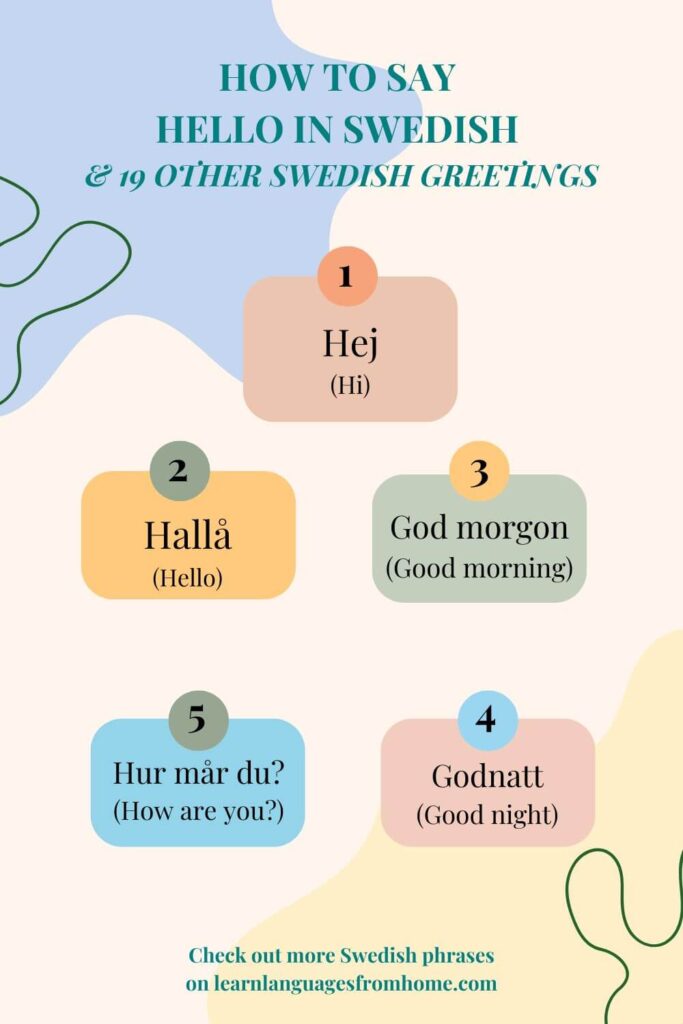
1. “Hi” in Swedish – Hej
Wherever you are in the country, Hej (pronounced ‘hey’) is by far the most common way to say hi in Swedish. Occasionally, Swedes will double up and say “hej hej”. You might even find a Swede who says “Hej, hej, hemskt mycket hej” (Hi, hi, an awful amount of hi).
2. Slang words for “hi” in Swedish – Tja, Tjenna, Tjenare
Here’s where it gets a little more complicated. Different regions have different ways of saying hi in Swedish colloquially, so apologies to fellow Swedes from outside Stockholm, my native city. I know they use these words too, so that’s why I’ve settled on them.
Tjenare is the full word for “what’s up”, even though it actually means ‘servant’. It comes from a longer phrase, similar to the archaic English phrase “your servant”. But as we Swedes are punctual and haven’t got time to waste, we’ve sliced it in half, and then half again to create tjenna, and tja. All three mean the same thing, and of course they’re very informal greetings. Pronunciation “she-nah-re” for “tjenare”, “shearna” for “tjenna” and “sha” for “tja”.

3. “Hello” in Swedish – Hallå
“Hello” in Swedish is most commonly expressed by saying “hej” in an informal setting. However, hallå is the correct equivalent of hello in Swedish. The correct pronunciation of “hallå” can be broken down to ‘hall’ and ‘lå’, with the ‘hall’ rhyming with ‘shall’ and the ‘lå’ rhymes with ‘more’.
In my experience, “hallå” is used to draw your attention rather than to say hello. For instance, if it looks like you aren’t really listening, a Swede may irritably say “hallå?” (Or maybe that’s just me, oops!)
Some Swedes also use the word nämen! (pronounced: nare-men) to say hello in Swedish if they run into someone unexpectedly. For this reason, airplanes with Swedes on board always chime with “nämen!” The world is pretty small.
4. “Good morning” in Swedish – God morgon
Pleasingly, good morning in Swedish is straightforward. A simple god morgon will suffice. The “d” and “g” are often silent, so phonetically spelled it would be “goo morron”. Everyone says good morning, old and young, so don’t worry about appearing too formal. For Swedes it’s about welcoming each other to the day ahead. You can also expect some Swedes to repeat this greeting: god morgon, god morgon!
5. “Good evening” in Swedish – God kväll
Swedish TV shows that start in the evening usually start with an emphatic God kväll! It means “good evening” in Swedish, and kväll is pronounced kvell. It’s a pretty formal way of greeting someone, and as such you’ll basically only hear it at formal gatherings or the theatre. Just as with good morning, the d is sometimes silent in the word “god“.

6. “Good night” in Swedish – Godnatt
The last thing you hear from Swedes at the end of the day is a yawn-stifled godnatt. It means goodnight, and it’s pronounced how it’s spelled. However, yet again, some Swedes drop the d and just say “goo-natt”. This isn’t a formal greeting, and everyone says it as a customary last word before bedtime.
If you’re feeling really pleasant, you can wish a Swede a good night’s sleep by saying sov gott (soar-v gott”), meaning “sleep well”.

7. “What’s up” in Swedish – Hur är/går det?
First, be aware that young Swedes especially have been known to use the English phrase “what’s up” as an introduction. After you’ve said your hej or hej hej however, it’s customary to ask how the other person is. You do that by either asking hur är det? (how is it?) or hur går det? (how’s it going?).
The only thing to observe when pronouncing either phrase is that the ‘t’ in “det” is silent.
Swedes will usually respond to this question with a “jo, tack” (yeah, thanks) when asked either of these questions. Also be aware that that might just be the end of the conversation. Just as in most English-speaking countries, Swedes don’t like to delve into details with strangers.
8. “How are you” in Swedish – Hur mår du?
That leads us on to ask how someone is. You can use either of the previous phrases, or you can ask the more intimate question hur mår du? One thing to note is that “mår” is pronounced more or less the same as the English word “more”.
As previously mentioned, this is a very personal question for Swedes to be faced with, so don’t expect this from service personnel or similar – and don’t ask them this, either. Small talk just isn’t done in Sweden. If you’re friendly with the person however, you can expect this question to be answered in total, unwavering honesty. Ask with caution, unless you want to hear about how the person’s cat is sick, builders woke them up at 5am, or their kid puked on their iPad, etc.
9. “Goodbye” in Swedish – Hejdå
Goodbye in Swedish can be done in a couple of ways. The full, and most formal way of saying goodbye is hejdå (pronounced hey-door). But mostly, Swedes will wave you off with a “vi ses!” (see you!) or “vi hörs!” (talk soon).

10. “Thanks” in Swedish – Tack
Swedish manners might seem very peculiar if you aren’t used to them. We don’t have a word for please (sorry Canadians!), for instance. If you really can’t live without it, you can say “är du snäll” which literally translates to “are you kind”. Be aware that Swedes might look at you as if you’re a bit crazy if you say this too often.
Thanking is a big deal in Swedish, however, and there are a few occasions where it’s imperative you say thank you. The first is at the dinner table. Without fail, you must thank whoever provided dinner for you by saying tack för maten.
Another peccadillo is thanking someone for hanging out with you – “tack för sist”. Not straight after you’ve spent time together, oh no, that’d be way too simple. But the next time you run into them, you say “tack för sist” (thanks for the last). Young people might not bother with this one, but older people really appreciate it.
Also Read: 15 Ways to Say Thank You and You’re Welcome in Swedish
11. “Nice to meet you” in Swedish – kul att träffas
As I already mentioned, it’s customary to say kul att träffas when you meet Swedes for the first time. Swedes will most likely respond to this by saying “roligt” (fun). And then they’ll proceed to quiz you about your accent, hometown, culture, etc.
12. “I miss you” in Swedish – Jag saknar dig
This one is kind of adorable and also heart wrenching. You see, when you say “I miss you” in Swedish, you say Jag saknar dig. However, linguistically speaking, what you’re actually saying is You are missing from me, or, I am without you. Aww.

13. “Cheers” in Swedish – Skål
Researchers believe Swedes got the word for cheers, skål from our Viking ancestors. Etymologically speaking, skål is derived from the word ‘skull’, which it’s believed the vikings used to drink out of after battles. Yuck.
Anyway, Swedes say “skål” an incredible amount of times during a formal dinner. Especially Midsommar, crayfish parties, or similar. Don’t forget to look everyone in the eye at the table after you’ve taken a sip, it’s considered very rude not to.
14. “Welcome” in Swedish – Välkommen/Välkomna
Whether you’re inviting other people into your home or being invited into someone else’s, you can expect to hear a word of welcome. This can be done in a few different ways. When a Swede answers the door, they might say välkommen in (welcome in). It’s more likely they’ll just say “kom in” (come in), though.
At more formal occasions, use “välkommen” to welcome just one person, or “välkomna” (plural) if there’s more than one.
15. “It’s been a while” in Swedish – Det var längesen
If it’s been ages since you saw your Swedish friend, you can murmur det var längesen into their shoulder as they crush you into a hug. Don’t forget to leave the ‘t’ in ‘det’ silent. Here’s how to pronounce the whole phrase, spelled phonetically: “dear var lengersenn”.
16. “What’s your name?” in Swedish – Vad heter du?
If you’re meeting someone new and you didn’t catch their name, or you’ve spotted a Scandi you’d like to get to know better, it’s always good to be able to ask what their name is. The phrase vad heter du? will come in handy for that. Here’s how it’s pronounced, phonetically: vard hear-ter du?

17. “Make yourself comfortable” in Swedish – Slå dig/er ner
Literally translated, this phrase sounds a lot more violent than it actually is. Swedes say Slå dig ner (throw yourself down) when they mean “make yourself comfortable”. This is how most Swedes communicate to others that they don’t need to remain standing in social situations. Use “er” instead of “dig” if there’s more than one person, and remember that “er”and “ner” sound like or rhyme with the English word “near”.
18. “Congratulations” in Swedish – Grattis
If you’re in Sweden to celebrate a birthday, wedding, birth of a child or a graduation, the word to know is grattis. You can say this for any happy occasion if you’re congratulating another person. If you want to wow someone, say “grattis på födelsedagen” (gratt-iss pour fur-dells-eh-darg-en) for happy birthday. If you’re writing it, don’t forget that grattis has two t’s, gratis means free, as in complementary. It would be weird to see the word “free” in your birthday card, wouldn’t it?
Learn more in our article dedicated on saying “happy birthday” in Swedish.
19. “Enjoy your food” in Swedish – Smaklig måltid
I told you we’d get around to some IKEA wall greetings, didn’t I? You might have seen smaklig måltid wherever you go to grab your meatballs or princess cake, and yes, all it says is “enjoy your food”. But if you get a job in Sweden as a waiter or waitress, this quickly becomes the phrase you use most. Here’s how to pronounce it: “smark-ligg maul-teed.”
If this is said at the table of a dinner party, you can assume it’s alright to start eating. Informally though, Swedes favor the phrase hugg i meaning “tuck in”.
20. “Excuse me” in Swedish – Ursäkta mig
First, a quick caveat. Swedes don’t always excuse themselves the way English speakers do. That’s to say, if a Swede wants something, and you’re standing in front of it, expect to be shunted to one side. But if that gives you shivers, you can say ursäkta mig to encourage others to move aside. Alternatively, if you want to stop someone on the street to help give you directions, “ursäkta mig” is a very polite way of stopping them in their tracks.
Family members in Swedish – Mamma, Pappa, Bror, Syster

In case you get introduced to someone’s family, it can be useful to know who’s who. Mom and dad in formal Swedish is mor and far, diminutives of the even more formal words moder and fader. These terms aren’t common anymore in Sweden (the same as in English speaking countries, who calls their mom ‘mother’ for instance?).
Mom in Swedish is usually called mamma, and dad is pappa. Brother is bror, and sister is the easiest to remember as she’s simply your syster.
Names for grandparents in Swedish are interesting, as we’ve come up with a way to stack our relatives. Not literally, you’ll be glad to know. Your mother’s mother in Swedish is mormor (literally, mom’s mom), and your father’s mother is farmor (dad’s mom). Swedes are literal minded, so this model works for nearly every member of the family.
This stacking approach also works with the Swedish word for grandchildren – barnbarn (kid’s kids). Oh and Swedes have a wonderful name for step-children, bonusbarn. Yep, bonus kids.
Untranslatable Swedish words

Okay, so they can be translated. But what I really mean is, these are words that aren’t yet in the English language, and their literal translations don’t actually tell you what they mean. Just as a treat, here are some weird and wonderful Swedish words we need in English.
- Revirpinne: You know the divider that goes on the conveyor belt at the grocery store to separate your goods from someone else’s? Well Swedes call that a revirpinne, or literally translated, territory-stick.
- Smunka: Ever told your friends you couldn’t hit the bars and given a lame excuse, just so you could stay home with your girlfriend or boyfriend? Swedes call that excuse a “smunka”
- Bygga en nalle: For Americans, Build-a-Bear is a store where little kids’ dreams come true. To build a bear or, bygga en nalle, in Swedish isn’t quite as adorable. It means ‘to go for a poop’.
- Hemmablind: You know that phrase about not being able to see the forest through all the trees? Well Swedes use just one word for that, and it’s hemmablind (home blind).
- Snuskhummer: Weirdos who haunt bars and clubs, insisting on trying to hit on people in a gross manner have many names in English. Swedes would call one such weirdo a “snuskhummer”, “a dirty lobster”.
Now you know 20 Swedish phrases, including how to say hello in Swedish, to make your next conversation with a Swede all the more free-flowing. We barely scratched the surface here, so let us know in the comments below what you want to learn about Swedish! And as for fellow Swedish speakers, help me share regional slang in the comments (I’m no expert on Göteborgska).
Also Read:
- 100+ Swedish Words And Phrases You Need To Master
- How to Say Happy Birthday in Swedish and Celebrate it, Swedish-Style!
How to say hello in Swedish – Pin it!