Ojibwe, also known as Ojibway, Otchipwe, Ojibwemowin, or Anishinaabemowin is an indigenous language spoken in North America. It is mainly used by Anishinaabe people in Canada (from Quebec, across Ontario and Manitoba, to Saskatchewan) and in the United States in some areas of Michigan, Wisconsin, Minnesota, North Dakota, Montana, Kansas, and Oklahoma.
This language is not standardized. Rather, it’s a series of about a dozen dialects that vary in pronunciation, vocabulary, grammar, and writing systems. These dialects make up the second most commonly spoken First Nations language in Canada after Cree, and the fourth most widely spoken in the US after Navajo, the Inuit languages, and Cree.

Despite these seemingly good stats, Ojibwe is classified as Severely Endangered by the UNESCO Atlas of the World’s Languages in Danger. So, props to you for taking an interest in learning this language!
That said, if you’re looking for online resources to learn Ojibwe and in particular, a Duolingo Ojibwe course, you’ll be disappointed.
But you don’t have to be. Finding Ojibwe learning resources is a bit harder but not impossible.
This article may contain affiliate links. As an Amazon Associate, I earn from qualifying purchases. For full information, please see the disclaimer here.
Why is there no Ojibwe on Duolingo?

Duolingo is one of the most popular language learning apps, offering over 100 gamified courses in 40 languages. It even offers conlangs like Esperanto, Klingon, and High Valyrian. So, why is Ojibwe not on Duolingo?
One possible reason is the number of speakers. An estimated 50,000 people speak rudimentary Ojibwe, with a small percentage being fluent. And like in many other rare languages, this number is dwindling. Duolingo isn’t known to create courses in minority languages.
Compared to other languages (yes, including fictional ones), there’s also not enough interest in Ojibwe. Which is sad, considering that it’s an endangered language.
An even more plausible is that Ojibwe isn’t exactly easy to learn. As mentioned above, Ojibwe comprises many dialects with varying degrees of mutual intelligibility. Sometimes, the differences are big enough to deter speakers from understanding each other.
The lack of standardization among these dialects poses a challenge when creating a course, especially a gamified one.
There’s no telling when Duolingo will come up with an Ojibwe course (or if it will ever happen) but in the meantime, don’t let this stop you. There are Duolingo alternatives that you can explore to learn and preserve Ojibwe.
The best Duolingo alternatives for learning Ojibwe
You’d have to do a more thorough search to find resources for learning Ojibwe. But I’ve already rounded up the good ones so you don’t have to.
1. Pimsleur
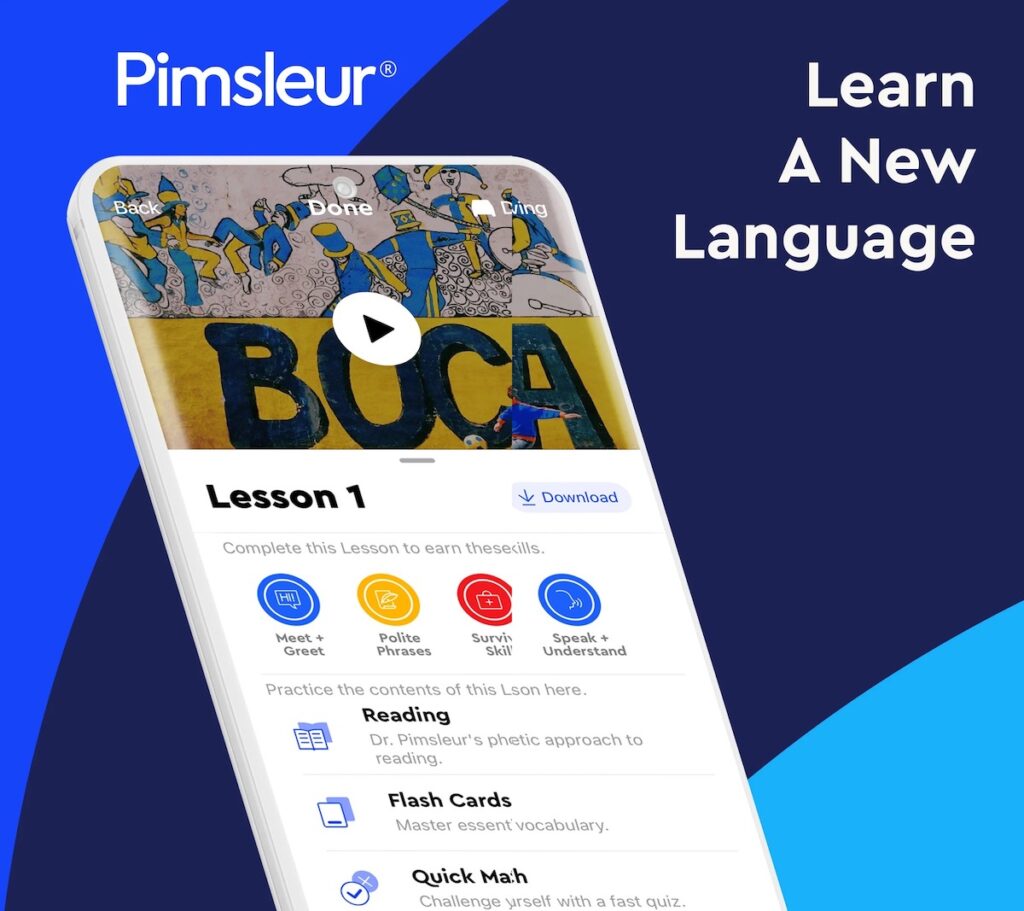
Pimsleur is one of the best language-learning apps, period. But it’s also one of the best tools to learn Ojibwe, as you can see from these reviews.
This audio-based app is based on the Pimsleur Method (a type of SRS method) that essentially teaches you new Ojibwe words and phrases, and reviews them at well-timed intervals to ensure long-term memory. You also learn in context — no drills, rote memorization, and boring grammar lectures.
Take note, however, that the program teaches the Southwestern Ojibwe dialect spoken in Minnesota and Wisconsin, so there might be some differences in vocabulary and pronunciation.
Learn more with this Pimsleur review. Or try it yourself for free!
Key features:
- 30-minute audio lessons (total of 16 hours) that improve your listening and speaking skills
- Voiced by native speakers so you learn the correct pronunciation and accent
- Comes with a hands-free mode, digital flashcards, and cultural info
2. Ojibwe Learning

This app was developed by Ogoki Learning Inc., an indigenous-owned company that aims to revitalize and preserve the world’s ancestral languages.
Darrick Baxter, Ogoki’s CEO, created the app to help his daughter learn their language Ojibwe. After hearing his daughter speak Ojibwe to her grandmother by using the app, Baxter decided to make the app available to everyone.
This fuss-free app includes words and phrases in the Northwestern Ontario dialect. You’ll learn greetings, body parts, months, colors, and more through quizzes, matching with images, and memory games. Plus, you’ll hear authentic pronunciation from a native speaker.
Key features:
- Simple, clutter-free interface
- Audio recorded by a native speaker
- Interactive games to help you learn new words
3. Aamjiwnaang Language App
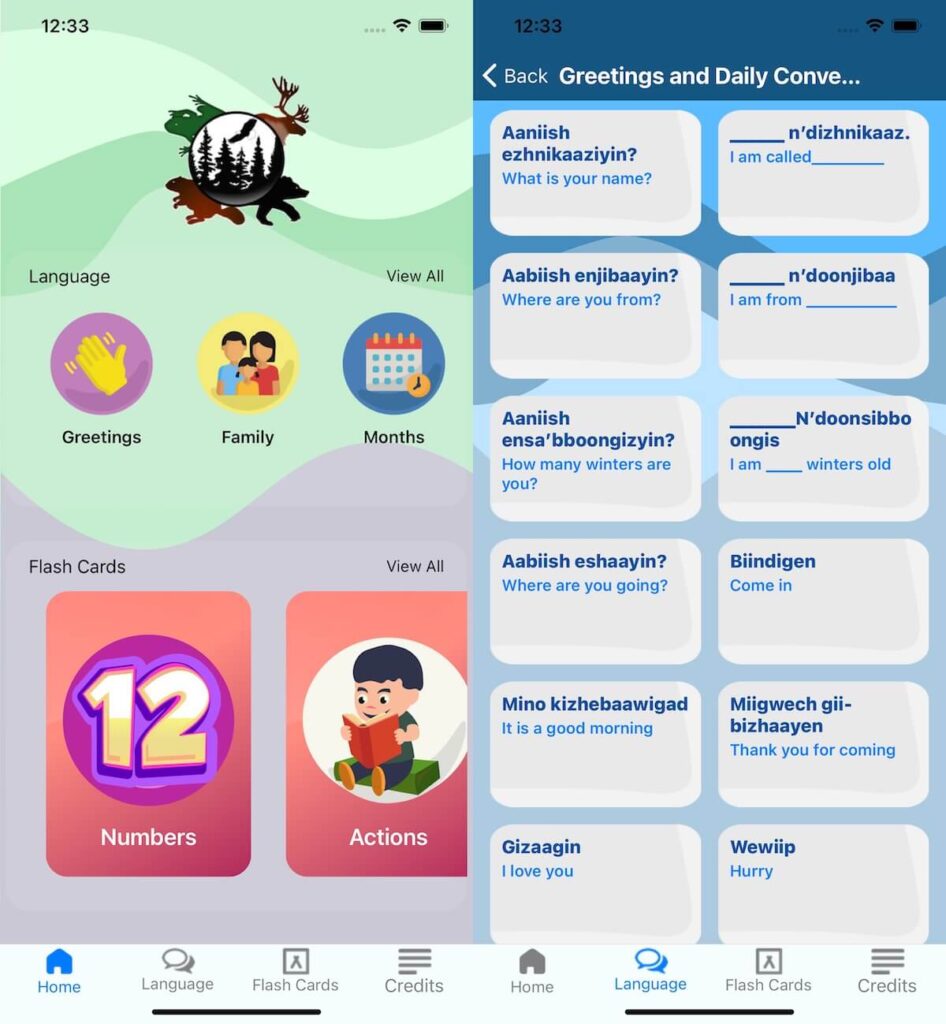
Learn Ojibwe on the Aamjiwnaang Language App
The Aamjiwnaang Language App, also by Ogoki, is catered to beginner learners of the language, but it is accessible for all ages and skill levels.
This app features basic words and simple everyday sentences that can be heard for the individual to practice on their own with a variety of subcategories to choose from such as animals, body parts, and more.
What’s great about this app is how user-friendly it is. It provides a fun and interactive way to learn the language. Plus, it’s great for learning the language at their own pace and provides a variety of subcategories to choose from.
Key features:
- Beginner-friendly lessons
- Flashcard-style lessons
- Self-paced lessons that you can access for free
Other great resources to learn Ojibwe
No language learning app or website is perfect and every learner has different goals. Exploring more options will help you identify which resource works best for you. Check out these recommendations:
Let’s Start Ojibwe: Part of Sault College’s video learning series, this YouTube playlist provides a basic framework of Ojibwe orthography and pronunciation. You’ll learn essential vocabulary, parts of speech, declension, conjugation, and more in short videos.
The Ojibwe People’s Dictionary: An expansion of the above dictionary, this website founded by Nichols serves as a talking Ojibwe-English dictionary that features the voices of Ojibwe speakers. It also houses the Ojibwe collections at the Minnesota Historical Society. With thousands of entries and audio (and more coming each week), this is one of the most reliable sources for learning Minnesota Ojibwe.

A Concise Dictionary of Minnesota Ojibwe: Written by University of Minnesota professors John Nichols and Earl Nyholm, is a comprehensive dictionary covering more than 7,000 of the most frequently used Ojibwe words. It comes with inflected forms, roots of words, vowel changes, and some illustrations.
Ojibwe.net: This non-profit website teaches basic Ojibwe words and phrases and provides an introduction to verbs and pronouns for beginners. The intermediate-level course is in the works, but advanced learners can dive into aphorisms and short stories.

Ojibwemodaa Podcast: This podcast couldn’t be more specialized — its entire catalog is dedicated to verb conjugations! While there’s no word as to when it’ll return for a second season, its first season’s 17 episodes will prove useful to anyone who wants to zoom in on Ojibwe grammar.

- Used Book in Good Condition

Living Our Language: Ojibwe Tales and Oral Histories: A bilingual anthology, this book contains stories from Anishinaabe elders living at Leech Lake, White Earth, Mille Lacs, Red Lake, and St. Croix reservations.
The stories come with English translations on the opposite page. An Ojibwe-English glossary is also included at the back of the book. Perfect for those who want to learn more about Ojibwe history and culture, but not ideal for beginners.
Conclusion
Deciding to study Ojibwe, whether to honor your roots or connect with the Anishinaabe people, is a commendable choice. Promoting language diversity and cultural survival is a worthy cause!
And even without a Duolingo Ojibwe course, you can start your learning journey. With the right mindset, dedication, and the tools above, you’re set!
Duolingo alternatives for learning Ojibwe – Pin it!