A few years ago, there was a way for Duolingo users to know if a certain language was being added to the app’s line-up and what its development status was. If you’ve been a long-time user of Duolingo, then you probably know what I’m talking about: the Duolingo Incubator.
Now, when you try to access the link incubator.duolingo.com, what you’ll see is Duolingo’s complete list of language courses.
If you’re wondering what happened to the Duolingo Incubator as I was when I clicked said link some time ago, stick around and let this article explain.
What was the Duolingo Incubator?

Launched on October 9, 2013, the Duolingo Incubator was a program where bilingual and multilingual volunteers from around the world collaborated to build new language courses for Duolingo.
To standardize its courses, Duolingo releases only one course for each language. This was the case back then and still is today. Under the contributor program, Duolingo invited people fluent in two or more languages to apply. For each language, two to three moderators were chosen through this application system.
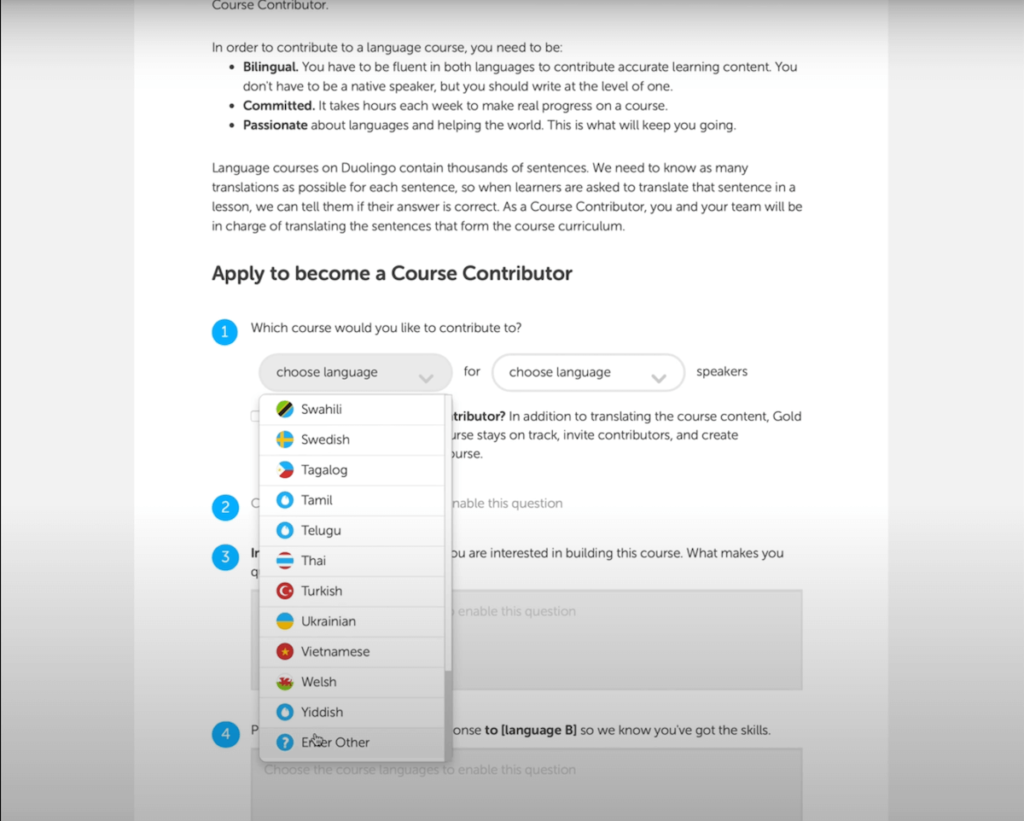
The selected moderators then chose and built teams of people (contributors) to help them create the courses, following a few standardized steps.
Through the Duolingo Incubator, you could see how many courses were being developed, their current development status, and estimated completion dates. The course creators were also credited.
The Duolingo Incubator breaks down the progress of each course into smaller objectives but the phases are mainly classified into three:
- Courses in phase 1 were those in the process of being created. At this stage, volunteers translated thousands of words from the source language to the language the course teaches, translated the Duolingo interface itself, arranged sentences and word images, and obtained audio recordings.
- Phase 2 courses were those that were released to the public via beta testing. This meant that some of them would have issues or mistakes.
- Phase 3 courses were courses that met specific criteria (e.g., having a low rate of error reports) and were considered “graduated” from beta. These courses were released to the public.
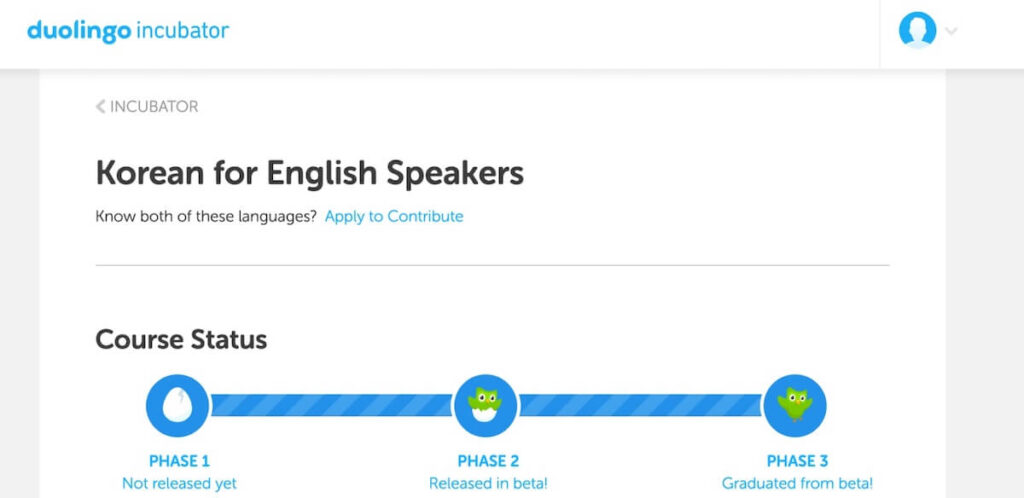
The Duolingo Incubator page showed only courses that were given the green light by Duolingo. This meant that even if a course had applicants, it wouldn’t be shown until Duolingo decided to begin making it.
Why was the Duolingo Incubator shut down?
Today, the development of language courses on Duolingo happens internally and is carried out by the Duolingo staff.
In its blog post in March 2021, Duolingo explained that while the Contributor program was an incredible feat in crowdsourcing history, it wasn’t sustainable in the long run for two reasons.
First off, at the time Duolingo launched the Incubator, they weren’t earning money from their courses. Years later, the company started earning from Duolingo Plus (the app’s premium version).
Moderators and contributors developed language courses for free out of their passion for language education. This is one of the biggest reasons why many of us could continue to access the courses for free. Still, it wouldn’t be fair for Duolingo to continue receiving free work while the company is earning.
Secondly, the decision to shut down the Contributor Program aligned with Duolingo’s move to standardize its courses according to CEFR (Common European Framework of Reference). The company started implementing strict timelines and specific templates for course content, which they couldn’t impose on the contributors.
What Duolingo didn’t explicitly state in the said blog post was its IPO (initial public offering) which it filed on June 2021 on NASDAQ under the ticker DUOL. Duolingo likely terminated the Contributor Program in preparation for the IPO.
Being publicly listed meant Duolingo would continue making money, so how could it continue not paying its course creators?
One Redditor also had a logical explanation: Duolingo couldn’t control the release dates of its courses under the Contributor Program, which could be a con for prospective investors. What’s more, the courses created by contributors could also be subject to intellectual property rights management. Having paid course creators would ensure that Duolingo had rights to the courses.
What happened to the volunteers?
All that said, Duolingo didn’t just ditch its volunteers.
The company set up the Duolingo Language Impact Award, a $4M fund shared among the Contributor community. There was also an award ceremony where additional honors and benefits were given, including this cute Duo trophy.
Some of the volunteer contributors were also hired as part-time course specialists.
How does this affect Duolingo’s future courses?
The Duolingo Incubator was still live for a few months after the program was terminated. You could still see the progress and launch dates but it was not open for new contributors. Today, as I mentioned above, the link leads to the official list of language courses.
Upon axing the program, Duolingo said that it didn’t expect major changes to its courses and that its commitment to providing free and fun courses (especially for indigenous and endangered languages) will remain unchanged.
Duolingo kept its word — the courses remained free and new courses for English speakers, such as Haitian Creole and Zulu, were released. English courses for Tagalog and Telugu speakers were also launched.
However, the development of new courses or courses that were already in phase 1 of the Incubator noticeably slowed down.
For instance, CEO Luis von Ahn announced at Duocon 2021 that Duolingo would release five new courses for English speakers. These were highly requested languages — Zulu, Xhosa, Tagalog, Maori, and Haitian Creole.
As mentioned above, Zulu and Haitian Creole were already released in 2022. Maori was supposed to be in February 2021 according to the Incubator. As of writing, Duocon 2023 has passed and the course hasn’t been launched yet. There’s hope though as an official Duolingo Maori page is now live and says “coming soon”.
Now that the Duolingo Incubator is no longer available, there’s just no telling when the Tagalog and Xhosa courses will be launched. Such is the case for other sought-after language courses such as Icelandic, Punjabi, and Croatian.
It’s likely that Duolingo has now shifted its focus to improving existing courses rather than churning out new ones. It’s sad for us who are waiting for new courses, but I, for one, am grateful that Duolingo continues to make language learning accessible and fun.
And for courses that aren’t available on Duolingo, no need to stall as you can simply explore these alternatives.