
If you’ve learnt a bit of French, you’ll realise that there are many similarities with English. These are all down to the many historical, geographical and cultural events, trading, and conquests that have occurred over many centuries.
This all started when William the Conqueror came to England in 1066 and became King. This meant Norman French was the official language (at least in government and among the upper class) while the masses continued to speak English. Naturally, therefore, there was an impact on English.
Though there are similarities and overlaps, French still remains a distinct language with many differences. In this article, we’ll look at the differences between French and English in detail.
French vs English
If you’re a native English speaker wanting to learn French, you’ll be pleased to know that it’s one of the easiest languages for us to learn. With our shared history, shared alphabet, and proximity, you’ll find learning French much more straightforward than you realise.
One thing that will help is understanding some key differences between the languages too. Here, we present 12 important differences between the two.
#1 All nouns in French have genders

For new language learners that only know English, learning that nouns have genders can be surprising. So, we might have words like hero/heroine, duke/duchess, and husband/wife, but our nouns in English don’t have genders like the French.
In French, each noun is either masculine or feminine. Sometimes, there isn’t a logical reason why a word is feminine rather than masculine. But the good news is that there are often clues in the spellings of the words to help you out. Let’s take a look.
Feminine endings
- La patience (patience)
- L’action (action)
- La baignade (bathing)
- La cigarette (cigarette)
- La chimie (chemistry)
- La liberté (freedom)
- La chaleur (warmth)
- L’ambiance (atmosphere)
- La voiture (car)
Though there are a few different feminine endings, you will pick these up quickly and it will become second nature!
Masculine endings
- Le voyage (journey)
- Le bateau (boat)
- Le journal (newspaper)
- Le réalisme (realism)
- Le changement (change)
- Le couloir (corridor)
- Le téléscope (telescope)
- Le téléphone (telephone)
Some people teach themselves that nouns ending in ‘e’ are feminine. However, there are the -age, -isme, -scope, and -phone exceptions to confuse matters!
As if things weren’t complicated enough, the gender of the noun also affects the construction of the sentence, too – the word for ‘the’ or ‘a’ must reflect the gender, as must any adjectives and relative pronouns, too!
#2 Adjectives come after nouns
Since we’re already talking about nouns, it’s a good time to mention another difference between French and English: their position in a sentence.
In English, we would say “a white wall”. However, in French (and other languages too!) we would say “un mur blanc,” which means a wall white.
Most of the time, this is the rule that applies. However, like lots of things when you’re learning a new language, there are exceptions to the rules. Some adjectives come before nouns in French – and it’s simply a matter of learning which.
Here are some examples:
– beau/belle (beautiful) = un beau garçon (a beautiful boy)
– vieux/vieille (old) = une vieille dame (an old lady)
– bon/bonne (good) = un bon livre (a good book)
– petit/e (small) = une petite chaise (a little chair)

There is a good way of being able to remember which adjectives come before nouns, however. You can use the acronym BAGS.
B – beauty (beautiful, pretty)
A – age (old, young)
G – Good (good, bad, kind, mean, best, worst)
S – Size (tall, short, long, small)
#3 French negatives are different

French negatives are a little more complicated than English ones (and Spanish if you happen to know that language too). In English, we negate a verb by putting the negation before it. For example: “I don’t swear” or “I never eat”. In French, there is a double negation around the verb. I remember my French teacher calling it a negative sandwich. There are different ways to negate a sentence, depending on what you’d like to convey. They are:
- Ne … pas (not/don’t) – e.g., je ne mange pas (I don’t eat)
- Ne … jamais (never) – e.g., je ne mange jamais (I never eat)
- Ne … plus (no longer) – e.g., je ne mange plus (I no longer eat)
- Ne … que (only) – e.g., je ne mange que… (I only eat…)
- Ne … rien (nothing) – e.g., je ne mange rien (I eat nothing)
The most important thing to remember is that these negative structures wrap around the conjugated verb only – and not the subject pronoun. For example:
Je joue au foot = I play football.
Je ne joue pas au foot = I don’t play football.
#4 There are lots of ‘false friends’

Though French does have lots of legitimate cognates (words that share the same meaning in both languages), there are also lots of ‘false friends’. These are words that look like English words but mean something entirely different. Here are some of the most common ones:
| French | English |
| Blessé | Injured (not blessed) |
| Le bras | Arm (not bra) |
| Car | Because or coach (not car) |
| Crier | To shout (not cry) |
| Prune | Plum (not prune) |
| Raisin | Grape (not raisin) |
| Sensible | Sensitive (not sensible) |
| Laid | Ugly (not laid) |
| Large | Wide (not large) |
| Roman | Novel/book (not Roman) |
#5 French doesn’t use ‘do’ as an auxiliary verb
When we speak English, we often use the verb ‘to do’ as an auxiliary verb. Simply put, an auxiliary verb is one that adds meaning or function to a sentence – it might be used to express an emphasis or a tense, for example. Here are some examples of the verb ‘to do’ being used as an auxiliary verb:
- Do you have?
- I don’t have.
- Don’t you learn? Yes, I do learn.
In French, you’d never use the verb faire (to do) in this way. Instead, you’d use a different technique.
To ask a question like “do you have?,” you’d invert the verb and subject. For example, “as-tu…?” Alternatively, you could use intonation to make a statement into a question. For example, “tu as…?”
#6 Sometimes feelings are expressed with ‘have’ not ‘be’

When we talk about our feelings in English, we’ll say things like “I’m hungry” or “I’m cold.” In French, you would use the verb avoir (to have) with these feelings. Essentially, you’re not saying “I’m hungry” or “I’m cold,” you’re saying, “I have hunger” or “I have cold.”
This also applies to other things like age (j’ai 20 ans = I am 20) and fear (j’ai peur = I am scared).
#7 There aren’t as many prepositions in French
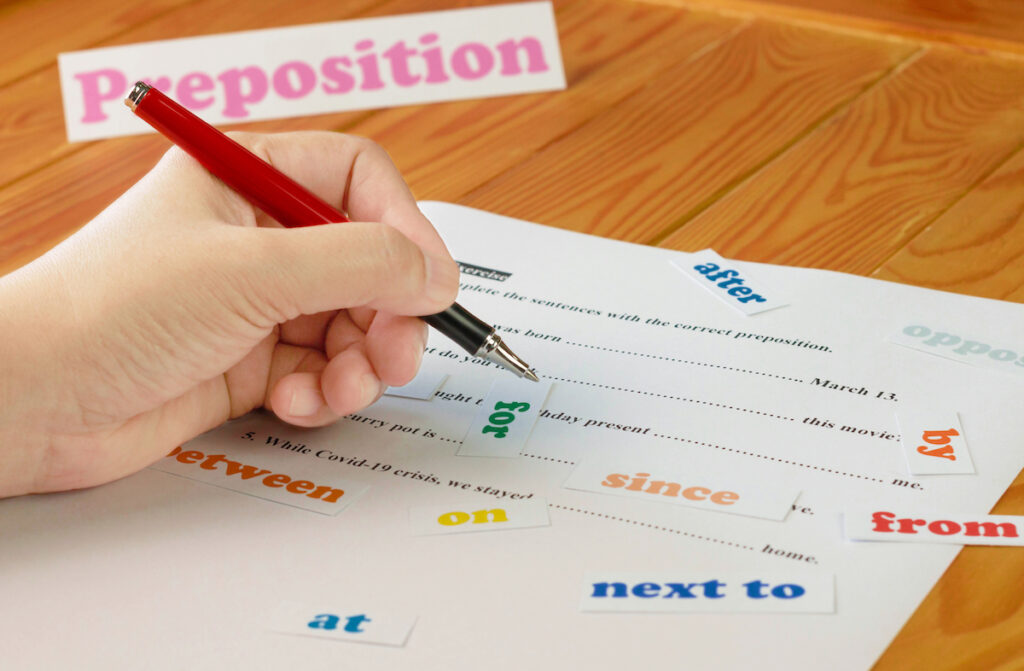
In English, we have lots of prepositions to describe the position of something – on, under, behind, across, in front, over, about, in, etc. In fact, compared to our 14 different prepositions in English, French only has nine!
This is down to the fact that English is a Germanic language and is, therefore, an analytic language. French, on the other hand, is a synthetic language and as such, uses fewer prepositions. We can see this different type of language if we delve further into looking at prepositional and phrasal verbs.
#8 Possessives are different
While you’ve still got possessive pronouns like ‘my’ and ‘their,’ when you’re talking about something belonging to someone, you need to word it differently. There is no possessive “’s” in French.
For example, to say “Jack’s father,” you would say “le père de Jack” (literally, the father of Jack).
What’s more, when talking about body parts, you don’t use possessives either. In English, we’d say “my arm hurts,” in French, this would be “j’ai mal au bras” (lit. I have pain in the arm).
#9 Tenses aren’t the same

In English, we use different tenses to show when something happened. While French does have tenses like past, present, and future, there are subtle differences in how meanings are conveyed.
The preterite or simple past tense (I ate/I went/I saw…) in English, doesn’t exist in French – or at least it’s not in everyday usage. Instead, the French use the perfect tense (I have eaten/I have gone/I have seen). The simple past is only really seen in literature and is never spoken. Chances are, you’ll never even learn it because you just don’t need it.
#10 French has a subjunctive mood
Commonly (though incorrectly) referred to as a tense, the subjunctive mood is a verb structure that isn’t used often in English.
Essentially, the subjunctive is used to express things like wishes, emotions, judgements, possibilities, opinions, or actions that haven’t yet occurred. It refers to something that isn’t necessarily real. You’ll most often see subjunctive being used in a subordinate clause (after the word that, in particular).
In English, the subjunctive is only really used in sentences like “I suggest that she stay next to you” or “it’s important that you be careful.” Normally, it would be she stays and you are.
Though use is very limited in English, it isn’t in French, which means you have a whole new concept to get your head around!
#11 Punctuation and capitalisation are different

Putting the complexities of the subjunctive to one side, an easy difference in French vs English is that days of the week and months of the year are not capitalised. While in English you would say “Monday” and “October,” in French, it would be “lundi” and “octobre.”
Punctuation-wise, the decimal point is not used for currency. Instead of €12.99, you will see €12,99. What’s more, the decimal point is used for larger numbers e.g., 1,000,000 would be 1.000.000.
Another of the key differences between French and English will be obvious if you read a lot of books! In French, inverted commas (quotation marks) “” don’t exist. Instead, guillemets « » are used. Also, a space and a colon are used to introduce speech rather than a comma.
Here is an example:
James a dit : « Je veux faire du judo. »
Jean said, “I want to do judo.”
#12 Spelling and pronunciation are harder

If you think English spelling is difficult, French is harder. At least when you’re already used to spelling being difficult, you’ll be prepared!
Though there are general spelling rules in French, it isn’t a phonetic language like Spanish. There are 26 letters in the alphabet (like in English) but there are over 38 different phonetic sounds. Added to that are the different accents – é, ê, è, à, ç, etc.
There are also things like silent letters and multiple sounds for single letters that you just have to learn and get used to.
Here are some examples of silent letters being used:
- Corps meaning ‘body’ is pronounced like the English word “core”
- Faux meaning ‘false’ is pronounced like the English word “foe”
Generally speaking, lots of consonants on the end of a word aren’t pronounced like quand (when) and compris (understood).
But, when it comes to speech, there is something called the liaison, which means the word might be pronounced differently depending on what follows! E.g., in the sentence Quand est-ce qu’il arrive? (when will he get there?), the final ‘d’ in quand sounds like a ‘t.’
Final thoughts on French vs English

So, there you have it — 12 key differences between French and English! Unfortunately, as you develop your knowledge of the language, you’re probably going to find a few more. It’s these differences, though, that make language learning so fascinating. So, embrace them and enjoy learning about them!
I have the impression that the French use the present more often in storytelling than the English.
For example,
French : “Elle traverse la forêt. En arrivant, elle s’assied à côté de sa grand-mère et commence à parler”.
English : “She walked through the forest. When she arrived, she sat beside her grandmother and started to talk”.
When would it be correct to do so in French and/or in English ?