
Should you learn Portuguese or Spanish? That may not be a straightforward decision, since both languages are beautiful, fantastic in terms of business opportunities, and in fact quite similar to each other.
With that in mind, I’ll outline the criteria you should use to make up your mind if you’re meant to study either Spanish or Portuguese.

Among other things, you’ll need to factor in your motivation, the popularity of each language, and how easy they might end up being based on the languages you already speak.
Should You Learn Portuguese or Spanish? Base your decisions on these factors:
1. What’s your language background?

Spanish and Portuguese have a common origin and as such share a related vocabulary and similar language structures — they coincide some 86% of the time.
If we were comparing languages like Greek and Japanese, which have virtually nothing in common, this question would make a lot more sense.
However, there’s no denying Spanish is a tad closer to English than Portuguese: between 30% and 40% of English words have a Spanish equivalent, whereas that percentage falls under 30% when we put English and Portuguese side by side.
You can have either an easier or a harder time learning Portuguese or Spanish, sure, yet that’s not the only reason why your background should be taken into account.
If, for example, you live in the southwest of the U.S., Spanish is all over the place. So learning Spanish in that scenario would be a more reasonable choice. Anywhere in southern Africa, on the other hand, makes Portuguese a much stronger contender.
The bottom line is location matters! Well, unless you’re in Eastern Europe or Asia, where both Spanish and Portuguese belong in a sort of remote dimension.
2. Why do you want to learn a new language?

Don’t skip this question if you’re determined to learn Portuguese or Spanish — or any language for that matter. You’ll need to put in a couple of hours every week for several years, so your decision will impact your routine and your life as a whole.
Doing business is one of the most common reasons why people study a foreign language. They may also dream of traveling to a country that speaks that language or studying there. If that sounds like you, check out no. 5 and you should find some guidance.
Some folks approach a new language for fun, which is kind of how I ended up taking up Italian, for example. In this case, you should factor in the culture and the sound of each language in this case and decide which is more seductive to you.
Eventually, Italian unexpectedly turned into an asset to me, as I got my first job and, in a way, became a writer thanks to it. We never know what lies in store, so motivations are simply a guideline.
Still, being aware of what has drawn you to that language beforehand is essential to stay strong in your pursuit, so do set some time aside to assess all that.
3. Which of them is harder to master?

If you’ve ever wondered “Is Portuguese easier than Spanish?”, know you’re not alone. Answering that question can have a huge impact on your decision. In theory, the two are among the easiest languages for an English speaker to learn.
At least that’s how the Foreign Service Institute of the U.S. government has categorized Portuguese and Spanish, which, alongside Italian, French, Dutch, and Swedish (among a few other languages) should take you between 575 and 600 hours to master.
Just to give you a clearer picture, languages like Russian and Greek may require about 1,100 class hours, while you’ll need twice as much time to master Japanese, Chinese, Arabic, and Korean.
Having said that, a couple of factors may make learning Portuguese a slightly more challenging endeavor. It is, after all, spoken on four continents, which means Portuguese dialects can vary more widely than Spanish’s.
What’s more, Portuguese is notorious for the astonishing gap between the oral and written languages. Finally, since Spanish is far more common in mainstream culture, chances are you’ll be exposed to it more often than Portuguese.
4. Which of them is more popular or widely spoken?
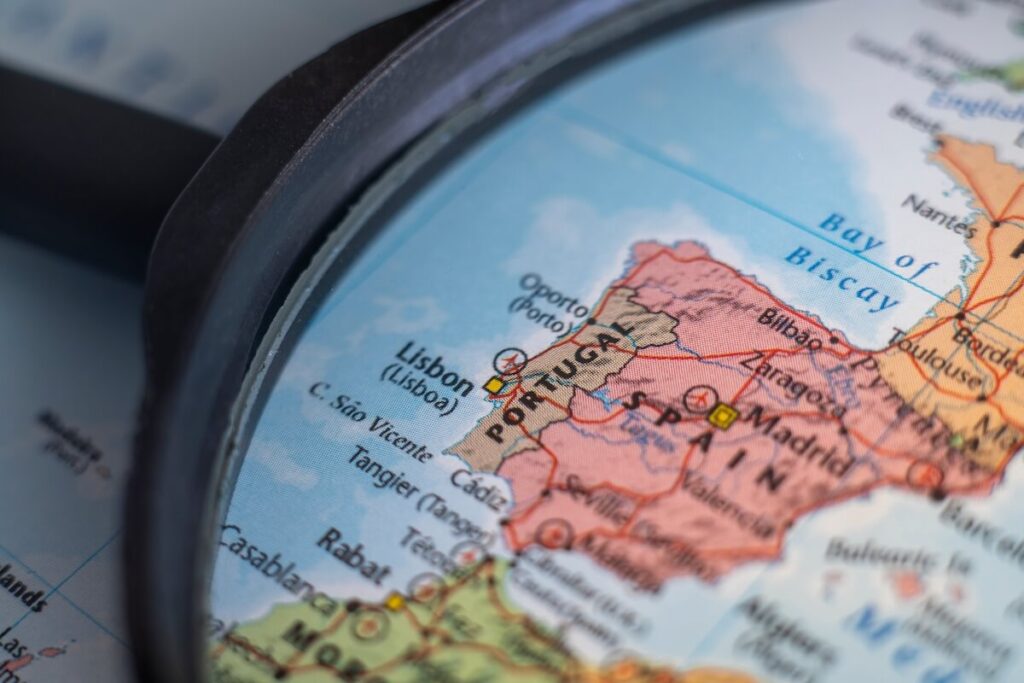
Here, there’s no glossing over: Spanish destroys Portuguese. Between those who have it as their first and second language, Spanish counts around 600 million speakers. Portuguese, in turn, is spoken by 275 million worldwide.
When it comes to the number of countries where each has official status, Spanish has the upper hand too: it’s spoken in 20 nations (Mexico, Colombia, Spain, Argentina, Peru, Venezuela, Chile, Ecuador, Guatemala, Bolivia, Cuba, Dominican Republic, Honduras, Paraguay, El Salvador, Nicaragua, Costa Rica, Panama, Uruguay, Equatorial Guinea).
Portuguese is instead the official language in nine countries (Brazil, Portugal, Angola, Mozambique, Guinea-Bissau, Equatorial Guinea, Timor-Leste, Cabo Verde, and São Tomé and Príncipe).
As for the number of foreign students learning either language, data are conflicting. It’s fair to assume Spanish is more in demand because 18 million learners across the globe are committed to mastering it.
Despite a lack of reliable figures regarding Portuguese, the language is quite popular in South America, Spain, and in Angola and Mozambique’s neighbors like South Africa.
5. Which is more promising career-wise?

The sole fact that Spanish is spoken in 20 countries against Portuguese’s nine may lead you to think Spanish may score an easy win here, yet the result of a detailed comparison is more subtle. Let’s see why.
To begin with, several of both Spanish- and Portuguese-speaking countries are among the richest on Earth in terms of GDP. Spanish holds a slim edge, given it is spoken in so many countries: Mexico ranks 13th, Spain is 16th, Argentina is 29th, and Colombia is 32nd.
Still, Brazil has the 8th-largest economy and one of the most dynamic domestic markets on the planet (Portugal and Angola 50th and 66th, respectively). Portuguese is also less popular as a foreign language and may end up being more valuable on your resume.
When it comes to setting up a business, Portugal and Spain are among the most affordable nations, though Portugal is slightly better off. Brazil, then Argentina are overall a good deal in that respect as well, while Colombia and Mexico are on the other end of the ranking.
As developing nations become more relevant on the international stage, both languages will become even more prized. But since Brazil is usually considered to have more potential as an emerging power than, say, Mexico or Argentina, Portuguese may turn out to be a good bet.
So ultimately, which language will be best for business will depend on your field of expertise and career goals. Before making a final decision, you may want to look up what the perspectives for your sector are in the largest Portuguese- and Spanish-speaking economies.
What should you do if you want to learn both?

Learning a second Romance language after mastering the first is a lot easier than moving to another language family (i.e. studying Italian after German).
I speak from experience, as after mastering Spanish, becoming fluent in Italian and learning how to speak passable French felt almost like a walk in the park.
So if you’re down to learn both Portuguese and Spanish, by all means do it! You’ll benefit from all of the advantages that I’ve highlighted above and double the fun as well.
In case you can’t learn the two at the same time (which is totally understandable), do go over the factors once again to assess which you’ll prioritize. The next two sections, where I break down why each language is so relevant, should be of great help too.
Why is learning Portuguese important?

Making the case for learning Portuguese is child’s play. First of all, there’s the population factor: hundreds of millions of people on four continents speak Portuguese. Becoming fluent in it will introduce you to the cultures of Brazil, Portugal, Mozambique, and other beautiful countries, which share basic features but are beautiful in their own unique way.
Plus, Portuguese sounds poetic and sweet according to most foreign learners. Due to the superb music, literature, and art in general at your disposal, studying it will never get old. On the contrary: you’ll fall in love with it in the blink of an eye.
Navigating Portuguese pronunciation can indeed be challenging, yet its structure is overall similar to that of English. As I’ve highlighted before, it will give you a much easier time than any Asian, African, or Eastern European language.
Last but not least, adding the badge “fluent in Portuguese” to your will look more impressive than any other Romance language because of how rare it is to find foreigners who speak it well, especially if your sector or the company you’re applying to has interests in Brazil, Portugal, or Angola.
Why is learning Spanish important?

Spanish has been a major world language for five centuries and will continue to be one of the best languages to learn for the future.
It’s already the second language by the number of speakers on a global scale and should become the mother tongue of half of Americans over the next 50 years.
It’s also one of the easiest languages to master for an English speaker, which will give you a head start if you eventually decide to learn Spanish.
Spoken in countries such as Mexico, Argentina, and Colombia — apart from Spain, of course —, Spanish will open many doors where job and business opportunities are concerned.
If you want to move to one of those countries or simply discover their dazzling landscapes and exhilarating cities, being able to communicate will be crucial for interacting with locals and diving into their fascinating cultures as well.
Final thoughts on learning Portuguese vs. Spanish
Do you already have a final answer to the question “should you learn Portuguese or Spanish?”? Don’t worry; you can take as much time as you need to decide.
The bottom line is you now have all the elements you’ll have to consider before committing to one of them, which is essential given learning a new language is usually a long (if exciting) process.