
*This article may contain affiliate links. For full information, please see the disclaimer here.
Picture this: your favorite Korean idol or actor started a live broadcast on Instagram. You get excited and rush to tune in, only to realize that you won’t be able to understand what he/she is saying. You might catch a few words and phrases but not comprehend the whole thing.
If that sounds awfully realistic, it’s because it has happened to me and my friends so many times. Not every Korean content comes with subtitles. While this should not be the sole reason for learning Korean, it’s one of the most common.

Have you experienced something similar? Do you struggle to communicate in Korean because of your limited vocabulary? You probably need a Korean vocabulary app.
Why use a Korean vocabulary app?
Even if you’ve managed to memorize the Korean alphabet, having a limited vocabulary means it’s still tough to understand what you’re reading or hearing. And what is communication without comprehension?
For effective communication and mastery of the language, having a strong Korean vocab is a must. And for you to achieve that, you’ll need a great Korean vocabulary app.

While other resources like books or online courses are great, using mobile apps to learn Korean vocabulary means you can study anywhere and anytime. We spend so much time on our phones anyway, so why not use some of that time to learn Korean?
That said, not all apps are created equal. Some Korean learning apps focus on improving your conversational skills, some are more grammar-oriented, while others teach reading and writing Hangeul. If your priority is to expand your vocabulary, you should find an app that addresses this.
Top picks
The good news is, there are plenty of apps to help you build your Korean vocabulary. If you want to find the one that suits your preference, it’s best to play around with all my recommendations below. But if you simply don’t have the time, you can just pick any of my favorites:
- Mondly, uTalk, and Rosetta Stone help you pick up new words through visual associations.
- To learn Korean through fun games, go for Ling or Duolingo.
- Rocket Korean features Korean vocabulary with ample cultural insight.
- For memorizing Korean words through flashcards, use Quizlet or Anki.
Now, time to take a closer look at these apps. 가자!
Best Korean vocabulary apps for language learners
1. Ling App

With a variety of games, quizzes, practice dialogues, and tips, you won’t be bored while learning Korean vocabulary on Ling.
But while Ling App’s lessons are gamified, the content is not simplified or dumbed down. You will be learning essential phrases and sentences, not just individual words. Plus, you’ll understand how to use what you learn by applying it as you practice dialogues with the app’s chatbot.
Ling also offers extensive grammar tips and instructions that help you master Korean. Perfect for beginners and intermediate learners looking for a fun and well-rounded tool.
Check out this review of Ling app to know more.
Key features:
- Learn Korean vocabulary in just 10 minutes per day
- Interactive games and challenges
- Expand vocab and build conversational skills with the chatbot
Pricing: Some contents are available for free but you can unlock more lessons and features for as low as $14.99/month.
Devices: iOS and Android
2. Mondly
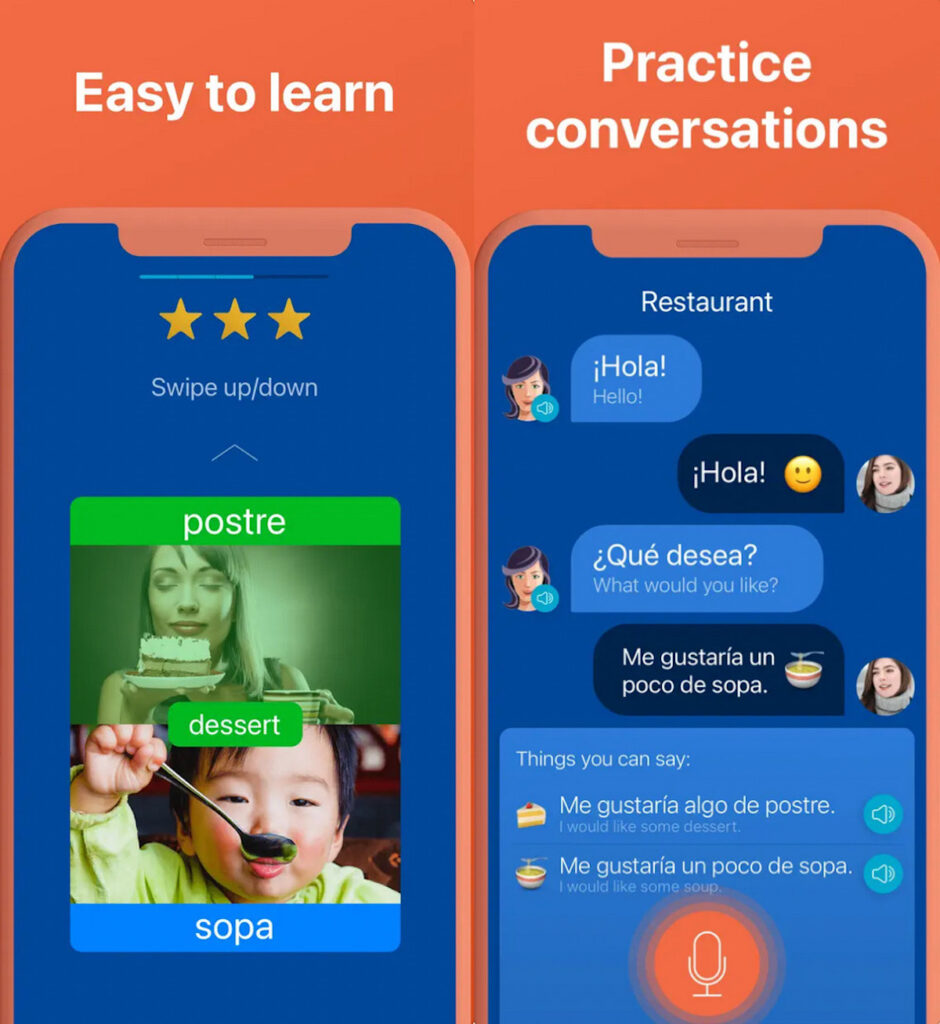
An award-winning app, Mondly effectively helps learners widen their vocabulary by focusing on phrases, not individual words. What’s more, Mondly does this in the context of conversations so that you can form long-term recall of what you learned.
Learning on Mondly means you will gain relevant vocabulary — words that allow you to take part in conversations almost instantly. Even better, the audio guides are spoken by native speakers so you don’t just learn words but also how to say them in flawless pronunciations and native accents.
Mondly’s Korean vocabulary lessons feature 50 topics that’ll prepare you for the most common situations you might encounter with native speakers. Aside from vocab lists, you also get grammar features and conjugation tables — a huge plus if you want to dive deep into Korean grammar later on.
(I reviewed Mondly here; find out how it fared!)
Key features:
- Learn Korean vocabulary through quick conversation-based lessons
- A variety of relevant topics
- 36 vocabulary builders and extensive grammar features
Pricing: The premium plan starts at $9.99/month. You can also check out Mondly’s latest promo.
Devices: iOS and Android
3. Rocket Korean
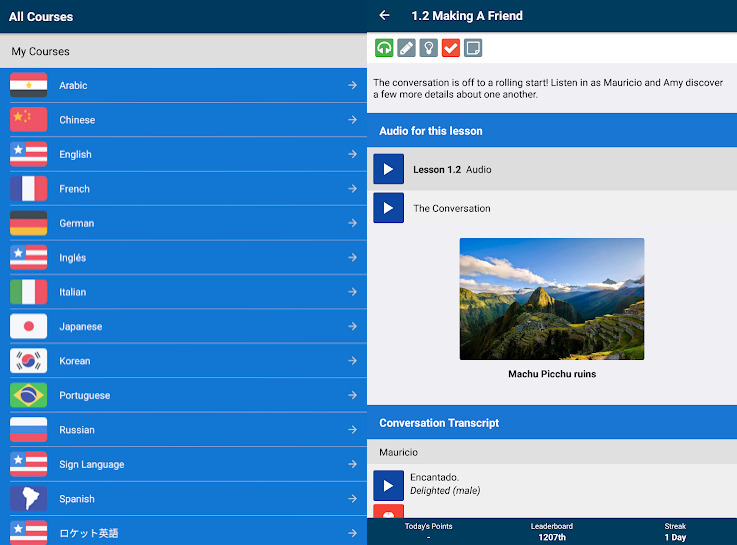
Learn Korean with Rocket Languages
Rocket Languages teaches Korean through audio lessons, interactive exercises, and reading materials that help learners acquire all core skills: reading, writing, listening, and speaking.
What I really like about this app is that it doesn’t skimp on the Hangeul lessons. It has 27 writing lessons that show you how to read and write using the Korean alphabet. While you can easily build your vocabulary through audio drills, having a strong Hangeul foundation helps you remember new words the way they’re written and spelled.
With Rocket Korean, you can learn vocabulary associated with greetings, survival phrases, travel and eating, and so much more. You get 120 hours of lesson time, enough to amass a sizable vocab and get comfortable conversing with locals.
Find out more with this comprehensive review of Rocket Languages.
Why you should try Rocket Korean:
- High-quality audio lessons and lots of speaking practice
- Offers a strong writing and reading foundation
- Gain practical vocabulary and cultural info
Pricing: Introductory lessons are free but the rest aren’t. Lifetime access to all materials starts at $27/month. Check the latest discounted rates here.
Devices: iOS and Android
4. Rosetta Stone

Learn Korean with Rosetta Stone
Want a little more challenge in your Korean vocab learning journey? Consider Rosetta Stone. This app teaches Korean vocabulary and contextualized grammar, and improves speaking skills.
Sounds good so far, right? Here’s the catch though: it teaches Korean… in Korean.
Known for its Dynamic Immersion approach, Rosetta Stone teaches Korean words and phrases purely in Korean. Save for a few instructions, you will not see or hear a word in English. You do get audio and visual cues but for the most part, you’ll be figuring things out in Korean.
While this Korean vocabulary app is great for learning useful words, it might not be the best if you don’t know how to read Hangeul.
Key features:
- Learn real-life Korean vocabulary in bite-sized lessons
- Immersive program for learners who can already read Hangeul
- Authentic pronunciation and accent from native speakers
Pricing: Starts at $11.99/month. Check out the latest Rosetta Stone Korean promo here.
Devices: iOS and Android
5. uTalk
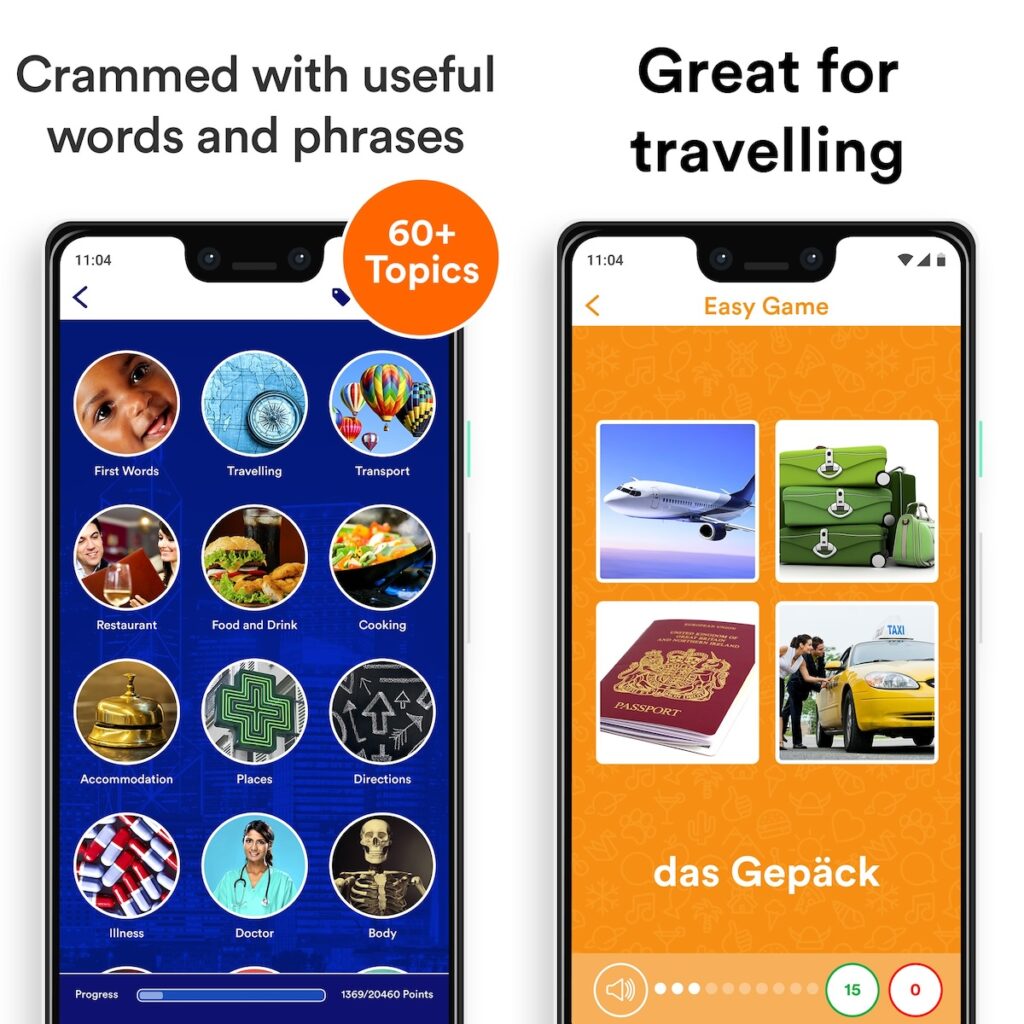
If your goal is to quickly build a rock-solid foundation of Korean words and authentic pronunciation, uTalk is the app to download.
This app is less about grammar deep-dives and more about getting you to speak useful, everyday Korean right away. You’ll have a blast playing fun, engaging games to master over 2,500 essential words and phrases across more than 60 real-world topics.
The best part? Every single word is voiced by native Korean speakers, and the app’s unique voice recording function lets you instantly compare your own speech with theirs. This is perfect for fine-tuning your accent until it sounds just right.
Key features:
- Massive vocabulary bank across everyday situations
- All content is voiced by authentic Korean speakers.
- Fun, easy games to boost retention and memory.
Pricing: Monthly subscription starts at $8.99/month. Check out the latest uTalk sale here.
Devices: iOS and Android
6. Busuu

Busuu is like having a Korean study buddy and teacher rolled into one neat app, perfect for building solid vocabulary and real-world conversational skills.
You get expertly designed, bite-sized lessons that keep you motivated and moving at your own speed, with fun specialized courses like Hangeul for mastering the alphabet and even a K-drama track!
Beyond just listening to native speaker audio, its key feature is the community: you can post on the Community section and get personal feedback and corrections directly from native Korean speakers around the globe.
Key features:
- Bite-sized, interactive lessons
- Includes courses dedicated to Hangeul and K-drama dialogue
- Smart tools help you practice and retain new words.
Pricing: Starts from $12.99/month. Find Busuu discounts here.
Devices: iOS and Android
7. Glossika
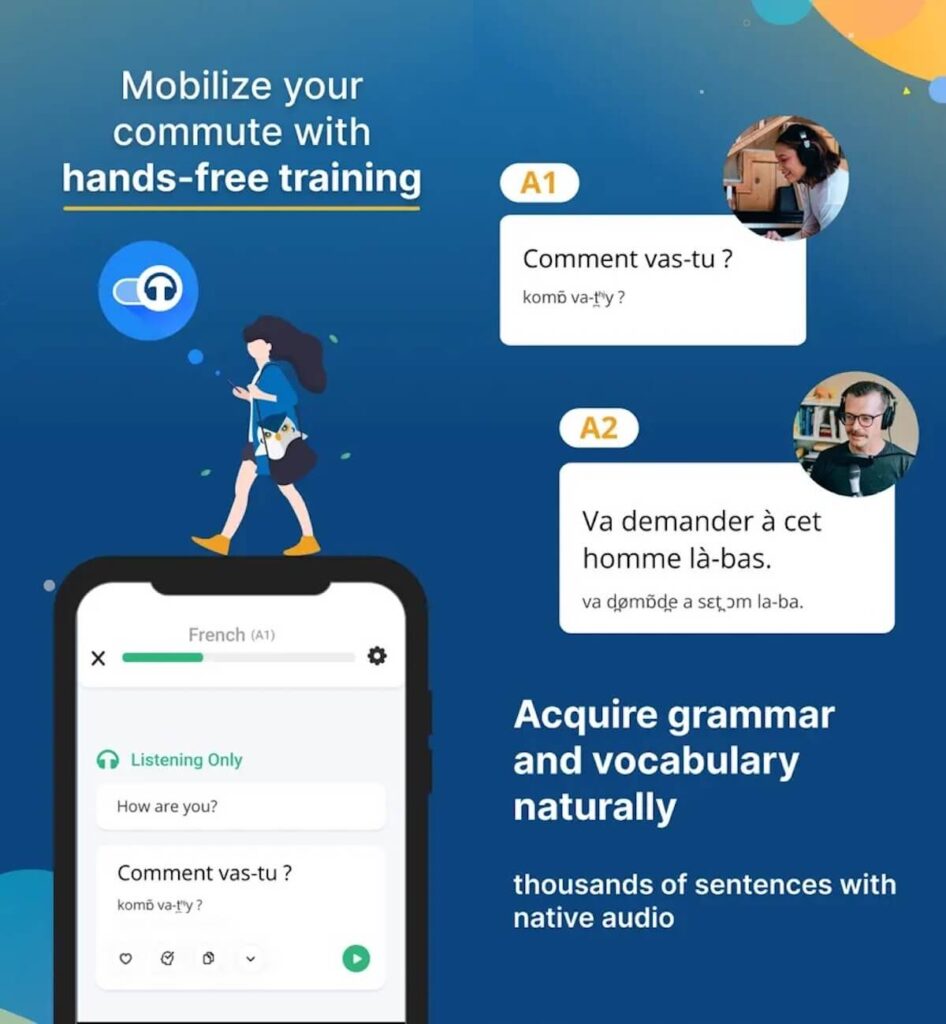
Forget learning Korean by memorizing endless, isolated words—Glossika is the refreshingly unique app that trains your brain with thousands of complete Korean sentences.
This approach, called “Mass Sentence Repetition,” mimics how native speakers actually learn, allowing you to absorb grammar and vocabulary naturally through context. The program’s powerful spaced repetition system (SRS) brings back sentences you’re about to forget.
What’s more, every sentence is voiced by native Korean speakers, you quickly master authentic flow, pronunciation, and intonation.
Key features:
- Focuses on thousands of full, real-world sentences, not isolated words
- Helps you internalize grammar rules organically through sentence patterns
- Excellent quality recordings for perfect pronunciation and rhythm
Pricing: Starts at $16.99/month after a free trial. Check out Glossika discounts here. If you’d like to support Learn Languages From Home, make sure to complete your purchase through the Glossika website (not the mobile app). You can sign up and use whatever platform you want, but if you make the purchase using the website, I make a small commission. Thanks!
Devices: iOS and Android
8. Promova
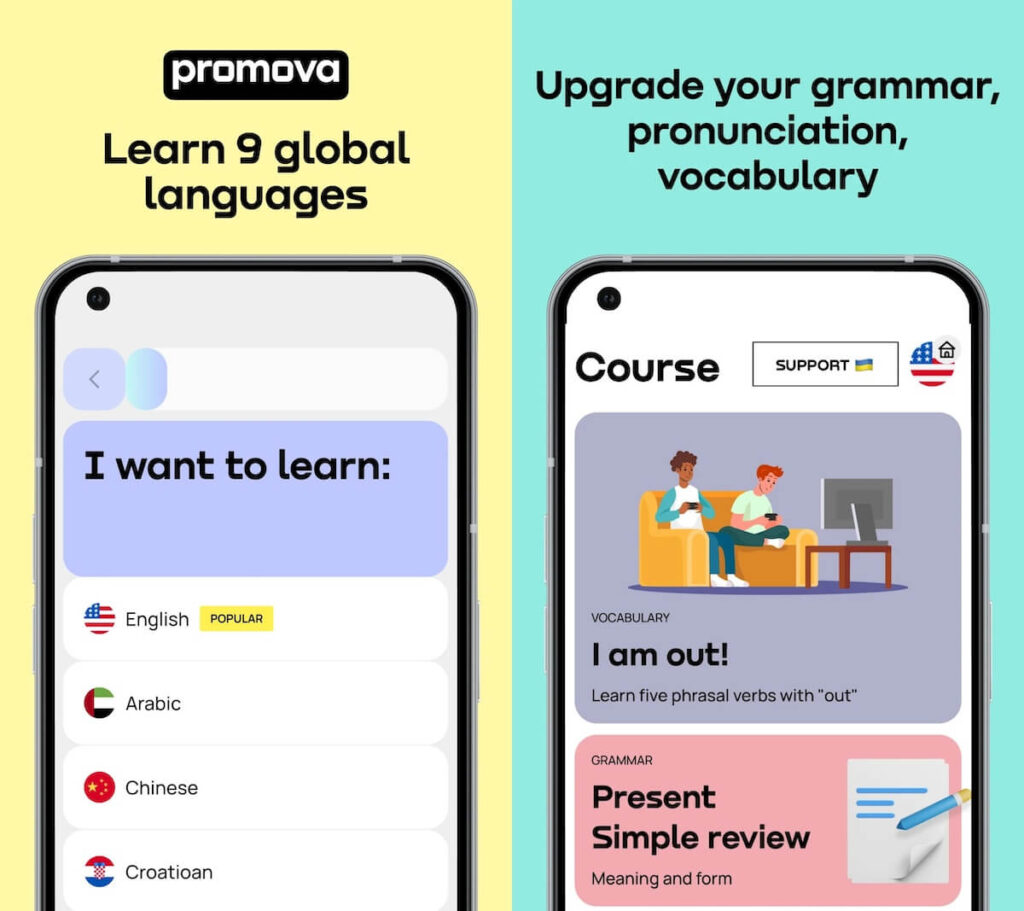
Promova is an engaging, all-in-one Korean learning platform that ditches the one-size-fits-all approach by giving you a personalized learning plan based on your unique goals. It breaks down the language into fun, bite-sized lessons that cover essential vocabulary, practical grammar, and even fascinating Korean cultural insights.
What I love about this app is that it uses a mix of interactive exercises, AI-powered speaking practice for real-time feedback, and enjoyable quizzes to help you confidently develop all four skills: listening, speaking, reading, and writing.
All in all, a solid app for learning the stuff that truly matter for everyday conversations.
Key features:
- Focus on essential vocabulary
- Quick, easy-to-digest modules that fit into busy schedules
- Comprehensive skill coverage
Pricing: Starts at $49.99 for three months but you can snatch a good deal here.
Devices: iOS and Android
9. Memrise

Memrise is perfect for acquiring vocabulary and developing conversational skills. The app uses a talk-first approach that helps you learn new words and phrases and say them without sounding like a textbook.
Memrise’s Korean courses include over 3,000 relevant and commonly used words and phrases. To learn them, you can watch over 10,000 native speaker audio and video clips that’ll teach you the right pronunciation and tones.
It’s also worth noting that Korean is one of the most famous courses on Memrise. While you can access Memrise’s official 7-level Korean course, there are also lots of user-made courses that tackle essential words, slang, verbs, grammar, and more.
Key features:
- Learn new Korean words and phrases that can be used in real conversations
- Hear naturally-voiced audio and video clips
- Multi-level courses cater to different proficiency levels
Pricing: Some features are available for free. You can access all content with Memrise Pro.
Devices: iOS and Android
10. Drops

In just five minutes a day, you can learn new Korean words through beautifully illustrated and immersive vocabulary games on Drops. It’s effective, too, since you’re making visual associations with new words.
Learning on Drops is quite easy. You simply match the word with the right illustration, and vice versa. You will also hear pronunciation guides for the words so you’re not just reading them but also learning how to say them.
Drops covers a variety of topics such as greetings, travel essentials, food, music, and more. It also teaches Hangeul. You will be taught how to “write” Korean characters through swiping, which simulates real handwriting. However, if you want to get used to typing in Korean, that feature is not yet available.
Key features:
- Visually pleasing app design
- Learning Korean vocabulary through memory association
- Fun mental workout for casual learners
Pricing: Free for five minutes per day. You can extend the time limit with Drops Premium.
Devices: iOS and Android
11. Lingopie
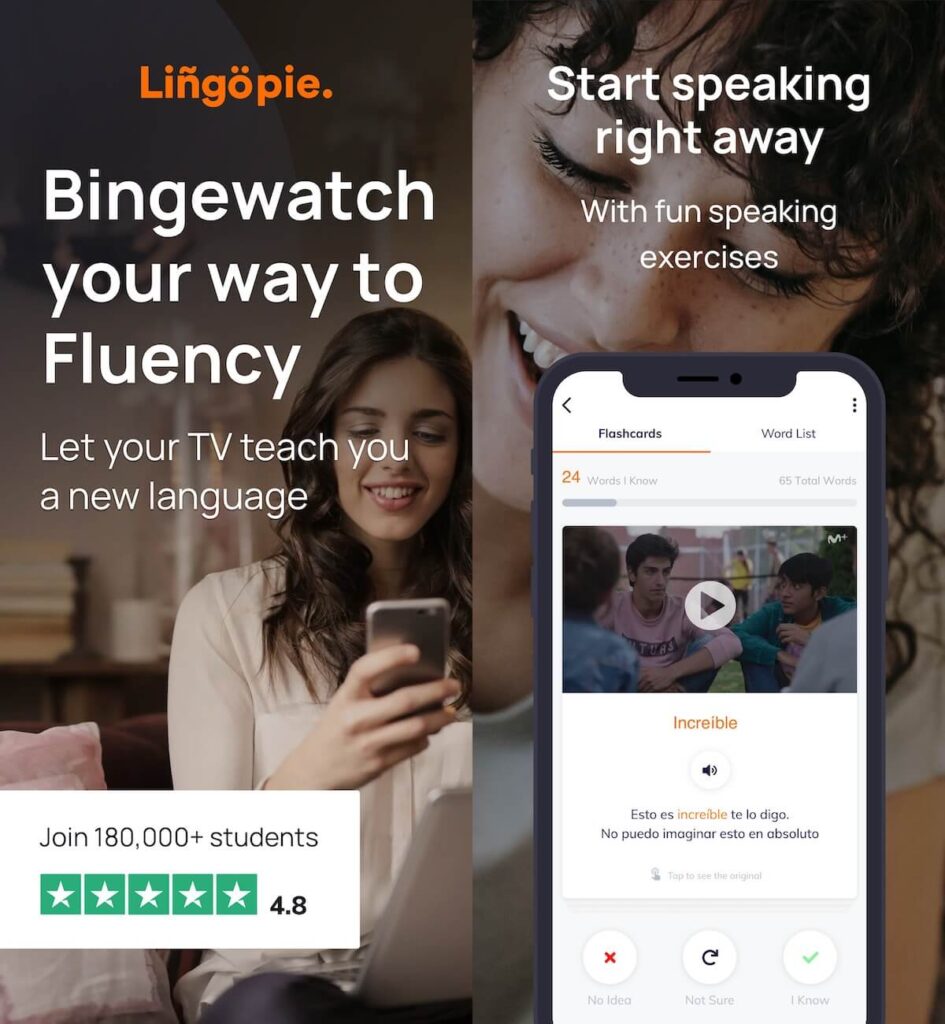
In my years of watching Korean shows and movies, I’ve often wished that instead of only English subtitles, they come with both Korean and English texts. Imagine my surprise when I found out that Lingopie has this feature!
Lingopie has a collection of Korean TV shows and movies that come with interactive learning tools: dual subtitles, voice speed control, transcripts, and voice recorder. Simply click on any word and you’ll learn the meaning, hear the pronunciation, and save it for review!
That said, don’t expect popular K-dramas to be on Lingopie, at least not yet. But the current catalog has lots of programs that will prove entertaining.
Key features:
- Learn Korean by immersing in TV shows and movies
- Innovative features help you learn and review new vocabulary
- Fit for Korean learners of any proficiency level
Pricing: Starts at $5.99/month on the yearly plan. Start a FREE 7-day trial here!
Devices: iOS and Android
12. LingoDeer

One of the most innovative apps for learning Korean, LingoDeer has a holistic course that tackles essential words and phrases through fun exercises.
LingoDeer’s expertly crafted curriculum includes vocabulary flashcards, audio guides voiced by native speakers, grammar tips, and engaging stories that teach vocabulary with cultural context. And for absolute beginners, a comprehensive guide for Hangeul is available.
Consisting of two levels with six units each, LingoDeer’s Korean course includes vocab related to everyday items, travel, numbers, dates, routines, honorifics, wishes, and more. I especially love that it has lessons on negation and politeness levels, which should come in handy when talking to locals.
Key features:
- Well-crafted course with detailed explanations
- A wide selection of vocabulary words and phrases over two course levels
- High-quality audio to learn pronunciation
Pricing: Some lessons are free. Unlock all content with LingoDeer Plus starting at $8.99/month.
Devices: iOS and Android
13. Duolingo

Korean, which Duolingo started offering in 2017, is one of the app’s fastest-growing courses. As of writing, there are nearly 11 million active Korean learners on the app, making it one of the most popular online tools for learning Korean.
Quite frankly, you shouldn’t rely on Duolingo alone if you want to learn Korean vocabulary. While it does teach you lots of new words and phrases, not all are essential. It would take several units before you acquire words that are useful in conversations.
However, Duolingo’s interface and repetition system enforces you to remember words longer. And because you’re rewarded for remembering and leveling up, you end up wanting to learn more. Simply put, Duolingo makes learning Korean fun. Just don’t make it your sole resource.
Key features:
- Immersive and competitive learning interface
- Build Korean vocabulary in as short as five minutes per day
- Ideal as a supplement to an existing resource
Pricing: Free. Duolingo Super, which has no ads and lets you make unlimited mistakes, is available for $6.67.
Devices: iOS and Android
14. Quizlet

Flashcards are among the oldest tools for studying any subject. To this day, I still use physical flashcards. But let’s be real: unless you’re studying in your room or the library, using physical flashcards can be inconvenient.
Enter Quizlet, one of the most well-designed apps for digital flashcards. Like physical flashcards, Quizlet is not limited to learning Korean, or any language for that matter. But with over 600 Korean study sets, it’s particularly great for learning Korean vocabulary.
To choose a study set, you can filter based on the number of terms, who created it (you can limit it to teachers or verified creators), and content type (e.g., images, diagrams). Once you’ve chosen a set, you can start studying and using different modes of reviewing like the Test and Match modes.
Key features:
- Build Korean vocabulary through a time-tested method
- A vast collection of study sets to choose from
- Added option of creating your own flashcards
Pricing: Free with limited features. Additional features are available with Quizlet Plus for $35.99/year.
Devices: iOS and Android
15. Naver Papago

Papago is not a vocabulary app per se. It’s a Korean translator app developed by Naver Corporation. But its Android and iOS apps have features that are great for learning Korean vocabulary.
Papago supports real-time text translations, text recognition, voice input, handwriting, and website translation. On top of that, it also supports offline translation. While other popular translation tools like Google Translate offers the same, Papago’s Korean translations are more accurate and sound more natural.
But what makes it great for studying Korean is the Dictionary feature and phrasebook. It also allows you to save words that you can study later. Plus, you can create flashcards!
Key features:
- Real-time translations for a variety of inputs
- Dictionary feature for learning new words
- Extra tools for studying
Pricing: Free!
Devices: iOS and Android
16. Simply Learn Korean

Learn Korean with Simply Learn Korean
From the maker of Ling App, Simply Learn Korean is a Korean vocab app that’s designed for travelers and language learners. It’s also one of the most authentic phrasebooks online as it’s recorded by a native speaker.
With the free version of Simply Learn Korean, you can access over 300 Korean phrases and words. These include vocabulary related to numbers, greetings, asking for directions, food, sightseeing, shopping, accommodation, and emergency. If you upgrade to the paid version, you’ll have access to the whole catalog.
In addition, you can listen to high-quality audio recordings of these words, review them through quizzes, and save your favorites. Plus, all entries come with both Romanizations and Korean spellings.
Key features:
- Thousands of Korean words and phrases in 33 categories
- High-quality audio recorded by a native speaker
- Flashcards and quizzes for review
Pricing: Some content for free. Upgrade to Pro to access all content.
Devices: iOS and Android
17. Anki

Anki hardly needs an introduction. Since it was released in 2006, it has grown to be one of the most popular flashcard apps.
Anki’s mobile apps (AnkiDroid on Android and AnkiMobile on iOS) both support images, audio, videos, and even scientific markup (via LaTeX). While other apps have slicker interfaces, Anki’s SuperMemo 2 algorithm is what makes this a great app for studying — it shows you words you have to review just before you’re likely to forget them.
There are hundreds of pre-made Korean vocabulary decks on Anki, with decks by Evita and TTMIK being among the popular ones. You can also create your own!
Key features:
- Lots of pre-made decks for learning Korean vocabulary
- Flexible features for customizing decks
- Media-rich flashcards
Pricing: Free on Android, $24.99 on iOS
Devices: iOS and Android
18. Clozemaster

For intermediate and advanced learners who are looking for something more challenging and fast-paced, Clozemaster is worth looking into.
Clozemaster teaches Korean vocabulary in context. The app presents a sentence with a missing word and your goal is to select or enter the right word from context. This is a great way to not just memorize words but also increase your comprehension.
Aside from this, you can also access vocabulary lists that include the most common words in Korean. And since the app also comes with audio guides, you can also improve your Korean listening skills.
Key features:
- Learn Korean vocabulary and grammar in context
- “Most Common Words” groupings
- Practice listening skills with pronunciation guides
Pricing: Free. For more features and stats, get Clozemaster Pro starting at $8/month.
Devices: iOS and Android
Bonus: YouTube
While the above apps are the best of the best when it comes to enhancing your Korean vocabulary, there’s one more app that’s worth mentioning — YouTube.
A quick search for “Korean vocabulary” on YouTube will yield several results. Some videos feature thousands of Korean words while some have fewer but more specialized terms. My favorites are the ones from Talk to Me in Korean and KoreanClass101 but many other content creators produce vocab lists that you can listen to for hours on end.
The best part? YouTube is free and it’s already on your phone!
Final thoughts

Learning new words in Korean is a crucial part of mastering the language. I dare say it’s also the most long-lasting, as you’ll probably have to continue learning new words and phrases even after you’ve mastered grammar and pronunciation. Not to mention that Korean has a wide lexicon.
At any point in your Korean language learning journey, a Korean vocabulary app will remain vital. So, I hope you were able to choose from the list above. Download one or two of these, pair them with a good Korean book (or a Korean vocabulary book, to be more specific) and a Korean podcast, and soon, you might just be able to ditch the subtitles. Happy learning!