
If you’ve ever looked into the world of language professionals who bridge communication gaps across cultures, chances are you’ve heard the terms “interpreter” and “translator” being tossed around without a clear distinction between interpreter vs translator.
With that in mind, I’ll unravel the similarities, differences, and unique skills each of these two professions brings to the table.
From the medium they work with to the goals they strive to achieve, I’ll explore the factors that shape their roles. We’ll also touch on the impact of technology on their workflows and the different compensation models they operate on.
What does an interpreter do?

Imagine this: you’re attending an international conference, surrounded by delegates from different countries, each speaking their own language.
As conversations unfold, you notice an interpreter quietly sitting beside the speaker, listening intently and effortlessly conveying the message to the audience in their respective languages.
Interpreters are language wizards whose no. 1 role is to enable and facilitate effective verbal communication between individuals or groups who speak different languages.
Whether it’s in diplomatic settings, business meetings, medical consultations, or community events, interpreters serve as the vital parts that ensure conversations flow smoothly across linguistic boundaries.

One of the two main work modes in the field is consecutive interpreting. In this approach, the speaker delivers a segment of their speech, pausing afterward to allow the interpreter to render the message into the target language.
This pause allows the interpreter to take notes and come up with an accurate and concise interpretation. The beauty of consecutive interpreting lies in its methodical nature, which allows interpreters to carefully analyze and transmit the speaker’s message.
Another mode, particularly in fast-paced settings such as conferences or multilingual gatherings, is simultaneous interpreting. In this case, interpreters work in soundproof booths, equipped with specialized audio equipment.
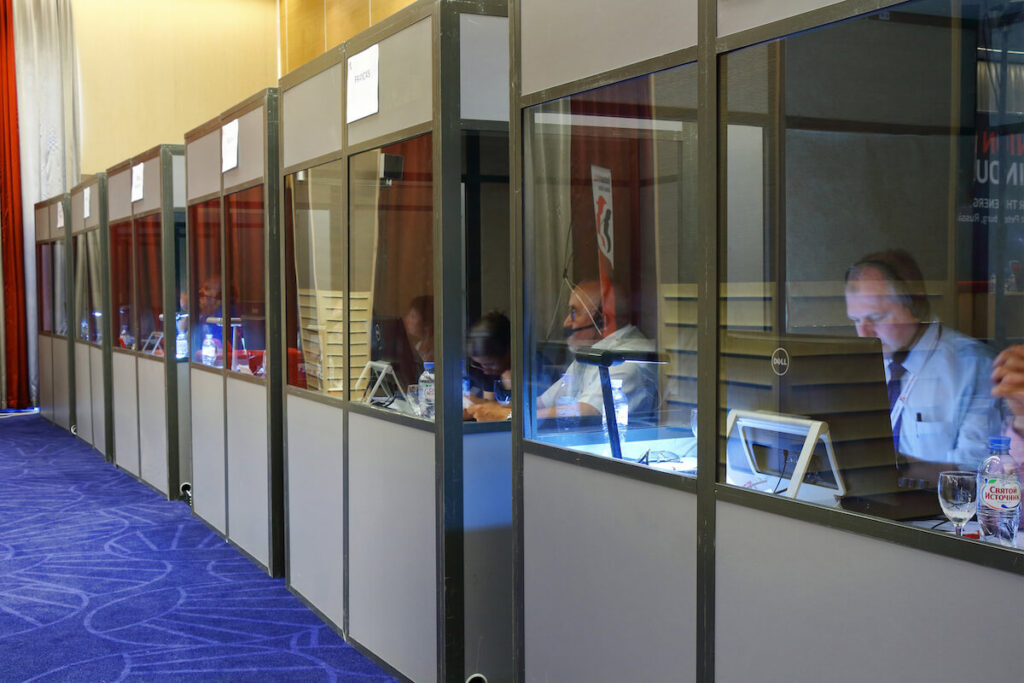
They listen to the speaker through headsets, quickly interpreting their words into the target language, which is instantly relayed to the listeners via wireless receivers.
This high-pressure technique demands exceptional concentration, lightning-fast linguistic processing, and the ability to seamlessly convey the speaker’s tone, nuances, and intended meaning on the spot.
What does a translator do?

Now, instead of attending a conference, you’re holding a beautifully written piece of literature, originally penned in a language you don’t understand. Cue in the translator, who can transport you into the captivating world of that foreign text.
Translators breathe life into written words, transforming them from one language to another while preserving the essence, style, and cultural nuances of the original work.
Their work typically spans a vast range of materials, including books, articles, websites, legal documents, marketing materials, and much more. Through their craft, they enable the sharing of ideas, stories, and knowledge across borders, opening up new horizons for readers worldwide.

Translators work tirelessly to refine their craft, building an extensive vocabulary in both languages they work with.
They dive into dictionaries, thesauruses, and specialized terminology books to ensure they have a comprehensive understanding of the subject matter at hand.
This quest for linguistic excellence extends to staying on top of language trends, idiomatic expressions, and even slang, as translators are expected to produce translations that feel natural and up-to-date.
Being a translator requires patience, precision, and attention to detail. It often involves research to grasp the context and background information relevant to the text being translated.
It’s worth noting that translators often work independently as freelancers or as part of translation agencies, collaborating with clients from different industries and walks of life.
Effective communication and negotiation skills are essential to understanding the client’s requirements, answering questions, and building long-term working relationships.
What is the difference between interpretation and translation?
1. Format: oral vs written

One of the most basic differences between working as an interpreter vs translator lies in the format in which they operate.
Interpreters specialize in oral communication, while translators focus on written texts. This distinction not only affects the medium through which they relay information but also shapes the specific skills, challenges, and approaches they employ in their respective roles.
This distinction between interpretation and translation brings its unique set of challenges. Interpreters must have exceptional active listening skills, as they need to grasp the speaker’s message swiftly and accurately while simultaneously formulating an interpretation in real-time.
They must be quick thinkers, adapt well to fast-paced environments, and remain composed under pressure. Interpreters also rely on their ability to capture non-verbal cues, such as facial expressions and body language, to translate the speaker’s intended meaning effectively.
Translators, in turn, enjoy the luxury of more time for reflection and research. They can carefully analyze the source text, check dictionaries and specialized resources to ensure accuracy, and capture the nuances specific to the content they are working on.
Translators possess a deep understanding of the subject matter and the ability to research and grasp complex concepts, ensuring that the translated text is not only linguistically accurate but also contextually appropriate.
2. Intent: efficacy vs accuracy

When it comes to the goals behind their work, interpreters and translators have distinct focuses: efficacy for interpreters and accuracy for translators.
These divergent intentions reflect the unique demands of their respective roles and the specific goals they strive to achieve in their projects.
The primary goal of interpreters is to facilitate effective and smooth conversations between individuals who speak different languages.
In real-time settings, such as conferences, meetings, or negotiations, interpreters need to maintain the flow of communication, ensuring that the message is conveyed promptly and comprehensibly to all parties involved.
In pursuit of efficacy, they might simplify complex concepts, adapt language registers, or even rearrange sentence structures to ensure clarity and comprehension.
Translators, on the other hand, prioritize accuracy as their key objective. Their focus lies in faithfully conveying the meaning, nuances, and cultural references embedded within the written text.
Their goal is to provide readers of the translated text with the same level of understanding, emotional impact, and insight as the readers of the original work.
To achieve accuracy, translators commit time to research and familiarize themselves with the subject matter. They strive to grasp the author’s intentions, literary style, and cultural context, ensuring that these elements are successfully transferred to the target language.
3. Delivery: immediacy vs deadlines

Interpreters and translators operate in distinct ways with regard to time as well, with interpreters prioritizing immediacy and translators working within specific deadlines.
Interpreters thrive in fast-paced environments where immediacy is key. Whether it’s a conference, a diplomatic meeting, or a courtroom proceeding, interpreters are on the frontline, ready to convey messages in the moment.
They must think swiftly to guarantee that the interpretation flows seamlessly and without delay. Interpreters embrace the challenge of instantaneously converting spoken words into another language, matching the pace of the speaker, and delivering interpretations on the spot.
This need for immediacy can be exhilarating, as interpreters navigate conversations, discussions, and debates in real-time. They must possess exceptional active listening skills, quickly processing information and formulating accurate interpretations in the blink of an eye.
Interpreters thrive under pressure, embracing the adrenaline rush that comes with the demand for immediate delivery of their linguistic expertise.
Translators, in turn, work within specific deadlines. They craft and rework their translations, ensuring accuracy, cultural appropriateness, and linguistic finesse. Translators often receive documents, manuscripts, or projects that require careful analysis and thorough research.
The deadline-driven nature of translation allows for a more structured work process. Translators can plan their time, allocate resources, and carefully review their work before submission.
4. Direction: both ways vs one way

In the field of language services, the concept of direction plays a crucial role in distinguishing between the roles of interpreters and translators.
Interpreters specialize in bidirectional communication, acting as the linguistic bridge between individuals who do not share a common language. They have the remarkable ability to listen to one language, mentally process the information, and convey it in another language.
The bidirectional nature of interpreting requires interpreters to have excellent active listening skills, linguistic agility, and the ability to think quickly on their feet.
On the other hand, translators predominantly work in a one-way direction, focusing on transferring written texts from the source language to the target language—usually their mother tongue.
The one-way direction of translation allows translators to analyze the source text deeply, research specialized terminology, and ensure that every word and phrase is accurately translated.
5. Technology: audio equipment vs translation tools

When it comes to technology, interpreters rely on audio and translation devices, whereas translators harness the power of translation tools and resources.
Interpreters commonly find themselves in dynamic, real-time settings where immediate communication is essential.
To enable effective interpretation, they often use audio equipment such as headsets, microphones, and sound systems. These tools allow interpreters to listen to the speaker’s words clearly and transmit their interpretations to the intended audience in real-time.
The reliance on audio equipment in interpreting also extends to remote interpretation, where interpreters provide their services remotely, connecting with clients and participants via teleconferencing platforms.
Translators use a different set of technological tools to support their work. They rely on a range of translation resources, including computer-assisted translation (CAT) tools, online dictionaries, terminology databases, and translation memory software.
These tools assist translators in managing terminology consistency, improving productivity, and enhancing the quality of their translations.
As technology continues to evolve, the best interpreters and translators embrace these changes, adopting innovative tools and practices that empower them to overcome challenges, improve their workflows, and provide even more accurate and efficient language solutions.
6. Pay: hourly fee vs rate per word

As for compensation in the field of language services, interpreters and translators have different payment structures based on the nature of their work. Interpreters typically receive an hourly fee, while translators are often paid based on a rate per word.
The hourly fee structure for interpreters recognizes the need for continuous active engagement and the ability to think on their feet.
It acknowledges the immediate and real-time nature of their work, where they are present throughout the duration of an event, facilitating communication and ensuring a smooth flow of conversation.
The rate-per-word model for translators, in turn, acknowledges the meticulousness and attention to detail required in their craft.
It recognizes the in-depth analysis, research, and linguistic expertise involved in accurately translating written materials, while also considering factors such as the volume of text and the time required for research, proofreading, and quality assurance.
It’s worth noting that payment structures may vary depending on the specific circumstances, agreements, and contracts between language professionals and their clients.
Factors such as the industry, the location, the client’s budget, and the level of experience and reputation of the interpreter or translator can also influence the compensation arrangements.
Final thoughts

In a world that’s increasingly interconnected, where global conversations are happening in the blink of an eye, both interpreters and translators play crucial roles.
They ensure messages are accurately conveyed, whether it’s making real-time conversations flow seamlessly at international conferences or faithfully transforming written content into a different language for readers worldwide.
While interpreters excel in spoken language, efficiently capturing the essence of conversations in real-time, translators showcase their skills in the written word, carefully crafting translations that capture not only the literal meaning but also the nuances embedded within the text.
Requirements for working as either an interpreter or translator vary according to several factors, yet, in many cases, formal training isn’t mandatory—I for one didn’t need any to start working as a translator.
So if you already are bilingual, you’ve got a head start in this field. But if you’ve just started dabbling in foreign languages, there’s no reason to be discouraged: learning a new language can be quick and easy if you use the best available tools and adopt the right strategies.