
*This article may contain affiliate links. For full information, please see the disclaimer here.
Learning languages these days is much more fun and convenient, thanks to a plethora of mobile apps that help us unlock new tongues anytime, anywhere. But with so many choices, choosing the right platform can feel overwhelming.
Two of the most popular apps are Duolingo and Mondly, which are both known for short, gamified lessons. But which app reigns supreme?

In this article, we’re exploring the strengths and weaknesses of Mondly and Duolingo, as well as their best features and benefits. So, buckle up, and let’s find out which one’s the better fit for you!
Mondly vs Duolingo: A head-to-head comparison
Mondly and Duolingo are often compared against each other because they both use bite-sized gamified lessons to engage language learners. Both are known for interactive exercises that include flashcards, matching tasks, fill-in-the-blank activities, and listening/speaking drills to improve your vocabulary, grammar, and comprehension.
Both apps also have leaderboards and reward systems, although this feature is more prominent on Duolingo.
Here’s a quick comparison of Mondly and Duolingo based on their language offerings and features:
| Points of comparison | Mondly | Duolingo |
| Languages offered | 41 languages | 40 languages |
| Learning methods | Gamified approach, focus on visuals and audio, emphasis on practical phrases | Gamified approach, focus on translated sentences and building foundations |
| Course structure | Thematic units with flexible path, vocabulary module, daily lessons, chatbot conversations | Thematic units with linear path, alphabet lessons for non-Latin languages, review lessons, daily/weekly/monthly challenges |
| Pricing | Freemium model with limited content; $12.90/month; 7-day free trial | Free model with ads; $12.99/month; 14-day free trial |
| Free features | Daily lessons, entire “Hello” category, one chatbot conversation | All content is available for free but there’s a cap on mistakes |
| Other features | Conjugation tables, specialized courses (e.g., Business Communication, Project Management, etc.), Mondly VR | Alphabet charts, Stories, DuoRadio, Adventures, Podcasts |
Looking at the above table might not help you decide, that’s why we’re diving deeper into these apps. Let’s go!
Mondly vs Duolingo: Languages offered

Mondly covers 41 languages, including widely spoken and less-known ones. The best part is that Mondly uses localized content so you can learn these languages in multiple combinations. This means you can learn Korean from Italian, Turkish from Swedish, Persian from German, and so on.
To clarify though, while all 41 languages are available as target languages, not all of them can be source languages. For example, you can learn Latvian from most of the languages but you can’t learn any of the 41 languages from Latvian.
It’s worth noting that languages such as Croatian, Thai, Tagalog, Persian, Slovak, and Urdu are available on Mondly but are missing on Duolingo.
Duolingo, on the other hand, offers 39 courses for English speakers and English courses for non-English speakers (hence, a total of 40 languages). Aside from popular languages, Duolingo also notably offers courses on vulnerable languages such as Haitian Creole, Navajo, and Yiddish. Conlangs such as Esperanto, High Valyrian, and Klingon are also on its line-up.

So, when choosing between Duolingo and Mondly, your first step is to check if your target language is on the app.
Mondly’s learning methods and course structure
Mondly’s bite-sized lessons emphasize engagement, practical application, and immersion.
Instead of a strictly linear progression, Mondly adopts a theme-based approach, focusing on practical vocabulary and real-life situations under themes like “Greetings,” “Shopping,” or “Public Transportation.” Each theme usually includes five or six core lessons that you don’t need to take in succession.

These lessons include a mix of exercises that train your reading, writing, listening, and speaking skills. After the core lesson, you can practice your listening and speaking skills through immersive modes like the hands-free mode or by taking a chatbot lesson. You can review further with the word list and core vocabulary module.
Grammar is gradually introduced within the context of these themes. When a verb is introduced, you can click on it to see its conjugations. There are also a few grammar lessons toward the end of the learning path.
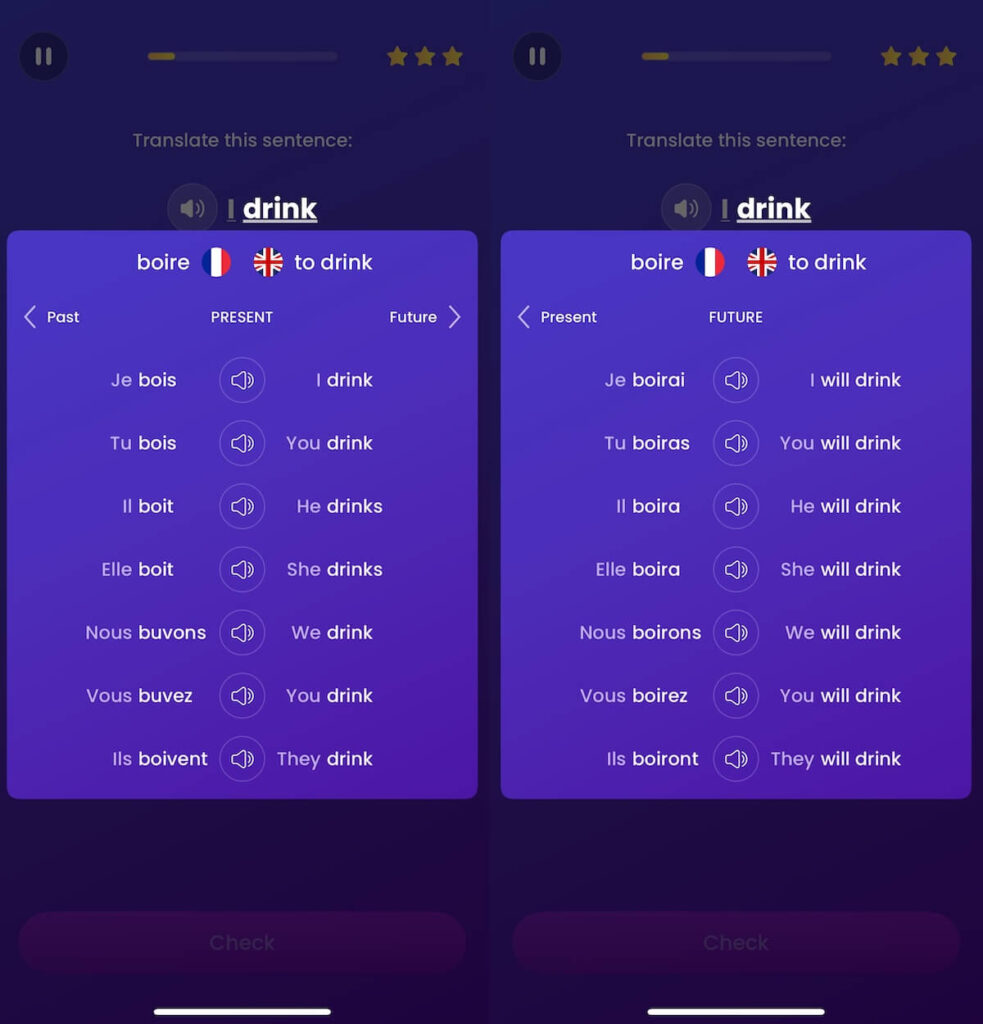
Mondly’s daily lessons (which should take you more or less five minutes to play) unlock every twelve hours. Completing an entire week of daily lessons lets you unlock a longer weekly test. When you complete each weekly quiz, you get to unlock a monthly challenge, which then gives you access to more learning materials. You also get points from these lessons and challenges, allowing you to stack up on the leaderboard.
To know more about Mondly’s best features, check out this detailed Mondly review.
Duolingo’s learning methods and course structure
Just like Mondly, Duolingo also focuses on quick lessons that you can easily squeeze into your daily schedule. These lessons include fun and easy exercises like multiple-choice questions, translations, and sentence completions to target your core skills.

Duolingo used to have a non-linear structure but in 2022, the app was redesigned. Today, the learning path is linear and you can’t work on new lessons until you complete your current lesson. However, you can jump into more advanced units, as long as you pass the test, which allows for only three mistakes. The test, like the regular “Legendary” exercises, doesn’t include the option to click the words for translations.
Review lessons (Practice) are also integrated into this learning path. Depending on the language you’re learning, Stories are also built into the path (my French path has this, Korean doesn’t). Furthermore, spaced repetition is built into Duolingo lessons so you’ll often encounter words and phrases that were introduced in previous lessons.
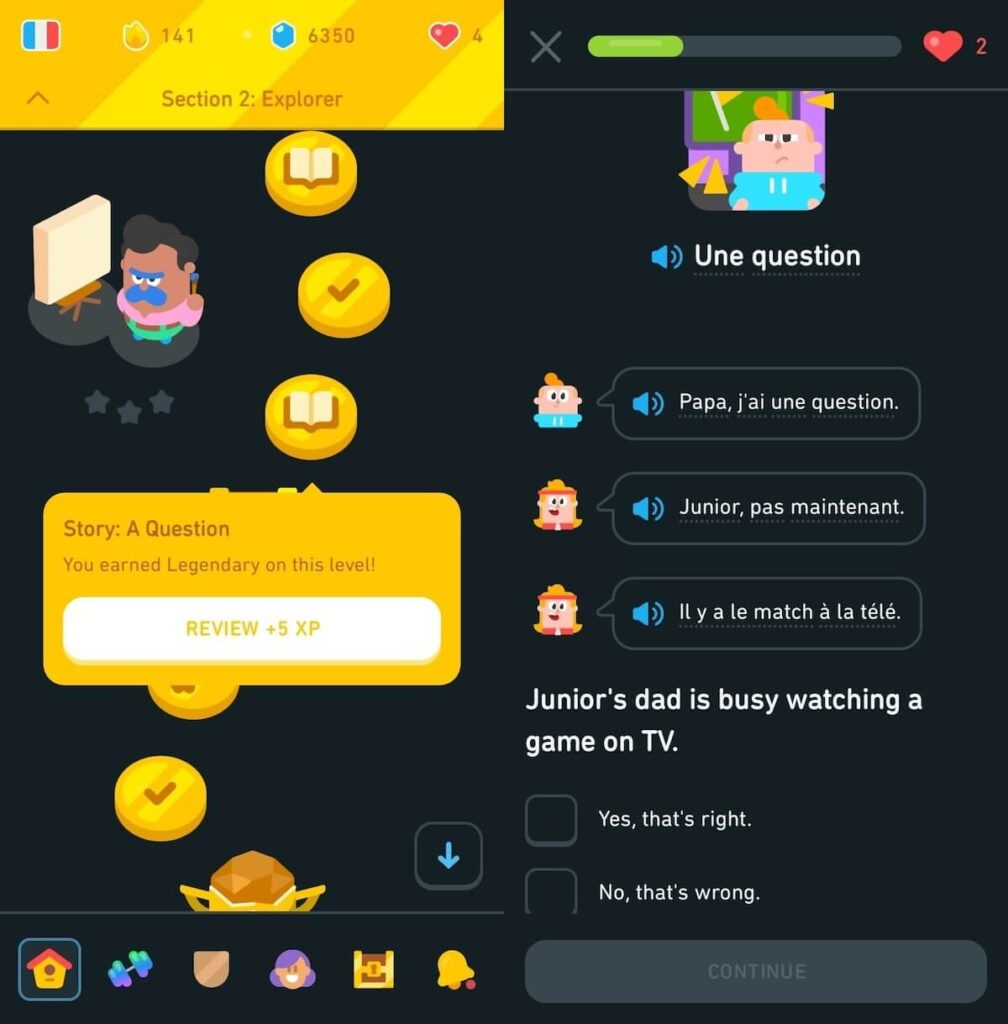
If you’re studying Spanish and have made your way to Section 4, you’ll also find lessons in short, podcast-format shows hosted by Duolingo characters.
Duolingo doesn’t dedicate entire lessons specifically to grammar rules. Instead, you learn grammar from context within the lessons. There are, however, grammar guidebooks within units.
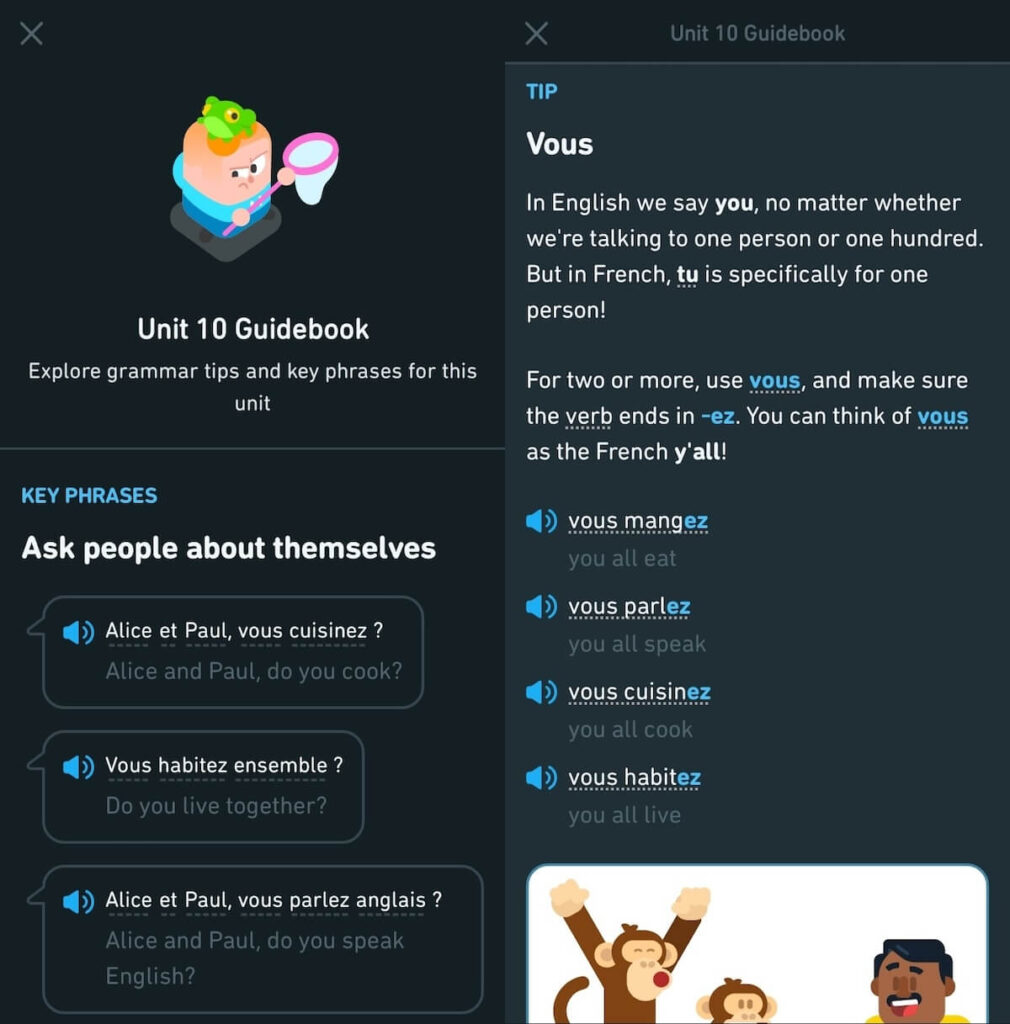
Like Mondly, Duolingo sports a gamified interface, perhaps even more gamified. Here, you earn points and badges, compete with other learners on leaderboards, and take quests with friends. Each week, depending on your total XP, you can be promoted or demoted to a league, or stay in the same league. You can also earn gems that you can use to buy streak freezes, timer boosts, and heart refills (for more lives).
Mondly vs Duolingo: Pricing and free features
Both Mondly and Duolingo work on a freemium pricing model. This means you can access a limited portion of the apps’ features for free and unlock additional features with a paid subscription. Just how “limited” these features are, that’s where these apps differ.
On Mondly’s free version, you can access one daily lesson, the entire introductory section (Hello), vocabulary builders, and a chatbot lesson. You also get weekly quizzes and monthly challenges.
Upgrading to the premium subscription unlocks these features:
- 250 lessons organized into practical topics
- 41 conversations covering day-to-day scenarios
- 36 vocabulary builders
- Over 3,000 daily lessons (as of writing), weekly quizzes, and monthly challenges
- Conjugation tables and grammar tips
- Download lessons for offline access
Mondly Premium costs $12.90/month and $61.92/year for one language. The latest Mondly promo allows you to get a lifetime subscription to all 41 languages for only $105. You can also try it for free for 7 days.
On Duolingo, you can access the full course and most features for free. The catch? It comes with (annoying) ads and you have limited “hearts” (lives) for mistakes.
Super Duolingo costs $12.99/month or $83.99/year ($6.99/month)and gives the following:
- Ad-free experience
- Unlimited hearts
- Monthly streak repair
- Unlimited attempts at Legendary levels and timed challenges
- Personalized practice sessions on conversation and mistake review
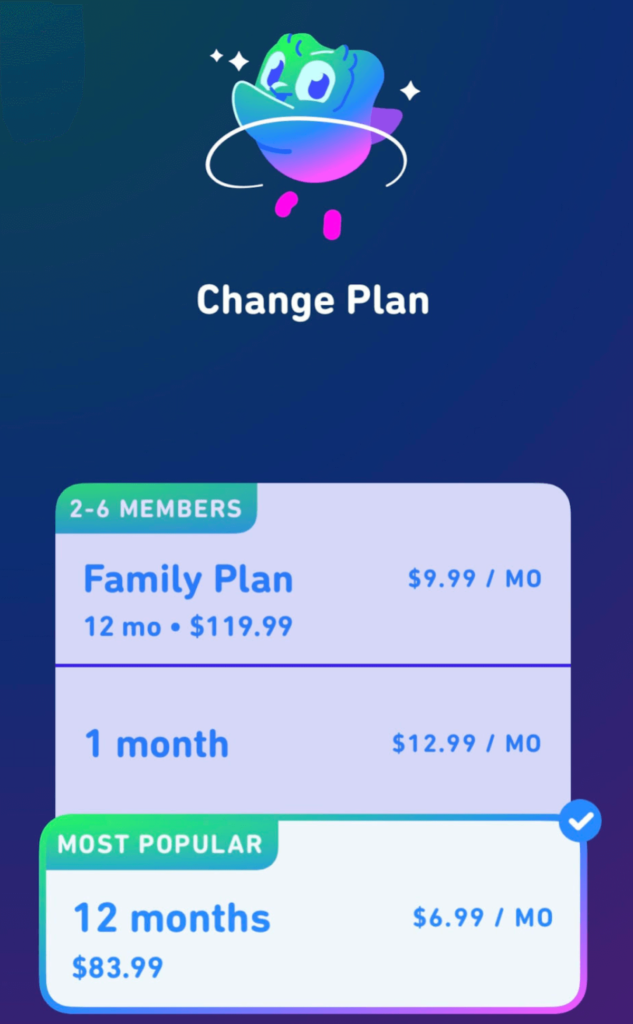
Super Family costs $9.99/month or $119.99/year. This allows you to share your Super Duolingo subscription with five other users.
Mondly: Pros and cons
Now, the fun part. What do I like (and don’t like) about Mondly?
First off, I appreciate how quick Mondly lessons are. While I enjoy learning languages, I don’t have the longest attention span and prefer my language lessons to be quick and engaging but still effective. It takes five minutes (sometimes less) for me to finish a Mondly lesson, so that’s clearly a win.
Mondly’s hands-free lessons are great for learning on the go so you can study even when you’re driving or doing chores at home. Together with the chatbot conversations, Mondly offers an immersive way to improve your conversational skills.
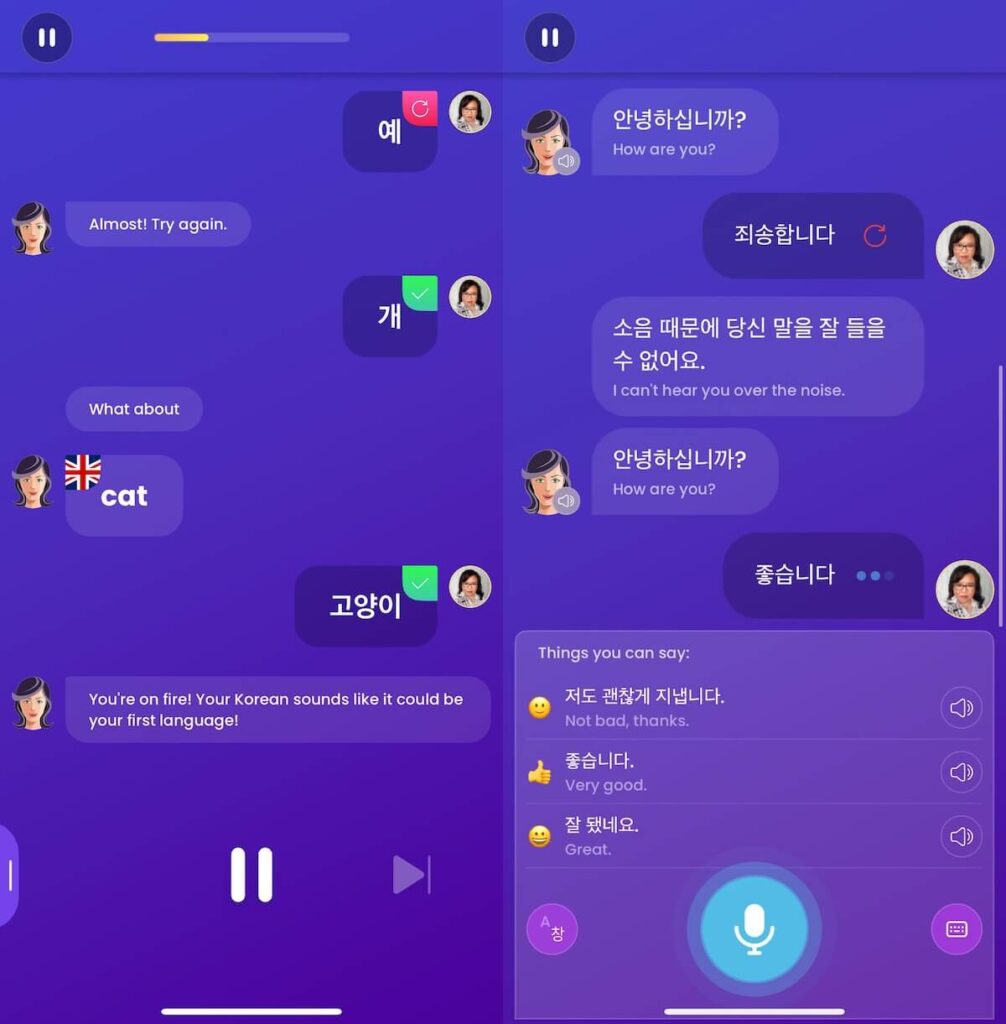
I also love that the vocabulary you learn is based on real-life situations so you can use newly learned phrases immediately. And because you can pick which topic to study, it’s great for learning vocabulary that you’re interested in. The word lists also help expand and reinforce vocabulary, especially since they come with audio recordings.
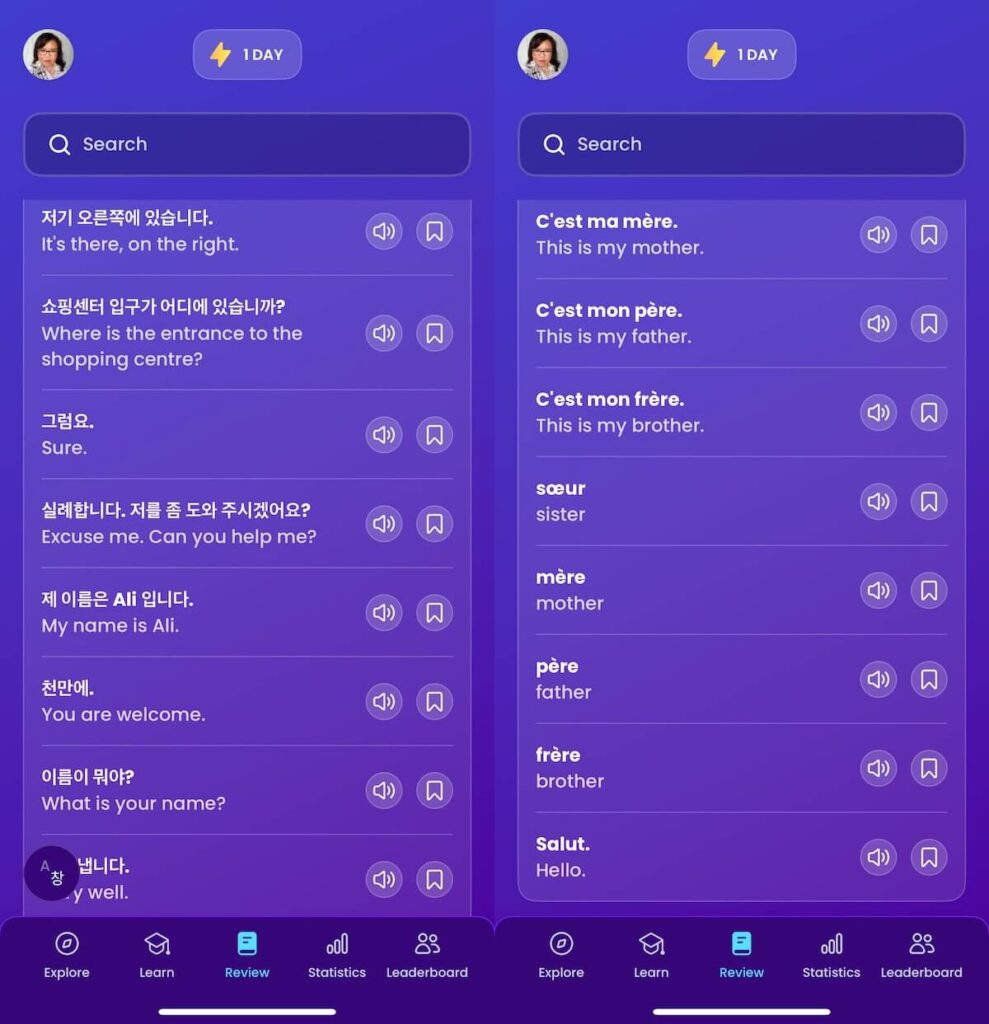
That said, Mondly’s limited grammar focus (even at more advanced levels) means you won’t be developing knowledge of grammatical rules and structures. And after some time, you’ll see that the material doesn’t get more challenging, except for a few grammatically complex sentences once in a while.
If, like me, you’re learning a language that uses a non-Latin script, Mondly’s course structure isn’t ideal for learning how to write. There are no writing drills on Mondly. You can toggle between the target language’s script and Romanization but this assumes that you’re already familiar with the said language.

Finally, the biggest disadvantage is its limited free features. You’ll need a paid subscription to access most of its features.
Duolingo: Pros and cons
I’ve been using Duolingo on and off for years and I believe it’s the best gamified language learning app. Learning gamification is almost synonymous with Duolingo now.
The app truly does a great job of making you feel like you’re merely playing, not studying. The points, badges, leaderboards, and streaks make learning engaging. Even if you’re not a highly competitive person, the rewards feel satisfying.

Like Mondly, Duolingo’s short, manageable lessons make it easy to fit language learning into busy schedules. You can easily turn playing a game or two into a habit and at some point, it even becomes addicting, thanks to its fun interface. The lessons become repetitive but looking at it from an SRS standpoint, the repetition is effective in retaining information.
I also love that Duolingo places significant attention on mastery of non-Latin writing systems. In the Korean course, for example, the Hangeul characters are integrated into the introductory units and also available as a separate chart. It does rely on Romanization for teaching the sounds but it’s a good start.
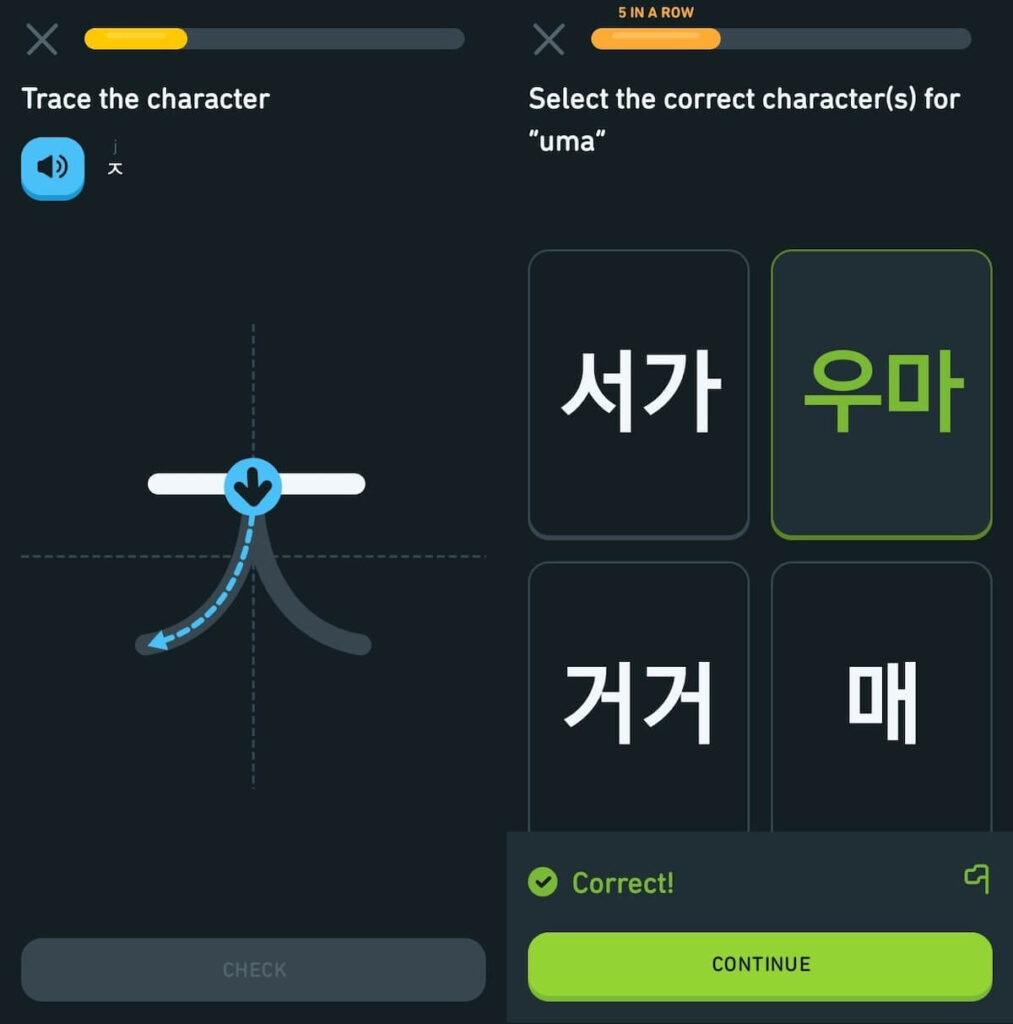
However, Duolingo’s biggest draw is its freemium model. Since most of the features are available for free, there’s hardly a reason for you to subscribe to the paid plan unless you want unlimited hearts and cannot tolerate ads.
Unfortunately, in an effort to make learning simple and fun, Duolingo focuses on vocabulary building and not grammar. Apart from a few grammar notes, you’ll learn grammar primarily through context. This is a disadvantage, especially for beginners.
And speaking of vocabulary, Duolingo focuses on random translated sentences and not practical vocabulary. From time to time, you’ll come across useful phrases and not-so-useful but fun sentences. But more often than not, you’ll encounter nonsensical stuff (mostly related to animals) that you’ll have no use for in real life.
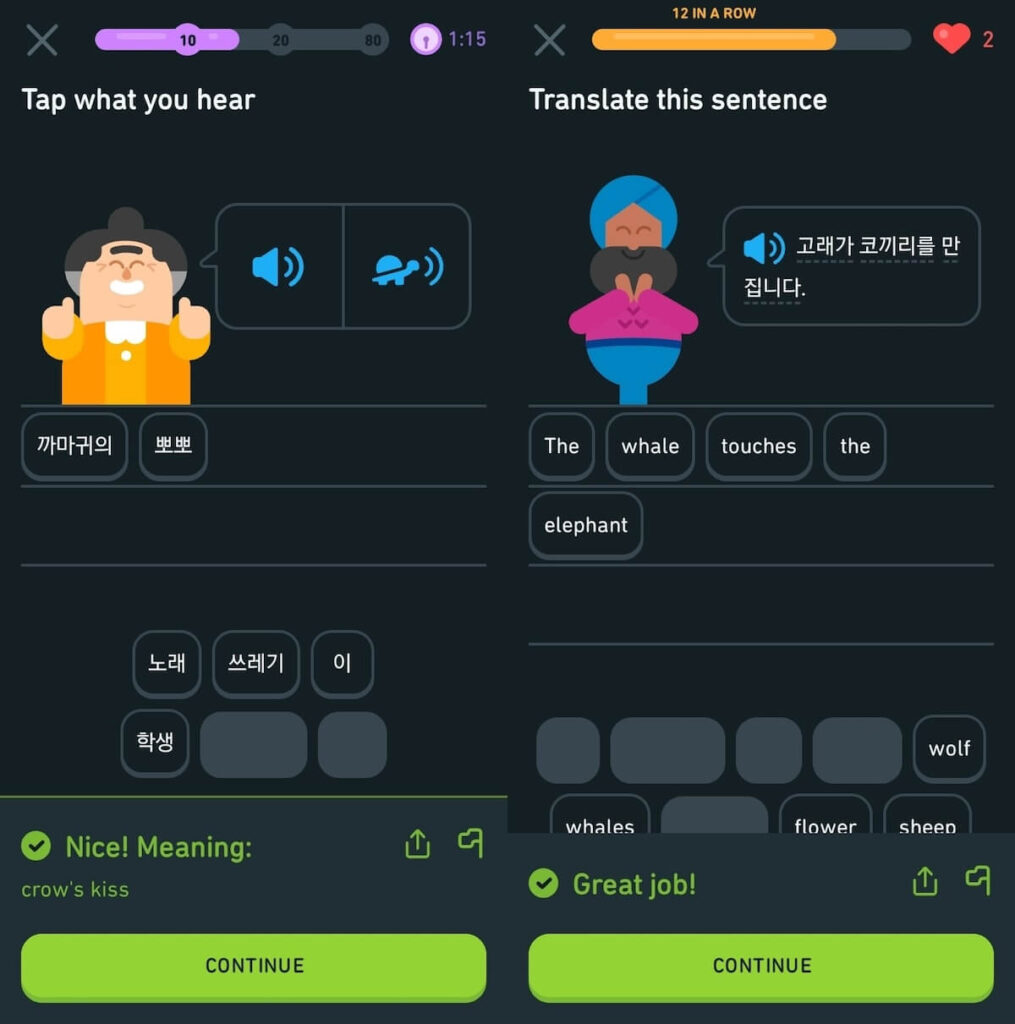
Course content also varies per language. Popular languages such as Spanish and French are longer and more developed and come with stories, radio-format lessons, and even Spotify podcasts. The same can’t be said for Asian languages such as Korean and Japanese.
Also, unlike Mondly, Duolingo doesn’t allow downloading of lessons for offline use.
Mondly vs Duolingo: Which is better?
Neither Mondly nor Duolingo can get you to fluency. But both apps are solid platforms for beginners who want to expand their vocabulary through engaging, bite-sized lessons. The speech recognition system in each app is almost the same in terms of accuracy, although there are times when I’d had to hold my phone closer to my mouth to get Mondly to recognize what I was saying.
Ultimately, the “better” option between Mondly and Duolingo depends on your learning style, goals, and budget.

For the learner seeking an immersive and practical approach, Mondly’s the better option, with its chatbot conversations and real-world vocabulary. You get lots of speaking practice here, as long as you’re willing to shell out some bucks.
For the game-loving learner seeking a low-barrier entry to a new language, Duolingo excels with its gamified approach and bite-sized lessons. And you can pretty much get by with the free version.
However, both Mondly and Duolingo have limited grammar explanations. And while they’re great for beginners, advanced learners may benefit from using other apps. Here are some of my favorites:
- For a deeper understanding of grammar, try Babbel or Rocket Languages
- For more conversational practice, use Pimsleur or Glossika
- For personalized coaching, hire tutors on italki
The best course of action might lie in exploring both options. Both platforms offer free tiers, allowing you to test their features and see which resonates better with your learning style.
Then, once you’ve decided which one to stick with, you can pair it up with any of the alternatives I suggested above, plus other resources like books, educational YouTube channels, and podcasts for a well-rounded approach to learning.

Remember, the ideal language learning journey involves a blend of resources and personalized approaches to maximize effectiveness and enjoyment. So, embrace the learning process, experiment with different tools, and discover the path that leads you toward fluency in your chosen language!
Mondly vs Duolingo: FAQ
Which app is better, Mondly or Duolingo?
There’s no single “better” app, as both cater to different learning styles and goals. If you’re looking for an immersive approach to improving your speaking skills, I recommend Mondly. Duolingo is a better option if you enjoy gamified and fun lessons.
Are Mondly and Duolingo free?
Both offer freemium models with limited features available for free. Paid subscriptions unlock additional features and benefits.
Is Mondly good for learning grammar?
While Mondly introduces grammar through context, it doesn’t offer in-depth explanations like other platforms. Consider combining Mondly with grammar-focused resources if needed.
Can Duolingo make me fluent?
Duolingo provides a good foundation and introduces speaking practice, but it might not be sufficient for achieving advanced conversational fluency. Mondly does better in providing speaking practice, but Babbel, Rocket Languages, Pimsleur, and other Duolingo alternatives are also worth exploring.
Can I learn a language effectively using only Mondly or Duolingo?
While both apps are valuable tools, supplementing your learning with other resources, like dedicated grammar practice or conversation practice with native speakers on italki, can significantly enhance your learning outcomes.
What resources can I use alongside Mondly or Duolingo?
Many resources are available, like grammar textbooks, online courses, or language exchange platforms. Consider your specific learning needs and goals when choosing additional resources.
I have been working on Duolingo for two years now. Your listed subscription price for the Duolingo app is incorrect.
$29.99/ individual monthly plan (charged monthly)
167.99/ Individual annual plan (charged annually, but = 13.99/mo)
239.99/ Family annual plan (charged annually, but = 19.99/mo).
I took a screen shot of my subscription options page, but I couldn’t paste it here for you to verify.