
This article may contain affiliate links. As an Amazon Associate, I earn from qualifying purchases. For full information, please see the disclaimer here.
So, you’ve decided to learn Japanese. Maybe you’ve begun reading Japanese characters from a manga and you’ve learned the accents. You’ve also familiarized yourself with grammatical structures. What now?
Well, if you want to achieve fluency in Japanese, you’ll need to know about 3,000-5,000 Japanese words.

The reality is that the basics will only get you so far. You’ll need an expansive vocabulary to express yourself better and reap the benefits of learning Japanese.
Fortunately, you’re not without good tools. Japanese vocabulary books are one of the best resources you can use to expand your vocabulary and master this language.
About Japanese vocabulary
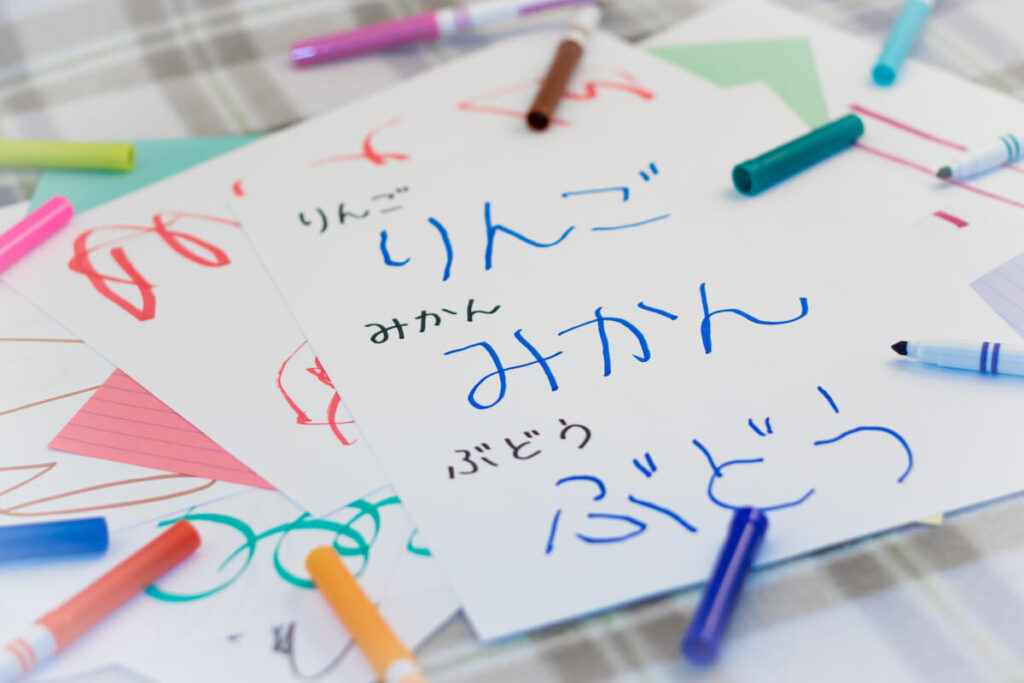
When learning Japanese vocabulary, it’s important to remember that the language has a unique structure and several scripts — Hiragana, Katakana, and Kanji. While you can certainly learn spoken Japanese vocabulary through listening and romaji (romanization of Japanese characters), essential to learn and understand the usage of these scripts to master Japanese vocabulary.
For one, Japanese has many homophones — words that sound the same but have different meanings — and kanji is often used to distinguish between these. Also, context is key in comprehension. The meaning of a word can change based on the context in which it’s used, so you have to pay attention to the surrounding words and phrases.
Another crucial aspect to remember is the politeness level. The Japanese language has different politeness levels, and the vocabulary can change depending on the level you’re using. There are also many English loanwords in Japanese, which may not carry the same connotations or meanings as they do in English.
Read more: 25 Fun Facts About the Japanese Language
The way you learn English or other languages will differ from how you learn Japanese, and keeping all these in mind will help you better appreciate the process. Now, shall we look at the best Japanese vocabulary books?
Top books to learn Japanese vocabulary
1. 2000 Most Common Japanese Words in Context


A comprehensive guide to learning Japanese vocabulary, 2000 Most Common Japanese Words in Context contains a list of the 2000 most frequently used Japanese words, along with their meanings and example sentences. But it doesn’t just increase your vocabulary but also improves your general understanding of the Japanese language.
Because this book teaches common words in context, you’ll be able to see how they can be used in real-life situations. The words are listed in order of frequency. Particles that are critical in learning Japanese grammar, as well as other grammatical elements, are also included.
This book uses kana and kanji (with furigana) to aid with pronunciation. It doesn’t use romaji though, so I wouldn’t recommend it to absolute beginners.
What I like about this book:
- A wide variety of words and phrases, along with their meanings and example sentences
- It helps you understand the usage of words in different scenarios
- Comes with kanji and equivalent kana for pronunciation
2. Japanese Picture Dictionary Coloring Book

Studying a language need not be dry and boring. With the Japanese Picture Dictionary Coloring Book, you can have fun while growing your vocabulary.
This picture dictionary and coloring book includes 50 different, detailed, and beautiful illustrations for you to color and over 1,500 words and phrases to learn. The words come with kana, kanji, romaji, and English translations so it’s perfect for learners of all ages and levels.
Every few sections, you’ll encounter challenging quizzes to further train your Japanese skills. Aside from vocabulary, you’ll also get a guide on pronunciation, spelling, word order, and the Japanese writing systems.
What I like about this book:
- A fun dictionary that can be a pastime for visual learners too
- Quizzes to reinforce learning
- Useful tips on pronunciation, grammar, and Japanese writing
3. Japanese Short Stories for Beginners

One of the best ways to build your vocabulary is within a narrative context. The book Japanese Short Stories for Beginners is designed with this purpose in mind.
Featuring 20 short stories in a variety of genres (but mirroring real-life situations), this book is a great way to learn relevant vocabulary and grammar within context, while also getting a taste of Japanese culture. It helps that the stories are easy to read and compelling.
The stories are told in Japanese using kana and kanji (with a few furigana) and supported by English summaries. At the end of each story, there’s a vocabulary list that also includes romaji so you’ll have no problem learning the pronunciation.
What I like about this book:
- Interesting stories to learn from
- Beginner-friendly features (e.g., English summary, furigana, romaji)
- A quiz after each story to assess what you’ve learned
4. 1000 Essential Vocabulary for the JLPT N5
![1000 Essential Vocabulary for the Jlpt N5[english/Vietnamese Edition] (English and Japanese and Vietnamese Edition)](https://m.media-amazon.com/images/I/414Q0Y-7stL._SL160_.jpg)
As you can guess from its name, 1000 Essential Vocabulary for the JLPT N5 is an excellent resource for anyone preparing for the Japanese Language Proficiency Test (JLPT) N5 exam. It contains 1,000 of the most common Japanese vocabulary words, grouped into ten chapters based on daily life themes.
Each chapter of the book contains detailed explanations of the vocabulary words, the part of speech, example sentences, and exercises to help learners practice. It also has English and Vietnamese translations.
The book also includes furigana, to help you read kanji characters. If you’ve gone past the N5 level, you can also check out the other levels in the series.
What I like about this book:
- Easy-to-follow structure
- Small, so it’s easy to carry
- Trilingual edition (extra points for those who can also speak Vietnamese)
5. Japanese Picture Dictionary

Another one for visual learners, the Japanese Picture Dictionary is a beginner-friendly resource that provides a clear introduction to Japanese.
This book deftly illustrates more than 1,500 commonly used Japanese words and phrases, providing learners with a comprehensive vocabulary that is essential for daily conversations. It’s also great for AP Japanese and JLPT exam prep.
The dictionary is organized into 38 themes or topics, each with 35 to 45 words and several sentences. This structure allows you to understand the context in which the words are used, enhancing your grasp of the language. What’s more, this dictionary includes culture-specific Japanese words and images that you won’t find in other dictionaries.
What I like about this book:
- Appealing illustrations
- Concise explanations and examples for each word
- Free audio online
6. Essential Japanese Vocabulary
No products found.
A compact guide to colloquial Japanese, Essential Japanese Vocabulary is a useful reference for building a strong foundation in Japanese. The title itself clues you in — this book tackles just the essentials (about 500 Japanese words and phrases) but these are the ones you absolutely need to learn.
The book is organized in alphabetical order, with each entry providing the term in romaji followed by kanji and/or kana and English translation. One of the best things about this book is that it covers words and phrases that learners often struggle with in their day-to-day usage, including synonyms and homonyms.
The author provides common erroneous sentences along with the correct equivalents, which can help you avoid making the same mistakes. Grammar is also explained clearly.
What I like about this book:
- Clear, straightforward explanations
- Ample vocabulary coverage, with emphasis on colloquial use
- Focuses on avoiding common mistakes
7. Japanese Vocabulary for JLPT N5

- Amazon Kindle Edition
The JLPT N5 is the first level of the JLPT and to pass it, learners need to be comfortable reading hiragana, katakana, some kanji, and have a vocabulary of about 800 words. Japanese Vocabulary for JLPT N5 takes care of the vocabulary part, providing a detailed list of words along with example sentences.
The book is structured to facilitate easy learning, with each entry providing the term in romaji followed by kanji and/or kana and English translation. To truly prepare you for the test, it covers words and phrases that learners often struggle with.
The best part is that the book comes with a link where you can download 1,445 MP3 recordings of each vocabulary and sample sentence. Not only will you learn the words but also how to pronounce them!
What I like about this book:
- Extensive vocabulary coverage
- Includes lots of sample sentences and usage notes
- Extra resources such as grammar lists, practice tests, and sound files
8. Easy Japanese Phrase Book
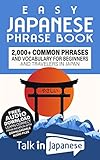
Even if you don’t have immediate plans to travel to Japan, you’ll find this pocket-size travel book helpful. Written by Talk in Japanese, a team of native Japanese speakers who are passionate about teaching their language to foreigners, this book is well-organized, making it easy for readers to navigate and locate topics quickly.
The book covers a wide range of topics and scenarios, from greetings and introductions to transportation and emergencies. Each topic contains a list of useful phrases and expressions, along with their English translations and phonetic pronunciations. The words are all updated so you won’t learn any archaic expression.
The book also provides a downloadable audio file, where you can listen to the phrases spoken by a native speaker and practice your pronunciation and listening skills.
What I like about this book:
- Covers only relevant topics and scenarios you’ll encounter as a tourist in Japan
- Concise English translations and phonetic pronunciations
- Easy to carry!
9. How to Sound Intelligent in Japanese: A Vocabulary Builder

If you’ve ever felt frustrated about lacking the necessary vocabulary to comment on things like, say politics, art, or science, this book is for you.
How to Sound Intelligent in Japanese is a great resource for students who are looking to expand their Japanese vocabulary in topics that aren’t typically covered by other resources. The book is divided into seven chapters, each covering broad academic topics such as philosophy, religion, politics and government, science, law, economics, the fine arts, humanities, and social sciences.
The structure of the book allows you to go to the category that interests you (or where you need help) and learn the keywords there, instead of floundering around in a dictionary. You’ll learn how the words are used and their etymology. This is especially helpful if you’re taking classes at a Japanese university in Japanese.
What I like about this book:
- A wide variety of topics not discussed in other books
- Great way to acquire specialized vocabulary
- Well-organized themes
10. Learn Japanese for Beginners Easily & in Your Car!
No products found.
Learning Japanese from an audiobook means you can build your vocabulary while driving, working out, or doing chores.
Learn Japanese for Beginners Easily & in Your Car!, available as an ebook and audiobook, is a great option for busy individuals who don’t have the time to sit down and study Japanese. But that doesn’t mean it’s just for passive learning. In fact, the audiobook comes with a PDF guide that you can follow along.
The audiobook is divided into 25 chapters covering various topics like numbers, relationships, travel, sports, and more. It also includes a section on Japanese culture, which provides learners with a better understanding of the language and its cultural context. As it’s narrated by a native speaker, you also get to learn the correct pronunciation of words and phrases.
What I like about this book:
- Contains over 1,500 common Japanese vocabulary words
- The words are pronounced slowly and multiple times
- Comes with a PDF reading material
- Also available
11. Short Stories in Japanese for Intermediate Learners

Olly Richard’s Short Stories series is popular for a reason. The Japanese edition is designed for intermediate learners who are looking for a compelling way to learn Japanese vocabulary as well as grammar.
Featuring eight captivating short stories for young and adult learners, this collection of short stories helps you acquire vocabulary that you can use in real conversations. It’s also a great way to improve your reading comprehension and make your writing more vibrant and creative.
The book covers a wide range of genres, including romance, mystery, and science fiction. Aside from vocabulary and grammar, you’ll also learn more about Japanese culture. And since it’s also available as an audiobook, you can hone your listening and speaking skills too.
What I like about this book:
- Engaging stories in different genres
- The stories provide context for the vocabulary you’ll acquire
- Controlled language and accessible grammar fit for intermediate learners
12. Learn Japanese with Manga

Are you learning Japanese to better understand manga? Why not learn using manga itself?
Learn Japanese with Manga is a solid resource that teaches you how to read, write, and speak everyday Japanese using manga stories. The book is designed for self-study use by adult learners, so no prior knowledge of Japanese is required.
The language lessons are interspersed with entertaining manga comic strips, making it easy to learn and remember all the key vocabulary and grammar. Do note that there’s a focus on the casual speech used by young people in Japan, including expletives and insults. So even though it’s accessible to beginners, it’s not recommended for learners below 16 years old.
What I like about this book:
- Hundreds of useful words and phrases from manga stories
- Comes with kana, kanji, romaji, and English translations
- Exercises after each lesson to strengthen recall
Tips on how to improve your Japanese vocabulary
As with any language, learning Japanese requires not just the right books, apps, or other learning resources. There are also Japanese vocabulary apps that hone this particular skill.
To progress in your Japanese learning journey, and, specifically, to boost your vocabulary, you need to develop good study habits.
Here are some tips you can apply to your Japanese study:
Set achievable goals. Setting SMART (specific, measurable, attainable, realistic, and timely) goals is a great way to keep yourself motivated when learning a new language.
Start with one goal, write it down, set short-term milestones, and measure your progress. For example, you can aim to learn 30 words in a week, 100 words in a month, 500 words in 6 months, 1,000 words in a year, and 2,000 words in two years.

Learn through frequency. Learn words based on how frequently you use them. Learning the most frequent words you use on a daily basis and adding them to your Japanese vocabulary is a great way to learn.
If you use these words daily after you say them in English, repeat them in Japanese. You can start with words like “I” (私), “you” (あなた), “good” (良い), and “love” (愛).
Learn kanji. Many learners start with hiragana, then move on to katakana, and learn kanji last because of its complicated nature. While kanji is indeed more complex than kana, it’s also an effective way to improve your Japanese vocabulary.
Kanji are ideograms that represent words or ideas. They are used in conjunction with hiragana and katakana to write Japanese. Learning kanji earlier will help you understand the meaning of words and remember them better.

Build a multimedia arsenal. Don’t limit yourself to books. You spend hours on your phone anyway, so why not use Japanese learning apps? And, you probably do this already, but watching Japanese movies, TV shows, anime, and reading Japanese novels and manga can expose you to a wide range of Japanese vocabulary.
You can also listen to Japanese music, podcasts, and radio shows to learn new words and phrases. Watching Japanese educational videos on YouTube or TikTok can help too. The key is immersion!
Practice writing and speaking. Using what you learned in writing or speaking is a great way to not just test your skills but also strengthen recall. The more you use the vocabulary you’ve gained, the more you’ll remember it. Plus, if you practice speaking with a native speaker, they’ll be able to provide feedback and help you improve too!
Conclusion

With this list of Japanese vocabulary books and the tips I shared, you’re well on your way to growing your vocabulary and upgrading your other core skills.
Remember, learning a new language is a journey, so take your time and enjoy the process! 頑張ってください… that’s Japanese for “Do your best”!