
Whether you’re in the process of learning how to teach English as a Second Language (ESL), considering joining the field, are a veteran instructor, or have that certificate crisp in your hand, you need to know a variety of ESL teaching methods to be an effective teacher.

Of course, this is easier said than done—there are an awful lot of teaching methods out there when it comes to ESL (and in general, but that’s a story for a different day).
To make your teaching life a little bit easier, I’ve compiled this list for you of 16 effective ESL teaching methods you should know.
Why you should know different ESL teaching methods

The most capable ESL teachers know that to be truly impactful, each lesson will involve a variety of different learning styles, to ideally reach every student in the classroom.
That’s not a big ask or anything, am I right? But don’t worry—knowing a variety of different ESL teaching styles and methods of teaching English as a second language will actually make this part of your job easier!
Once you’ve learned the various types of ESL methodology, you’ll be able to increase your ability to cater to individual students with lessons that are most effective for their specific age, learning style, and English level.
These differing methods and styles will help you design lessons that are more interactive, enhance your cultural awareness and sensitivity, give you the ability to think on your feet to adjust the lesson plan as needed, and overall, maximize your students’ learning potential.
Other side benefits? These new methods will help you increase your confidence in the classroom, improve your chances of getting hired, and ultimately, knowing a variety of ESL teaching methods will increase your job prospects.
Effective ESL teaching methods you should use
1. Total Physical Response (TPR) Method
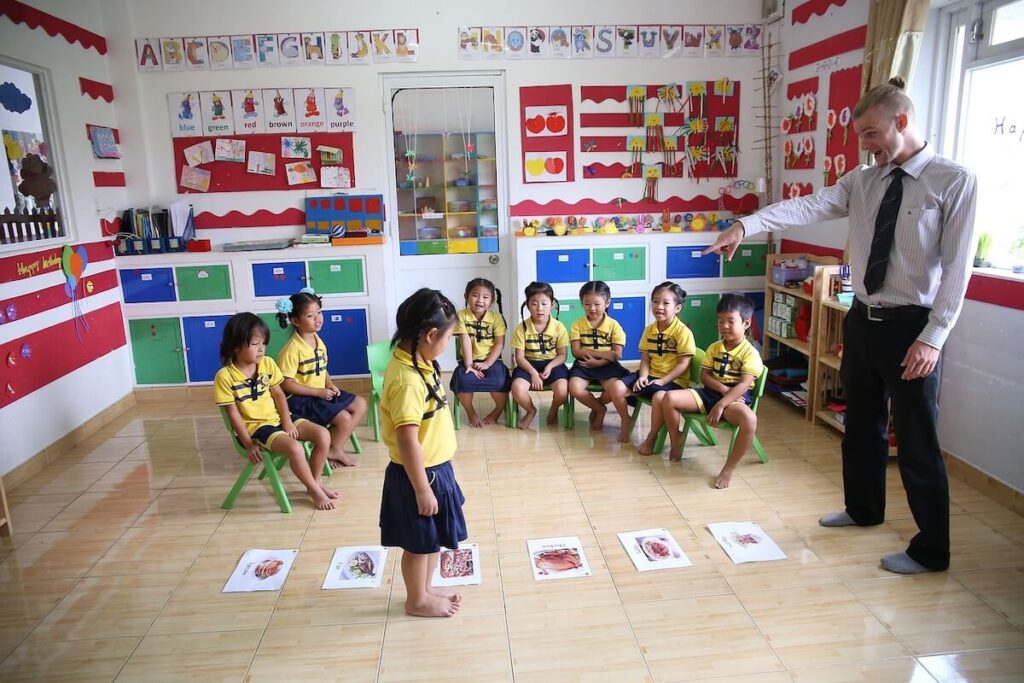
The Total Physical Response (TPR) method of ESL teaching utilizes movement and physical activity coordinated with verbal learning. This method is based on the idea that, when as children we learn our native language, we acquire it, rather than learn it, while we are also learning the basics of movement.
TPR is designed to provide a link between movement and speech. Studies show that pairing action and speech is an effective way to learn, and produces a trigger in the brain to promote fluency.
While TPR is often encouraged for use when teaching English to kids, it can be beneficial for all ages and levels.
2. Direct Method

The direct method, or “natural approach,” is supposed to enable the student to learn English naturally and instinctively. This is done by immersing the students in English (no translations allowed!) and focusing on speaking, rather than grammar.
The direct method provides little to no translation, little grammar analysis, and promotes listening and speaking spontaneously.
3. Indirect Method

The indirect method uses group or activity-based work to introduce the language or lesson, followed by individual work and instruction. Studies show that this can improve retention, as the engagement with the lesson is increased and presented in multiple ways.
The underlying idea of the indirect method is that students will gain an understanding of English and English fluency indirectly, while immersed in other activities.
4. Content and Language Integrated Learning (CLIL) Method

Content and Language Integrated Learning is a language immersion method, where students are taught new content through English (or the target language).
Using the CLIL method does require knowledge of other subjects, such as science, history, and math, but fluency has been shown to increase when the lessons naturally incorporate English and focus on knowledge rather than accuracy.
5. Inquiry-Based Learning

The inquiry-based learning method of ESL teaching, also called exploratory learning, has the teacher in a facilitator role, while the students take the lead.
The teacher provides the materials, while the students choose topics, identify questions regarding said topics, and then collaborate to answer these questions (all while being immersed in the English materials provided).
This is similar to the indirect approach, as learning English is almost an afterthought or an indirect product of focusing on the topics at hand.
6. Communicative Language Teaching (CLT)

The Communicative Language Teaching (CLT) method is based on the idea that ESL students should focus on real-life language and communication.
The CLT approach emphasizes interaction between students, such as role-playing various scenarios that will enable useful English fluency.
7. Task-Based Language Teaching (TBLT)

Task-Based Language Teaching (TBLT), also called task-based instruction (TBI), uses a task, such as writing a letter, running a meeting, or making a video, to facilitate learning English.
As students need to complete the task with the help of their peers, they must learn to communicate effectively in English to finish the activity or complete the task.
This method of learning has been shown to be effective for learning English, as the students’ understanding of English is deepened because the task is chosen to be relevant to their life—they almost forget they’re speaking English and focus on the task at hand, instead.
8. Step-by-Step Instruction

The step-by-step instruction method is helpful when learning the complex intricacies of a second language (in this case, English).
The teacher breaks down the lesson into smaller, easier-to-digest steps, and then guides the students through each step to gain an understanding of the larger ideas or language concepts.
9. Activity-Based Learning

Activity-based learning employs the use of activities to engage students in the learning process, thus improving retention.
Also called tactile learning, activity-based learning is a hands-on, active approach, and incorporates games, scavenger hunts, classroom movement, role-playing, and more.
Activity-Based Learning is interactive and engaging, and is student-led, allowing the learner to progress at their own pace.
10. The Silent Way

The Silent Way teaching method believes that the teacher’s most powerful tool is silence.
In this method, the teacher is more of an engineer, designing a lesson that promotes self-reliance, exploration of the language, and minimal distractions (including the teacher’s voice).
Students are encouraged to correct their own mistakes and grow their instincts in English along with their fluency. The teacher is even discouraged from providing praise or criticism, leaving that up to the student to discover.
11. Suggestopedia

The language-learning method of “Suggestopedia” relies on the power of suggestion to form positive associations for the student to promote learning.
Suggestopedia is based on the idea that to really learn, a student needs to be in a comfortable environment, which will enhance their retention of the language.
Music, a relaxing room, and a friendly relationship between the teacher and student, all promote a positive association with the language, and therefore encourage learning of said language (English).
12. The Structural Approach

The Structural Approach method is based on the idea that to really learn a language (in this case, English), a student needs to understand the structure of the language.
By understanding the grammar rules and learning the vocabulary, plus learning how these elements of English work together, students can gain fluency and comprehension.
13. The Grammar Translation Method
The Grammar Translation Method is similar to the Structural Approach detailed above, in that much of the method is designed around learning the structure of the language.
This method focuses on using translation exercises to introduce new grammar concepts to gain an understanding of the underlying structure, thus enabling students to develop better fluency in English.
The Grammar Translation Method is considered the “classic” way of learning English (and any language) that is still used often.
14. Community Language Learning (CLL)

The Community Language Learning (CLL) method focuses on using the relationship between the teacher, student, and the students themselves to create a safe environment for learning. CLL utilizes the teacher as a “counselor” and the student as a “client” or “collaborator.”
CLL is often considered one of the most accessible methods for learning English, and for teaching spoken English to beginners, as focusing on community building and group work takes out some of the individual’s fear of making mistakes while learning a new language.
15. The Lexical Approach

The Lexical Approach method uses computer-generated statistics to establish the most commonly used words in English.
These words are then separated into “chunks” or “lexical lumps” by their type of use and frequency of use. Once students have learned these “lumps,” the idea is that they will be able to access their inventory of words for real-world use.
16. The Audio-lingual method

The Audio-lingual Method, or the Army Method, is based on the idea that language is best learned via constant reinforcement. The emphasis of this method is not on vocabulary, but on the patterns in everyday English.
The students are immersed in English from the beginning, and the teacher supplies constant feedback, both positive and negative (just like in the actual army).
This method is also called the “Army Method” as it was developed by the army during World War I and II, to promote quick fluency in languages to get spies and soldiers on the group as quickly as possible.
The Audio-lingual Method is most often used when teaching English to adults.
Extra tips to incorporate ESL teaching methods

Now that you’re familiar with some of the most effective ESL teaching methods, what do you do with them?
Of course, that’s up to you—you’re the teacher! Of course, the most successful ESL teachers use a variety of different ESL teaching methods, to provide the most value for their students, and to reach as many students as possible.
To incorporate some of these ESL teaching methods into your lessons, you should use a variety of resources and authentic materials—and don’t be afraid to embrace technology, such as movie clips, newspapers, online exercises, TV shows, and textbooks.
This will also enable you to use relevant cultural references and real-life situations to make lessons relatable. Use these types of visual aids, plus group work, role-playing, and physical activities to keep your students engaged.
A few more tips: make sure to collaborate with other ESL teachers to exchange ideas, assess student progress as much as possible (and adjust accordingly), and reflect on your teaching style by using a journal for your class.
Finally, remember to be patient and flexible. Even in a class at the same level, students will have various learning styles and levels of proficiency.
And there you have it! Of course, this list of ESL teaching styles is just the beginning. The best part of teaching is that you can pick various parts of each method that resonate with you, combine several methods, and even develop your own techniques.