
Are you considering learning either Spanish or Italian? What a great choice you’ve got!
Learning any language has fantastic benefits and can bring about wonderful things that you otherwise might never have experienced or known about. Lots of people struggle to decide which language to choose and if you’re stuck between choosing to learn Italian or Spanish, we’re here to help.
In this article, we’ve put together some points of consideration for anyone asking, “should I learn Spanish or Italian?” Let’s go!

Italian vs Spanish language: The four considerations
1. Does Spanish or Italian culture appeal the most?
All of the world’s languages are more than just words spoken or words on a page. Each one has a unique set of ties to culture, food, and traditions – and that’s definitely the case with Spanish and Italian.
Spanish culture

Choosing to learn Spanish would open you up to a copious number of thinkers, philosophers, artists, and authors from a vast spread of countries around the globe. You’ve got the likes of Mexico’s artist Frida Kahlo, Chilean politician and poet Pablo Neruda, Spanish painter and sculptor Pablo Picasso, and Spain’s Early Modern writer, Miguel de Cervantes to name a few from the past.
Present-day giants in the Spanish-speaking world include Mexican filmmakers Guillermo del Toro (Pan’s Labyrinth, The Devil’s Backbone, The Shape of Water, Crimson Peak, Cronos) and Alfonso Cuarón (Y Tu Mamá También, Children of Men, Gravity, Great Expectations, Roma, Harry Potter and the Prisoner of Azkaban) as well as musical sensations like Carlos Santana, Ricky Martin, and Shakira.
As well as these great personalities, you’ve also got wonderful food and traditions like paella, churros, tacos, burritos, flamenco, and Argentine tango.
Italian culture

Like Spain, Italy has made huge contributions to the world stage. You’ve got film director Federico Fellini (La Dolce Vita, 8 ½, Nights of Cabiria), Baroque composer Antonio Vivaldi, and astronomer and physicist Galileo Galilei to name but a few.
How could we talk about Italian culture without mentioning food and drink? Prosecco, negroni, Spritz Veneziano (Aperol Spritz), pizza, pasta, gelato and coffee! We guarantee you’ll already be able to work your way around many items on an Italian menu before you begin to learn the language. Cappuccino anyone?
2. Italian vs Spanish language: Which one is more challenging?
To be entirely honest, these two languages have lots in common in terms of difficulty. They have both developed from Latin and the Roman Empire and share many common root words. If you’re Spanish and listen to an Italian, you’ll be able to pick up a few words here and there and vice versa.
If you’re a native English speaker with no experience of either (or any experience of other Romance languages) then you’ll likely face a similar challenge when learning either language. The main challenges of both Spanish and Italian are:
- The pronunciation
- Masculine and feminine words and agreements
- Verb conjugation
- New sounds – the rolled ‘r’
Some argue that Spanish is easier to learn for English people – but only slightly. This is because there are more irregular verb endings to learn in Italian and the pronunciation isn’t as straightforward. Spanish is a phonetic language, which means the pronunciation rules never falter.
3. Why do you want to learn the language?

Another consideration when you’re asking yourself “should I learn Spanish or Italian?” is your motivation to learn the language.
If you’re wanting to travel extensively and meet lots of new people, you might prefer to learn Spanish. This is the 2nd most spoken first language, which means there are a lot of places you can go and people you can meet. Italian, on the other hand, has around 65 million native speakers – it comes up number 22 on the list of most spoken languages.
If you’re wanting a language that will be useful in work and business, Spanish is a good choice. It’s an official language of the United Nations and is spoken in South and Central America as well as Spain. Italian, however, is spoken mainly in Italy with a smattering of speakers in Croatia, Romania, and Switzerland.
However, if you plan to get into the world of fashion, Italian makes the most sense!
4. Where you’re based
If you’re in the UK, then your location is much of a muchness and won’t really have much of an influence on your decision.
However, if you’re in the U.S. and are in a neighbourhood where Italian or Spanish is largely spoken, it would make sense to learn that language. What’s more, with lots of native speakers around you, you’ll have more opportunities to practise too!
Should I learn Italian or Spanish? What do you already know?
With the world being so interconnected both Italian and Spanish words have made their way over to English and become a part of their language. If you work out which language you know more of already, it might help you decide which one to pursue!
Italian in the English Language

There are heaps of Italian loan words in English. These are common in food, drink, banking, music, literature, architecture, commerce, the military, and art.
Examples of Italian words in English include:
- Al fresco – meaning outside in the open air
- Al dente – meaning “to the tooth” or firm and chewy (as we like our pasta)
- Biscotti – a type of biscuit
- Antipasto – an appetizer with cured meat, peppers, artichokes, and olives
- Cappuccino – an espresso topped with milk foam
- Focaccia – a type of herby flatbread
- Panini – a grilled sandwich
- Prosciutto – cured salted ham
- Tiramisu – a coffee dessert
- Tortellini – stuffed pasta
- Maestro – master
- Solo – a piece of music for one person
- Folio – a folder containing loose papers
- Cameo – a brief appearance in a performance
- Fiasco – a complete failure
- Vista – a view
Spanish in the English language
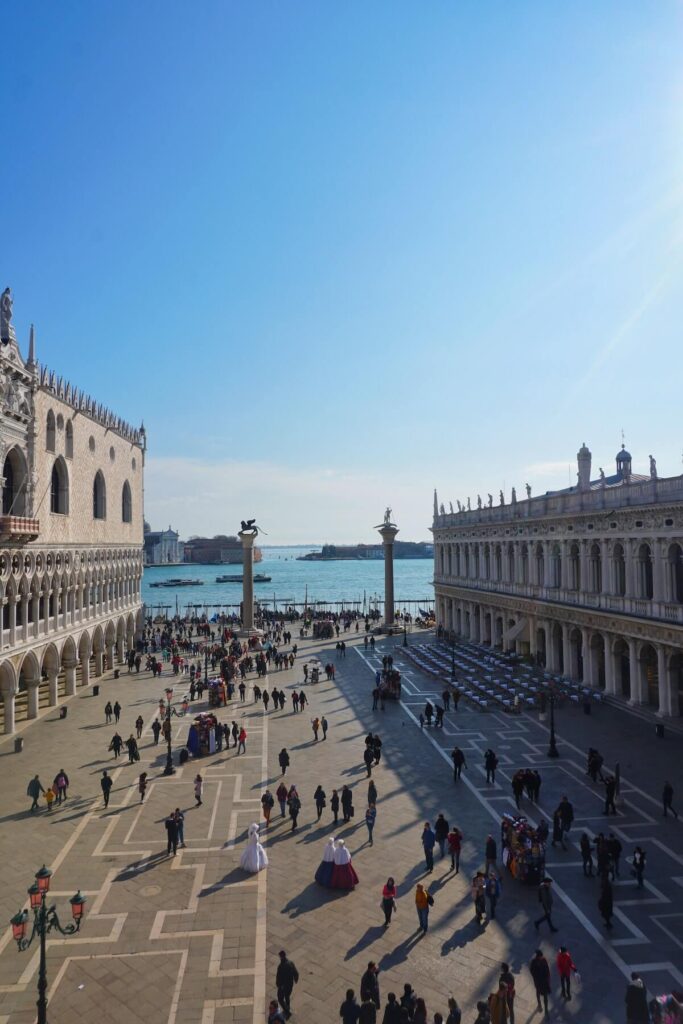
There don’t seem to be as many Spanish loan words in English as there are in Italian. Here are some we found:
- Guerrilla (as in guerrilla fighters)
- Cargo – from the Spanish verb ‘cargar’ which means to load
- Quixotic – coming from Don Quixote by Cervantes and meaning capricious or impractical
- Mosquito – which means little fly – ‘una mosca’ is a fly
- Breeze – from the Spanish ‘brisa’meaning a gentle blow
- Patio – a courtyard or open area on a house
- Macho – to be strong, unemotional, aggressive, or robust
- Plaza – a public area or town square
- Tornado – from the 16th-century Spanish word ‘tronada’
Can I learn Spanish and Italian at the same time?

Learning a new language is difficult and learning two new languages at the same time will be even more of a challenge. For those who are a little adventurous, it is possible to learn two languages at once but it’s not recommended that you start learning two brand new languages at the same time.
When you begin learning a new language, it takes some time to get your head around how it sounds and how it works. So, if you start learning two new languages this way, you can easily become confused.
What makes it even more difficult with Spanish and Italian is that they are both Romance languages and are remarkably similar. If you were considering learning Spanish and Mandarin at the same time, this wouldn’t be so much of an issue.
With Spanish and Italian, you’ve got pronunciation differences as well as subtle differences in how different tenses and moods are used, which means you’ve got much more to remember!
The similarities between the two languages
Italian and Spanish do have a lot in common. For example:
- Their sentence order is the same (subject – verb – object)
- There are two grammatical genders and adjectival agreements
- Formality – there are formal ways of speaking to people you don’t know or older people, for example
- They use indirect, direct, and object pronouns similarly
- There are no cases
- The conjugation of verbs and the same moods are used (with only slight rule differences)
The differences between the two languages
Some things can confuse learners who decide to learn both at once. For instance:
- Spanish uses the preterite (simple past tense) more while Italian uses the perfect tense more
- Italian uses the verbs to be (essere) and to have (avere) as auxiliary verbs to form the perfect tense while Spanish only uses haber, which means ‘to have’ but only as an auxiliary verb.
- Italian has adverbial pronouns like French (ci and ne, for example) while Spanish doesn’t.
- Subject pronouns aren’t formally needed in Spanish but are in Italian.
Final thoughts: Which language should you learn?
The simple answer is – learn whichever language you think you’ll enjoy the most and stick to it.
When you stumble in your progress (it happens to everyone), you’re going to need something to keep you going and motivated. Enjoying the language and liking the culture will be more important in these moments that knowing that it is a useful language for business. For real progress to be made, enjoyment and passion have to be there!